Threat intelligence solutions for businesses of all sizes
Joined January 2015
- Tweets 12,466
- Following 89
- Followers 657
- Likes 69
7,158 Photos and videos
Pinned Tweet

9 Aug 2024
We have started posting sample preprocessing analyses of threat reports from our Report Hub, showcasing results from one of the first stages of our multi-stage engine. If you have any suggestions for tweet format improvement, please send us a message
1
3
6,025
#threatreport #LowCompleteness
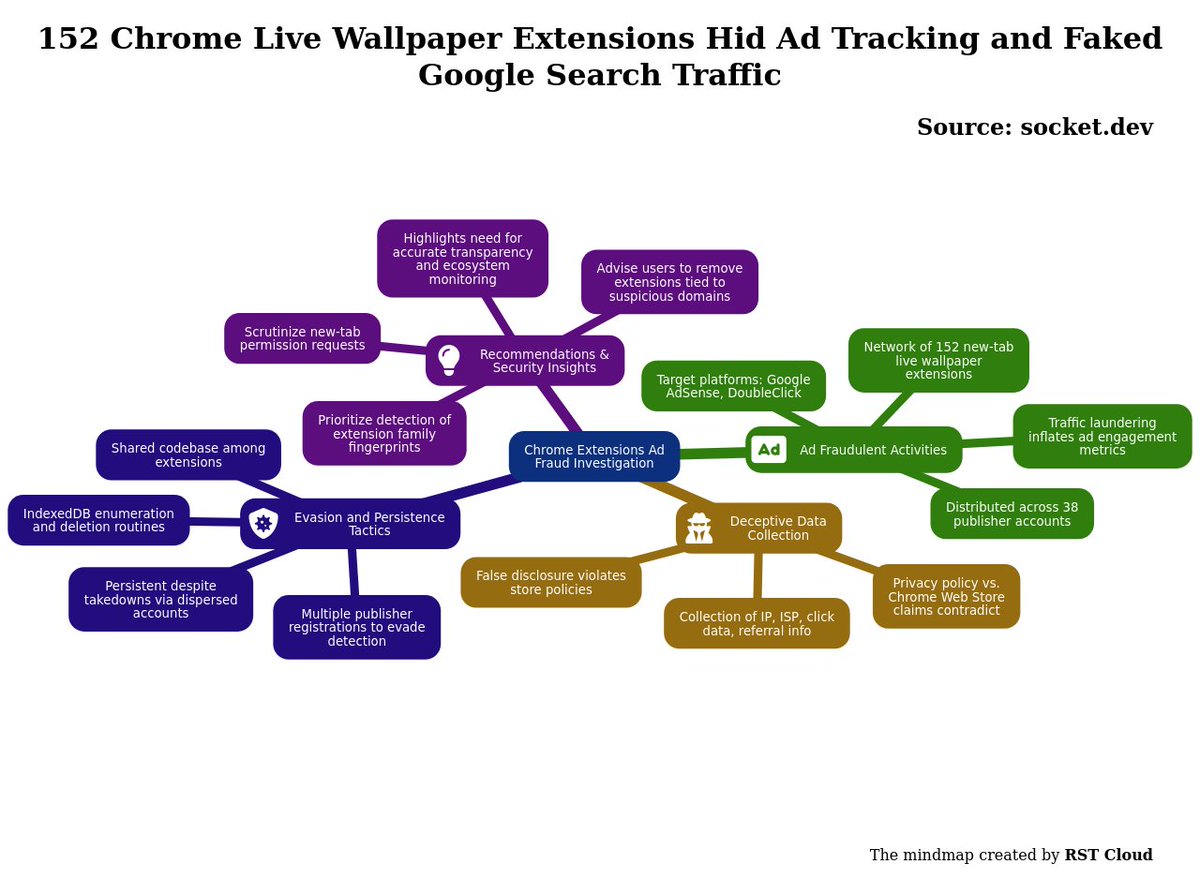
152 Chrome Live Wallpaper Extensions Hid Ad Tracking and Faked Google Search Traffic | 13-06-2026
Source: socket.dev/blog/152-chrome-l…
Key details below ↓
💀Threats:
Bumblebee,
🎯Victims: Advertising, Ad technology, Affiliate marketing, Chrome users
🏭Industry: Telco, Transport, Education
🌐Geo: Tokyo, Ankara, Turkish, Turkey
📚TTPs:
⚔️Tactics: 1
🛠️Technics: 5
🧨IOCs:
- Domain: 4
- File: 9
- Email: 6
- IP: 2
- Coin: 11
- BrowserExtension: 141
💽Software: Chrome, IndexedDB, Outlook, WordPress, Kitty, Minecraft
🔠Functions: setUninstallURL, deleteDatabase
#threatreport:
A recent investigation by Socket's Threat Research Team revealed the existence of a network of 152 Chrome Web Store extensions, specifically new-tab live wallpaper applications, which are concentrated around ad-related fraudulent behaviors. These extensions are distributed across 38 different publisher accounts and utilize a shared codebase. They have been collectively installed approximately 105,000 times. Notably, while the Chrome Web Store listings assert that user data is not collected, the actual privacy policy associated with these extensions contradicts this by stating that IP addresses, ISP data, click counts, and referral information are logged and shared with ad platforms such as Google AdSense and DoubleClick.
A subset of 54 extensions employs a technique known as traffic laundering, where the extensions falsify Google organic search traffic metrics. This is achieved through the manipulation of the installation and uninstallation URLs, which disguise extension-driven traffic as genuine web searches. Such deceptive practices inflate perceived user engagement metrics, making the extension appear more popular to potential advertisers, thereby enhancing its profitability through ad revenue. This mechanism detracts from genuine analytics and pollutes traffic attribution systems across various platforms.
Concerning installation processes, the service worker in the extension’s code is engineered to send fabricated organic attribution signals when the extension is installed. Simultaneously, it wraps the uninstallation process in a cloaked Google search result click, sending false data back to the operator's analytics. Furthermore, every instance of these extensions includes a routine that engages in IndexedDB database enumeration and deletion, although, in this particular case, it operates harmlessly since it targets only the extension's own databases, which contain no significant data to erase.
Moreover, the infrastructure behind these extensions is specifically crafted to evade detection and takedown efforts. Each operator employs multiple registrations under various publisher accounts, which allows for the dispersal of identical code across numerous extensions. This careful distribution strategy means that even if one account is removed, others remain undetected. The ad monetization strategy relies on aggregating traffic generated through the malicious extensions to bolster ad revenue on affiliated websites.
The investigation raises concerns about the broader implications regarding the inaccuracies of user data collection and attribution within the Chrome ecosystem. The contrasting claims in privacy disclosures highlight a clear violation of the Chrome Web Store policies, which mandate that such disclosures be accurate and not misleading. Users are advised to remove any extensions linked to the implicated domains, such as tabplugins.com, yowgames.com, or chromewallpaper.com, and to thoroughly scrutinize extensions that request new-tab permissions. Security professionals should focus on identifying the broader fingerprint of such extension families rather than isolating individual cases due to their mass-produced nature.
81
10h
#threatreport #MediumCompleteness
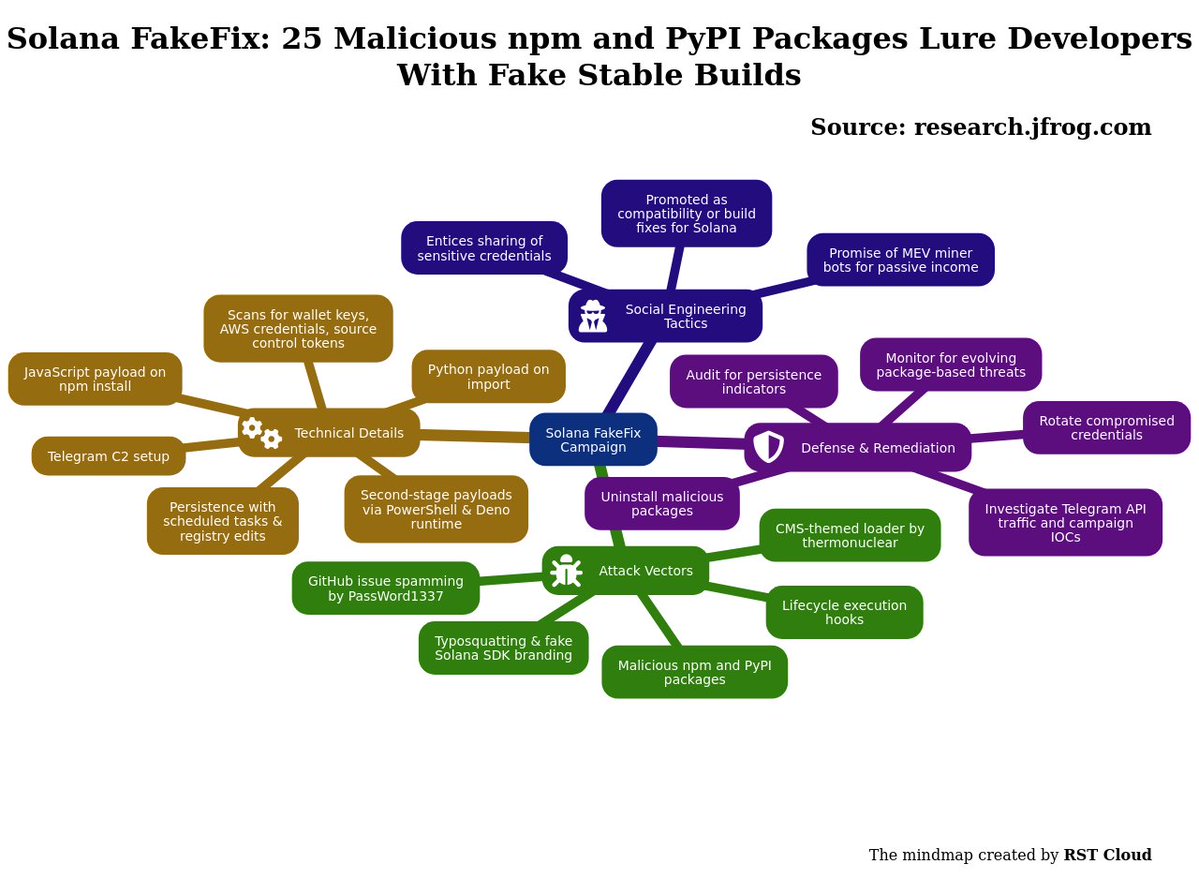
Solana FakeFix: 25 Malicious npm and PyPI Packages Lure Developers With Fake Stable Builds | 11-06-2026
Source: research.jfrog.com/post/sola…
Key details below ↓
🧑💻Actors/Campaigns:
Solana_fakefix
💀Threats:
Typosquatting_technique, Deno_loader,
🎯Victims: Solana developers, Developers, Ci pipelines, Software development, Cryptocurrency
🏭Industry: Financial, Healthcare
📚TTPs:
⚔️Tactics: 2
🛠️Technics: 0
🤖LLM extracted TTPs:`
T1005, T1033, T1036, T1053.003, T1053.005, T1059.001, T1059.006, T1059.007, T1070.004, T1071.001, ...
🧨IOCs:
- File: 24
- Url: 17
- IP: 1
- Path: 3
💽Software: Telegram, ETHERSCAN, Unix crontab, macOS, Windows scheduled task, Windows Registry
🪙Crypto: solana
🔢Algorithms: base58
🔠Functions: Set-ExecutionPolicy, setTimeout, Set-ItemProperty
📜Programming Languages: python, javascript, powershell, typescript
#threatreport:
The Solana FakeFix campaign, identified by JFrog Security Research, involves the distribution of 25 malicious npm and PyPI packages specifically targeting Solana developers, utilizing tactics like typosquatting, fake branding for Solana SDKs, and lifecycle execution hooks to facilitate data theft. These packages aim to extract sensitive information, including wallet keys, cloud credentials, source control tokens, and various environment secrets.
The primary deceptive approach leveraged in this campaign was the promotion of these dangerous packages as compatibility fixes for Solana build issues. The campaigns operated through GitHub issue spamming by user PassWord1337, who posed as a community contributor, effectively targeting developers experiencing dependency challenges. The first stage of the attack required the execution of JavaScript controlled by the attacker during the npm package installation. This executed payload immediately set up a Telegram command-and-control (C2) channel and initiated a search for developer secrets.
For the Python packages, malware was triggered during a standard import process, highlighting differences in execution methods between npm and PyPI. Each type of package shared common payload characteristics, indicating a coordinated effort to breach systems. The later npm variants evolved their attack vector by embedding malicious code within functional-looking Solana JavaScript libraries, enabling them to operate unnoticed while scanning for sensitive information such as Solana keypairs and AWS credentials.
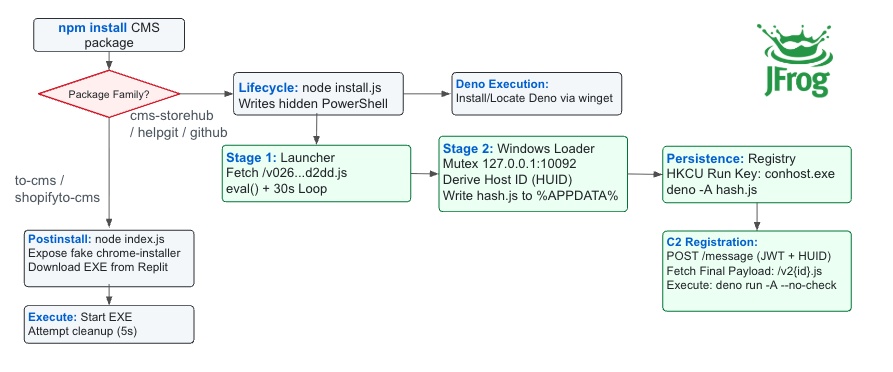
In another facet of the campaign, a CMS-themed loader involved npm packages uploaded by a user named thermonuclear. While not specifically tied to Solana, these packages contained mechanisms for executing remote Windows payloads via PowerShell scripts and JavaScript executed within the context of the Deno runtime. These practices included clandestine installations, dynamic second-stage retrieval of payloads, and attempts to maintain persistence through various Windows functionalities such as scheduled tasks and registry modifications.
The threat actors also leveraged the concept of MEV (miner extractable value) bots to entice victims into providing sensitive credentials under the false promise of passive income. This represents a blend of technical package exploitation and classic phishing tactics.
Remediation steps include uninstalling affected packages, rotating all sensitive credentials, and auditing for potential persistence indicators that could enable attackers to maintain access. Investigation should focus on signs of the Telegram API traffic and other specific IOCs related to the campaign. The complexity of the methods utilized, transitioning from simple backdoors to sophisticated Trojanized libraries, underlines the rapid evolution and increasing sophistication of such cyber threats targeting developer ecosystems.
1
43
10h
#tireport #ExtractedDiagrams
The key diagram for the report (ML Classifier):
schema: 3, windows: 2
8
11h
#threatreport #MediumCompleteness
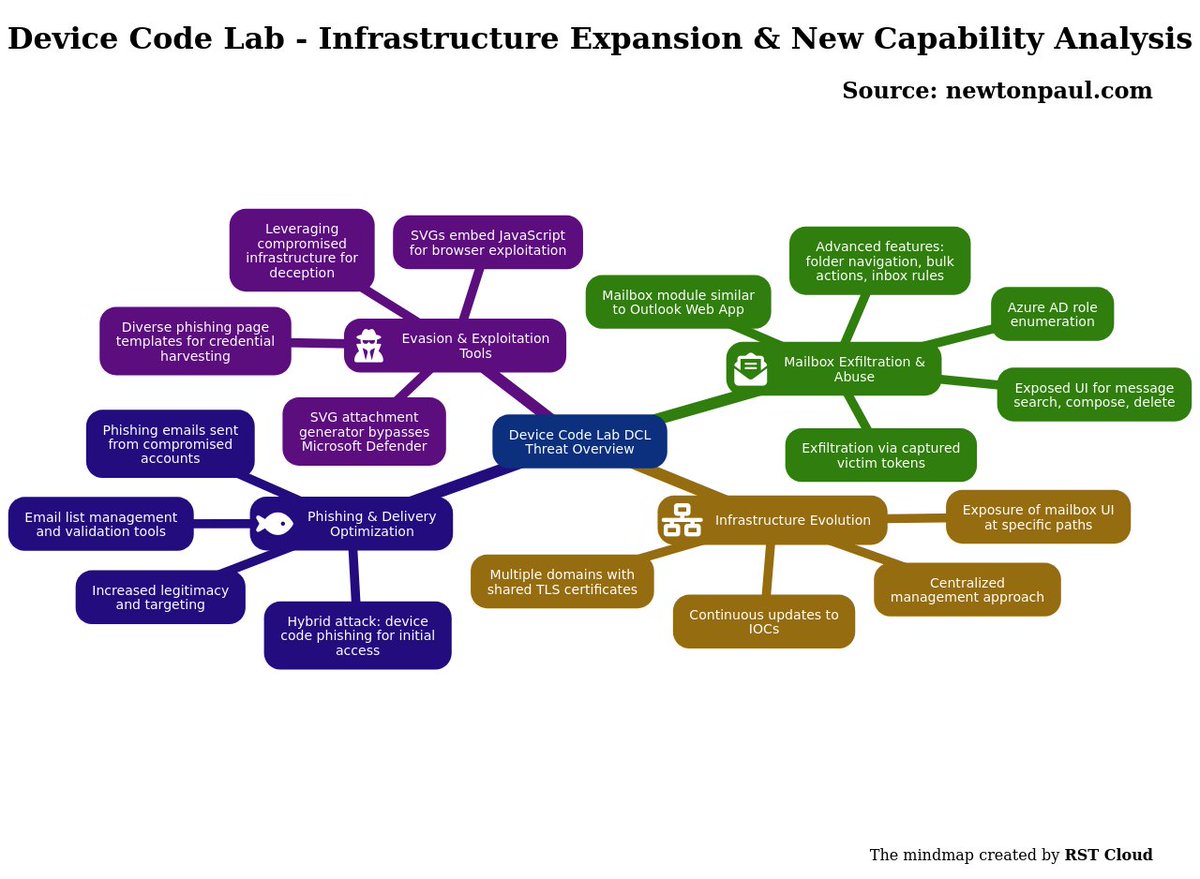
Device Code Lab - Infrastructure Expansion & New Capability Analysis | 10-06-2026
Source: newtonpaul.com/blog/dcl-infr…
Key details below ↓
💀Threats:
Device_code_lab_tool, Evilginx_tool, Device_code_phishing_technique, Credential_harvesting_technique,
🎯Victims: Microsoft 365 tenants, Exchange online users, Onedrive users
🏭Industry: Telco
🌐Geo: London, Brazilian
📚TTPs:
⚔️Tactics: 1
🛠️Technics: 0
🤖LLM extracted TTPs:`
T1069.003, T1078.004, T1087.004, T1098, T1098.002, T1114.002, T1114.003, T1136.003, T1213, T1528, ...
🧨IOCs:
- IP: 14
- Domain: 28
- Url: 1
- File: 4
💽Software: MSSQL, nginx, Outlook, Azure AD, Graph API, chrome, Gmail, protonmail, Microsoft Defender for Endpoint, Microsoft Exchange, ...
🔢Algorithms: zip
🔠Functions: Set-Mailbox, Get-MessageTrace, mbBase, Set-InboxRule, Set-TransportRule
📜Programming Languages: php, javascript
#threatreport:
The Device Code Lab (DCL) infrastructure has notably expanded, revealing several exposed tool modules that facilitate various malicious activities. Key capabilities include a mailbox module that allows operators to exfiltrate emails using captured victim tokens. This module resembles the Outlook Web App and supports advanced features such as folder navigation, bulk operations, the creation of inbox rules, and even Azure AD role enumeration. Such depth of functionality suggests a sophisticated methodology employed by operators to manipulate compromised accounts.
The DCL environment is linked through multiple domains using shared TLS certificates, indicating a centralized management approach to their operations. The continuous update of indicators of compromise (IOCs) emphasizes the evolving nature of this infrastructure as new vulnerabilities and tools are identified.
Significantly, the exposed mailbox UI at specific paths enables operators to interact with victim emails seamlessly, performing actions like searching, composing, and deleting messages. Moreover, tools for managing email address lists and validating them for phishing use have been identified, enhancing the effectiveness of their campaigns by ensuring better deliverability and targeting. DCL's infrastructure supports hybrid attack workflows leveraging device code phishing for initial access, followed by the distribution of phishing emails from the compromised accounts themselves, adding a layer of legitimacy to subsequent attacks.
Furthermore, the DCL's SVG attachment generator is noted for its ability to bypass Microsoft Defender for Endpoint detection mechanisms. This tool allows for the creation of SVG files that can embed JavaScript, allowing attackers to exploit browser contexts while evading common detection methods.
The operational landscape of DCL also includes various phishing pages designed to harvest credentials across multiple themes, leveraging compromised infrastructure to deceive victims. This breadth of tactics and tools indicates a well-coordinated effort to exploit vulnerabilities in enterprise environments while evading detection through careful design and feature-rich tools.
37
12h
#threatreport #HighCompleteness
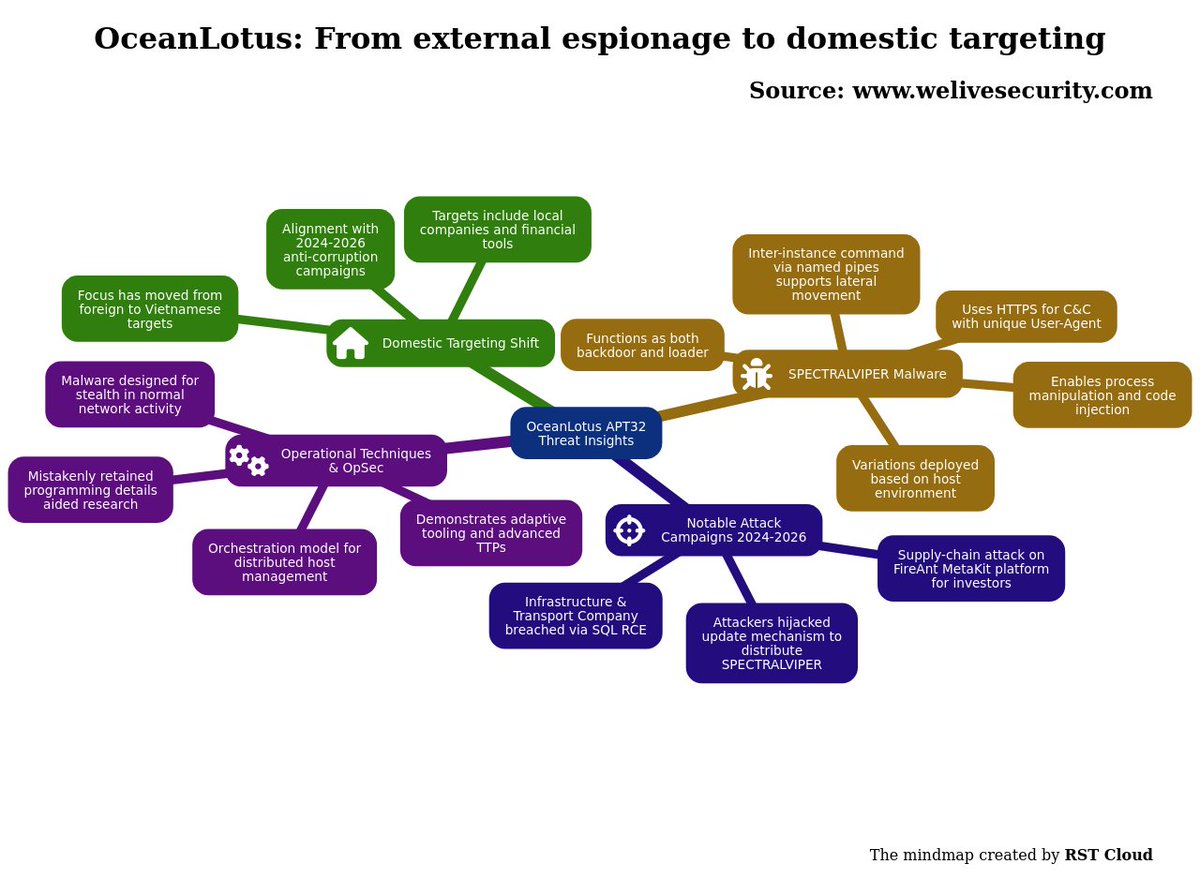
OceanLotus: From external espionage to domestic targeting | 12-06-2026
Source: welivesecurity.com/en/eset-r…
Key details below ↓
🧑💻Actors/Campaigns:
Oceanlotus (🧠motivation: cyber_espionage)
💀Threats:
Spectralviper, Supply_chain_technique, Dns_tunneling_technique, Soundbite, Phoreal, Cuegoe, Watering_hole_technique, Process_injection_technique,
🎯Victims: Stock investors, Financial services, Infrastructure and transport construction, Businesses, Human rights activists, Human rights defenders, Government
🏭Industry: Financial, Government
🌐Geo: Germany, China, Asia, Vietnam, Vietnamese, Singapore
📚TTPs:
⚔️Tactics: 8
🛠️Technics: 16
🧨IOCs:
- Url: 2
- Domain: 6
- File: 11
- IP: 8
- Hash: 20
💽Software: Linux, Microsoft SQL server, Microsoft SQL, curl
📜Programming Languages: python
#threatreport:
OceanLotus, also known as APT32, has demonstrated a notable shift in its operational priorities from external espionage to increased domestic targeting, particularly within Vietnam, as observed between 2024 and 2026. The group has engaged in two specific campaigns utilizing its backdoor malware, SPECTRALVIPER. One operation involved compromising a Vietnamese infrastructure and transport construction company, while the other was a supply-chain attack aimed at the FireAnt MetaKit software platform, a tool commonly used by stock investors in Vietnam.
The construction company was reportedly breached between November 2024 and February 2026, likely through remote code execution (RCE) vulnerabilities, specifically in a Microsoft SQL server. Various iterations of SPECTRALVIPER were employed within the network, demonstrating tailored adaptations to the specific environments of compromised hosts. Meanwhile, in the supply-chain attack against FireAnt MetaKit, which began in October 2025, attackers infiltrated the legitimate update mechanism of the platform to distribute malicious versions that deployed SPECTRALVIPER.
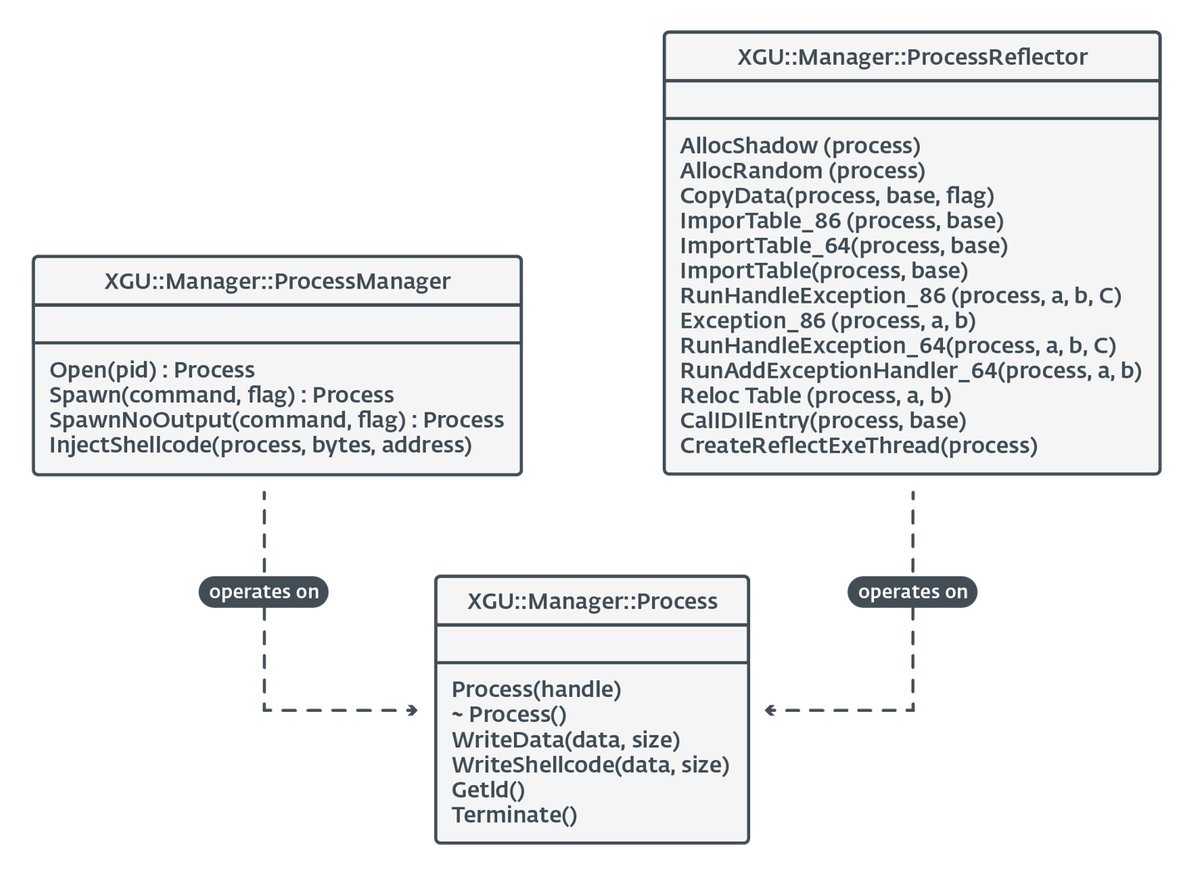
SPECTRALVIPER's architecture features capabilities allowing it to function both as a backdoor and as a loader, facilitating process manipulation and injection of malicious code into target applications. The malware initiates contact with its command and control (C&C) servers using HTTPS, embedding key data such as host profiling information and a unique User-Agent header within HTTP requests. This communication infrastructure appears designed to avoid detection within normal network traffic.
One notable aspect of SPECTRALVIPER is its orchestration model, where different instances can communicate and activate commands via named pipes, allowing for lateral movement within compromised networks. This method highlights the malware's potential for distributed operations, making it capable of managing multiple infected hosts effectively.
The timing and focus of these attacks correlate with Vietnam's domestic anti-corruption efforts, suggesting that OceanLotus may be aligning its cyber operations with state objectives against financial crime and corruption. The operational security misstep, which left certain programming details intact in SPECTRALVIPER, has facilitated deeper insights into the malware's workings, illustrating how the group is leveraging advanced techniques to fulfill its espionage goals within Vietnam’s evolving political landscape.
1
1
28
12h
#tireport #ExtractedDiagrams
The key diagram for the report (ML Classifier):
code: 2, windows: 2, schema: 4
8
13h
#threatreport #MediumCompleteness
Pythagora-io/gpt-pilot Compromised on GitHub - Shai-Hulud Credential Stealer Blocked by Python Linter | 08-06-2026
Source: stepsecurity.io/blog/pythago…
Key details below ↓
🧑💻Actors/Campaigns:
Teampcp
Mini_shai-hulud
💀Threats:
Shai-hulud, Credential_stealing_technique, Supply_chain_technique,
🎯Victims: Open source software, Software development, Artificial intelligence development
🌐Geo: Russian
📚TTPs:
⚔️Tactics: 3
🛠️Technics: 8
🧨IOCs:
- File: 1
- Hash: 2
💽Software: Mistral, Kubernetes, HashiCorp Vault, Claude, Linux, macOS, Node.js
🔢Algorithms: md5, sha256, base64, aes-256-gcm
🔠Functions: run, v3MNGJU, HJgj4ju, require, rMq3gu, eval, unref, GetSecretValue
📜Programming Languages: javascript, typescript, python
💻Platforms: arm, cross-platform, x64
#threatreport:
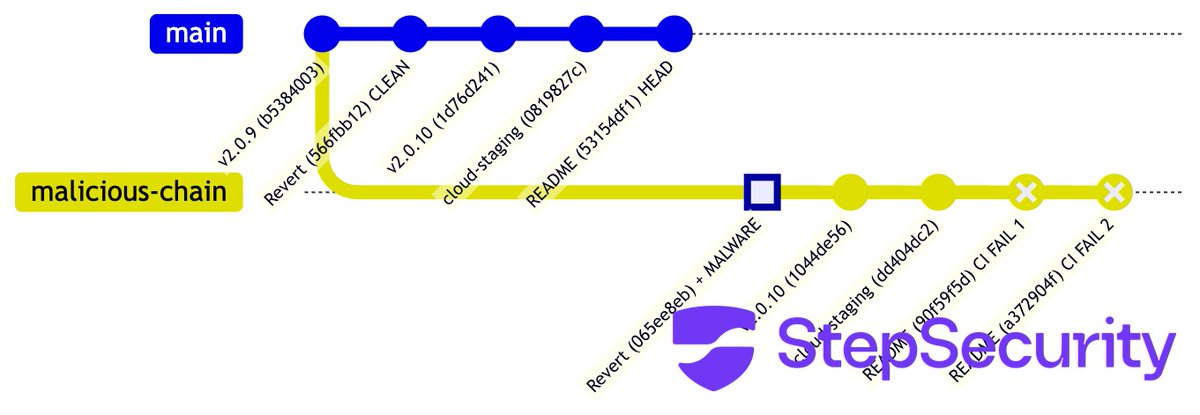
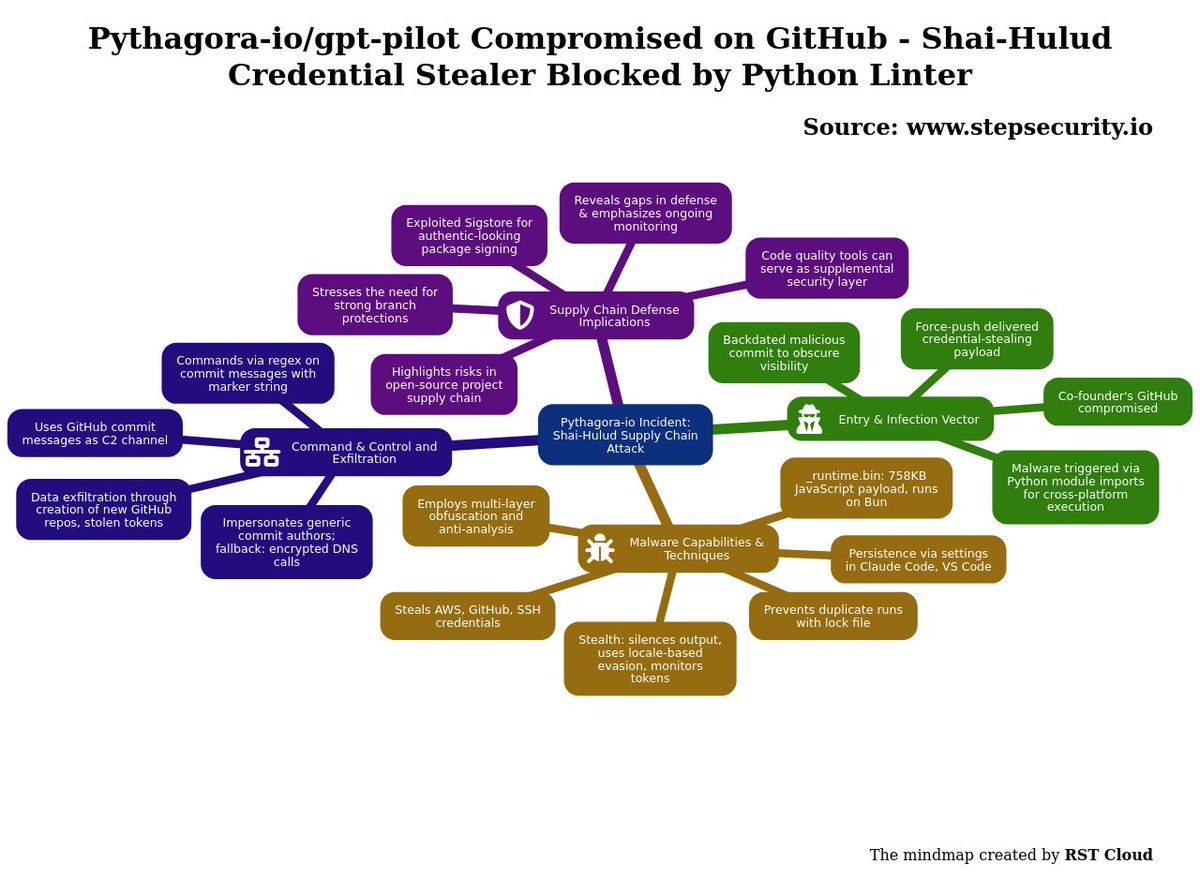
On June 8, 2026, a co-founder of the popular open-source AI developer tool, Pythagora-io/gpt-pilot, had their GitHub account compromised, resulting in a force-push of a credential-stealing payload. This malicious payload is a variant of the Shai-Hulud worm, specifically designed as a 758KB obfuscated JavaScript credential stealer, which targets sensitive credentials such as AWS keys, GitHub secrets, and SSH keys. The malware utilizes GitHub commit messages as a covert command-and-control (C2) channel, exfiltrating stolen data by creating and committing to new GitHub repositories, making its operations difficult to detect.
The attack demonstrated a sophisticated method of concealment, as the attacker backdated the malicious commit to August 2025. This was intended to obscure its visibility in the project's history. Notably, the malware leverages a Python module import system for activation, displaying cross-platform capabilities across Linux, macOS, and Windows. It prevents duplicate executions through a lock file and silences its output, further aiding in its stealth.
The core of the malware is the _runtime.bin payload, which is designed to run under the Bun runtime and employs multiple layers of obfuscation to evade analysis. The malware establishes a novel C2 channel through the GitHub commits API, where it searches for a specific marker string. Commands are extracted using regex, allowing the attacker to control infected machines by merely creating public commits containing this marker, blending the malicious activity with routine developer operations.
Exfiltration occurs primarily through new GitHub repositories using stolen tokens, impersonating a generic commit author to reduce visibility, while a secondary method involves encrypted DNS calls. Persistence is achieved through settings files for Claude Code and VS Code, which re-execute the malware during code sessions. The malware also showcases advanced anti-analysis techniques, including locale-based evasion strategies and monitoring for newly created tokens.
This event aligns with other incidents attributed to the Shai-Hulud campaign, believed to be connected to the threat actor group TeamPCP/UNC6780. The sophistication in the methods used, including substantial obfuscation and the exploitation of Sigstore for publishing malicious packages with misleading authenticity signals, suggests a well-planned approach to software supply chain attacks. Subsequently, it highlights the need for enhanced security measures, such as enforcing branch protection on main branches, to prevent unauthorized changes to repositories. The incident emphasizes that traditional code quality tools can inadvertently provide security protection by rejecting code that does not conform to established standards, indicating gaps in supply chain defense mechanisms.
2
1
72
13h
#tireport #ExtractedDiagrams
The key diagram for the report (ML Classifier):
schema: 4, chart: 1
8
14h
#threatreport #MediumCompleteness
From Phishing Email to Process Injection: Inside a Multi-Stage Agent Tesla Infection Chain | 09-06-2026
Source: pointwild.com/threat-intelli…
Key details below ↓
💀Threats:
Process_injection_technique, Agent_tesla, Process_hollowing_technique, Native_loader, Credential_harvesting_technique, Credential_dumping_technique, Spear-phishing_technique, Amsi_bypass_technique, Lolbin_technique,
🎯Victims: Windows users
🏭Industry: Financial
📚TTPs:
⚔️Tactics: 11
🛠️Technics: 26
🧨IOCs:
- File: 23
- Hash: 1
- Email: 2
💽Software: Chromium, Internet Explorer, Microsoft Edge, Chrome, Opera, Vivaldi, Firefox, Pale Moon, SeaMonkey, Waterfox, ...
🔢Algorithms: xor, md5, base64
🔠Functions: FromBase64String, GetWindowText, Grab, BXX
🗂️Win API: CreateRemoteThread, VirtualAlloc, NET, GetForegroundWindow, GetKeyboardState, OpenProcess, VirtualAllocEx, WriteProcessMemory
📜Programming Languages: powershell, autoit, python, javascript
#threatreport:
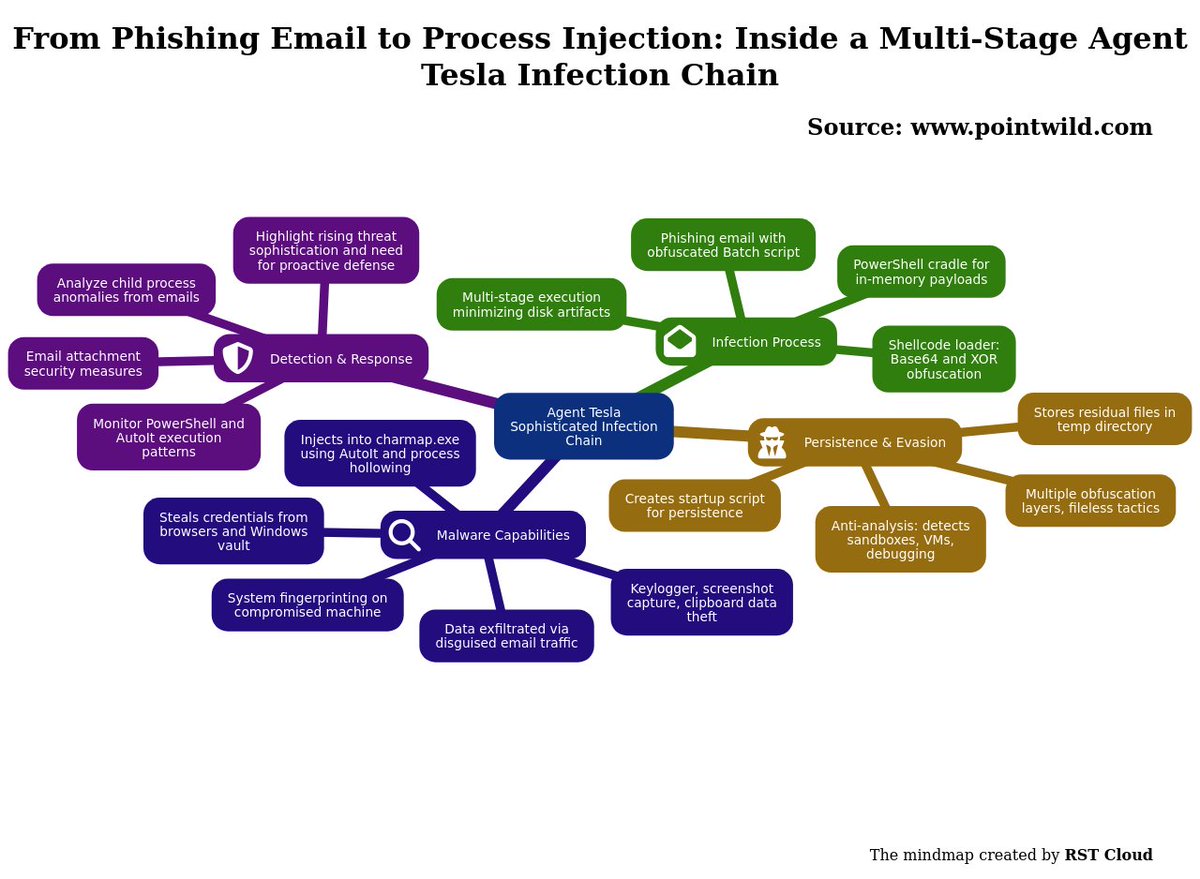
The article delves into a sophisticated malware infection chain tied to the Agent Tesla infostealer, initiated through a seemingly innocuous phishing email containing a heavily obfuscated Batch script. The infection process is multi-staged, progressing from initial access via the malicious attachment to full system compromise while employing a range of evasion techniques to remain undetected.
Upon opening the attachment, a Batch script executes a PowerShell command that serves as a cradle for downloading further malicious payloads directly into memory, minimizing the risk of detection by not leaving traditional disk artifacts. This includes the execution of an in-memory shellcode loader that decodes and runs more malicious code, employing techniques such as Base64 encoding and XOR decryption to obscure its true intent. The malware establishes persistence on the victim's system by leaving residual components in the temporary directory and creating a startup script, ensuring continued execution even after a reboot.
A significant aspect of the attack includes the use of an AutoIt-based script as an injection loader. This loader injects the Agent Tesla payload into a legitimate Windows process, specifically charmap.exe, utilizing remote memory allocation and process creation techniques often associated with process hollowing. Once operational, the malware engages in extensive data theft activities, including capturing browser credentials, keystrokes, and screenshots, which are then exfiltrated via SMTP communication disguised as regular email traffic.
The analysis reveals the malware's sophisticated structure, designed to act stealthily and persistently. It performs system fingerprinting to gather detailed information about the compromised machine. Specific functionalities target various web browsers for credential extraction, including both Chromium and Mozilla-based browsers, and it gathers sensitive data from the Windows Credential Vault. The keylogger component further emphasizes its capability for detailed user activity monitoring.
Significantly, the malware incorporates anti-analysis measures such as checks for debugging, sandbox environments, and virtual machines, enhancing its ability to evade detection during analysis. The implementation of multiple layers of obfuscation and its reliance on fileless execution signify modern infostealer tactics that blend covert operations into legitimate system activities.
Detection strategies discussed in the article emphasize the necessity for proactive monitoring of PowerShell execution patterns, AutoIt usage, email attachment security, and recognizing child process anomalies. The case underscores the evolution of infostealer attacks into comprehensive execution frameworks designed to maximize stealth, persistence, and efficacy in credential theft and data exfiltration, highlighting the growing sophistication of cyber threats.
30
15h
#threatreport #MediumCompleteness
Threat Actors Weaponize AI Hype to Deliver AsyncRAT | 11-06-2026
Source: fortinet.com/blog/threat-res…
Key details below ↓
💀Threats:
Asyncrat, Process_hollowing_technique, Runpe_tool,
🎯Victims: Users seeking ai related learning resources
🌐Geo: Chinese
🤖LLM extracted TTPs:`
T1012, T1027, T1033, T1036.004, T1036.005, T1036.008, T1041, T1053.005, T1055.012, T1059.001, ...
🧨IOCs:
- File: 31
- Domain: 3
- IP: 1
- Hash: 3
💽Software: PostgreSQL, Claude, AutoHotkey, NET Framework, Microsoft Defender, Task Scheduler
🔢Algorithms: aes-cbc, zip, exhibit, md5, base64, pbkdf2, gzip, xor
🔠Functions: Execute
🗂️Win API: Run
📜Programming Languages: powershell
#threatreport:
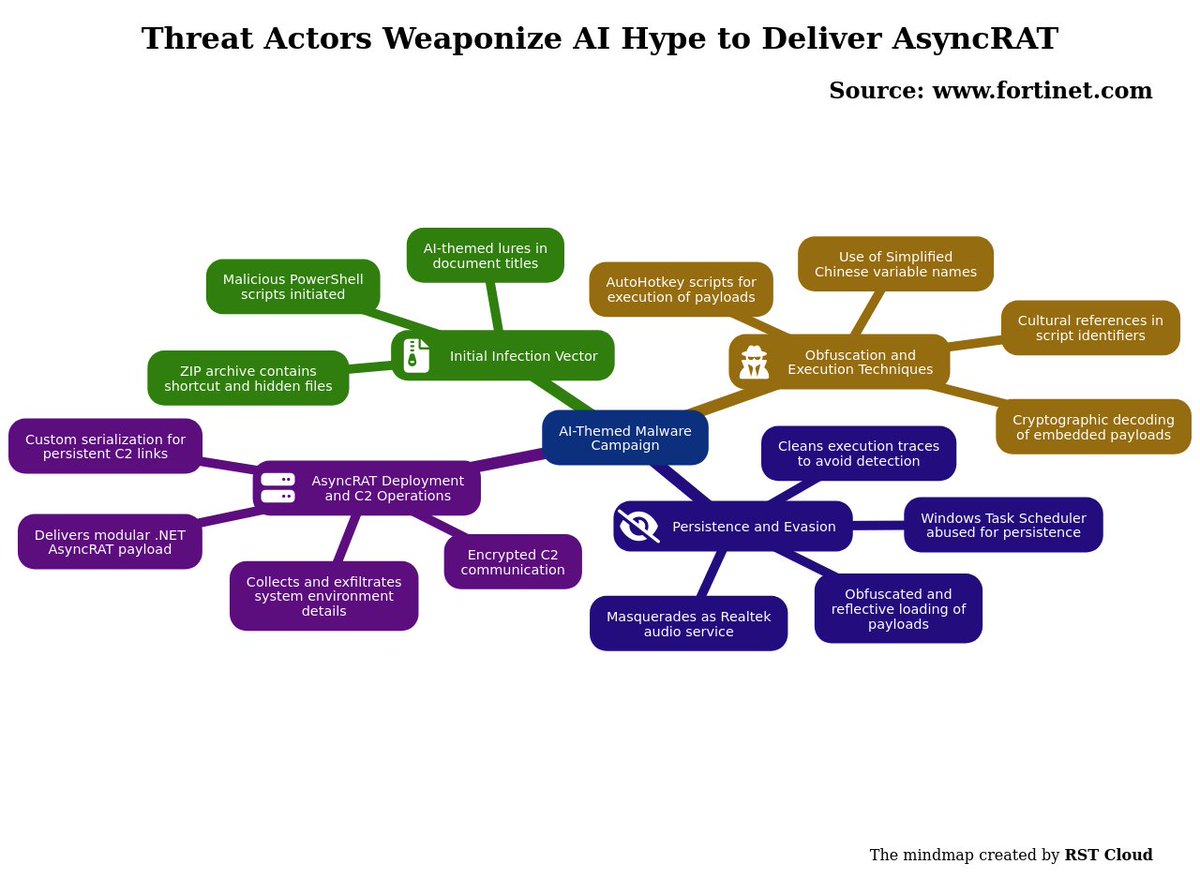
Threat actors are exploiting current AI trends by distributing malware disguised as legitimate AI-related documents. A recent campaign observed by FortiGuard Labs involves files with titles related to AI learning resources, which are crafted to entice users searching for such content. The initial phase of this attack involves a compressed archive that seems innocuous, but actually conceals malicious scripts designed to execute a complex multi-stage infection chain, ultimately delivering AsyncRAT, a .NET-based remote access trojan.
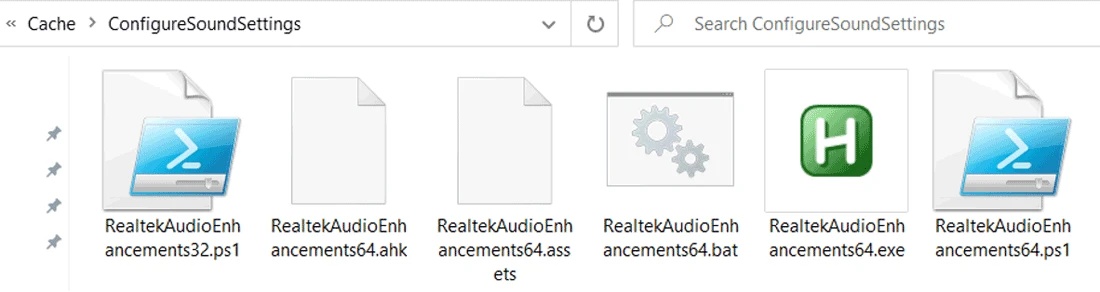
The malware begins its execution with a ZIP file containing a shortcut and hidden files. A PowerShell script is triggered, leveraging cryptographic techniques to decode payloads hidden within the initial documents. This script creates other scripts and establishes persistence through the Windows Task Scheduler, disguising its activity under the guise of a Realtek audio service. The scripts employ obfuscation techniques, including the use of Simplified Chinese variable names and unconventional identifiers drawn from cultural references, which complicates analysis and detection.
Particularly noteworthy is the use of AutoHotkey scripts which serve as an execution engine for the malware, allowing for the loading and execution of additional components without relying solely on compiled binaries. The attack's latter stages involve sophisticated techniques, such as process hollowing and reflective loading, to execute .NET payloads in a stealthy manner, while minimizing forensic visibility by cleaning up traces of execution.
The main payload, identified as a modular RAT, establishes communication with command-and-control (C2) servers, collecting and exfiltrating detailed system information about the victim’s environment. The malware employs advanced communication methods, including encryption of outbound data and custom serialization, ensuring persistent interaction with the C2 infrastructure.
1
28
15h
#tireport #ExtractedDiagrams
The key diagram for the report (ML Classifier):
schema: 2, windows: 1, code: 26, dump: 1, chats: 1
8
16h
#threatreport #HighCompleteness
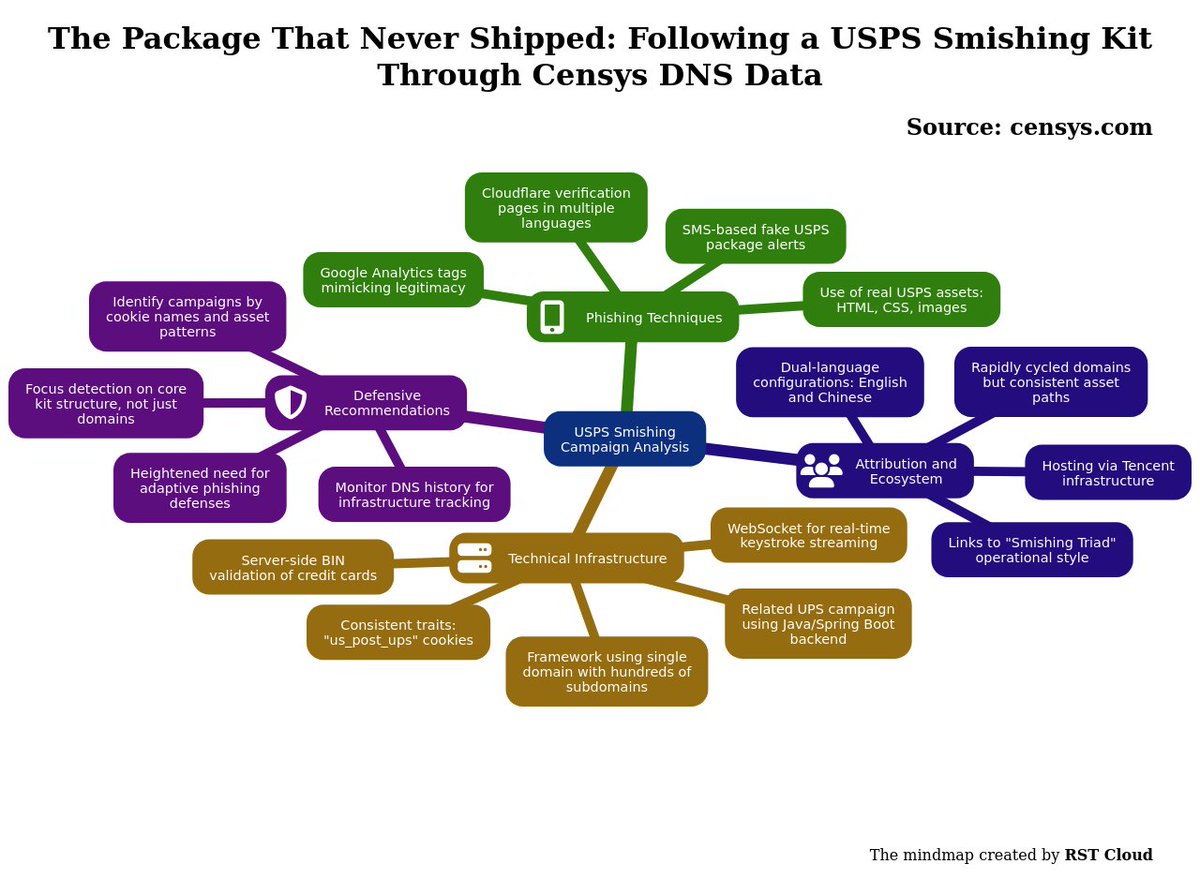
The Package That Never Shipped: Following a USPS Smishing Kit Through Censys DNS Data | 12-06-2026
Source: censys.com/blog/following-a-…
Key details below ↓
🧑💻Actors/Campaigns:
Smishing_triad (🧠motivation: information_theft)
💀Threats:
Smishing_technique, Regre_ssh_ion_vuln, Lighthouse_tool,
🎯Victims: Postal services, Package delivery, Logistics, United states citizens
🏭Industry: Financial
🌐Geo: Brazil, United kingdom, California, Asia, China, Spanish, United states, Chinese, Singapore
🔓CVEs: CVE-2024-6387 \[[Vulners](vulners.com/cve/CVE-2024-638…)]
- CVSS V3.1: *8.1*,
- Vulners: Exploitation: True
Soft:
- sonicwall sma_6200_firmware (-)
🤖LLM extracted TTPs:`
T1041, T1056.003, T1071.001, T1090, T1566.002, T1583.001, T1583.003
🧨IOCs:
- Url: 2
- Domain: 4
- File: 4
- IP: 7
- Hash: 2
💽Software: Caddy, OpenSSH, Linux
🔠Functions: JSONP
🗂️Win API: LTD, ARC
📜Programming Languages: java
#threatreport:
A recent analysis of a smishing campaign impersonating the United States Postal Service (USPS) has unveiled sophisticated technical methodologies utilized by cybercriminals. The phishing kit operates through SMS messages that entice victims with a fake USPS package delivery notification. The malfeasants employed legitimate USPS assets, including HTML, CSS, images, and Google Analytics tags, which interact with USPS's real marketing infrastructure. This design enables them to capture sensitive data in real-time by opening a WebSocket connection back to their server, allowing keystrokes of credit card details to be streamed instantly. Moreover, the backend performs a server-side Bank Identification Number (BIN) validation on submitted card information, optimizing the chances of capturing valid data.
The framework behind the smishing operation involves a single domain that has generated over a hundred subdomains. Passive DNS data from Censys highlighted the structural nature of this campaign, with a primary host resolving to 682 unique lookalike hostnames. Each of these domains typically shares characteristics such as cookie names that incorporate the theme “us_post_ups,” indicating a unified operational framework behind these multiple campaigns. Notably, this examination also uncovered parallel campaigns targeting UPS using a different backend technology (Java/Spring Boot) but employing the same underlying scheme, demonstrating a consistent operational model from a single threat actor.
The phishing process initiates with a deceptive Cloudflare verification page, presented in multiple languages to enhance trust and engage potential victims. Once a target submits information, the kit retains a history of card attempts to encourage the victim to enter additional card details under the guise of decline messages. This leads to sophisticated data extraction through a continuous connection with the cybercriminal's server.
Attribution of this activity points toward a broader ecosystem often associated with Chinese language content and operational styles in smishing campaigns, featuring characteristics typical of what has been dubbed “Smishing Triad.” Although no direct evidence links this cluster to specific prior incidents, indicators such as the dual-language internal configurations and infrastructures hosted via Tencent suggest a well-established and organized implementation. The campaigns exemplify a strategy where operational infrastructure is quickly cycled out while the structural traits such as cookie nomenclature and asset paths remain consistent, making them targetable by defenders.
This analysis emphasizes the need for improved defensive measures against such disposable phishing schemes. Employing detection methods that focus on the structural elements of the kits rather than specific domains or IPs is advisable, as these threats are designed to change frequently. Continued monitoring of DNS history clearly serves as a vital tool for tracking the lifecycle of these operations, revealing the extent of the infrastructure that underpins these malicious activities.
68
18h
#threatreport #MediumCompleteness
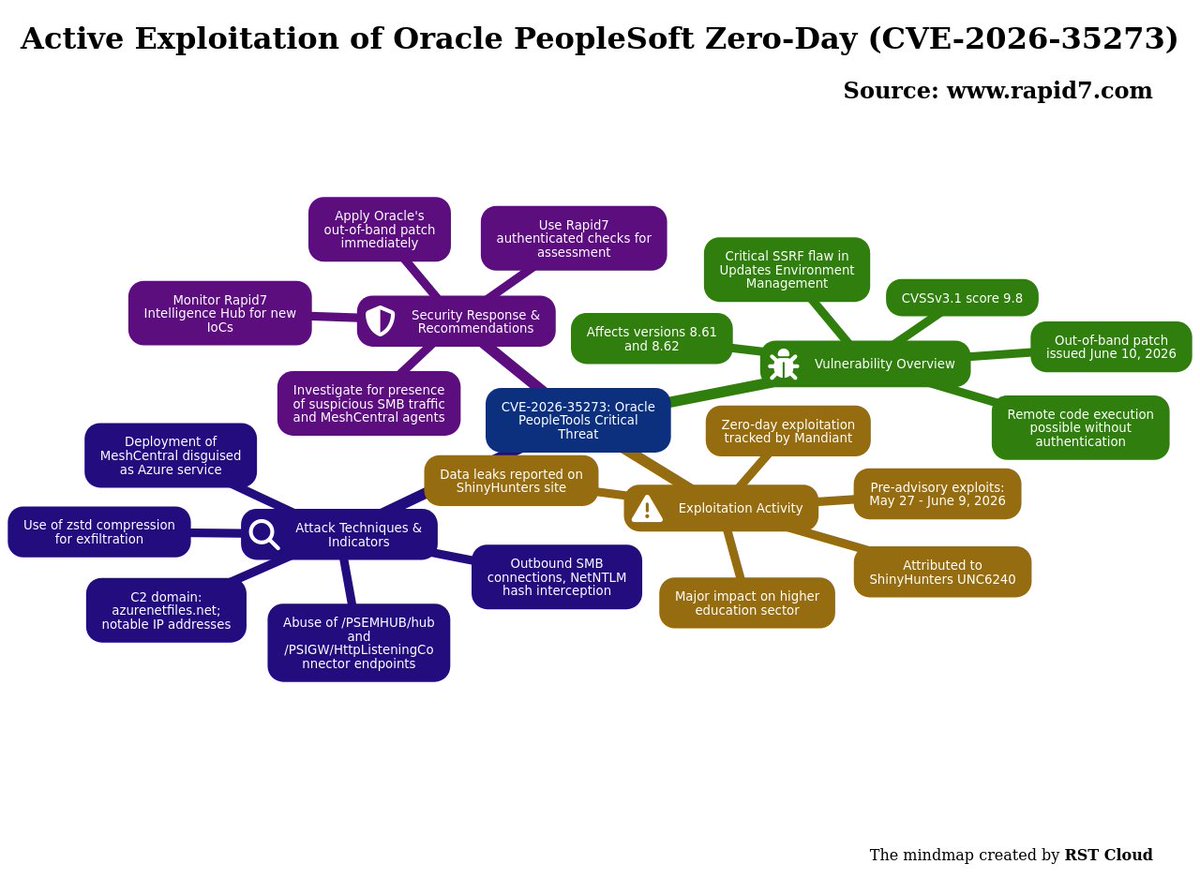
Active Exploitation of Oracle PeopleSoft Zero-Day (CVE-2026-35273) | 12-06-2026
Source: rapid7.com/blog/post/etr-act…
Key details below ↓
🧑💻Actors/Campaigns:
Unc6240 (🧠motivation: cyber_criminal, information_theft)
Shinyhunters (🧠motivation: cyber_criminal, information_theft)
💀Threats:
Meshcentral_tool, Meshagent_tool,
🎯Victims: Higher education, Universities and colleges
🏭Industry: Telco, Education
🔓CVEs: CVE-2026-35273 \[[Vulners](vulners.com/cve/CVE-2026-352…)]
- CVSS V3.1: *9.8*,
- Vulners: Exploitation: Unknown
CVE-2013-3821 \[[Vulners](vulners.com/cve/CVE-2013-382…)]
- CVSS V3.1: *6.4*,
- Vulners: Exploitation: Unknown
Soft:
- oracle peoplesoft_products (8.51, 8.52, 8.53)
CVE-2017-3548 \[[Vulners](vulners.com/cve/CVE-2017-354…)]
- CVSS V3.1: *6.5*,
- Vulners: Exploitation: Unknown
Soft:
- oracle peoplesoft_enterprise_peopletools (8.54, 8.55)
🤖LLM extracted TTPs:`
T1036.005, T1071.001, T1187, T1190, T1219, T1560.001
🧨IOCs:
- Url: 1
- IP: 6
- Domain: 1
- Hash: 5
- File: 1
💽Software: Linux
#threatreport:
CVE-2026-35273 is a critical vulnerability identified in the Updates Environment Management component of Oracle PeopleSoft Enterprise PeopleTools, which was publicly disclosed by Oracle on June 10, 2026. This vulnerability has been assigned a CVSSv3.1 score of 9.8 and is particularly concerning as it is remotely exploitable without authentication, allowing for potential remote code execution (RCE). The flaw has been characterized as a server-side request forgery (SSRF), and it specifically affects PeopleTools versions 8.61 and 8.62. Following the identification of this vulnerability, Oracle issued an out-of-band patch the same day.
Prior to the Oracle advisory, active exploitation of this zero-day vulnerability was reported by Mandiant, tracking incidents from May 27 to June 9, 2026. This exploitation has been attributed to a financially motivated hacker group known as UNC6240, or ShinyHunters, which has a history of data theft and breaches targeting various sectors, notably higher education, where 68 percent of the compromised organizations were universities and colleges. The exploitation primarily centered around the Environment Management Hub (PSEMHUB) endpoints, with data stolen during this campaign being released on the ShinyHunters Data Leak Site shortly after the exploitation period.
Technical analysis revealed two primary endpoints involved in the exploitation, namely /PSEMHUB/hub and /PSIGW/HttpListeningConnector. The exploitation chain could potentially lead to outbound SMB connections on TCP port 445, giving attackers the opportunity to intercept Windows machine account NetNTLM hashes. Activities following the initial compromise typically included the deployment of MeshCentral remote management agents disguised as Microsoft Azure services, enabling the attackers to maintain control and perform actions like internal reconnaissance, lateral movements, and data exfiltration using zstd compression techniques.
For organizations leveraging exposure assessment tools such as Rapid7's, authenticated vulnerability checks regarding CVE-2026-35273 were made available shortly after the vulnerability was disclosed. Furthermore, security teams can utilize resources from the Rapid7 Intelligence Hub to stay updated with recent activities related to this vulnerability, including relevant indicators of compromise. Network indicators associated with the campaign included multiple IP addresses as well as a command and control domain, azurenetfiles.net, which masqueraded as a legitimate Microsoft Azure service.
117
19h
#threatreport #LowCompleteness
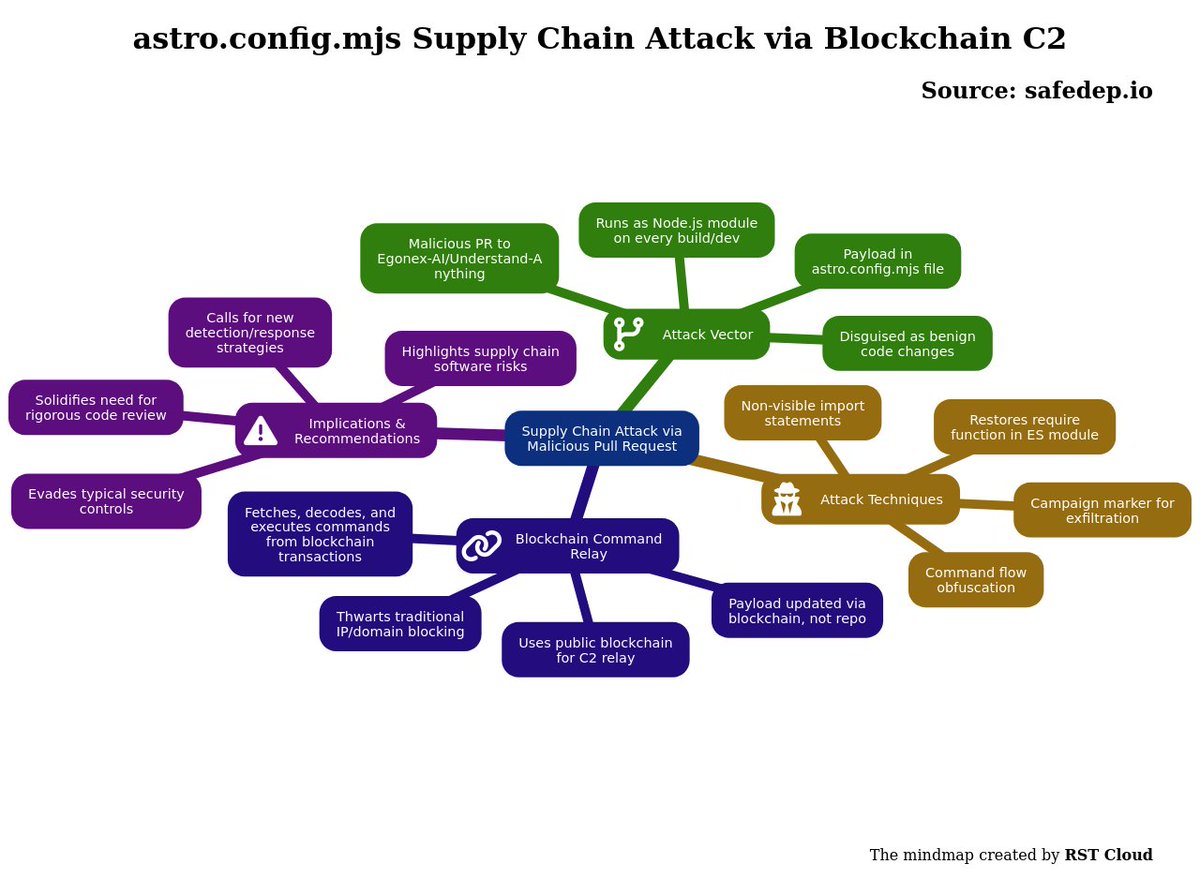
astro.config.mjs Supply Chain Attack via Blockchain C2 | 12-06-2026
Source: safedep.io/astro-config-bloc…
Key details below ↓
💀Threats:
Supply_chain_technique, Dead_drop_technique,
🎯Victims: Open source software projects, Software development
🏭Industry: Financial
🤖LLM extracted TTPs:`
T1008, T1027, T1041, T1059.007, T1071.001, T1102.001, T1105, T1140, T1195.002
🧨IOCs:
- File: 8
- IP: 4
💽Software: Node.js, Chrome, trongrid
📲Wallets: tron, mainnet
🪙Crypto: aptos, binance
🔢Algorithms: xor
🔠Functions: createRequire, eval, getJson
📜Programming Languages: javascript
💻Platforms: x64
#threatreport:
The recent supply chain attack utilizing a malicious pull request (PR) highlights significant vulnerabilities in the software development lifecycle, particularly with open-source projects. In this case, the attack was executed against the Egonex-AI/Understand-Anything repository, where the payload was cleverly embedded in the `astro.config.mjs` file. This file is essential in the Astro development framework as it runs as a Node.js module for every build and development operation, executing the payload automatically without user interaction.
The malicious PR, disguised under a benign title and description, presented fabricated technical changes that obscured the true nature of the modifications. The payload initiates a communication routine with one of three hardcoded command-and-control (C2) servers. Once the initial connection is established, it leverages a campaign marker for exfiltration and employs advanced techniques to download a bot client. Notably, it utilizes a second-stage command relay through public blockchain infrastructure, making it challenging to curtail the attack by simply blocking IP addresses used by the C2 servers.
The specific attack mechanism involved the obfuscation of the command flow, effectively restoring the `require` function within an ES module context without raising immediate concern during code reviews. This was accomplished by adding non-visible import statements to the code. Stage B of the attack further involved carefully orchestrated communication with blockchain systems to fetch transaction data, which then decoded and executed subsequent malicious commands.
The pivot to blockchain technology as a means for command relay is particularly significant. It allows the attacker to alter the payload via simple updates to transaction data on the blockchain, thereby avoiding conventional detection methods focused on IP addresses or domain blocking. The attacker can modify the command without changing the public repository, exploiting the reliance on public APIs, which complicates mitigation attempts due to their genuine use in legitimate applications.
This incident reveals a concerning trend in cyber threat tactics, combining social engineering, code obfuscation, and blockchain technology to create sophisticated attack vectors. The layered approach of this attack not only bypasses traditional security measures but also emphasizes the need for vigilant code review processes and heightened awareness of supply chain risks in modern software development practices.
42
20h
#threatreport #HighCompleteness
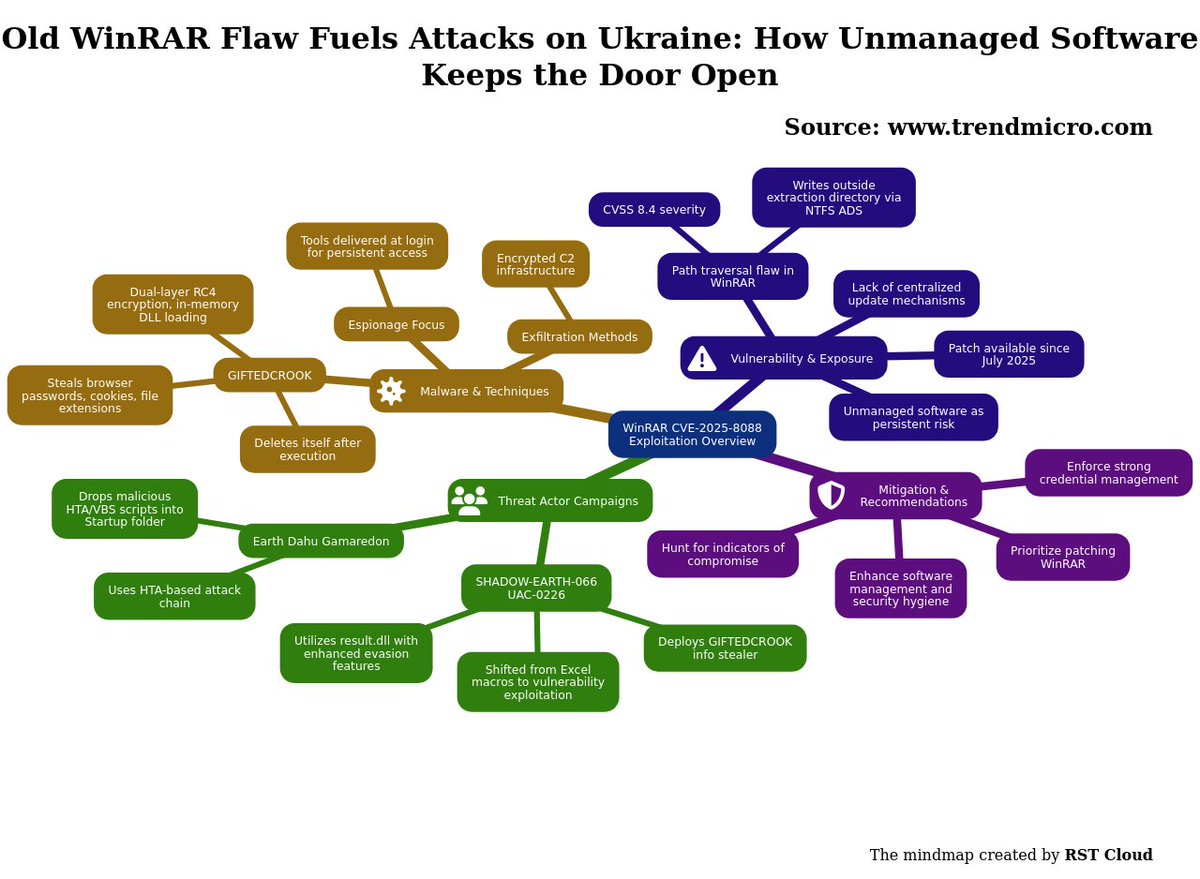
Old WinRAR Flaw Fuels Attacks on Ukraine: How Unmanaged Software Keeps the Door Open | 08-06-2026
Source: trendmicro.com/en_us/researc…
Key details below ↓
🧑💻Actors/Campaigns:
Gamaredon (🧠motivation: cyber_espionage)
Uac-0226 (🧠motivation: cyber_espionage)
Fancy_bear
Apt29
Sandworm
Turla
Void_rabisu
💀Threats:
Giftedcrook, Romcom_rat, Spear-phishing_technique, Antidebugging_technique, Gammasteel,
🎯Victims: Ukrainian organizations, Military innovation centers, Military formations, Law enforcement agencies, Local self government bodies, Government entities, Military entities
🏭Industry: Military, Government
🌐Geo: Malaysian, Crimea, Ukraine, Netherlands, Russia, Moscow, Switzerland, France, Germany, Ukrainian
🔓CVEs: CVE-2018-20250 \[[Vulners](vulners.com/cve/CVE-2018-202…)]
- CVSS V3.1: *7.8*,
- Vulners: Exploitation: True
Soft:
- rarlab winrar (le5.61)
CVE-2025-8088 \[[Vulners](vulners.com/cve/CVE-2025-808…)]
- CVSS V3.1: *8.8*,
- Vulners: Exploitation: True
Soft:
- rarlab winrar (<7.13)
CVE-2025-6218 \[[Vulners](vulners.com/cve/CVE-2025-621…)]
- CVSS V3.1: *7.8*,
- Vulners: Exploitation: True
Soft:
- rarlab winrar (<7.12)
📚TTPs:
⚔️Tactics: 8
🛠️Technics: 17
🧨IOCs:
- File: 13
- Hash: 37
- Command: 5
- Path: 3
- IP: 14
- Url: 5
- Domain: 2
- Email: 1
💽Software: Telegram, Chrome, Firefox, Opera, Google Chrome, Microsoft Edge, Mozilla Firefox, KeePass, PDQ Deploy
🔢Algorithms: rc4, prng, fnv-1a, sha256, exhibit, base64
🔠Functions: Get-Content, flexibility_denominator_wiretap, Sleep
🗂️Win API: NtProtectVirtualMemory, NtAllocateVirtualMemory, NtCreateThreadEx, CryptUnprotectData, CreateProcessW, DeleteFileW, CryptImportKey, VirtualAlloc
📜Programming Languages: powershell
💻Platforms: x64
#threatreport:
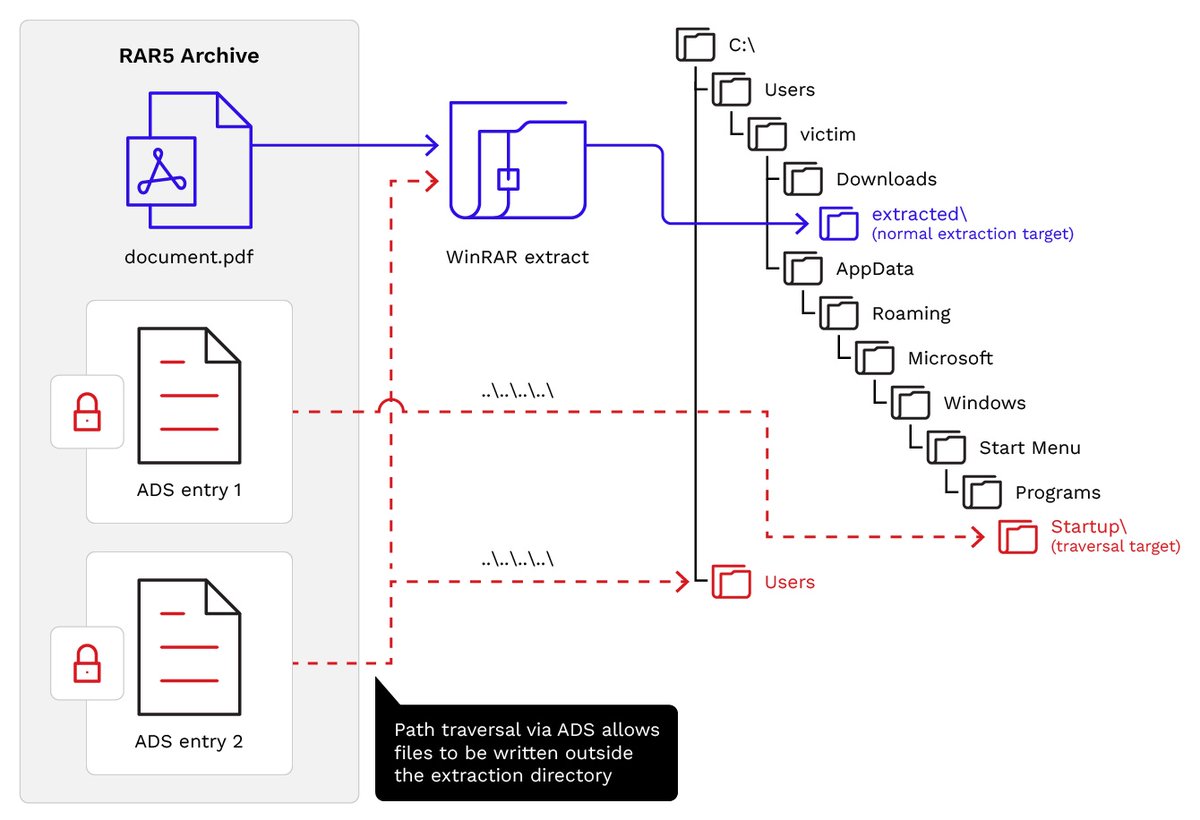
The ongoing exploitation of the WinRAR vulnerability CVE-2025-8088, which was patched in July 2025, continues to pose significant cyber threats to Ukrainian organizations. The vulnerability, a path traversal flaw (CVSS 8.4), allows attackers to write files outside the extraction directory using NTFS Alternate Data Streams. This vulnerability is leveraged by various Russia-aligned groups, including SHADOW-EARTH-066 and Earth Dahu (Gamaredon), against Ukrainian military and governmental entities.
SHADOW-EARTH-066, designated by CERT-UA as UAC-0226, has transitioned from an earlier tactic of using Excel macros for initial access to exploiting CVE-2025-8088. It deploys the GIFTEDCROOK information stealer, capable of harvesting browser passwords, session cookies, and specific file extensions before self-deleting. The evolved version of this stealer, known as result.dll, shows significant enhancements, such as in-memory DLL loading and encrypted command-and-control infrastructure. The malware, compiled in C , utilizes dual-layer RC4 encryption for stolen data exfiltration, indicating a deliberate attempt to evade detection and analysis.
In contrast, Earth Dahu exploits the same vulnerability using an HTA-based attack chain. The group drops malicious HTA files or obfuscated VBS scripts into the Startup folder, executing them at user login to deliver espionage tools. This method shows a characteristic shift in tactics, reflecting a need for operational security as other methods become less effective.
Both campaigns exemplify how unmanaged software like WinRAR can create vulnerabilities that persist long after patches are issued. The lack of centralized update mechanisms for such applications leaves organizations exposed, allowing threat actors to maintain access through a reliable entry point. Academic analysis points to a history of vulnerabilities in similar widely used utility applications, emphasizing the need for robust software management and security hygiene.
The exploitation strategies employed by both SHADOW-EARTH-066 and Earth Dahu highlight distinct differences in development and methodology, with one favoring a compiled C malware chain and the other relying on scripting mechanisms. However, both leverage the same weakness in WinRAR, representing a considerable risk to Ukrainian security initiatives and potentially impacting allied nations through compromised credentials and data.
Organizations are advised to prioritize patching WinRAR, conduct thorough hunts for indicators of compromise, and enforce stringent credential management practices to mitigate the ongoing risks posed by these cyber threat actors.
1
74
20h
#tireport #ExtractedDiagrams
The key diagram for the report (ML Classifier):
schema: 3, code: 1, chats: 1
5
21h
#threatreport #LowCompleteness
World Cup 2026 Mobile Targeted Phishing: The Global Social Engineering Threat | 11-06-2026
Source: zimperium.com/blog/world-cup…
Key details below ↓
🧑💻Actors/Campaigns:
Ghost_stadium
Retailphish
Offsidehire_phishing
💀Threats:
Typosquatting_technique, Aitm_technique, Mishing_technique, Credential_harvesting_technique,
🎯Victims: Consumers, Sports retail, Corporate google workspace accounts, Job seekers
🏭Industry: Transport, Retail, Entertainment
🌐Geo: Croatia, Ecuador, England, Germany, New york, France, Colombia, Chinese, German, Portugal, Portuguese, Spain, Spanish, Qatar, French
📚TTPs:
⚔️Tactics: 1
🛠️Technics: 0
🤖LLM extracted TTPs:`
T1056.003, T1078, T1111, T1557, T1566.002, T1566.003, T1583.001, T1583.006, T1656
🧨IOCs:
- Domain: 6
- File: 3
💽Software: WhatsApp, Telegram, TikTok, Chrome
📜Programming Languages: javascript
#threatreport:
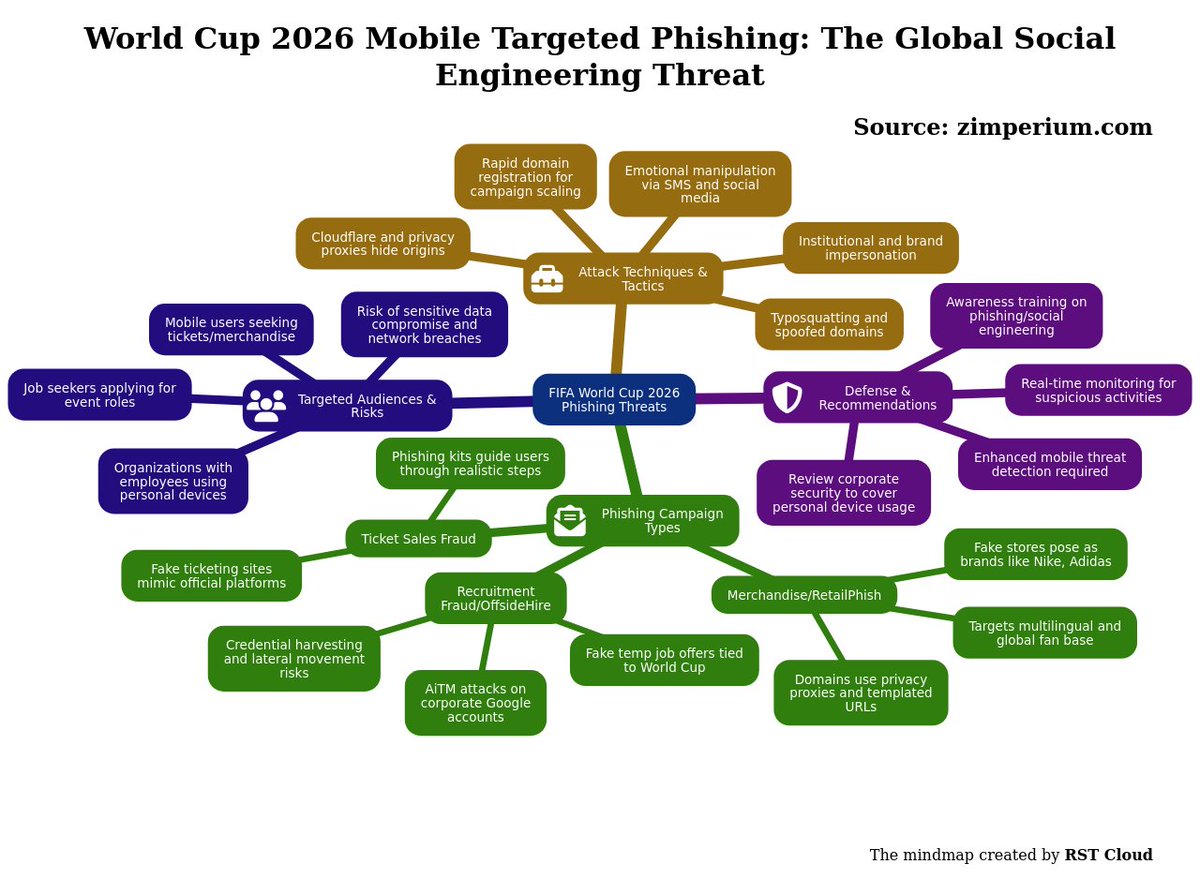
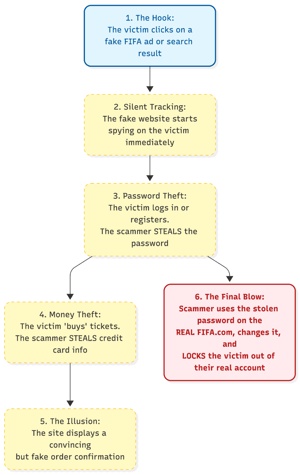
The surge in phishing campaigns associated with the FIFA World Cup 2026 poses significant risks to mobile users as cybercriminals exploit the high demand for game tickets and merchandise. With 48 teams and 104 matches, the event's scale creates an ideal environment for social engineering attacks aimed at various audiences, notably ticket buyers and job seekers. Threat actors have employed techniques such as Typosquatting and institutional spoofing, deploying fake domains like fifa-tickets.vip to mislead users who are desperate for tickets. Additionally, sophisticated retail campaigns are using sites that appear to mimic legitimate brands such as Nike and Adidas, often hiding their origins behind Cloudflare to evade detection.
Three main campaigns have emerged: the first focuses on ticket sales, the second on merchandise, and the last on recruitment fraud. These campaigns leverage urgent messages via SMS and social media to instill emotional panic among readers, prompting them to click on malicious links. For the ticketing scheme, attackers have created deceptive sites that closely resemble official platforms, effectively misdirecting users into providing sensitive personal and financial information. The implementation of advanced phishing kits enables thorough engagement throughout the fraudulent ticket purchasing process, ensuring victims are led through a realistic purchasing journey.
The merchandise phishing campaign, branded as RetailPhish, capitalizes on fans seeking team apparel after ticket availability dwindles. By using malicious domains registered under a privacy proxy, the attackers obscure their identities while employing templated URLs that target multiple languages and regions. Rapid domain registration allows for efficient scaling of their operations.
The recruitment fraud, dubbed OffsideHire, is particularly alarming as it focuses on temporary employment opportunities related to the World Cup. This involves setting up phishing sites designed to steal credentials from corporate Google Workspace accounts under the guise of legitimate hiring efforts. The site's structure compromises organizations by facilitating a form of Adversary-in-the-Middle (AiTM) attack, allowing for real-time credential harvesting that can lead to deeper breaches within corporate networks.
All these campaigns are strategically executed to operate outside conventional corporate security measures such as firewalls, often using personal devices that link back to company resources. Their intricate designs highlight the need for robust mobile threat detection and prevention solutions that can identify suspicious activities in real-time, thereby protecting sensitive organizational data from compromise.
1
2
124
21h
#tireport #ExtractedDiagrams
The key diagram for the report (ML Classifier):
schema: 1, code: 6
1
63
22h
#threatreport #HighCompleteness
Shai-Hulud Campaign Evolution: Miasma, Hades, and AI Scanner Evasion | 12-06-2026
Source: zscaler.com/blogs/security-r…
Key details below ↓
🧑💻Actors/Campaigns:
Teampcp
💀Threats:
Shai-hulud, Miasma, Hades, Supply_chain_technique, Aitm_technique, Dead_drop_technique,
🎯Victims: Software, Cybersecurity, Artificial intelligence, Automation, Open source projects, Aqua security, Litellm, Tanstack, Mistral ai, Guardrails ai, ...
🏭Industry: Financial
📚TTPs:
⚔️Tactics: 2
🛠️Technics: 0
🤖LLM extracted TTPs:`
T1001.003, T1027, T1078, T1102.003, T1195.001, T1195.002, T1528, T1546, T1550.001, T1562.001, ...
🧨IOCs:
- File: 8
- Domain: 1
- Url: 1
- Hash: 3
💽Software: Anthropic, Trivy, LiteLLM, jupyter notebook, TanStack, Mistral, OpenSearch, Claude
🪙Crypto: monero
🔢Algorithms: sha256, pbkdf2, aes-256-gcm
🗂️Win API: In
📜Programming Languages: python, javascript
#threatreport:
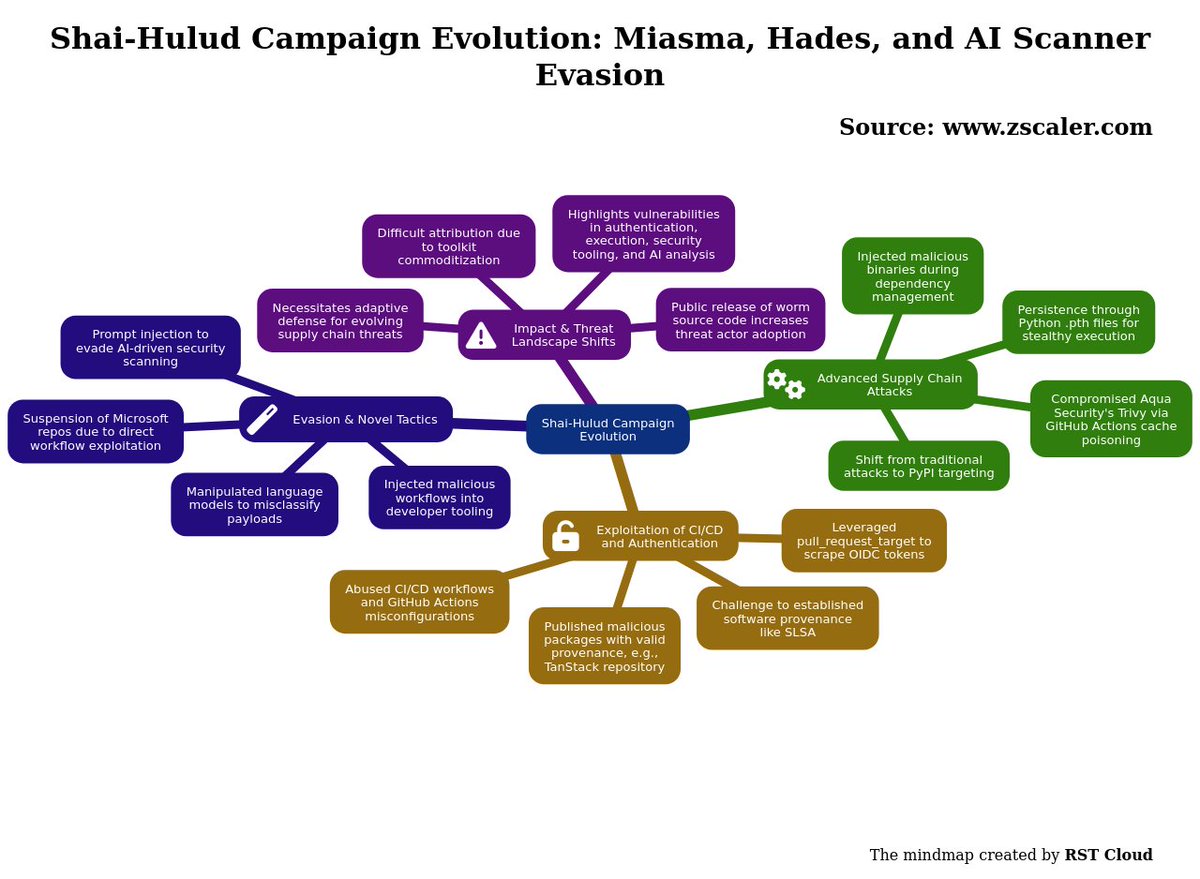
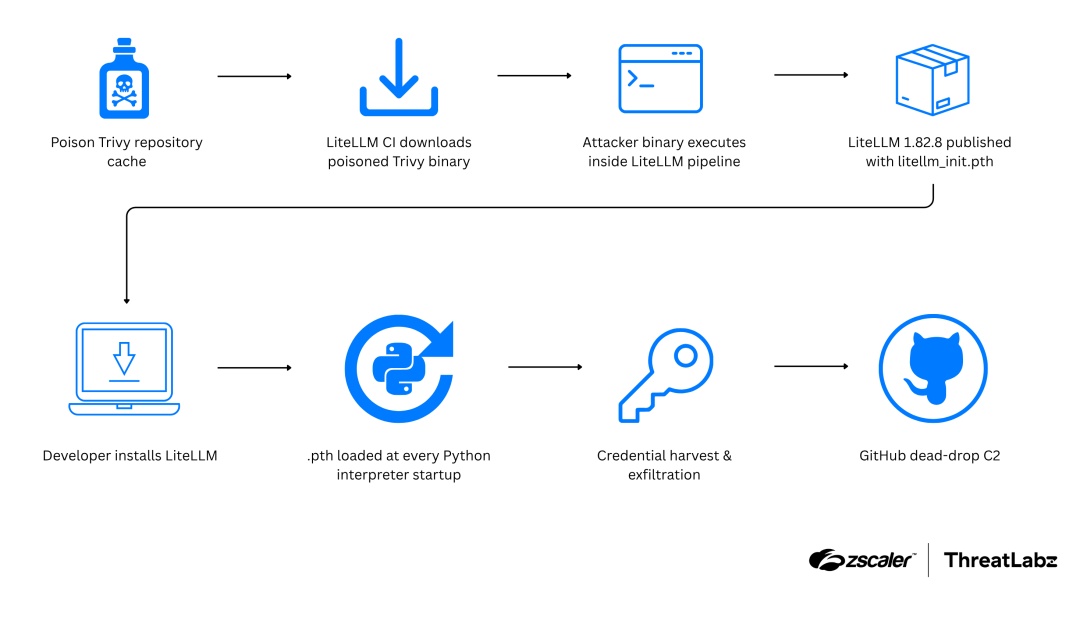
The Shai-Hulud campaign, associated with the threat actor TeamPCP (tracked as UNC6780), has undergone significant evolution since its initial analysis in November 2025. This campaign has notably transitioned from traditional software supply chain attacks to more sophisticated methods that include targeting the Python Package Index (PyPI) and exploiting continuous integration/continuous deployment (CI/CD) workflows, thereby undermining the integrity of established software provenance frameworks like Supply-chain Levels for Software Artifacts (SLSA).
A key development occurred in March 2026 when TeamPCP expanded their operations into PyPI by compromising Aqua Security's Trivy vulnerability scanner through a method of GitHub Actions cache poisoning. The attackers leveraged this vulnerability to install malicious binaries in dependency management workflows, particularly affecting the LiteLLM Python library. The persistence mechanism utilized by the malware involved .pth files, which are loaded by Python at startup, enabling the execution of malicious payloads without explicit user action.
In May 2026, the campaign escalated with the misuse of GitHub Actions, exploiting a pull_request_target misconfiguration, which allowed attackers to scrape OpenID Connect (OIDC) tokens from the CI runner's memory. These tokens facilitated the publication of malicious packages with valid provenance, even though the newly published 84 artifacts from the TanStack repository appeared legitimate. Such tactics demonstrated a critical exploit of the trust in automated publishing processes, where the underlying infrastructure remained intact but was compromised by malicious contributions.
Moreover, the campaign included novel approaches such as prompt injection aimed at bypassing AI-driven security scanning. By manipulating the parsing logic of language models, attackers could misdirect these tools into classifying their payloads as secure, thus allowing the malicious packages to evade detection during automated security triage processes.
On May 12, 2026, the public release of the entire worm source code initiated a major shift in the threat landscape, transforming private attack methodologies into public resources. This change complicates attribution efforts as external actors can now utilize and modify the toolkit for their own purposes.
The campaign further demonstrated its adaptability by extending its reach beyond traditional package registries. In June 2026, techniques evolved to inject malicious workflows and configuration files directly into developer tooling environments, leading to the suspension of several Microsoft repositories. The risk posed by this shift underscores the necessity for heightened vigilance within software development and deployment ecosystems.
The ongoing evolution of Shai-Hulud signifies a systematic assault on various facets of software supply chain security, highlighting vulnerabilities in maintainer authentication, execution during installation, security tooling reliability, and AI-assisted code analysis. The continued innovation and complexity of these attacks necessitate an adaptive defense strategy to safeguard against both known and emerging threats within the cybersecurity landscape.
1
1
94
22h
#tireport #ExtractedDiagrams
The key diagram for the report (ML Classifier):
schema: 5, code: 1
1
10