
In physics, everything is relative to something else. Apparently, the same applies inside the Russian mind.
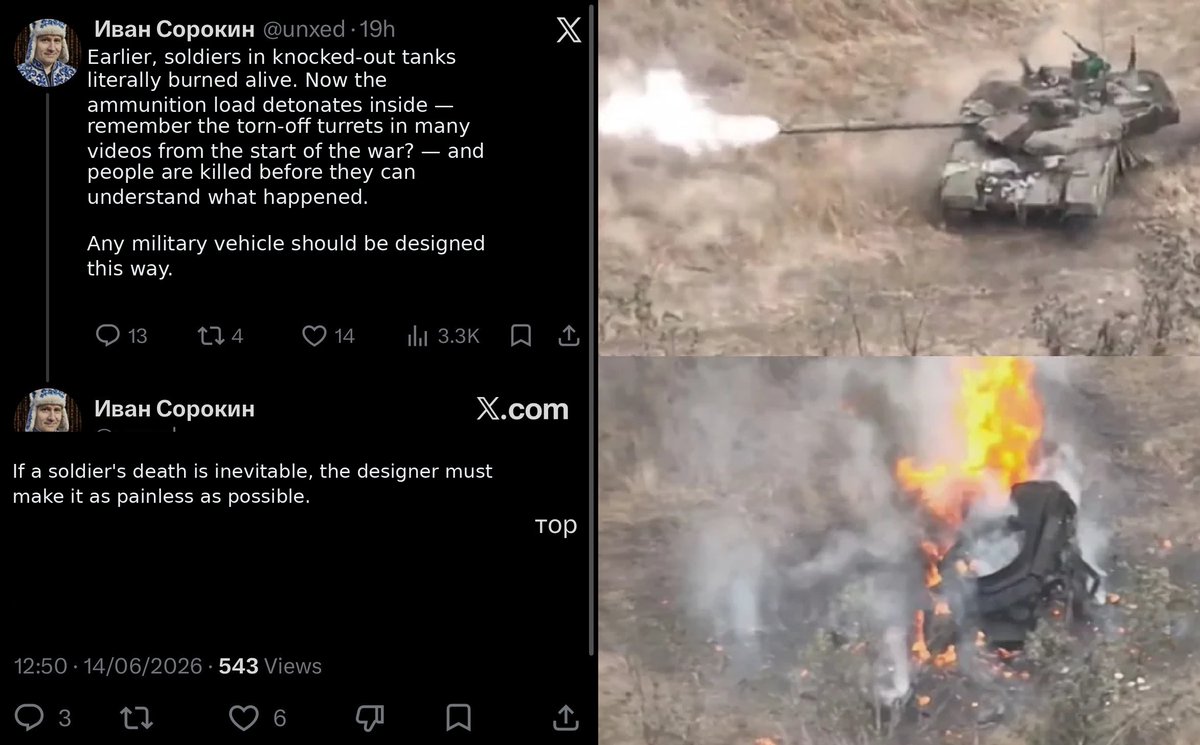
They do not see the crimes. They do not see the deaths of their own soldiers. They do not see the flaws in their own equipment. They judge everything relative to the result. So the problem, in their logic, is not that the tank fails to protect its crew. The “achievement” is that when the vehicle is hit, the crew dies quickly and supposedly without suffering.
It is a way of normalizing expendability — turning the death of soldiers into a design feature rather than asking why they are being sent to die in the first place.
1
4
82
3,962

The logic of the escalation ladder between the world's top two nuclear powers🇷🇺🇺🇸is such that the U.S. especially this Administration is hardly likely to escalate further against Russia if a British or French chopper seizing a Russian tanker goes down. Same logic if a French or British surveillance aircraft mapping Russian air defenses in Crimea goes down after an unfortunate collision with a Russian interceptor in the Black Sea. This is obvious to me sitting here thousands of miles away I don't understand why Brit and French servicemen could kid themselves about their relative greater expendability within the alliance, let alone Baltic states coast guard guys itching to seize a Russian tanker.
24

haha. Molested bum. remember someone signed up to look for you. Did they Renunciate Texas. And at the level of expendability that you were chosen. But by them. Same people. No. As what. AS dammit Piggy, <no> dammit no Molested anyway! they want to between Che Guevara sot and latc
12

Jun 12
UKRAINIAN CAMPAIGN AGAINST THE BLACK SEA FLEET - THE DRONE BOATS: A GARAGE-BUILT NAVY
Hi, this week I wanted to write about the Ukrainian campaign against the Russian Black Sea Fleet. I’ve divided it into six posts. I’ll be posting them daily around 4 p.m. I hope you enjoy reading them. This is the fourth post on this topic.
The weapon that reshaped the Black Sea more than any other isn't a ship or a famous missile. It's the uncrewed surface vessel - the explosive-laden drone boat. Small, cheap, and uncrewed, these craft did what Ukraine's nonexistent navy never could.
The basic design is very simple: a small hull, often fiberglass, fitted with a camera, satellite communications, and a warhead in the bow. The Royal United Services Institute described them as "generally the type of craft which can be built in a garage or small industrial unit." The key enabler has been high-capacity two-way satellite links like Starlink and Kymeta, which let an operator hundreds of kilometers away steer the boat onto its target in real time, watching through the onboard camera.
Ukraine runs two parallel drone-boat programs, which is a useful detail for following the war. Military intelligence (GUR) operates the Magura family. The security service (SBU) operates the Sea Baby. They're separate efforts, and they've each racked up kills.
According to specifications compiled by naval analyst H.I. Sutton at Covert Shores, the Magura V5 is about 5.5 meters long, carries a 320 kg payload, and has a range of roughly 450 nautical miles (around 833 km). That's the boat that sank the corvette Ivanovets, the landing ship Tsezar Kunikov, and the patrol ship Sergey Kotov - three significant kills from one platform.
The SBU's Sea Baby is a bit bigger: around 6 meters, range near 540 nautical miles, payload up to 850 kg, and it can carry unguided 122mm rockets on top of its main charge. SBU chief Vasyl Maliuk confirmed to CNN and The War Zone that the Sea Baby was used in the July 17, 2023 strike on the Kerch Bridge, as well as against the Olenegorsky Gornyak landing ship and the Sig tanker. Maliuk stressed the drones were developed and built entirely inside Ukraine, at a clandestine facility, without Western involvement.
Two qualities make these boats strategically potent: range and expendability. The strike on the Olenegorsky Gornyak happened at Novorossiysk, roughly 420 miles from the nearest Ukrainian-held shore - proof that no Russian port in the Black Sea was beyond reach. And because the boats are uncrewed and cheap, Ukraine can lose dozens of them in one operation and still come out ahead if a single one finds a target. No crewed navy can absorb losses like that.
The drone boats haven't stood still either. Newer Magura variants - the V7 and W6 - have been fitted with an improvised air-defense system called "Sea Dragon," carrying R-73 or AIM-9 Sidewinder missiles. Ukraine has used these to shoot down Russian helicopters and reportedly a Su-30 fighter, firing surface-to-air missiles from a boat. That's a striking evolution: a suicide drone that can now also defend itself and hunt aircraft.
Other systems keep appearing in the open-source record. The SBU's larger Mamai. The Toloka family of underwater loitering torpedoes. The longer-range Katran, designed to ferry first-person-view strike drones close to a target. What started as a single-purpose suicide boat is turning into a family of multi-role uncrewed combatants.
RUSI's conclusion is hard to argue with: Ukraine's success against the fleet "could only have been achieved using uncrewed vessels." Crewed boats sent on these missions, far from home and into defended waters, wouldn't have survived. The fact that nobody's aboard is the whole point - it's what makes the math work.
The video shows the sinking of the Ivanovets corvette
See the rest of the posts about Ukrainian attacks on the Black Sea Fleet in the comments.
Sources in the comment below
If you appreciate what I do, I'd really appreciate your financial support. Thanks a lot!
buymeacoffee.com/WarDroneX
10
81
643
32,890


Jun 12
You know . . . it’s a rather fascinating quandary.
Option A
Surrender yourself to the unforgiving weight of feminine beauty, a weight only a handful of women ever truly possess, and even then, only for a brief window of time.
Or
Option B
Relegate yourself to the unmitigated isolation, brutality, invisibility, and expendability of being a man.
Tough choice . . . really.
1
2
33

Jun 11
The team had 60 million on the books. Cap came in at 39
I’m sure someone will do the math for you but I didn’t help my expendability
Good thing I got my shit straight and came back
Rumor is you haven’t won a Cup without me in the lineup since 1955. Oh. Sorry. My bad. Those are Facts
Jun 11

Or making 2.5 million mighta had something to do with it
Thanks for the history lesson
I believe we had WON 3 Cups at that point. But no difference.
18
18
234
61,636

Jun 11
Taking Kharg island would be the greatest US military blunder in recent history and could lead hundreds or more of US Marines to their deaths.
The island measures 8 square miles and lies 12 miles from the coast of Iran.
It is easily within range of short-range drones and ballistic missiles.
The island has almost zero natural cover with a few flat, rocky hills and limited infrastructure.
Resupply is largely choked off by Strait of Hormuz closure.
Marines seizing the island would incredibly exposed. Their tragic deaths and expendability by the administration would provide the means for dramatic escalation into a broader conflict.
Horrendous idea.
Jun 11

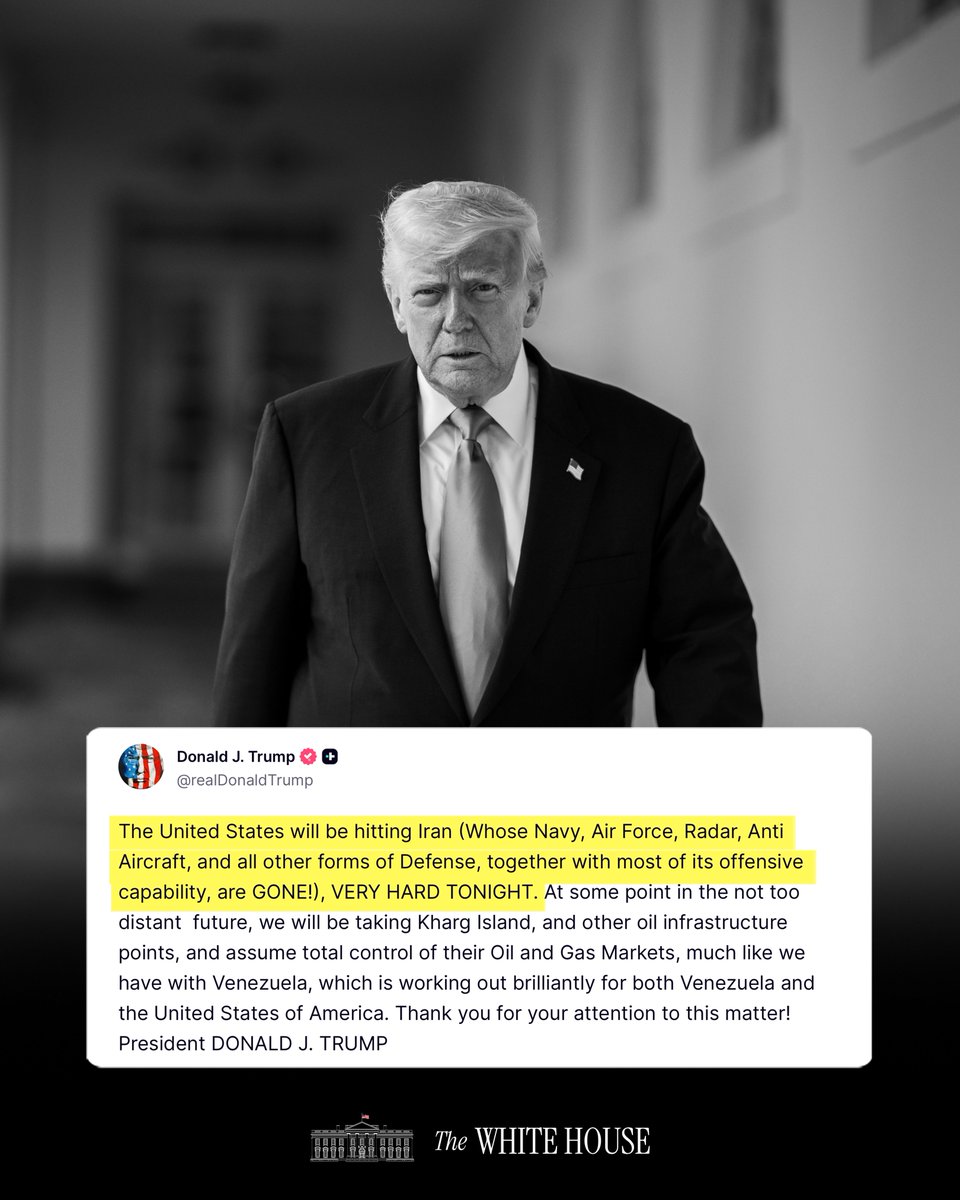
"The United States will be hitting Iran (Whose Navy, Air Force, Radar, Anti Aircraft, and all other forms of Defense, together with most of its offensive capability, are GONE!), VERY HARD TONIGHT..." - President Donald J. Trump
1
6
13
13,904

Jun 11
No. The stealth hurdle is that GlobalEye can't DETECT stealth (US aircraft pointed at 🇨🇦).
GlobalEye S-Band has ~150km range vs stealth, 200km if you're lucky. The 650km claimed is for conventional aircraft, not stealth.
Since AEW sits 100km behind the front fighter, this reduces net stealth detection range to ~50km. Meaning the front deployed fighter's radar may still pick up the inbound F22/F35 etc before the AEW does. Defeating the point of Airborne EARLY Warning in the first place.
The way to solve this is with FRONT DEPLOYED expendable drones, which can make a lower tech radar still give drastically farther net detection range vs stealth due to front deployment (which cheap expendability allows).
USAF has roughly ~900 stealth aircraft in inventory (about 40% of total fighter fleet), and roughly 100/yr are being added. In 5-10yrs, virtually all of their fleet will be stealth.
TLDR: If 🇨🇦 can't detect intercept stealth, we're fucked.
@JessieTweeting @brbishop1 @MikeTheNavyGuy1
1
1
7
606

Jun 11
Glittering real estate projects continue to be built upon the precarity, vulnerability, and expendability of workers’ lives. Raisul Haque (24) and Abdul Samad (45), migrant workers from West Bengal died today. This is the human cost that pins our urban skylines.
1
128

Just like Tim Scott and John James, Stephen A. Smith is learning the lesson of black expendability among MAGA. Damn Shame
2
106

There's no studying of anything, the reason is Niger(ia), its inorganic nature and mineral thirsty countries like the British and the United States of America that believe in the expendability of Niger(ians) whose division is good for business.
1
1
150

Jun 10
Other populations are more easily controlled due to lower IQ averages and collectivist heritage. They will serve as a slave class for the globalist elites, but their numbers must also be reduced due to overpopulation/expendability. First, they'll wield them as a weapon against Whites, as they have been doing.
1
3
48
(ash)tray heart retweeted

i wrote a note on expendability
and i really have no clue how else to explain it, so my first #strattland entry, i guess
archiveofourown.org/works/86…


1
5
311

Jun 9
Patriarchy is the oppression of marginalized genders (including children, who literally are treated as property) by adult cis men, primarily through mass sexual violence. It doesn't "exist to mitigate the expendability of males" lmao, you're just an MRA anti feminist lmfao.
1
3
53


Idk I think the resolution of Skyfall being Bond, a character who has *literally nothing* outside of his service to MI6, deciding to suck it up and tune out the very obvious nature of his expendability as an agent and the reckless authoritarian nature of espionage, is interesting
1
4
43

1/ Blackness is under attack globally.
This is not new.
What feels new is the precision of it:
a think-tank war against Black being, Black knowledge and Black lived reality.
Ontological.
Epistemic.
Phenomenological.
A stepped-up project to make Black people finally doubt their own existence, and to convince Westerners of their expendability.
A purge.
~ Gillian Schutte
#Blackness #BlackLiberation #AfricanSovereignty #AntiBlackness #EpistemicJustice #DecolonialThought #PanAfricanism #BlackThought #AfricanFutures #WhiteSupremacy
#ThePurge
#Imperialism #GillianSchutte

3
5
9
346