
Jun 8
★A nuclear weapon can destroy a nation.
An unchecked ego can destroy generations.
The most dangerous weapon on Earth was never uranium. It was insecurity armed with power.✨️🥂🤍
#InsecurityExposed 🎭 #PeoplePleaser #ExternalValidation #CopyCatWithOutIdentity😶


1
1
249

May 20
The so-called “#PressFreedomIndex” is not a UN ranking, not an international treaty mechanism, and not an elected global body. It is a perception-based index created by #ReportersWithoutBorders (RSF), founded in France in 1985, an #NGO with its own ideological frameworks and benchmarks rooted largely in #Western liberal media standards.
Its rankings are built largely on questionnaires, perception surveys, activist inputs, and NGO-driven frameworks — not on any universally accepted global legal standard. (Wikipedia)
#India absolutely should improve #journalism standards, protect genuine reporters, and encourage healthy scrutiny. But India also should not develop a national #inferioritycomplex every time a #foreign #NGO decides to downgrade it.
A nation of 1.4 billion people dealing with:
• terrorism
• separatism
• misinformation warfare
• deepfake propaganda
• communal incitement
• foreign influence operations
• social media radicalisation
…cannot be assessed using the exact same framework as tiny homogeneous European states with vastly different security realities.
Ironically, many countries ranked “high” on press freedom:
• aggressively censor online speech,
• criminalise certain opinions,
• raid journalists under national security laws,
• ban platforms,
• or openly pressure media through state narratives.
Yet India alone gets framed as uniquely “unsafe for democracy.”
What’s even more unfortunate is that some people within India treat these foreign perception indexes as absolute benchmarks of truth and immediately weaponise them to attack the Indian state, government, institutions, and even the country’s global image — as though external approval matters more than understanding India’s own complex realities.
RSF itself is funded through donations, foundations, partnerships, public-sector grants, European institutional support, merchandise/book sales, and private supporters. (Reporters Without Borders)
Critics have long argued that when NGOs are financially dependent on Western institutional ecosystems, grants, and political networks, questions about ideological bias and worldview alignment naturally arise — especially when the same Western nations consistently dominate such rankings. (The Colgate Maroon-News)
That does not automatically make every criticism invalid.
But it also does not make these rankings sacred or beyond scrutiny.
India’s rise geopolitically, economically, technologically and strategically has also made it a far bigger target for #narrativewarfare than before.
Constructive criticism is healthy.
Blind dependence on #externalvalidation is not.
A confident civilisation-state should listen to criticism where valid — but never outsource its self-worth to perception indexes built outside its own realities.

2
13
27
867

Apr 19
Diagnostic performance varied across the AI platforms evaluated and was generally low to moderate within this small sample. Open access article: jav.ma/aidx #radiology #artificialintelligence #externalvalidation #transparency #diagnosticperformance

1
3
306

Apr 8
2/10 It’s about the weird hunger to be chosen, verified, endorsed, texted back, applauded, and seen in the right light by the right people at the right time. #ExternalValidation #WritingCommunity
1
2
9


@iim_dashaa how many more times are you gonna keep asking this same question with the exact same pic?? You got some major #daddyissues and crave #externalvalidation. However, the solution to your problems is between my legs
5
160

13 Oct 2025

1
4
36

Someone i admire A Lot who i thought thought i was annoying just followed me back from my instagram reel #externalvalidation
21
2,027

16 Jul 2025
5
2
23
1,015

19 Jun 2025
In my latest newsletter, I explore why this pursuit often undermines the very foundation of authentic leadership, drawing on real-world examples. True leadership, as I've long emphasized, begins with deep self-awareness, rooted in understanding your life story and core values, your True North.
When we chase applause instead of purpose, we risk losing our way. Are you leading for impact or for approval? Reflect on this and more by reading my latest insights.
bit.ly/4mD5RK4
#AuthenticLeadership #TrueNorth #SelfAwareness #LeadershipDevelopment #ExternalValidation
1
5
448
3 Jun 2025
In my latest newsletter, I explore why this pursuit often undermines the very foundation of authentic leadership, drawing on real-world examples. True leadership, as I've long emphasized, begins with deep self-awareness, rooted in understanding your life story and core values, your True North.
When we chase applause instead of purpose, we risk losing our way. Are you leading for impact or for approval? Reflect on this and more by reading my latest insights.
bit.ly/4mD5RK4
#AuthenticLeadership #TrueNorth #SelfAwareness #LeadershipDevelopment #ExternalValidation
1
2
3
407
29 May 2025
In our achievement-driven world, accolades, wealth, and fame can be a powerful yet hidden trap.
In my latest newsletter, I explore why this pursuit often undermines the very foundation of authentic leadership, drawing on examples like Elizabeth Holmes and Howard Schultz. True leadership, as I've long emphasized, begins with deep self-awareness, rooted in understanding your life story and core values, your True North.
When we chase applause instead of purpose, we risk losing our way. Are you leading for impact or for approval? Reflect on this and more by reading my latest insights.
bit.ly/4mD5RK4
#AuthenticLeadership #TrueNorth #SelfAwareness #LeadershipDevelopment #ExternalValidation
2
321

9 May 2025
Scientists vs. Crowd: The TRUTH About Aliens & Validation!
#CrowdPsychology #ScientificValidation #PodcastDiscussion #MERGEDPodcast #ExpertAnalysis #MummyInvestigation #PilotPerspective #BeliefSystems #ScienceCommunity #ExternalValidation
2
15
1,162

Narcissistic envy often seeks to bring others down or one-up them.
Their self-esteem and ego is fragile and heavily dependent on external validation.
They might immediately counter someone else’s achievement with their own (often exaggerated) success to regain the spotlight.
They crave superiority and special treatment, so witnessing someone else receiving attention, success, or admiration triggers intense envy.
They may subtly (or overtly) criticize, belittle, or sabotage the person they envy to diminish their accomplishments.
#NarcissisticEnvy #FragileEgo #Insecurity
#ExternalValidation #InferiorityComplex
1
3
179

7 May 2025
Can we become addicted to external validation? 🤔
#kbla1580 #unapologeticallyprogressive #voiceofreason #thevoiceofreason #zowilliams #christopherjohnson #validation #externalvalidation #selfvalidation #societalnorms #waterhole @ZoWilliams
2
3
4
1,025

5 Sep 2024
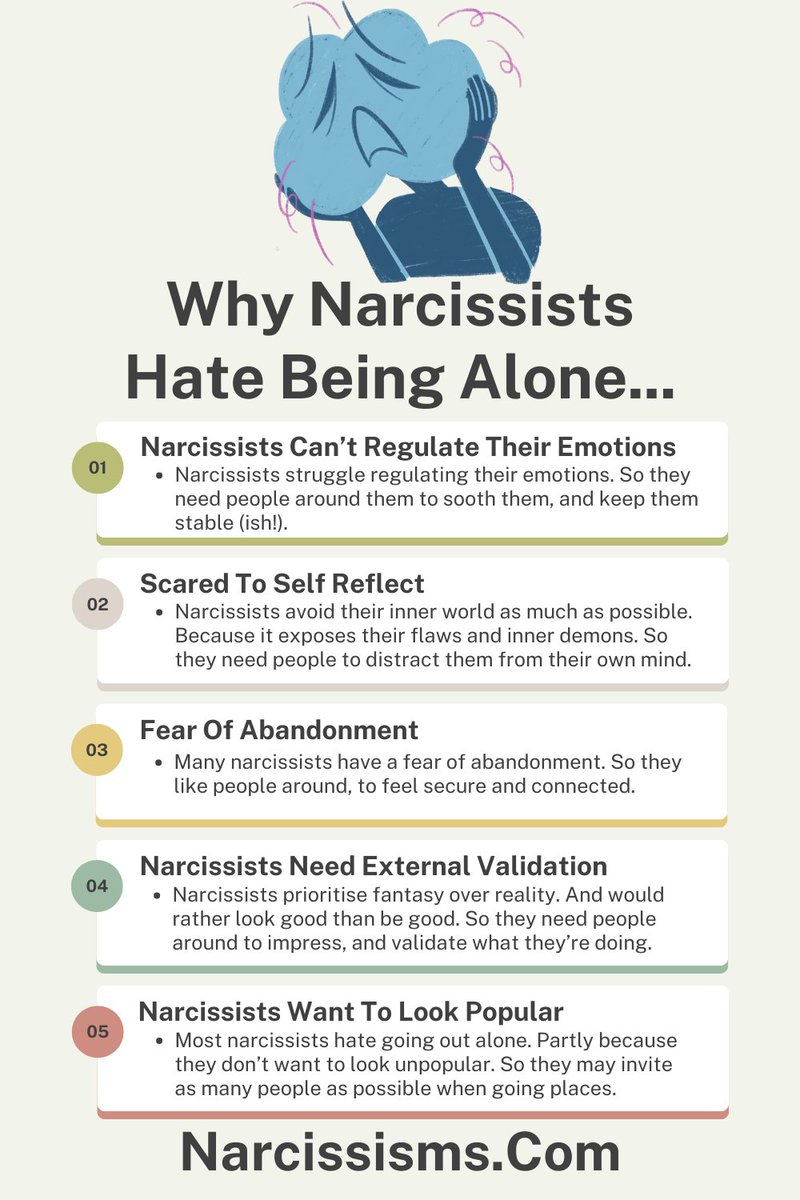
Did your narcissist hate being alone?
#narcissist #narcissistrelationship #externalvalidation #fearofabandonment
3
14
36
996

4 Sep 2024
They’re often driven by external validation. Seeking approval or attention from others can make them more susceptible to temptations that offer quick rewards or recognition. #ExternalValidation #SelfControl
1
223

13 Aug 2024
Beyond approval: How to shift from external validation to internal self-worth
By Junias Erasmus
In a world dominated by social media, constant feedback, and a culture that often measures success by external standards, it’s easy to fall into the trap of seeking validation from others.
Whether it’s the number of likes on a post, praise from a colleague, or approval from a loved one, external validation can feel gratifying in the moment.
However, relying too heavily on external sources for self-worth can be a double-edged sword, leading to a fragile sense of self that crumbles in the absence of constant affirmation.
thebrief.com.na/2024/08/beyo… #namibia #culture #externalvalidation

ALT Junias Erasmus
1
4
552

28 Mar 2024
#MichaelEParker was live on YouTube with a powerful discussion on the danger of chasing #accolades and seeking #externalvalidation. Stop and bring joy back to your #achievements.🔗 Watch: youtube.com/@Youareaceo #PersonalGrowth #GoalSetting #SelfImprovement #Mindset #YouAreACEO

1
4
4
76

16 Mar 2024
Despite #Oscar Snubs #MartinScorsese 💖 Continues To Create Impactful #Cinema Remaining A Central Figure In American Film Conversation 💬
Scorsese Won Oscars Only When Not Expecting It Showcasing His Ability To Keep Going Without ExternalValidation 🤩👏👏 collider.com/martin-scorsese…
5
159