
"Hairline" describes only the xray appearance. It IS a fracture, with the bone physically broken. Acute pain for 10 days until the bone begins to stick together, then easing as the fracture heals.
Please don't give medical opinions from ignorance.
BSc(med Sci) MB ChB FCFP
2
77
473

Jun 13
⎐كُـود⎐كوبِون⎐خـِصم⎐
⎐نون⎐
⊵S3Q⊴
ايهرب⊴ ايهيرب⊴
⊵GCA5893⊴
⎐نمشي⎐
⊵AABN⊴
⎐ريف▬للعطور⎐
⊵AX140⊴
ريــفا⎐
⊴ASMAA⊴
المـطار
⊵M24⊴
___
FcFp

Jun 1
🏆L’@Ifrecor #Polynésie lance la 3ème édition des Trophées TO’A Reef, les candidatures ouvertes
➡️outremers360.com/bassin-paci…
🪸 À l’occasion de la Journée mondiale de sensibilisation aux récifs coralliens, l’Ifrecor Polynésie a annoncé dans un communiqué le lancement de la 3ème édition des Trophées TO’A Reef. L’appel à candidatures, doté de 4,3 millions de Fcfp, est ouvert jusqu’au 5 octobre prochain. Le thème retenu cette année : « Les récifs sont notre survie, unissons-nous pour les préserver ! »
3
4
122
May 8
🛫#Polynésie : État et gouvernement local mobilisent 1,2 milliard de Fcfp pour moderniser l’#aéroport de Rurutu aux Australes
➡️outremers360.com/bassin-paci…
🗞️Le Pays et l’État ont validé, ce mercredi, une enveloppe de 9,1 milliards de Fcfp d’investissements pour 2026 dans le cadre du Contrat de développement et de transformation. Au total, 43 projets ont été retenus : modernisation de l’aéroport de l’île de Rurutu, réfection du quai de l’atoll de Tikehau et plusieurs opérations de protection du littoral
3
2
244
Apr 30
⛽️#Carburants : En #Polynésie, les prix à la pompe stables, mais jusqu’à quand ?
➡️outremers360.com/bassin-paci…
🗞️Alors que le cours du baril atteint des sommets et que les prix de l’essence et du gasoil ont explosé dans le reste du monde, le conseil des ministres de Polynésie française a voté ce mercredi pour le maintien des prix au 1er mai. Le gouvernement prévient toutefois depuis longtemps que les 3,5 milliards de Fcfp d’argent public injectés dans le Fonds de régulation des prix des hydrocarbures ne permettrait pas de tenir au-delà du mois de juin

2
2
174
Apr 25
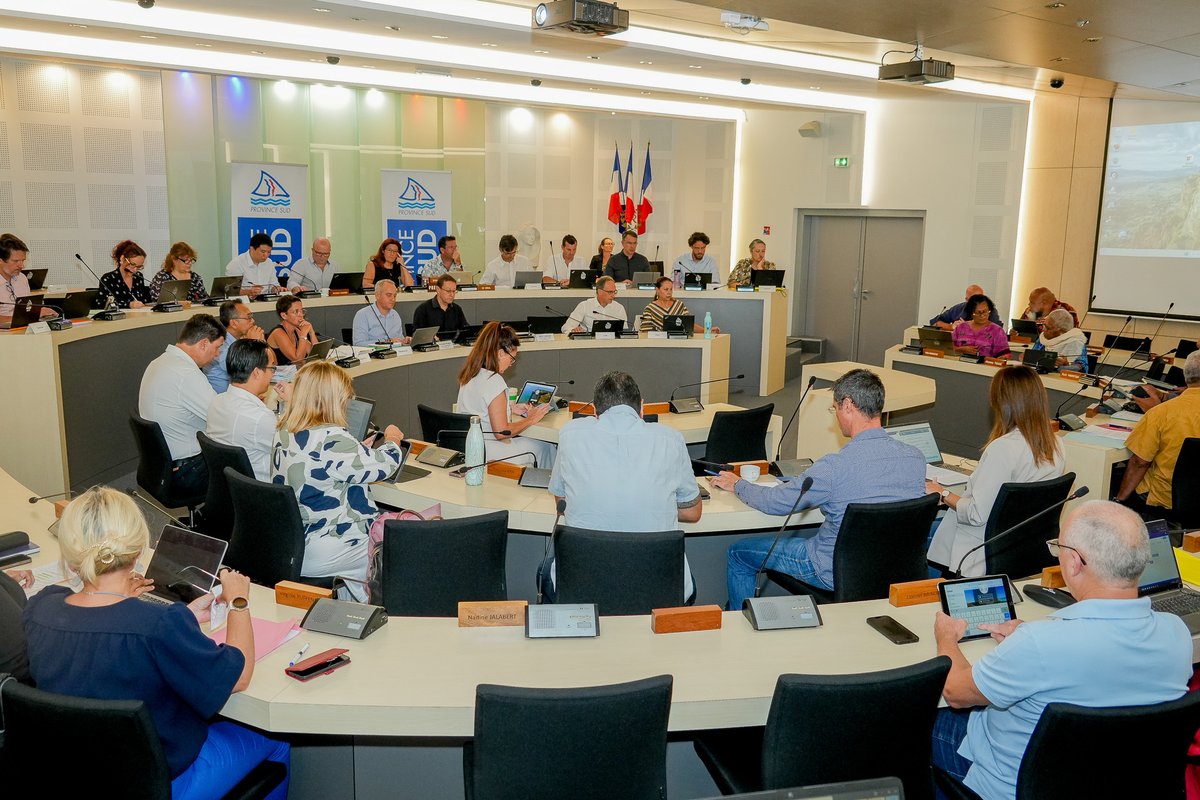
🗞️#NouvelleCalédonie : La province Sud flèche 1,2 milliard de Fcfp sur la santé, le social et le transport
➡️outremers360.com/bassin-paci…
➡️Grâce à une gestion qu’elle vante « rigoureuse » et des crédits supplémentaires de l’État, la province Sud affiche un excédent de 9,6 milliards de francs (plus de 81 millions d’euros) sur ses comptes administratifs 2025, examinés ce vendredi 24 avril en assemblée. Sur cette somme, 8,7 milliards seront réinjectés dans le budget 2026, dont plus du tiers viendra abonder la section investissement de la collectivité
2
4
254

Mar 14
My leader ✅, another Certification added to this;
- Fellow, Association of Chattered Certified System Accountants, 2024
- Fellow, Institute of Chattered Finance Professionals (FCFP, USA), 2024
- Associate, Chartered Institute of Taxation of Nigeria (ACTI),2024
- APMG certified Public Private Partnership Professional – Preparation, 2021
- Fellow, Chartered Institute of National Accountants (FCNA), 2018
- Professional Member, Financial Reporting Council of Nigeria,2018
- Member, Nigerian Institute of Business Strategy, 2015
- SAP FICO Certified – Financial Accounting and Controlling,2002
Let’s go there, Oyo Guber 2027, the man for the Job
#OSE2027
Mar 14

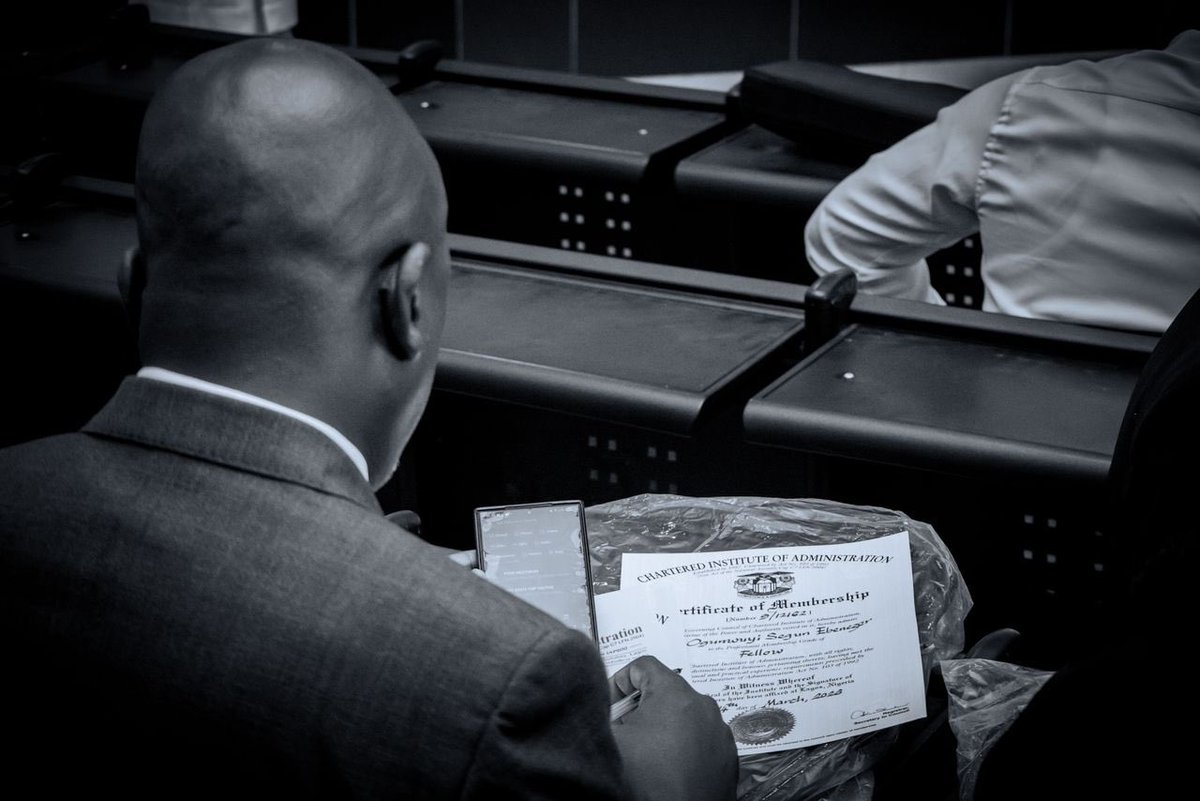
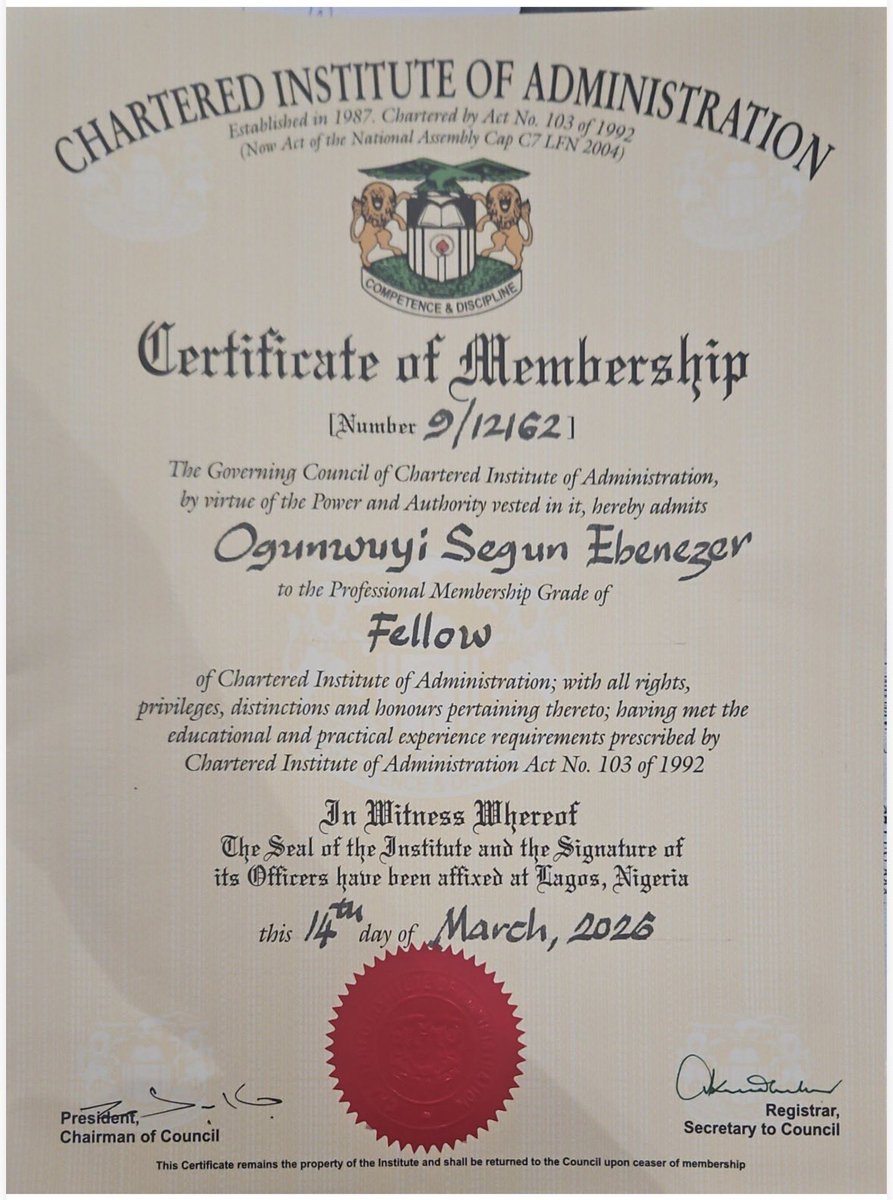
Today, I was inducted as a Fellow of the Chartered Institute of Administration (FCIA) after the completion of my Ph.D in Business Administration (bias in Strategic Management), an honour that reflects years of dedication to private & public administration, governance, and institutional development. I am grateful for this recognition and the responsibility it places on me to continue to uphold the highest standards of leadership and service.
Moments like this are reminders that capacity, preparation, and experience remain critical to building sustainable progress. I remain committed to contributing to governance that works, institutions that endure, and leadership that delivers tangible results for the people.


2
17
25
1,453

MCSが心理的要因だけでは説明できない生物学的基盤を持つ可能性[要約]化学物質過敏症(MCS)をめぐる議論で、ビンクリーによる論文「化学物質過敏症/特発性環境不耐症:診断と管理への実践的アプローチ」に対し、モロットらは最新の科学的知見を踏まえた重要な反論を提示している。この議論の背景には、MCSを主に心理的な問題として理解する立場と、生物学的・環境医学的要因を重視する立場の違いがある。
彼らはまず、同論文がTRPV1やTRPA1といった化学感受性受容体の感作に関する近年の研究成果を十分に反映していないと指摘する。これらの受容体は嗅覚刺激や気道刺激、神経免疫反応に関与し、MCS患者ではTRPV1やTRPA1の感作を示唆する研究が報告されている。また、受容体アゴニストを用いた脳画像研究では、MCS患者と健常者の間で受容体を発現する脳領域の反応に差異が示されており、MCSが心理的要因だけでは説明できない生物学的基盤を持つ可能性が示唆される。
モロットらは、症状や誘因、心理社会的影響の評価を推奨するビンクリー論文の姿勢を評価しつつも、環境曝露歴の聴取が欠落している点を問題視する。患者の多くは、化学物質曝露の少ない生活環境を整えることが症状管理に最も効果的だと報告しており、無香料の清掃製品の使用など、家庭内での曝露を減らす介入が症状の有意な改善につながった研究もある。曝露回避はMCSの管理戦略の中心的要素であり、診療において重視されるべきだと主張する。
精神疾患との関連についても、因果関係と相関を混同すべきではないと強調する。MCS患者では身体症状の発症後に精神症状が続発する例があり、これは化学物質が遍在する社会で生活することによるストレスや孤立、日常生活の困難さといった心理社会的負荷の結果と考えられる。医療従事者の偏見が診断の遅れや医療機関への受診を妨げる危険性も指摘される。
治療に関しては、心理療法が対処スキルの向上には役立つものの、疾患そのものを改善するエビデンスは乏しく、向精神薬は忍容性の問題が大きいとされる。マインドフルネス認知療法も情動調整には有用だが、病状全体の改善にはつながらない。こうした点から、MCSが疑われるという理由だけで精神科へ紹介することは不適切であり、刺激物質誘発性喘息や片頭痛、肥満細胞活性化症候群(MCAS)などと共通する生物学的機序を踏まえ、コンセンサス基準と検証済みツールに基づく包括的かつ多分野にわたる支援が必要だと結論づけている。
カナダではMCS患者が人権法で保護されているにもかかわらず、医療従事者の理解不足により支援が不十分な場合がある。モロットらは、医療従事者が偏見を助長するのではなく、診断、教育、支援を提供する立場に立つべきだと訴える。最新の科学的エビデンスに基づいたケアこそが、患者の生活と健康の改善に不可欠だとしている。
Challenging dated conceptions to advocate for evidence-informed care in multiple chemical sensitivity
John Molot, MD, FCFP・Farah Tabassum, MD, FCFP・Domenica Tambasco, MD, FCFP, MSc・Moira Sarah Selke, MB, MCh, BAO, CCFP・Kathleen Kerr, MD, Dip Env Health・Riina Bray, BASc, MSc, MD, FCFP, MHSc・Jennifer Swales, MBBS, CCFP・L. Christine Oliver, MD, MPH, MSc・Jonathan Fox, MD, CCFP, FCFP
(The Journal of Allergy and Clinical Immunology: In Practice 11/14/23)
jaci-inpractice.org/article/…
7
17
683
Mar 3
🗞️ #Polynésie : La future « Cité administrative » de Taravao, sur l’île de Tahiti, se dessine
➡️outremers360.com/bassin-paci…
🏘️Le cabinet nantais AIA Life Designers et l’agence polynésienne Corail Architecture ont été choisis pour concevoir la future Cité administrative de Taravao, à l’issue d’un concours lancé en août dernier par Grands projets de Polynésie (G2P). Ce projet, estimé à près de 6 milliards de Fcfp, et prévu pour une livraison en 2032, doit accueillir 500 agents de l’administration du pays dans un pôle « Aménagement » décentralisé, sur une surface de près de 30 000 mètres carrés, parkings compris. Sous « toitures traditionnelles polynésiennes » revisitées, des bureaux et guichets bien sûr, mais aussi un auditorium, une cafétéria, des espaces de coworking, un gymnase, 480 places de parkings et 110 stationnements deux-roues

2
3
198

Feb 26
🧵 2/2:
The reasons for these dangerous wait times, we under-built:
• Home First models of care
• Rehabilitation & restorative care
• Home hospice care
• Assisted living & long-term care
• Acute care capacity (Europe ~4.2 beds/1,000; Canada ~2.5; Alberta ~1.8)
• Team-based primary care & prevention
• Post-secondary health workforce training
Investments in these areas will relieve bottlenecks and restore safe patient flow, as it once was in the early 1990s.
Timely access to quality healthcare and education are not just social goods, they are foundational economic enablers.
They improve productivity, reduce long-term system costs, strengthen workforce participation, and help bend the cost curve.
A healthy, well-trained population positions Canada to compete globally as we diversify our economy and expand into new markets.
Healthcare delivery is provincial, but national funding and accountability are federal:
1. Increase federal health transfers and tie them to measurable access targets, as the U.K. did.
2. Expand training and responsibly credential internationally trained professionals.
3. Support a coordinated national plan to educate and train our homegrown healthcare workforce.
Canada can once again have a truly world-class system, not only once you’re in, but when you need it.
Will we make access the national priority?
Front-line physicians would welcome your leadership.
Dr. Raj Sherman
Emergency Physician (35 years)
M.D., CCFP(EM), FCFP
Assistant Clinical Professor
Former Alberta MLA & Opposition Leader
@picardonhealth @TheSGEM @raghu_venugopal @CBCNews @globeandmail #HealthCareAccess
1
4
20
365

International Community, PLEASE Stand with the people of Iran
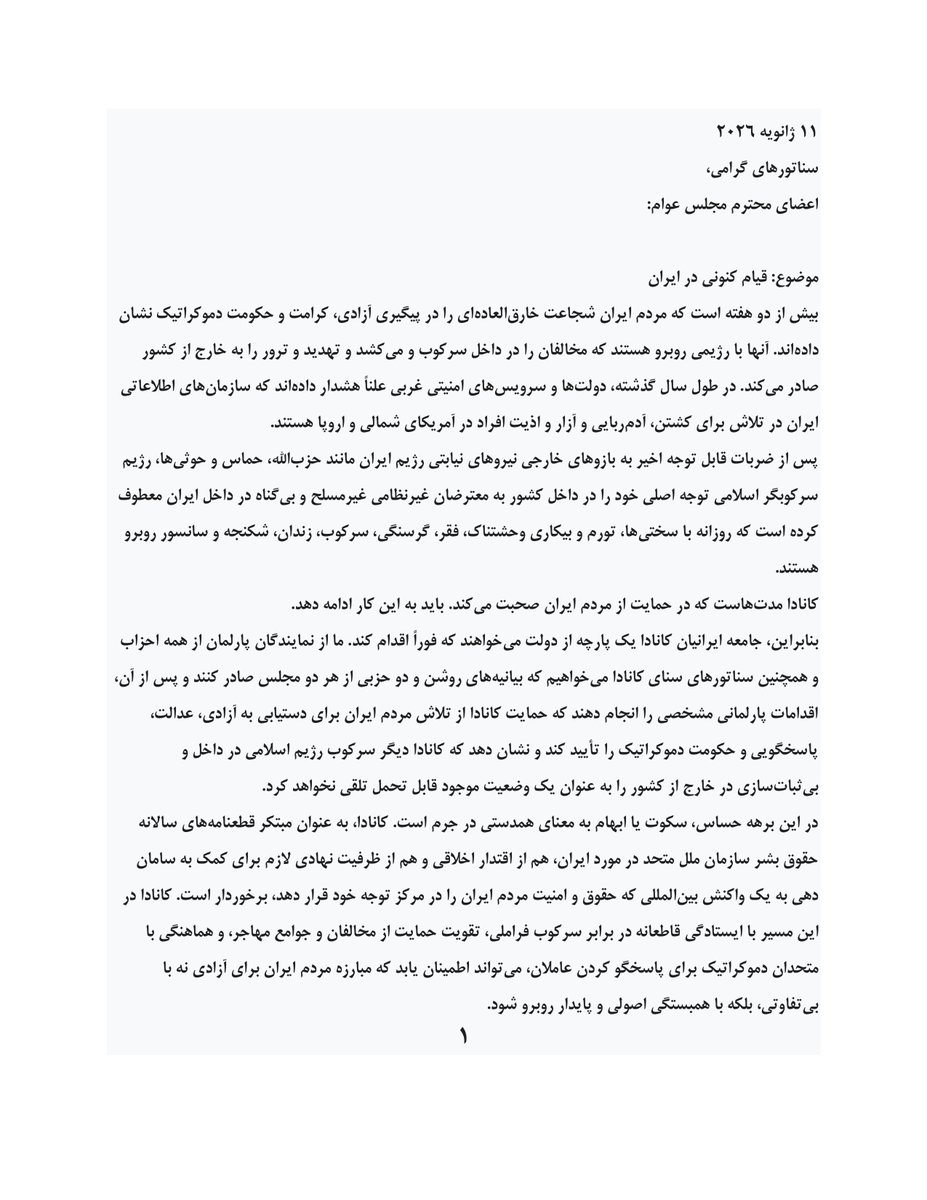
نامه به ۳۴۳ نماینده مجلس نمایندگان و ۱۰۰ سناتور کانادا در مورد شرایط ایران و درخواست کمک فوری از آنها.
اصل نامه برای اطلاع عمومی و انجام حرکت های مشابه در کشورهای دیگر دنیا توسط هموطنان ایرانی خارج کشور.
.............................................................................................
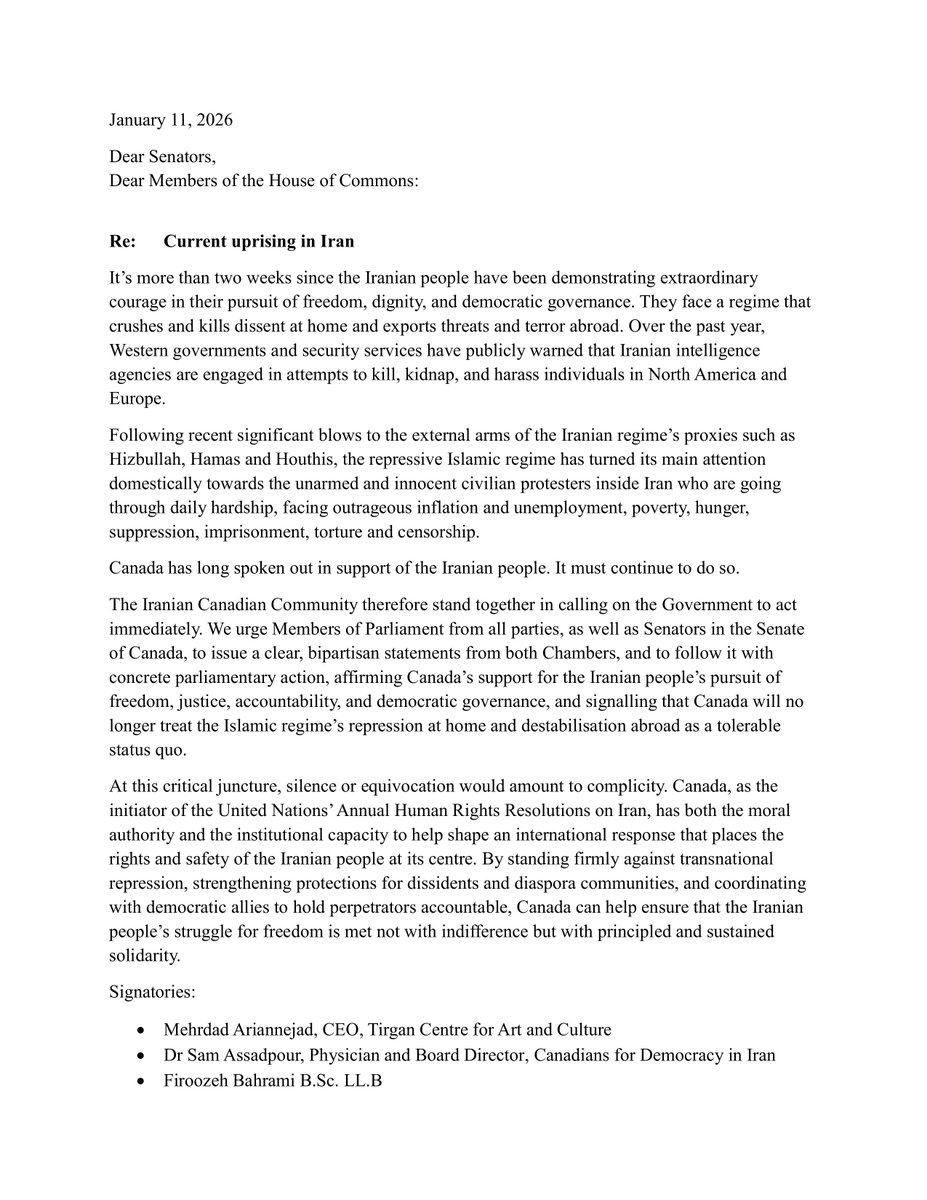
January 11, 2026
Dear Senators,
Dear Members of the House of Commons:
Re: Current uprising in Iran
It’s more than two weeks since the Iranian people have been demonstrating extraordinary courage in their pursuit of freedom, dignity, and democratic governance. They face a regime that crushes and kills dissent at home and exports threats and terror abroad. Over the past year, Western governments and security services have publicly warned that Iranian intelligence agencies are engaged in attempts to kill, kidnap, and harass individuals in North America and Europe.
Following recent significant blows to the external arms of the Iranian regime’s proxies such as Hizbullah, Hamas and Houthis, the repressive Islamic regime has turned its main attention domestically towards the unarmed and innocent civilian protesters inside Iran who are going through daily hardship, facing outrageous inflation and unemployment, poverty, hunger, suppression, imprisonment, torture and censorship.
Canada has long spoken out in support of the Iranian people. It must continue to do so.
The Iranian Canadian Community therefore stand together in calling on the Government to act immediately. We urge Members of Parliament from all parties, as well as Senators in the Senate of Canada, to issue a clear, bipartisan statements from both Chambers, and to follow it with concrete parliamentary action, affirming Canada’s support for the Iranian people’s pursuit of freedom, justice, accountability, and democratic governance, and signalling that Canada will no longer treat the Islamic regime’s repression at home and destabilisation abroad as a tolerable status quo.
At this critical juncture, silence or equivocation would amount to complicity. Canada, as the initiator of the United Nations’ Annual Human Rights Resolutions on Iran, has both the moral authority and the institutional capacity to help shape an international response that places the rights and safety of the Iranian people at its centre. By standing firmly against transnational repression, strengthening protections for dissidents and diaspora communities, and coordinating with democratic allies to hold perpetrators accountable, Canada can help ensure that the Iranian people’s struggle for freedom is met not with indifference but with principled and sustained solidarity.
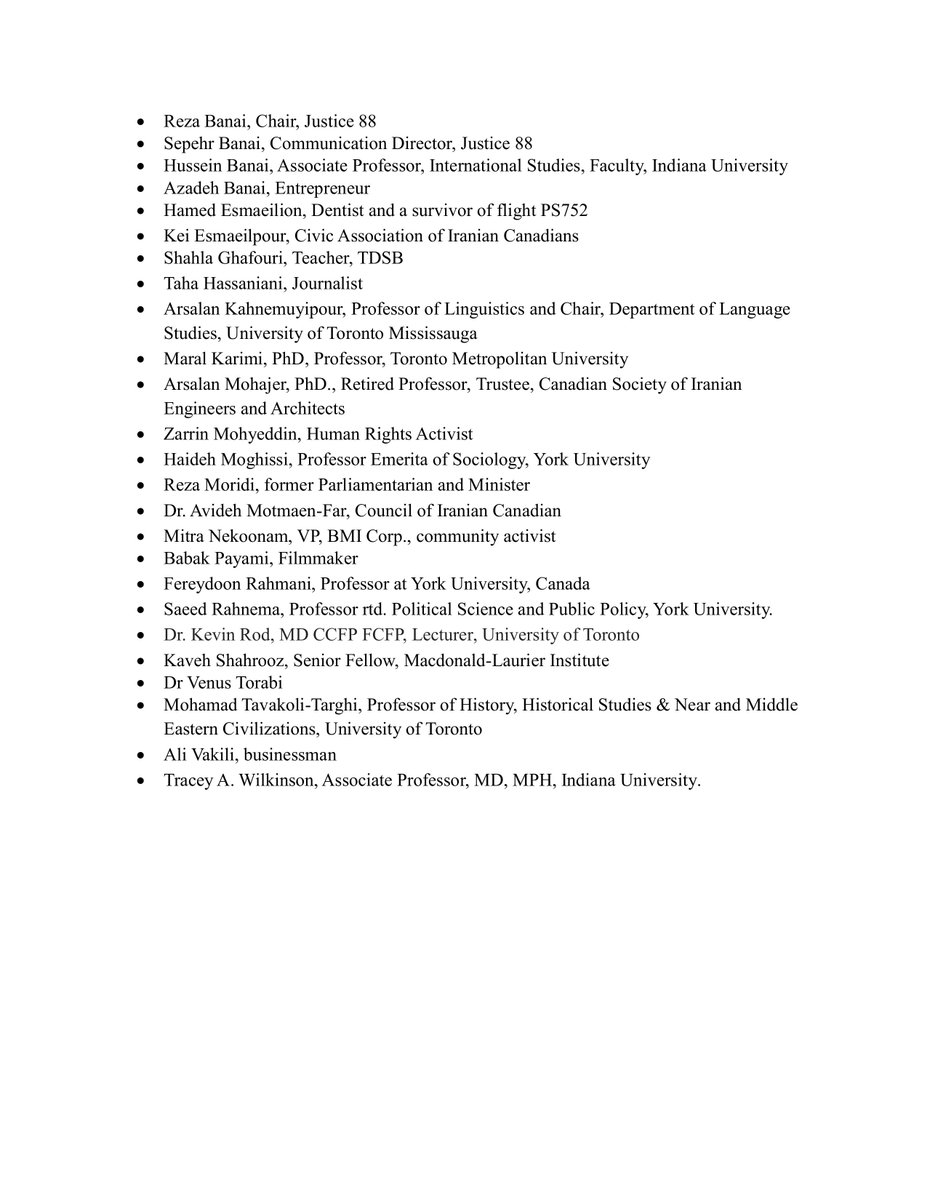
Signatories:
· Mehrdad Ariannejad, CEO, Tirgan Centre for Art and Culture
· Dr Sam Assadpour, Physician and Board Director, Canadians for Democracy in Iran
· Firoozeh Bahrami B.Sc. LL.B
· Reza Banai, Chair, Justice 88
· Sepehr Banai, Communication Director, Justice 88
· Hussein Banai, Associate Professor, International Studies, Faculty, Indiana University
· Azadeh Banai, Entrepreneur
· Hamed Esmaeilion, Dentist and a survivor of flight PS752
· Kei Esmaeilpour, Civic Association of Iranian Canadians
· Shahla Ghafouri, Teacher, TDSB
· Taha Hassaniani, Journalist
· Arsalan Kahnemuyipour, Professor of Linguistics and Chair, Department of Language Studies, University of Toronto Mississauga
· Maral Karimi, PhD, Professor, Toronto Metropolitan University
· Arsalan Mohajer, PhD., Retired Professor, Trustee, Canadian Society of Iranian Engineers and Architects
· Zarrin Mohyeddin, Human Rights Activist
· Haideh Moghissi, Professor Emerita of Sociology, York University
· Reza Moridi, former Parliamentarian and Minister
· Dr. Avideh Motmaen-Far, Council of Iranian Canadian
· Mitra Nekoonam, VP, BMI Corp., community activist
· Babak Payami, Filmmaker
· Fereydoon Rahmani, Professor at York University, Canada
· Saeed Rahnema, Professor rtd. Political Science and Public Policy, York University.
· Dr. Kevin Rod, MD CCFP FCFP, Lecturer, University of Toronto
· Kaveh Shahrooz, Senior Fellow, Macdonald-Laurier Institute
· Dr Venus Torabi
· Mohamad Tavakoli-Targhi, Professor of History, Historical Studies & Near and Middle Eastern Civilizations, University of Toronto
· Ali Vakili, businessman
· Tracey A. Wilkinson, Associate Professor, MD, MPH, Indiana University.
2
174
30 Dec 2025
Fix the Foundation Before We Add More Floors:
Colleagues and friends, grab a coffee. This is a longer read.
Let’s turn down the temperature and revisit how we got here, because history matters if we want a better future.
Anmol, I agree with you on one key point: we need full-service, team-based family medicine, properly resourced and compensated for evenings and weekends.
I also miss the era, especially in major urban centres, when family physicians admitted their own patients, delivered babies, worked in the ER, long-term care, and clinics, and did far more care in-office (suturing, casting, same-day labs and X-ray). This still happens in many smaller communities across Alberta and Canada.
Family doctors sent patients to the ER only when truly necessary, and they called us first. That continuity worked and trained generations of family physicians.
In the early 1990s, family physicians did most bread-and-butter hospital medicine. Specialists focused on complex cases. The system was balanced.
I started in the ER at the Royal Alex in 1992 as a family physician. Emergency Medicine wasn’t a specialty in Edmonton until 1993. I worked a lot, about 300 shifts a year for six years, often single-coverage nights at one of Canada’s busiest trauma hospitals. At 3:30 a.m., one-third of the emergency department would close.
How did that function? Because the system worked.
We had an integrated primary care system, adequate acute-care capacity, long-term care, rehab, and auxiliary hospitals, and clear accountability to move admitted patients out of the ER quickly. There was no ALC bed block. Every family clinic functioned as a de facto urgent care centre. Ambulances were back on the street within 30 minutes 90% of the time, completing 10–14 trips a night. We didn’t have, or need, special after-hours urgent care clinics, more ER beds, or more ambulances.
Then came the Barer–Stoddart report and the Klein cutbacks in the mid-1990s.
In Alberta, the result was stark:
~1,500 acute-care beds lost in the Edmonton region
-A 1,000-bed hospital demolished in Calgary; Holy Cross and Grace sold
-Family physicians, nurses, and staff driven out of hospitals or out of Alberta
-Medical schools and nursing schools were cut
Labs and imaging centralized
-Emergency departments became de facto inpatient wards, waiting rooms ballooned, ER footprints expanded, and this remains the case today
Short-term costs fell. That’s when the system broke, became fragmented, and long-term costs began to rise, along with access problems.
The facts in Alberta:
-Early 1990s: ~11,700 acute beds for 2.7M people (4.3/1,000)
-By 1994/95: ~7,600 beds (2.4/1,000)
-Today: ~8,800 beds for 5M people (~1.76/1,000), with ~1,400 ALC patients in those beds and an older, sicker population
-Many European systems average ~4.2 beds/1,000, anchored in strong primary, preventive, and community care
Add to that:
~1 million Albertans without a family doctor
-A workforce hollowed out by burnout, moral distress, and cuts that hit generalists hardest
-Income gaps driving medical trainees away from family medicine
-Specialists billing for generalist care because patients have nowhere else to go
Today, admitted patients routinely remain in ERs 27–80 hours at the 90th percentile. With every hour, they decondition, their length of stay grows longer, and some never return home, losing independence and driving up costs for taxpayers.
ERs are the 24/7 safety valve for the community, hospitals, and the profession, and they are no longer able to perform that role safely.
Minor illnesses: flu, migraines, palpitations, gastroenteritis, minor injuries and fractures, and even “the drunk”, are not the cause of the ER crisis, even if they dominate waiting rooms.
It’s understandable why the public, policymakers, politicians, and even physicians such as yourself often see them as the problem when the real pressures in the system aren’t visible to most.
These patients sit in RAZ chairs and are usually in and out once they are seen by the ER physician. At the Alberta Medical Association section level, ER physicians have consistently directed resources and fees toward complex care and resuscitation, not minor cases.
Edmonton already has two 24/7 standalone emergency departments with full labs and CT/US. Let’s call them “super UCCs” (my apologies to my ER colleagues who staff them). They are also full of sick and admitted patients who cannot be transferred, and their waiting rooms are full. The label doesn’t change the physics.
Building bigger ERs or more urgent care centres won’t hurt, but finite tax dollars and scarce staff are better deployed elsewhere.
What we need is system flow redesign. Bring in flow process engineers. Apply Lean or Six Sigma. Identify bottlenecks and fix flow.
I learned this in the early 1980s, working every job in a lumber mill in Squamish, B.C., from log inflow, the sorter, conveyor belts, to the green chain and chipper.
When you understand flow, you fix problems downstream (ALC), midstream (hospitals), and upstream (primary care). Frankly, that mill manager could run a health system, so long as politics didn’t interfere.
The bigger truth:
-No one owns end-to-end patient flow
-Flow failure is the most expensive way to run health care
-ERs used as warehouses drive burnout, staff loss, and compound costly medical errors and increases costs
-EMS offload delays quietly degrade public safety
-Data exists, but accountability does not
-“Innovation” without integration fragments care
-Leadership and investments in the right areas are sorely lacking
This is why the U.S. system, as you reference, is the costliest for families and businesses, leaving many without access to care, while European systems perform better at lower cost.
Repair the foundation and fix the leaky roof before renovating the main floor.
(For those interested:
edmontonjournal.com/opinion/…)
Finally, as a former leader of Alberta’s ER physicians, If you want to fix the acute-care and ER crisis, support what allows ERs to function:
- Full-scope family medicine, including after-hours care
- Geriatrics, pediatrics, rehab, home care, long-term care and respite care for home caregivers
- Removal of ALC patients from acute beds within 24 hours, 90% of the time
- Clear accountability for patient flow: discharge medically well patients within 2 hours, 90% of the time
- Timely specialist uptake after ER stabilization: admit patients to wards within 2 hours of consultation, 90% of the time
- EMS offload fixes so paramedics can get back on the street and answer 911 calls
ERs don’t fail because ER teams fail. They fail when the rest of the system can’t receive the patients we stabilize.
If you want to understand the problem, spend a Monday or Tuesday evening in a city ER. The issue becomes obvious very quickly.
A sincere thank-you to all frontline staff who work 24/7 to keep our communities safe.
And a belated Merry Christmas and Happy New Year to everyone.
Raj Sherman, MD, CCFP(EM), FCFP
Assistant Clinical Professor
Former Associate Minister of Health
Former Chair, HQCA
@pfparks @Bjwrz @CAEP_Docs @ABDanielleSmith @nenshi @AlikaMD @Albertadoctors @UnitedNurses @JMeddings @NightShiftMD @AdrianaLaGrange @MattJonesYYC
13
111
220
26,258

24 Dec 2025
法属太平洋领地法郎(FCFP)本身使用方就是半主权的法兰西共和国海外集合体(COM)法属波利尼西亚🇵🇫和瓦利斯和富图纳🇼🇫特殊地位海外集合体(COMSG)新喀里多尼亚🇫🇷🇳🇨。虽然汇率和非洲金融共同体法郎(FCFA)一样与欧元💶(EUR)挂钩但是问题不大毕竟本来这些地区主权就不完整。
1
47

17 Dec 2025
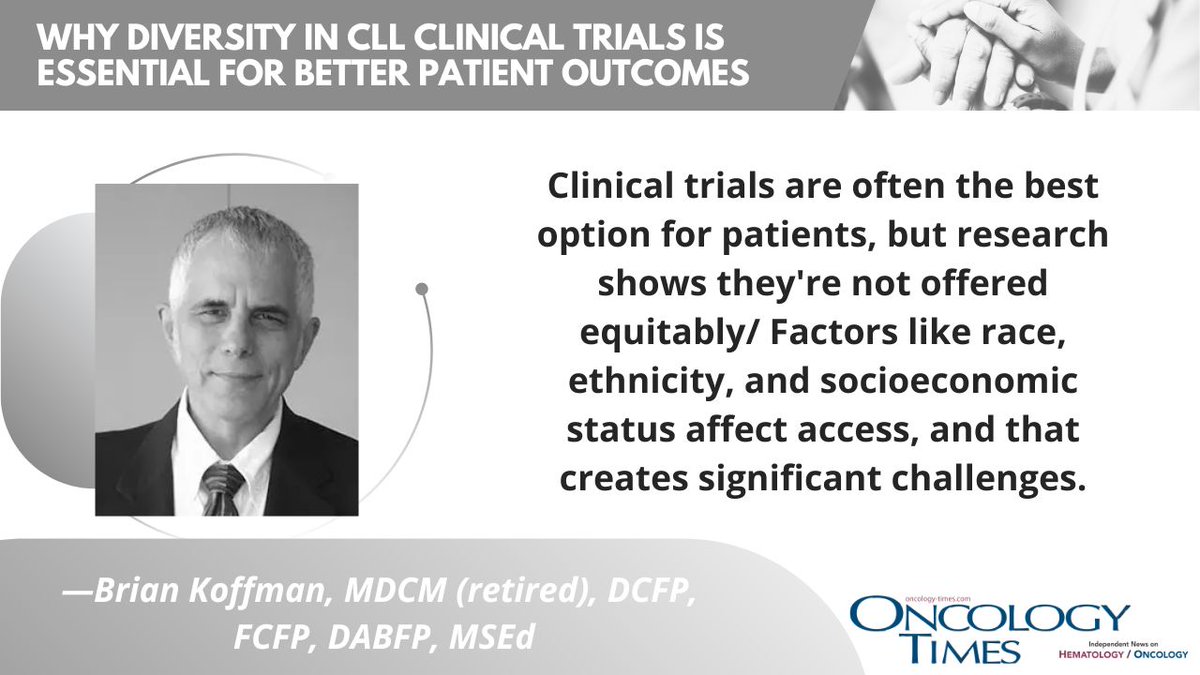
“Clinical trials are often the best option for patients, but research shows they're not offered equitably,” noted Brian Koffman, MDCM, DCFP, FCFP, DABFP, MSEd. ow.ly/OeY050XJIPi
1
2
332

10 Nov 2025
☝️POZOR:
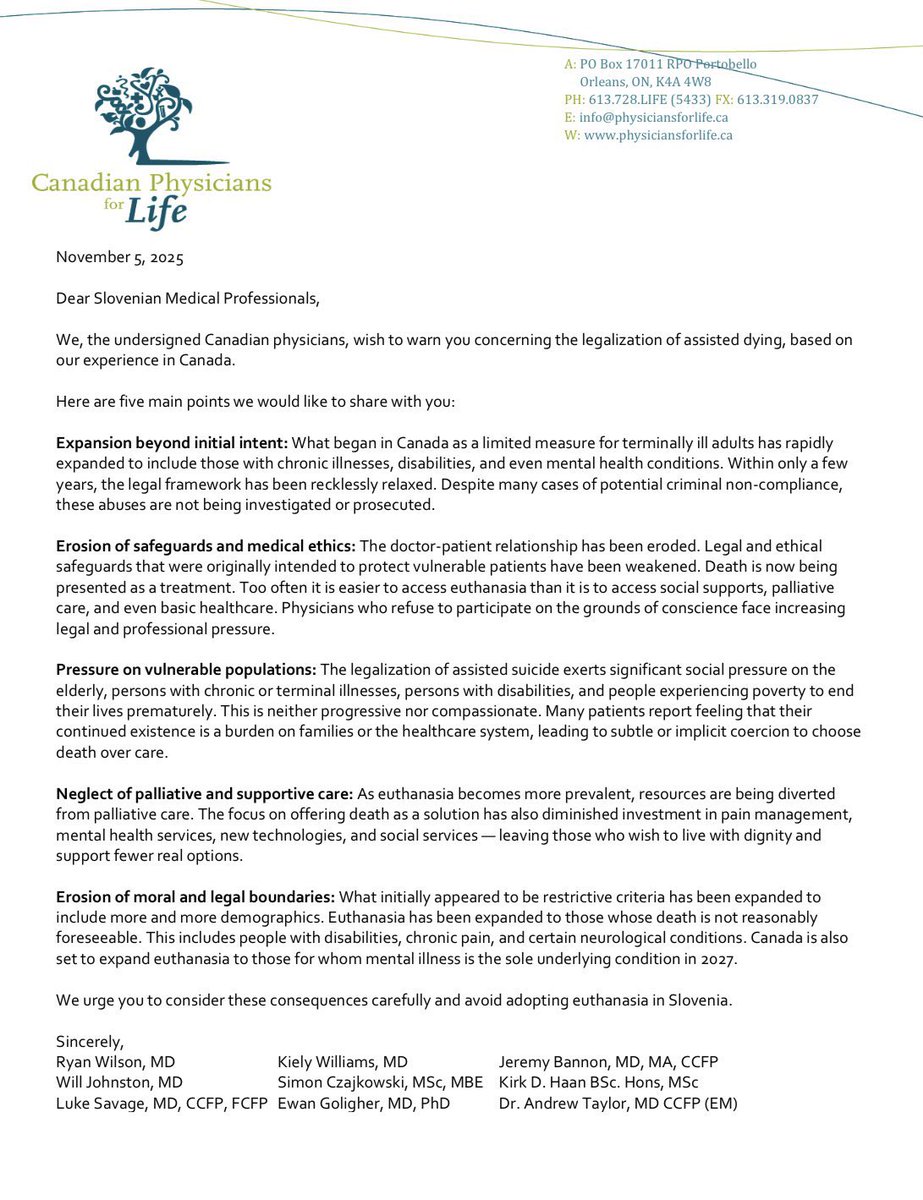
"Kanadski zdravniki za življenje" v pismu slovenskim zdravnikom opozarjajo na pasti asistiranega samomora❗️👇
PO Box 17011 RPO Portobello,
Orleans, ON, K4A 4W8
T: 613.728.LIFE (5433) F: 613.319.0837
E: info@physiciansforlife.ca
W: physiciansforlife.ca
5. november 2025
Spoštovani slovenski zdravstveni strokovnjaki,
mi, podpisani kanadski zdravniki, vas želimo opozoriti na legalizacijo pomoči pri umiranju na podlagi naših izkušenj v Kanadi.
Tukaj je pet glavnih točk, ki jih želimo deliti z vami:
Razširitev izven prvotnega namena:
Kar se je v Kanadi začelo kot omejen ukrep za terminalno bolne odrasle, se je hitro razširilo na osebe s kroničnimi boleznimi, invalidnostmi in celo duševnimi boleznimi. V le nekaj letih so se pravni okviri neodgovorno sprostili. Kljub številnim primerom možnih kaznivih neupoštevanj teh zlor ni mogoče preiskati ali preganjati.
Erozija varovalk in medicinske etike:
Odnos med zdravnikom in pacientom je bil oslabljen. Pravne in etične zaščite, ki so bile prvotno namenjene zaščiti ranljivih pacientov, so bile oslabljene. Smrt je zdaj predstavljena kot zdravljenje. Zdravnikom, ki zavračajo sodelovanje iz vestnih razlogov, postaja vse težje dostopati do socialnih podpor, paliativne oskrbe in celo osnovnega zdravstvenega varstva, saj se nanje vrši pravni in poklicni pritisk.
Pritisk na ranljive skupine:
Legalizacija samomora s pomočjo izvaja pomemben družbeni pritisk na starejše, osebe s kroničnimi ali terminalnimi boleznimi, osebe z invalidnostmi in osebe, ki doživljajo revščino, da predčasno končajo svoje življenje. To ni niti napredno niti sočutno. Številni pacienti poročajo, da se počutijo kot breme za družino ali zdravstveni sistem, kar vodi v subtilen ali implicitni pritisk, da izberejo smrt namesto oskrbe.
Zanemarjanje paliativne in podporne oskrbe:
Ko evtanazija postane bolj razširjena, se sredstva preusmerjajo iz paliativne oskrbe. Osredotočenost na ponujanje smrti kot rešitve je zmanjšala naložbe v obvladovanje bolečine, duševne zdravstvene storitve, nove tehnologije in socialne storitve – s čimer so tisti, ki želijo živeti z dostojanstvom in podporo, ostali z manj resničnimi možnostmi.
Erozija moralnih in pravnih meja:
Kar se je zdelo kot omejeni kriteriji, se je razširilo na vedno več demografskih skupin. Evtanazija se je razširila na tiste, katerih smrt ni razumno predvidljiva. To vključuje osebe z invalidnostmi, kroničnimi bolečinami in nevrološkimi stanji. Kanada se pripravlja tudi na razširitev evtanazije na osebe, pri katerih je edino osnovno stanje duševna bolezen, in sicer leta 2027.
Pozivamo vas, da te posledice skrbno pretehtate in se izognete uvedbi evtanazije v Sloveniji.
S spoštovanjem,
Ryan Wilson, MD; Will Johnston, MD;
Luke Savage, MD, CCFP, FCFP; Kiely Williams, MD;
Simon Czajkowski, MSc, MBE; Ewan Goligher, MD, PhD;
Jeremy Bannon, MD, MA, CCFP;
Kirk D. Haan BSc, Hons, MSc;
Dr. Andrew Taylor, MD CCFP (EM)
7
18
328
6 Nov 2025
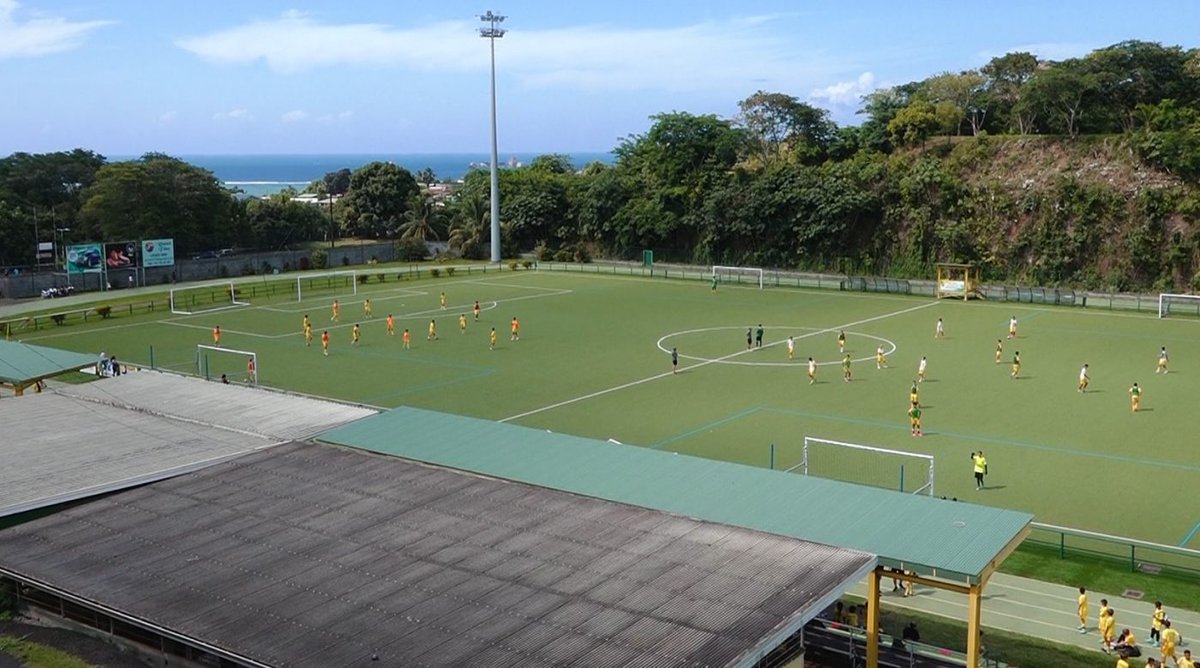
📰En #Polynésie, le gouvernement mobilise 1,5 milliard pour préparer les jeux du Pacifique 2027
➡️tinyurl.com/yfawndm4
➡️À un peu plus d'un an des Jeux du Pacifique, le gouvernement polynésien muscle ses infrastructures sportives. L’exécutif a validé, lors du Conseil des ministres du 5 novembre, l'octroi de 1,542 milliard de Fcfp de subventions à l'Institut de la Jeunesse et des Sports de la Polynésie française (IJSPF) pour accompagner les préparatifs
3
3
233

16 Oct 2025
QF Network - Weekly Engineering Update
This week, the team continued refining the core layers of the QF stack, from runtime upgrades to improved infra automation.
Blockchain updates
- Adjusted pallet-assets transactions execution time estimation for compatibility with 100ms block time and to fix deposits release functionality
- Multisig support added
- Proxy accounts support implementation started to allow users delegate specific blockchain actions, e.g. staking, from one account (e.g., cold wallet) to another account (e.g., hot wallet)
SPIN Secure Finality
- FCFP relayer was created to take FCFP from the fastchain and pass it to parachain for verification by the anchor chain
Infrastructure & Tooling
- Testnet RPC infrastructure improvement started to prepare for serving for dApp developer
- Several cloud providers were compared by features, and cost estimates were made for a selected few
- New Platform Engineer onboarded - welcome Leonardo!
Bit by bit, block by block, QF keeps evolving the foundation for next-gen onchain systems.
We are excited to share something new.. More to come, stay tuned.
QF
Start Where Freedom Is Engineered

16
55
151
19,897

7 Sep 2025
La 4ème édition de la « balade solidaire » organisée par @Groupama #Pacifique en #NouvelleCaledonie aura réuni les dons de 365 participants pour 593500 FCFP qui seront reversés intégralement au profit de la prévention du #diabete
#solidarité #responsabilité @LaVieGroupama




1
102

21 Aug 2025
Ad Agency: ‘You need a celebrity in your next TV advert’
Felix Cat food Publicity: ‘Someone connected with cats?’
AA: ‘Robbie Williams’
FCFP: ‘Sorry?’
AA: ‘Robbie Williams who then turns into a cartoon character like the cat’.
FCFP: ‘Brilliant!’
Joe Public: ‘WTF?’
2
3
23
490

11 Aug 2025
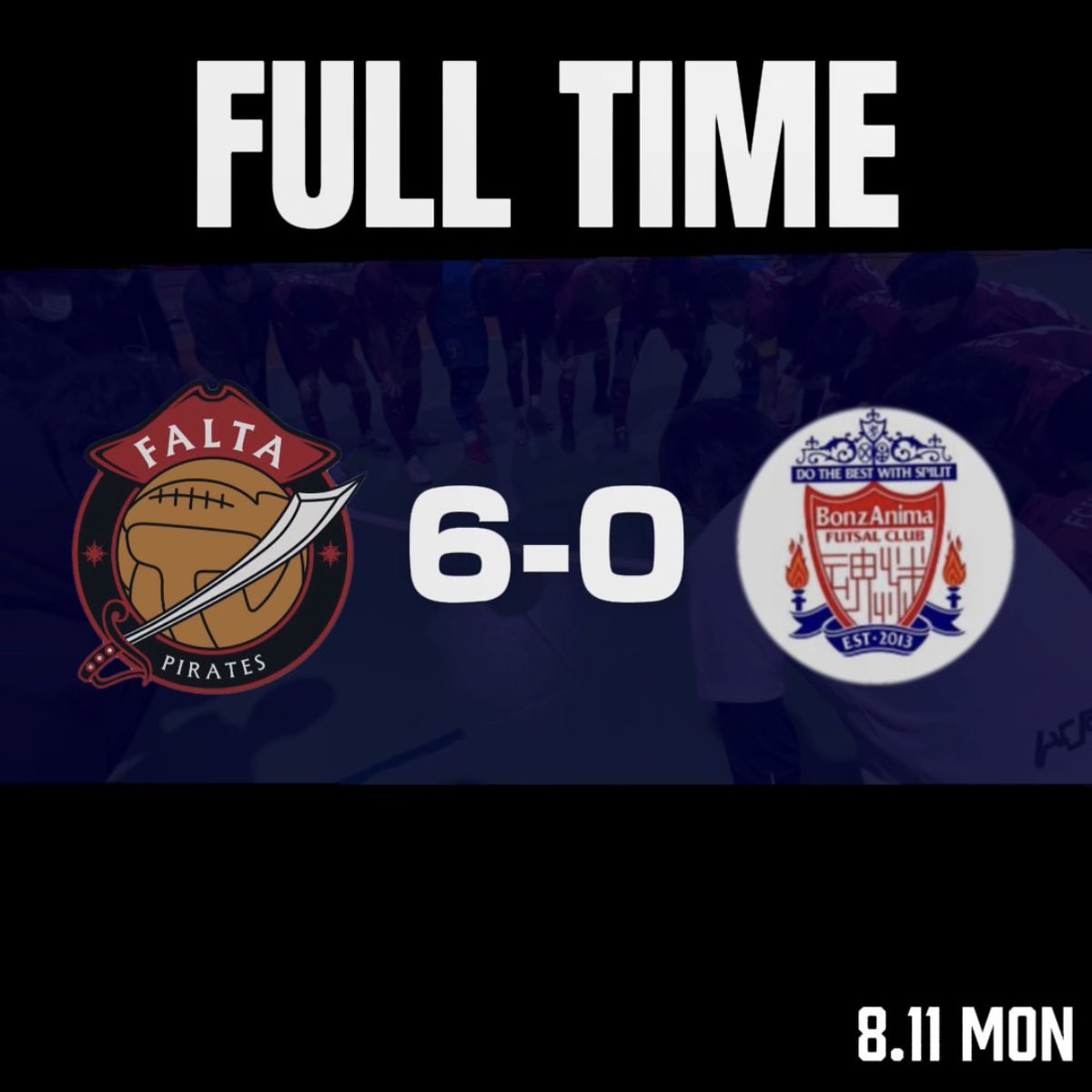
⚽️FULL TIME ⚽️
🏆東京都フットサル4部リーグ 第6節
*
FC FALTA PIRATES 6-0 Bonz Anima
*
⚽️得点者(アシスト)
石田(井浦)
佐野(青山)
佐野(冷水)
井浦(諏訪)
佐野
青山(佐野)
#FCFALTAPIRATES #fcfp #futsal
9
1,584