
52m
A really long article.
If there's one thing about ME/CFS, fibro & co. it's that there is no known promise of rescue/relief.
In my experience there are two kinds of therapists, those who come with a (path to a) solution, and those who are part of the problem.
So, what is your way?
1
17


Abdurrahman retweeted

19 Sep 2022
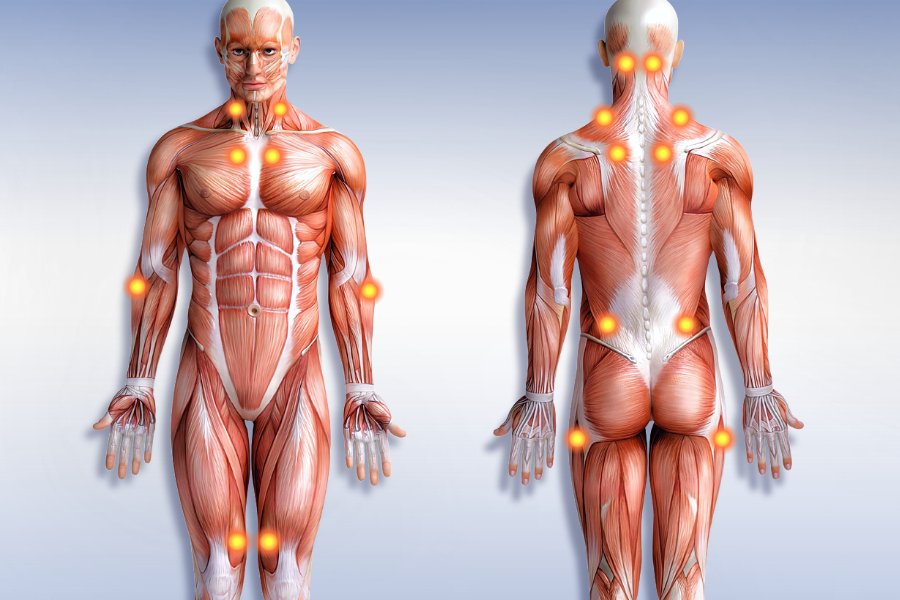
🔴FİBROMİYALJİ (mükemmelliyetçilerin büyük sorunu)
✔️Fibro = bağ doku
✔️miyo = kas doku
✔️Alji = Ağrı (algia)
《Bağ ve kas dokunun yaygın ağrısı》
➖️Ve bunlara ek yan hastalıklar...
📌Fibromiyalji= Dışlama tanısıdir. Ağrılar var,kas,kemik,bagirsak,boyun bacak...AMA
78
414
1,947

Grant Dodwell before A Country Practice. I was munching avo toast in a rented fibro shack on the outskirts of Melbourne, didn’t realise I was one of the elite 😅
1
16

What is the reference?
Clinically LC ME CFS Fibro diagnosis seems random, depending on signs symptoms & physician bias while medical history is ignored
Objective tests are sorely needed
As is specific treatment
I despair of doctors!! While research misses the point
7

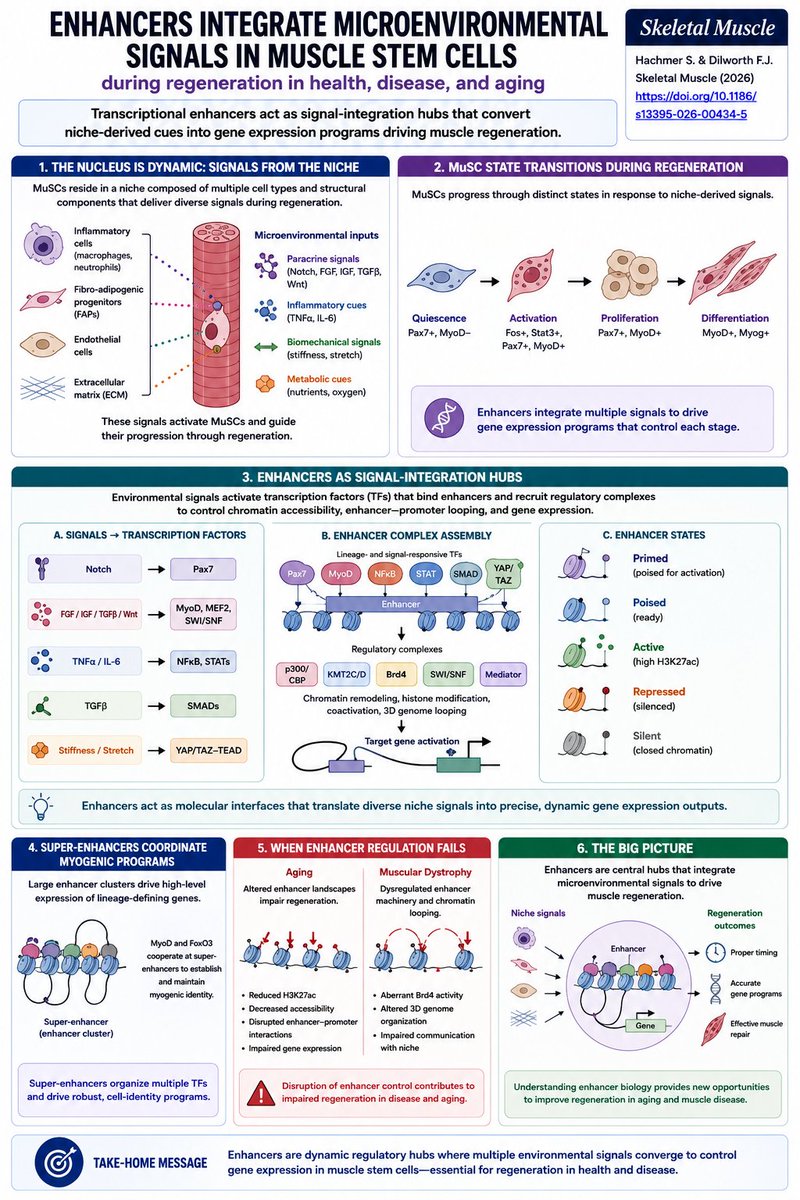
Muscle stem cells do not regenerate tissue in isolation.
They constantly interpret signals from their surrounding niche—and enhancers may be the molecular circuitry that translates those environmental cues into regenerative gene programs.
A new review in Skeletal Muscle proposes a unifying framework:
Enhancers act as signal-integration hubs for muscle stem cells (MuSCs).
The core idea
During regeneration, MuSCs encounter a changing environment rich in:
• inflammatory cytokines
• extracellular matrix signals
• fibro-adipogenic progenitor (FAP) cues
• endothelial-derived factors
• biomechanical forces
• metabolic signals
These inputs must be translated into cell-state transitions:
Quiescence → Activation → Proliferation → Differentiation.
The review argues that transcriptional enhancers are the key interface where this information converges.
Signal integration at enhancers
Different niche signals activate distinct transcriptional regulators:
🔹 Notch → Pax7
🔹 FGF/p38 MAPK → MyoD, MEF2, SWI/SNF
🔹 TNFα / IL-6 → NFκB, STAT pathways
🔹 TGFβ → SMAD factors
🔹 Mechanical stiffness → YAP/TAZ–TEAD signaling
These factors converge at enhancer regions, where they cooperate with chromatin remodelers and coactivators such as:
• p300/CBP
• KMT2C/D
• Brd4
• SWI/SNF complexes
• Mediator complexes
The result is dynamic control of chromatin accessibility, enhancer-promoter communication, and transcriptional output.
Beyond linear regulation
The review highlights that enhancer activity is not simply ON or OFF.
Enhancers exist in multiple states:
• primed
• poised
• active
• repressed
• silent
This allows MuSCs to remain highly responsive.
A poised enhancer can rapidly transition into an active state following injury, enabling fast regenerative responses.
Super-enhancers as regeneration hubs
The authors also emphasize super-enhancers.
These large enhancer clusters regulate lineage-defining genes and organize multiple transcription factors into highly active regulatory platforms.
In skeletal muscle:
MyoD FoxO3 cooperate at super-enhancers to establish myogenic transcriptional programs.
This suggests that regeneration is coordinated not by single enhancers, but by large regulatory networks.
Aging and muscular dystrophy
One of the most important translational implications:
Aging and muscular dystrophy may represent diseases of enhancer dysfunction.
In aged MuSCs:
• altered H3K27ac landscapes
• disrupted chromatin accessibility
• impaired enhancer-promoter interactions
• loss of transcriptional precision
In Duchenne muscular dystrophy:
• enhancer-associated regulators such as Brd4 become dysregulated
• chromatin looping is altered
• communication between MuSCs and their niche is impaired
A new view of regeneration
Rather than thinking of regeneration as a collection of isolated signaling pathways,
the review proposes a different model:
The niche provides signals.
Enhancers integrate them.
Gene programs execute regeneration.
This framework positions enhancer biology as a central organizing principle for muscle regeneration, aging, and regenerative medicine.
Future therapies may target not only stem cells themselves, but the enhancer networks that allow them to interpret their environment.
Reference
Hachmer & Dilworth. Enhancers integrate microenvironmental signals in muscle stem cells during regeneration in health, disease, and aging. Skeletal Muscle (2026).
2
19

💙⛧ Indie Nyx ⛧💙 retweeted

I am in soooo much pain this morning, the fibro flare is real 😩
Goddess needs coffee sends to make her feel better 😌
3
12
469

 ren 📁’s!
Nope they never even looked at my back or would even touch it when I got a fibro diagnosis too just like oh you have nice posture and move on
Shits wild out here
2
87

right now Im playing the game “am I having a flare up of fibro dude to caffeine or is it something else”
1
27
Kg234 retweeted

Ooof had a major fibro crash this evening and I feel terrible. Everything hurts and I'm exhasuted so I'm calling it a day and logging off (which most know is incredibly unlike me)
I'll be back when I'm back (prob tomorrow hopefully)
Get well gifts are always appreciated!
4
3
12
364


I am not ignoring anyone, I am simply being microwaved by my own nervous system today
fibro flare and extreme headache combo the last two days 😫
4
10
118

Hi, yes this works well for a lot of people with M.E with many totally cured. DNRS and ReOrigin protocols are both science based. I was very severe and bedridden unable to speak for years and I can now drive to the shop, do short walks, cook. MCAS and Fibro gone.
1
31

11h
3. Surmise. For when your tests come back "normal" but you know they're not.
Lupus, Crohn's, fibro, long COVID, or you just don't have a name for it yet. It keeps all your records so you can finally show a doctor, not just try to explain it again.
Coming soon.
1
6

“We usually wake up feeling worse than when we went to sleep. Perhaps, this is part of the crux of it… at some subconscious level I don’t want to go to sleep, knowing there is a good chance I’ll wake up feeling so much worse for it.” buff.ly/BO7mPPc @CreativeFibro #Fibro
1
2
8
112