theloneflower retweeted

ೃ🪡 🎀 predictions for earth 🌍/air 💨
someone will come forward with an apology
a virgo/taurus are friends for life, don’t sabotage this connection
influx of $, priorities in stability and work field
working towards a specific glow up routine
a gemini/aries are still
1
33
587
22,479
X Captain retweeted

Whether the Clarity Act passes or not? Canton, Ripple and Stellar will continue moving forward. They’re already built in, integrated and not slowing down… Wait until July. DTCC.
1
1
14
387

“Miu….if you would be so kind…” Izuru stepped forward, offering to rub the sunscreen on her.


Scott Taylor retweeted

The key to saving the environment is not looking backward, it’s moving forward.
I realized this the first time I visited Italy twenty years ago. Everything was clean and green. The rivers sparkled. The lesson for me was obvious: the answer is not underdevelopment. The answer is progress.
When China was poor, the air was so polluted that people could barely see the blue sky. Today, blue skies have returned to their cities. Development does not only create wealth, it also provides the resources needed to restore and protect the environment.
Some environmentalists want us to preserve every aspect of our biodiversity, including the mosquitoes for example, so that researchers can fly in once every ten years from their universities (which build particle accelerators and billion-dollar laboratories with their pocket money), study our ecosystems, and count how many people died from dengue outbreaks.
They want to buy our air through carbon credits. If carbon credits were such a great deal, they would be selling them to us, not the other way around.
Cleaning every river, lake, and water source in El Salvador, and ensuring they remain clean and sparkling, would cost roughly $12 billion. Where is that money supposed to come from without economic development? Carbon credits?
The path forward for our country is the path of Japan and Singapore, not the path of the Congo.
Jun 12

autonomous robot driving through the field at night. no chemicals. no pesticides. just UV light killing pathogens and pests while everyone sleeps. this is @tricrobotics.
this is what chemical-free pest control looks like at scale.
734
6,885
41,894
1,501,836
Matthew Jackson retweeted

Happy Birthday @POTUS. I look forward to seeing you tonight at the @ufc event.
This birthday is a milestone in your life and we are all grateful for your continued service to our country. You are pushing commonsense policies including lower taxes, fewer regulations, and secure borders to keep us safe and prosperous at home.
You are strongly dealing with problems abroad that other presidents have ignored and are on the verge of fundamentally changing the Mideast in a historic way.
Your energy and enthusiasm is unparalleled, and will pay great dividends for our country.
On the golf course, you’ve never been stronger. Nothing but fairways and greens! Enjoy my friend!


168
88
907
16,866

Carol 🇺🇲 🇺🇦 🇬🇧 🇸🇪 🇳🇴 retweeted

Jun 12
Today, the European Union took a major step forward.
All Member States agreed to open the first accession negotiations cluster with Ukraine and Moldova.
At the first Intergovernmental Conference on Monday, we will open the cluster on fundamentals; the backbone of the accession process.
It covers the core values and principles on which the EU is built, from the rule of law to strong democratic institutions.
This is a recognition of the determination, courage and hard work shown by both countries in advancing reforms, even in the face of immense challenges.
And a signal that the EU’s offer of peace, stability and opportunity is unmatchable.
Enlargement is a strategic choice.
By bringing our nations closer together, we strengthen peace, security and prosperity across our continent.
In a world marked by growing uncertainty, a larger European Union is in our common interest.
Enlargement remains one of the EU’s greatest success stories and our best investment in our shared future.

3,840
4,034
18,746
1,166,141
Dr. Surya Narayanan Sakthivel retweeted

🛬 Great news for #Thanjavur! 🛫
The long awaited #Thanjavur_Airport project is moving forward steadily. Preliminary designs for the passenger terminal and allied facilities have been finalized, 56 acres of land have already been allotted, and approval for funds is now awaited.👌🏻
Once approved, the ₹100 crore project will feature a modern terminal capable of handling 300 passengers, dedicated parking bays, and domestic ATR flight operations. ✈️
If completed, the airport is expected to significantly improve connectivity and support tourism, business, education, and overall regional development in #Thanjavur. 📈
To Read: 👇🏻
thehindu.com/news/cities/Tir…
#Thanjavur #ThanjavurAirport #DeltaRegion #TamilNadu

4
13
64
3,268
j.o.djangmah retweeted

🇵🇦🇬🇭Panama forward Ismael Diaz🗣️has expressed strong confidence in his country’s ability to compete against Ghana at the Mundial:
“We have shown that we can compete against any team”
“Throughout a player’s career, you learn a lot from both positive and negative situations.
1/2

1
3
218
7,520
OdyG retweeted

Micron's CEO just dropped the most bullish forward guidance in the company's history and the earnings report is 8 trading days away (Save this).
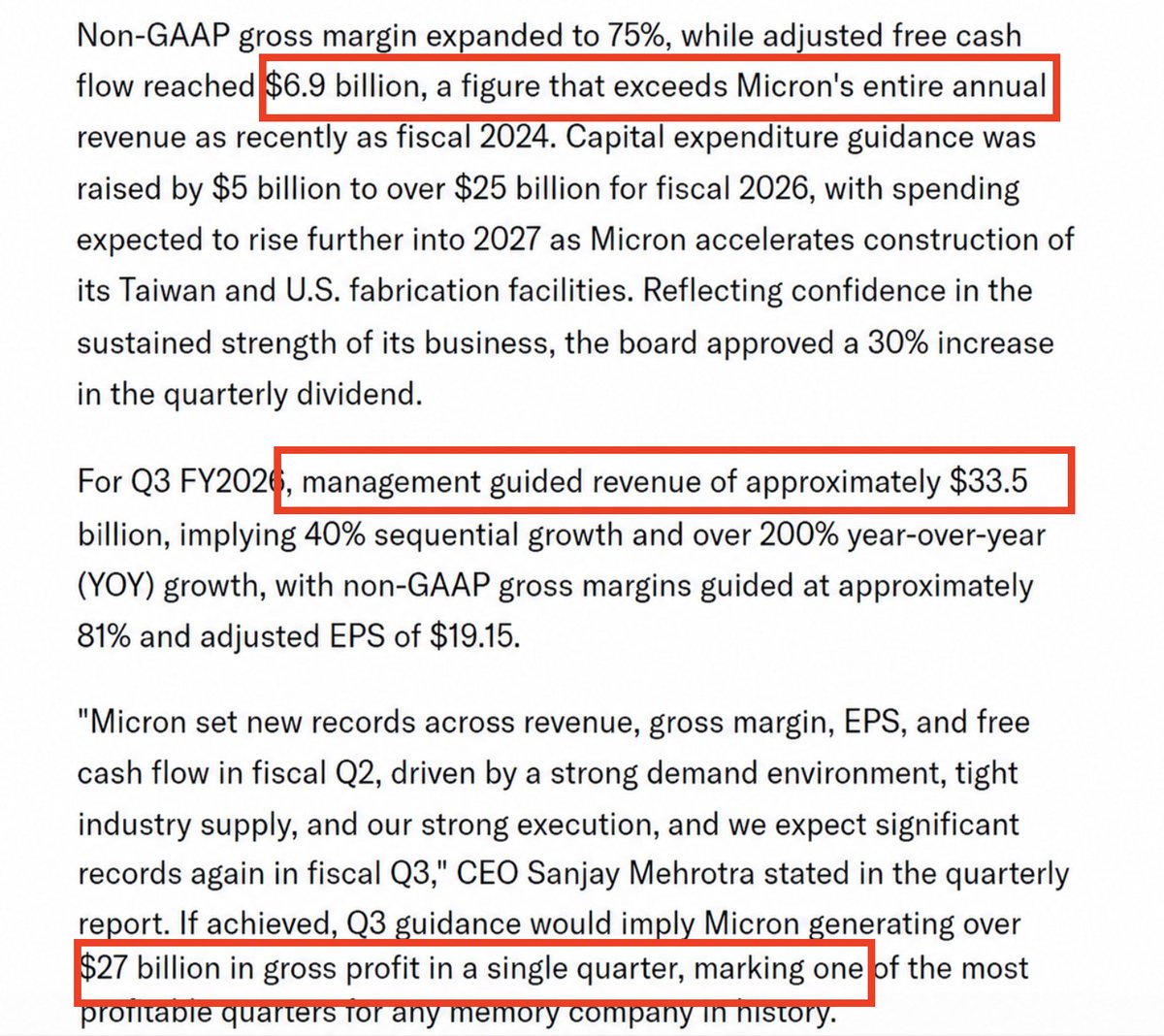
In Q2 FY2026, Micron reported revenue of $23.86 billion, up 196% year-over-year, with a non-GAAP gross margin of 75% and free cash flow of $6.9 billion, a figure that exceeds Micron's entire annual revenue as recently as fiscal 2024.
That was the fourth consecutive quarterly revenue record, and the $10.2 billion sequential increase was the largest in the company's history.
Then management guided Q3 FY2026 to $33.5 billion in revenue with 81% gross margins and EPS of $19.15, a figure so far above Wall Street's prior consensus of $24.29 billion that analysts had to rewrite their models entirely.
If achieved, that Q3 print would imply Micron generating over $27 billion in gross profit in a single quarter, marking one of the most profitable quarters for any memory company in history.
The bull case for understanding why this is possible and potentially sustainable starts with one product, high-bandwidth memory.
HBM is the critical bottleneck in every AI accelerator supply chain, Nvidia's Blackwell and Rubin architectures require it in substantial volumes, and the global HBM market is controlled by exactly three companies, SK Hynix, Samsung, and Micron.
Micron is the only American HBM supplier, which gives it a geopolitical moat that no amount of capital can quickly replicate.
More importantly, Micron's entire 2026 HBM capacity is already sold out and contracted at fixed prices, meaning the $33.5 billion Q3 guidance is not a forecast built on hope, it is largely revenue that has already been booked.
The demand side of this equation is equally extraordinary.
Hyperscaler capital expenditure commitments for 2026 alone exceed $500 billion, including Microsoft at $190 billion and Meta between $125 billion and $145 billion, and every AI server requires roughly six times more DRAM than a conventional server.
Micron's CEO Sanjay Mehrotra stated on the earnings call that the company can only fulfill 50% to two-thirds of key customer demand in the medium term meaning the constraint right now is not demand, it is how fast Micron can build.
To address that, Micron raised its capital expenditure guidance by $5 billion to over $25 billion for fiscal 2026, with spending expected to rise further into 2027 as it accelerates construction of new fabrication facilities in Idaho and Taiwan.
The board also approved a 30% increase in the quarterly dividend, a signal from management that they believe the cash generation is durable, not cyclical.
The HBM market itself is projected to grow at a 41% compound annual growth rate, expanding from $35 billion to over $100 billion by 2028, and Mizuho analyst Vijay Rakesh has projected DRAM contract pricing could see a 355% increase through 2026 while NAND prices could rise 510%.
The Q3 earnings report on June 24-25 is not just a quarterly print but rather the verdict on whether AI memory demand has permanently broken the boom and bust commodity cycle that defined Micron for decades.
Come join Milk Road Pro for our full breakdown, how to size MU ahead of the June 24-25 earnings, what the $33.5 billion guidance implies for full year estimates, and our entire AI thesis.
Link below.
21
85
503
59,087

Hoeny retweeted

Not lost on me that a few years ago The kardashians bullied and villainized her, fast forward she’s a really important WAG for the Knicks a team that hasn’t won a championship in 53 years! They’re calling her their lucky charm.


102
1,265
21,017
811,175

Feel for anyone who gets sent down like that after multiple years in the bigs but if Blaze Jordan could do even 1/4 of what he’s done already this weekend moving forward he’s already an upgrade. Just making contact at this point is an upgrade

C standards meeting has ended:
- std::embed has made progres (but it's not in yet).
- #embed "foo.bin" offset(3) is in the standard now and everything else is starting to move forward.
I'll get to the C Unicode in probably half a year, when the black mold stops killing me.

14s
Thanks for the transparency! I also got greedy I was buying and selling along the way all the way up to one dollar, then instead of cutting quickly when it went against me I started averaging down.
Lost a ton but could’ve lost way more if I hadn’t cut when I did. Lesson going forward: hope for the best plan for the worst!
qwertise 👍👍👍 retweeted

very much looking forward to kanji making adachi look even more sorry in revival with the new expressions, he might genuinely look terrified 😭

2
6
21

lol y’all just know this inside forward and outside forward thing? Thanks to fifa and ps5… all the same, they’re all part of the wing, I played inside forward in my high school days btw and that’s around 12/13
✌️#ThrowWilcoxIntoAVolcano retweeted

People don’t realise how good Lewis Hall is, he’s been the best itl since late 2024, special going forward, great positional dribbler, former midfielder so his passing chops are crazy, can invert all this he locked up Yamal at SJP 🤣
5
1
21
896