
@elonmusk has been telling us this for years now.. wake up people and buy solar stocks!!! $fslr is by far my favorite!! Elon, you still like solar??? The sun seems to be doing just fine

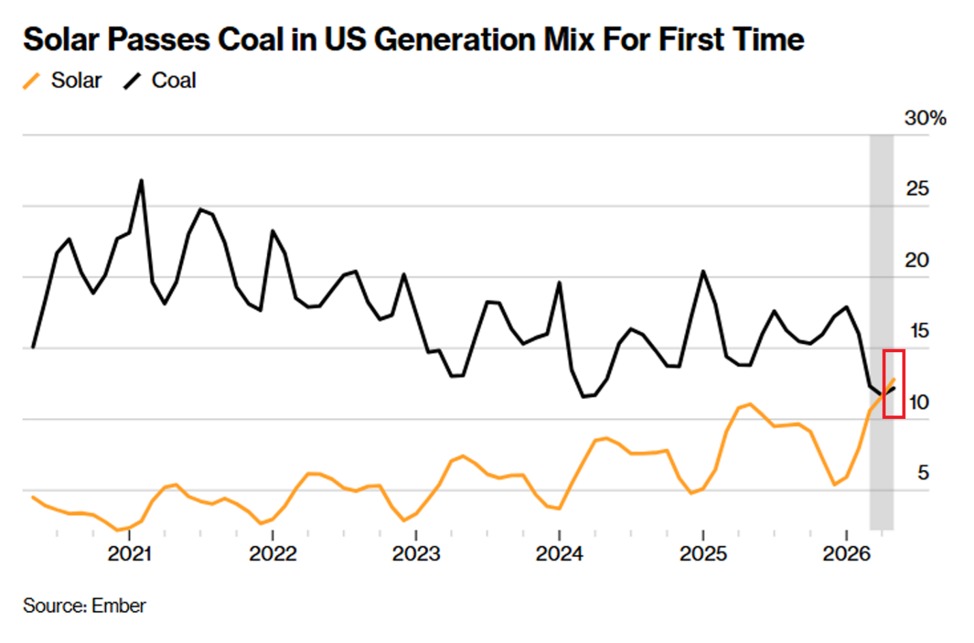
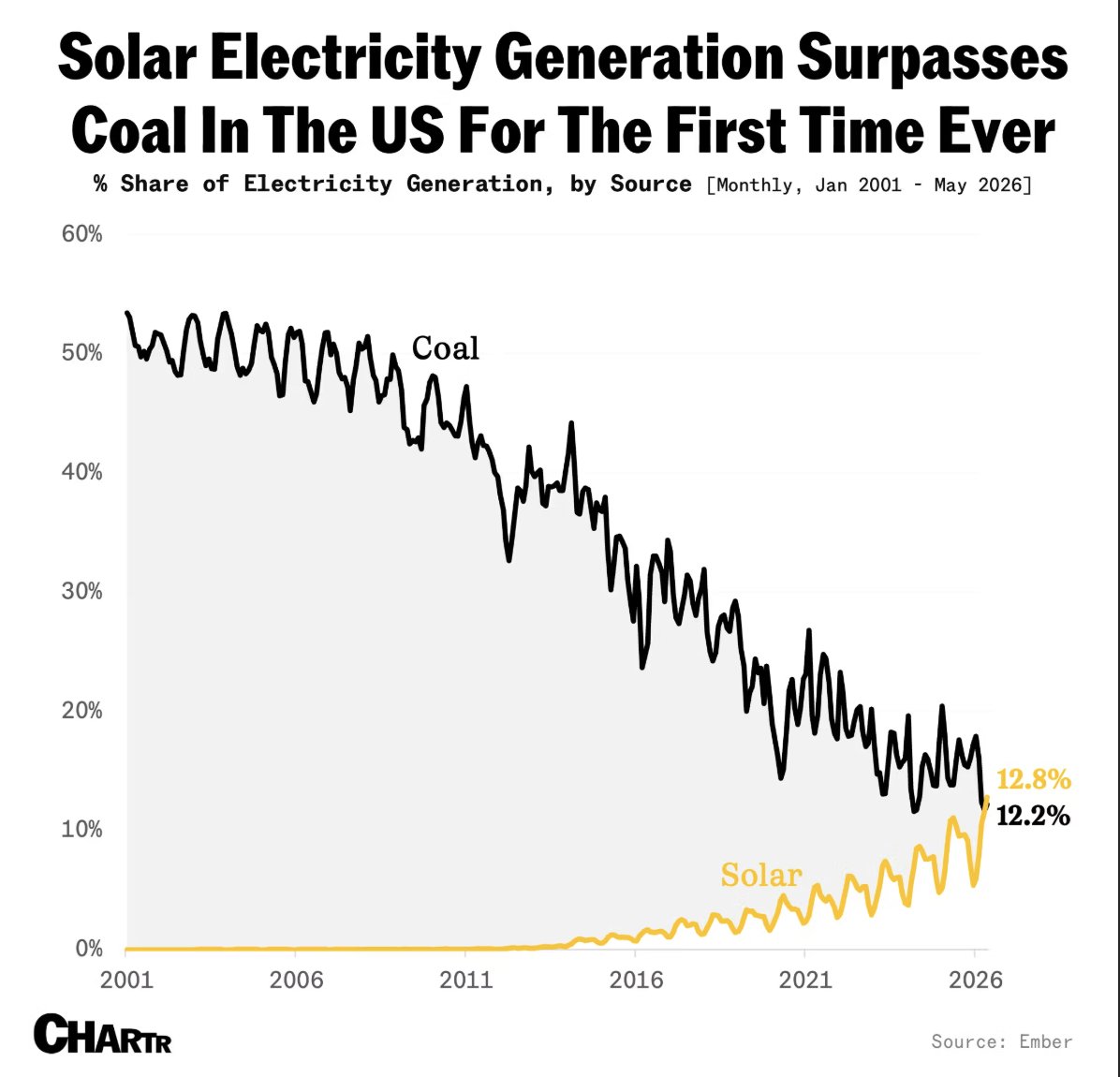
BREAKING: Solar energy accounted for 12.8% of US electricity production in May, surpassing coal at 12.2%, marking the first time this has occurred in a full calendar month.
Solar generation surged 17.0% YoY in May while coal output declined -11.0%, continuing a historic shift in the US power mix.
This shift has been supported by years of rapid solar deployment, while rising electricity demand from AI data centers further boosting investment in new generation capacity.
As a result, solar and battery storage together accounted for 91% of all new US power capacity installed in Q1 2026.
Meanwhile, natural gas remains the dominant source at 37% of the US electricity mix.
The AI revolution is accelerating America's energy transition.
9

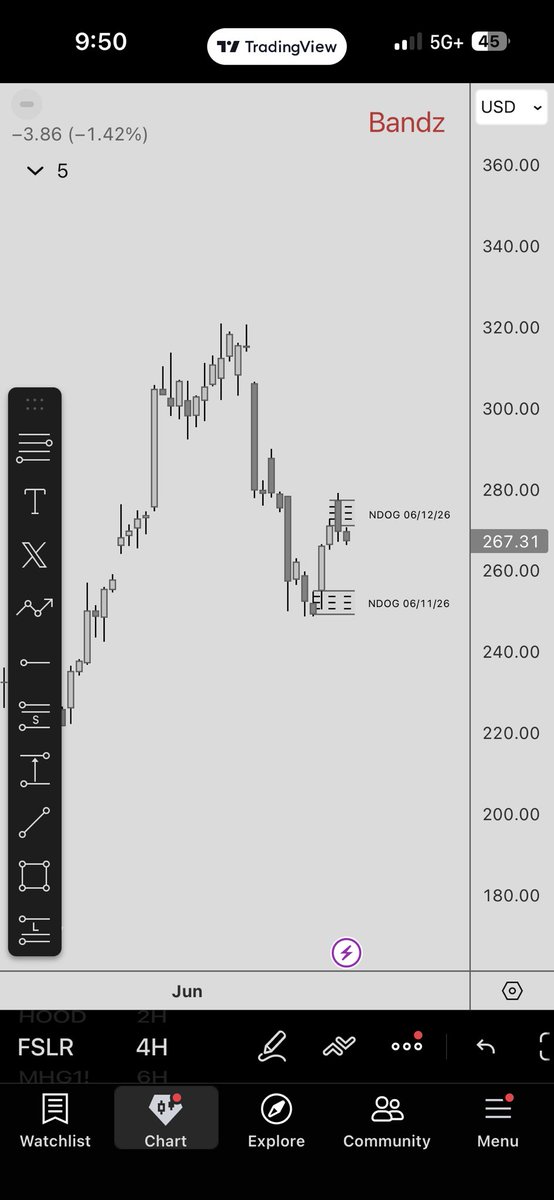


Summer Time ☀️
🔸 Earth Solar Stocks top 3 $FSLR 🥇
$ARRY 🥈
$CSIQ 🥉
—————————————
$FTCI (USA)
• Solar tracker systems and software for utility-scale solar farms.
• 2026 TTM rev. $70–80M
• cash $5.6M
• debt remains significant
• FCF negative (-$26M TTM).
——————————-
$SMXT (USA: HQ CA. )
• Commercial, residential and utility-scale solar EPC contractor.
• 2026 TTM Rev. $90–100M
• cash $4.3M
• debt $25–27M
• FCF near positive to break even
—————————
$SLRS (USA)
• Provides mobile power generation and energy infrastructure for industrial and data-center applications.
• 2026 TTM Rev. >$500M
• Cash $120M
• Debt $1.5B
• Positive FCF
————————-
$SEDG (Israel)
• Solar inverters, batteries, EV charging and energy management systems.
• 2026 TTM Rev. $1.6–2.1B
• cash $400M
• debt $350M
• FCF improving / positive
——————————-
🟢 FSLR (USA) 🥇
• Largest U.S. solar module manufacturer using thin-film technology.
• 2026 TTM Rev. $4.2-$4.5B
• cash $2B net
• $468M with massive cash buffer
• strong positive FCF
——————————
🟢 ARRY 🥈(USA)
• They are one of the two largest utility-scale solar tracker manufacturers globally, making them a direct peer to FTCI
• 2026 TTM Rev: $1.2B
(Tracking an expected full-year 2026 revenue of $1.4B–$1.5B following a massive Q1 rebound and sequential volume scaling).
• cash $200.7M
• debt: $667M (mitigated by strong operational backing)
• FCF Highly Positive backed by corporate record $2.4B order book entering second half of 2026.
————————-
🟢 CSIQ (Canada) 🥉
• Global solar module manufacturer and utility-scale project developer.
• 2026 TTM Rev. $7.2B
• cash $2.1B
• debt highly substantial due to project financing
• FCF cyclical.
—————————-
$SUNE (USA)
• Residential and commercial solar installer focused on Northeast U.S. markets.
• 2026 TTM Rev. $66.4M
• cash $1.69M
• debt $9.3M
• FCF negative
——————————-
$RUN (USA)
• Largest U.S. residential solar and home battery leasing platform.
• 2026 TRM Rev. $2.3-$2.5B
• cash >$1B
• debt very high asset backed debt
• FCF improving
———————————-
$TE (USA)
• Formerly FREYR; pivoting into U.S. solar manufacturing and energy infrastructure.
• 2026 TTM Rev.
Expanding out of Pre-scale revenue $177.6M
• cash $300M
• debt $549.7M
• FCF negative
———————————
$MWH (Singapore/Asia)
• Engineering, procurement, construction (EPC), and maintenance of utility-scale solar and battery storage.
• 2026 TTM Rev. $1.2B
• Cash Raised $512M
• Debt moderate
• FCF positive
————————————
🥇 First Solar FSLR wins the absolute #1 spot because it operates like an elite semiconductor technology giant rather than a volatile solar developer.
The Only True "Net-Cash" Balance Sheet
A Massive, Multilayered Government Moat
Record-Breaking Software-Like Margins
A Five-Year Locked-In Order Backlog
————
🥈 Array Technologies ARRY wins the #2 spot over CSIQ, SEDG, and SLRS because it possesses a highly profitable hardware business model with almost zero capital asset liabilities.
Unlike manufacturers and developers that must take on billions in debt to build physical solar farms or factories, Array operates a streamlined "asset-light" engineering model. This gives them structural financial advantages that the other three cannot match.
————
🥉 Canadian Solar CSIQ claims the #3 spot ahead of Solaria SLRS and SolarEdge SEDG because it possesses massive operational scale and superior revenue diversity, allowing it to safely outpace its peers despite holding a larger headline debt figure.
BREAKING: Solar energy accounted for 12.8% of US electricity production in May, surpassing coal at 12.2%, marking the first time this has occurred in a full calendar month.
Solar generation surged 17.0% YoY in May while coal output declined -11.0%, continuing a historic shift in the US power mix.
This shift has been supported by years of rapid solar deployment, while rising electricity demand from AI data centers further boosting investment in new generation capacity.
As a result, solar and battery storage together accounted for 91% of all new US power capacity installed in Q1 2026.
Meanwhile, natural gas remains the dominant source at 37% of the US electricity mix.
The AI revolution is accelerating America's energy transition.
2
229

5h
BREAKING: Solar energy accounted for 12.8% of US electricity production in May, surpassing coal at 12.2%, marking the first time this has occurred in a full calendar month.
Solar generation surged 17.0% YoY in May while coal output declined -11.0%, continuing a historic shift in the US power mix.
This shift has been supported by years of rapid solar deployment, while rising electricity demand from AI data centers further boosting investment in new generation capacity.
As a result, solar and battery storage together accounted for 91% of all new US power capacity installed in Q1 2026.
Meanwhile, natural gas remains the dominant source at 37% of the US electricity mix.
The AI revolution is accelerating America's energy transition.
1
6
593
Veryvery JmLee retweeted

Jun 13
“병목”
-어떤 과정 전체의 속도나 성과를 제한하는 ‘가장 큰 장애 요인’
메모리 병목-MU
전력 병목-FSLR
광학 병목-MRVL / LITE (One Team)
냉각 병목-DELL
지금은 병목의 시대
DELL / MRVL / LITE 나를 지켜보신 분들은 아시겠지만
나의 첫 매수가는 136 / 80 / 386 이었다🎯
1
8
56
3,168

BREAKING: Solar energy accounted for 12.8% of US electricity production in May, surpassing coal at 12.2%, marking the first time this has occurred in a full calendar month.
Solar generation surged 17.0% YoY in May while coal output declined -11.0%, continuing a historic shift in the US power mix.
This shift has been supported by years of rapid solar deployment, while rising electricity demand from AI data centers further boosting investment in new generation capacity.
As a result, solar and battery storage together accounted for 91% of all new US power capacity installed in Q1 2026.
Meanwhile, natural gas remains the dominant source at 37% of the US electricity mix.
The AI revolution is accelerating America's energy transition.
1
9
1,529

FSLR keeps popping up on my app that I built. I'm still uncertain about this thing and don't trust it. I will say that the last time something popped up this many times, it was AAOI at $7.
1
26
mouou retweeted

BREAKING: Solar energy accounted for 12.8% of US electricity production in May, surpassing coal at 12.2%, marking the first time this has occurred in a full calendar month.
Solar generation surged 17.0% YoY in May while coal output declined -11.0%, continuing a historic shift in the US power mix.
This shift has been supported by years of rapid solar deployment, while rising electricity demand from AI data centers further boosting investment in new generation capacity.
As a result, solar and battery storage together accounted for 91% of all new US power capacity installed in Q1 2026.
Meanwhile, natural gas remains the dominant source at 37% of the US electricity mix.
The AI revolution is accelerating America's energy transition.
2
1
11
1,955


Is it still too late to buy FSLR 🤔
BREAKING: Solar energy accounted for 12.8% of US electricity production in May, surpassing coal at 12.2%, marking the first time this has occurred in a full calendar month.
Solar generation surged 17.0% YoY in May while coal output declined -11.0%, continuing a historic shift in the US power mix.
This shift has been supported by years of rapid solar deployment, while rising electricity demand from AI data centers further boosting investment in new generation capacity.
As a result, solar and battery storage together accounted for 91% of all new US power capacity installed in Q1 2026.
Meanwhile, natural gas remains the dominant source at 37% of the US electricity mix.
The AI revolution is accelerating America's energy transition.
8


SpaceX dominated headlines this week, but the bigger story may be what’s happening beneath the surface.
AI remains the leader. Lithium is showing signs of life. Space is consolidating. Biotech continues building bases.
The market may be rotating, but it isn’t breaking.
🐂📈
#QuietBull #Investing
$ABNB $ALB $AMD $AMZN $ASTS $AVGO $BEAM $CCJ $CRSP $FSLR $IONQ $LUNR $NTLA $NVAX $NVDA $RKLB $SPCX $TSLA $TSM $UEC $VKTX $VRTX
1
1
32

12h
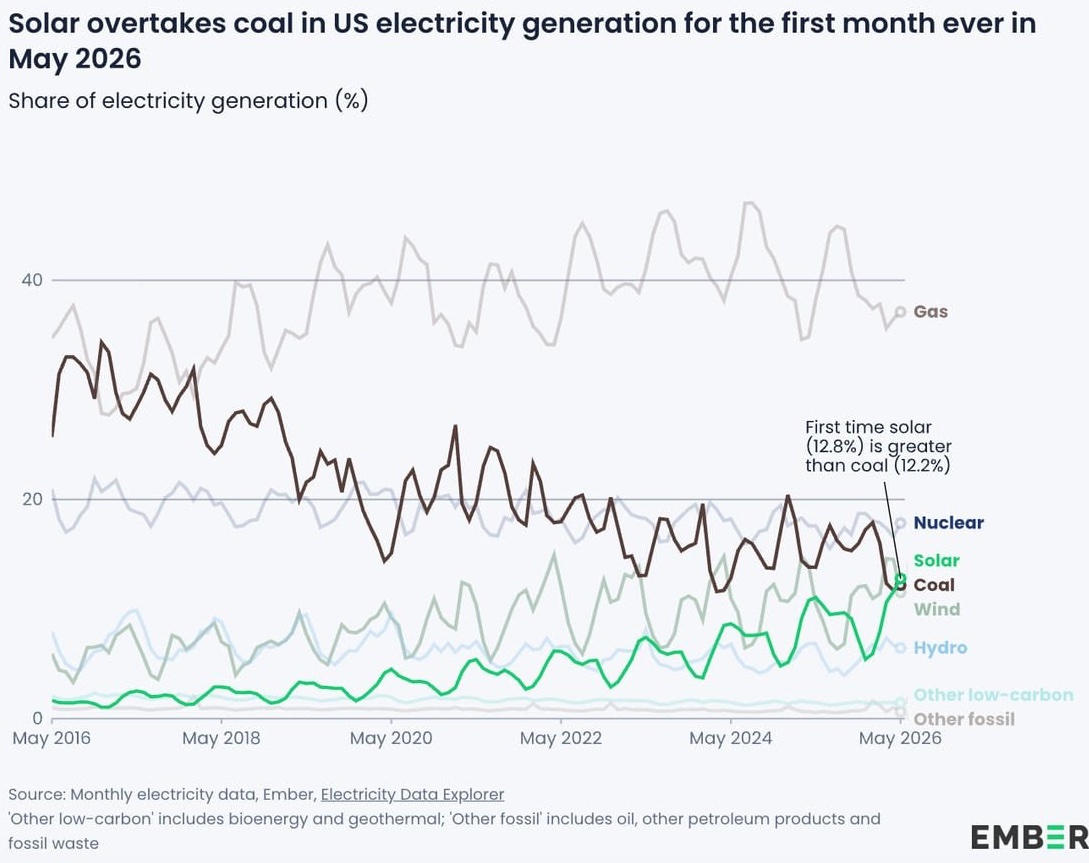
A key chart showing a bullish cross for solar. A sector that was in a big downtrend since 2022 and is now surpassing coal for the first time.
No matter what you think about it. Watch the data.
$FSLR $TAN

Solar adoption, given that it remains the fastest deployable source of power, is only going to accelerate from here.
107