
Feb 5
Right now the one that I know is private is something called filecloud it’s paid for, but it’s private and you can host a large library someone got me an NAS which is like a tiny server. I haven’t set it up yet, but it is private and you can share.
1
10
1,125

31 Jul 2025
Tired of relying on Dropbox or Google Drive?
You’re not in control, they are.
And they can change, lock, or leak your data.
Here are 5 ways to self-host your own secure cloud and take back control👇
1️⃣ Build your own private cloud
You can host your own cloud on an old laptop, spare PC, Docker, or even in AWS. The setup is easier than you'd think! Theres' no need to pay for someone else’s hard drive when you have your own.
2️⃣ FileCloud vs NextCloud: choose your weapon
FileCloud is enterprise-grade, ideal for businesses and serious homelabbers. NextCloud is great for open-source tinkerers. Both are free. Choose based on your goals: secure sharing or deep app integrations?
3️⃣ Deploy on AWS or your own hardware
In AWS, you can use EC2 S3 with IAM keys. Locally, plug in an external drive, mount it in Linux, and you’re ready. Both give you full control and teach you cloud architecture skills.
4️⃣ Share files with actual security
Limit downloads, add password protection, set expiration dates. FileCloud offers hyper-secure sharing natively — stuff Dropbox should’ve done years ago. Even better, mount your cloud as a drive on your PC.
5️⃣ Learn enterprise-grade file governance
FileCloud includes retention policies, data loss prevention, antivirus scanning, workflows, and more.
Just remember: You don’t have to give your data to the cloud giants. Take it back. Host it yourself.
15
52
520
33,019

30 Jun 2025
"The Long aged Crisis of Trust " and how @arcium is bringing new hope for humanity.
A Thread 🧵
--------------------------------------
Preface>>👇
Long ago, for ions, humanity have been plagued with a predicament, "harnessing trust and staying confidential", but no human, invention or technology, have the capacity to bring this longing for privacy to reality, as time goes on and new dispensation emerges, there emerge an idea,that has now become a technology that will power confidential computing at a global scale @arcium. I will make this write up historic and it will be my pleasure that you follow me to the end. Let's dive in fully 👇
--------------------------------------
>>The history of confidential data transfer leaks reveals a persistent challenge in cybersecurity, with breaches evolving in scale and sophistication. Early incidents, like the 2002 ChoicePoint breach, exposed 163,000 records due to inadequate authentication, highlighting vulnerabilities in data handling.
Again in 2013, the Yahoo breach compromised 3 billion accounts, exploiting weak encryption and poor password policies. It doesn't stop there, in 2017 Equifax hack exposed sensitive data of 147 million people, driven by unpatched software vulnerabilities.
More recently, the 2024 National Public Data leak exposed 2.7 billion records, including Social Security numbers, due to misconfigured cloud storage.
The 2025 "Mother of All Breaches" (MOAB) leaked 26 billion records, largely recycled but underscoring the aggregation risks of unencrypted data. These incidents often stem from human error (95% of breaches per Cybersecurity Ventures), phishing, insider threats, or misconfigured systems, costing businesses an average of $4.88 million per breach in 2024.
--------------------------------------
These are few among many crisis humans have faced or have been facing for long, and this occurrence had been happening repeatedly,and we've not seen a technology that could put an end to the problems or vastly reduce these risk.
Here emerge @arcium offering a novel solution to these challenges through its decentralized confidential computing platform.
Unlike traditional encryption, that depends on centralised systems, Arcium leverages Multi-Party Computation (MPC) to enable secure data processing without exposing sensitive information, and it's fully decentralised. Therefore data is encrypted during transfer and computation, ensuring confidentiality even if intercepted.
-------------------------------------- @arcium decentralized architecture reduces single points of failure, mitigating risks like those seen in the Equifax or National Public Data breaches.
Arcium’s approach allows organizations to collaborate on sensitive data without sharing raw information, addressing insider threats and third-party vulnerabilities, as seen in the 2020 Marriott breach.
Also by automating encryption and access controls, Arcium minimizes human error, a key factor in 95% of breaches. Its blockchain-based trust model ensures transparency and immutability, preventing unauthorized access which is oftentimes common in misconfigured cloud environments.
>> Compared to traditional Data Loss Prevention (DLP) tools, which rely on centralized monitoring and are reactive, Arcium proactively secures data at every stage. While solutions like FileCloud or Axur focus on monitoring and post-breach mitigation, Arcium’s MPC ensures data remains confidential during processing, not just storage or transfer. This is critical for industries like finance or healthcare, where breaches like the 2024 Slim CD incident (1.7 million credit card records) highlight the need for robust, proactive security.
In my honest and sincere opinion, I honestly believe that @arcium
Is the technology needed to cure this longed aged Crisis and bring back trust to humanity.
You found this guide helpful? Then give me a follow @Crypttwinner
For more insightful guides like this.

11
1
32
671

11 Feb 2025
شركة FileCloud، تفتتح مقراً إقليمياً لها في الرياض.
أعلنت شركة FileCloud، المنصة الرائدة في مجال مشاركة الملفات المؤسسية وإدارة البيانات، عن افتتاح مقرها الإقليمي الجديد في العاصمة السعودية الرياض، كمركزاً إقليمياً لعمليات الشركة في منطقة الشرق الأوسط وشمال أفريقيا.
يأتي هذا الإعلان نتيجة التوسع الكبير لأعمال الشركة في منطقة الشرق الأوسط، كما يتماشى ذلك مع خطط وبرامج ومبادرات رؤية المملكة 2030.
4
790

11 Feb 2025
#LEAP2025 is in full swing! The @getfilecloud team is live at Booth H3-G188 in the U.S. Pavilion! Meet our MENA team, CEO Ray Downes & SVP of Sales Leigh Bradford.
Learn how FileCloud powers secure file sharing, data residency & #PDPL compliance in #KSA & MENA.




1
3
121


23 May 2024
We are delighted to announce that @getfilecloud has acquired @Signority. This acquisition solidifies FileCloud's position as a front-runner in #WorkflowAutomation and #compliance simplification.
Get the full story 👉 prn.to/3VdNYpM
#FileCloud #Signority #Acquisition
2
3
258
22 May 2024
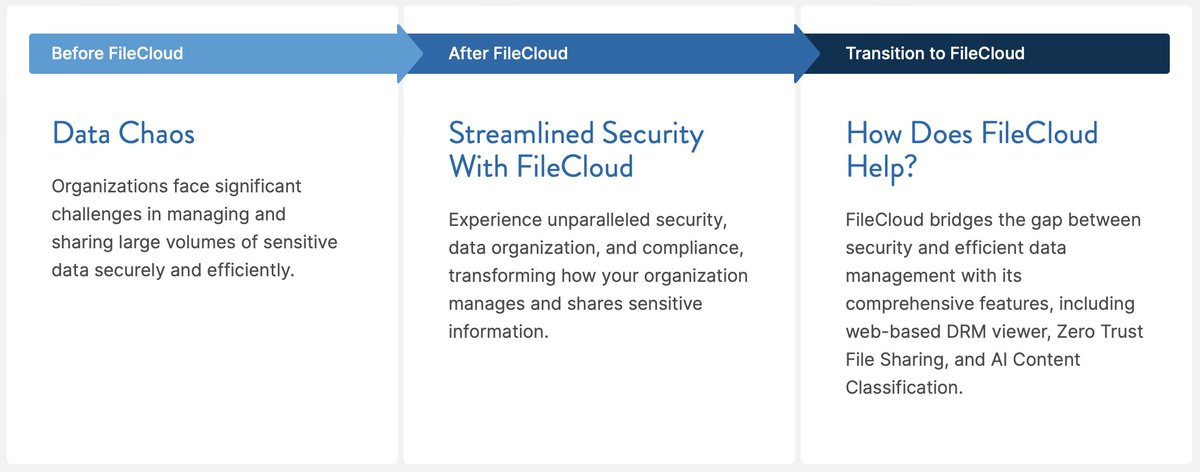
Confidential #FileSharing with #FileCloud
🔹#SecureWebViewer: Safe browser access, no downloads
🔹#ZeroTrust File Sharing: Share zip files securely with advanced encryption
🔹AI-driven #ContentClassification: Automate data organization & protection
More 👉bit.ly/3QUWqHD
1
67

#AIIM24. Gold Sponsor. FileCloud. Explained in 90 seconds.
 James Gingerich #B2B #Technology #Influencer
141
#AIIM2024. Gold Sponsor. FileCloud. Explained in 90 seconds.
James Gingerich #B2B #Technology #Influencer
1
1
203
#AIIM2024. Gold Sponsor. FileCloud. Explained in 90 seconds.
James Gingerich #B2B #Technology #Influencer
2
190
#AIIM2024. Gold Sponsor. FileCloud. Explained in 90 seconds.
134

7 Mar 2024
FileCloud expands data governance and compliance tools helpnetsecurity.com/2024/03/…
1
683

15 Feb 2024
Unlocking potential – FileCloud sees strategic advantage of setting roots in Ireland's Mid-West irishexaminer.com/business/t…
83
16 Jan 2024
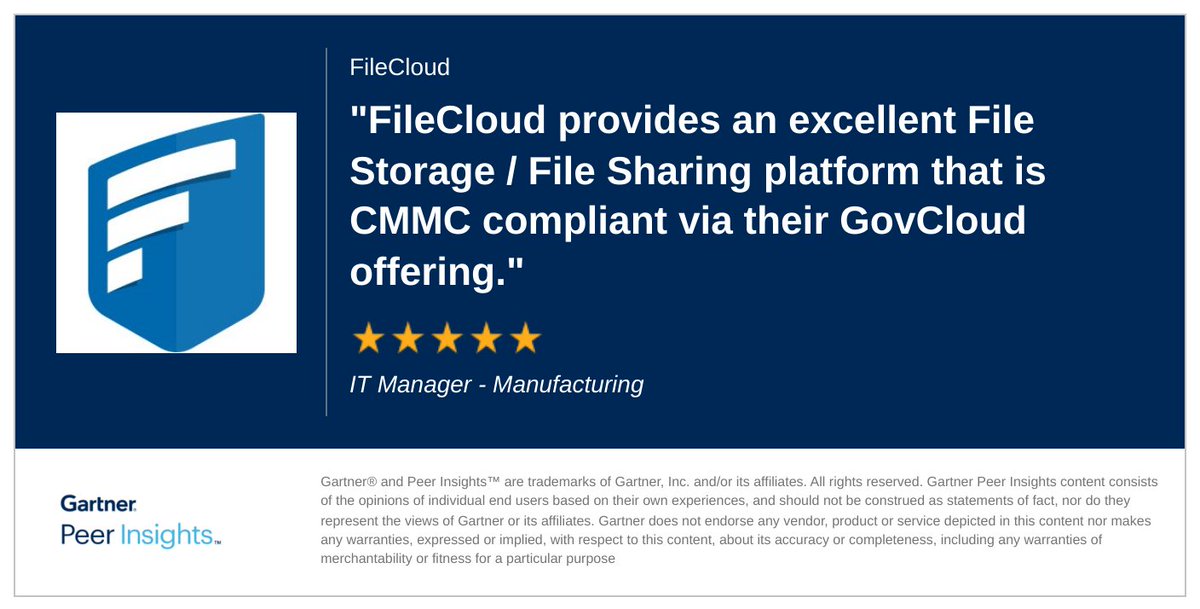
This glowing review is just one among the many shared by our users on @Gartner_inc. Want to know why millions of satisfied users choose FileCloud for their #compliance, #filesharing & #collaboration needs? Check out these recent reviews 💻🖊️
gartner.com/reviews/market/c… #GovCloud
1
56

11 Dec 2023
🌟Hiring!
New Remote job: Product Manager at FileCloud
Apply Here: remotedom.com/remote-jobs/pr…
#remotejobs #remotework
1
194
29 Nov 2023
FileCloud and Votiro join forces to protect customers from file-borne threats helpnetsecurity.com/2023/11/…
1
678
27 Nov 2023
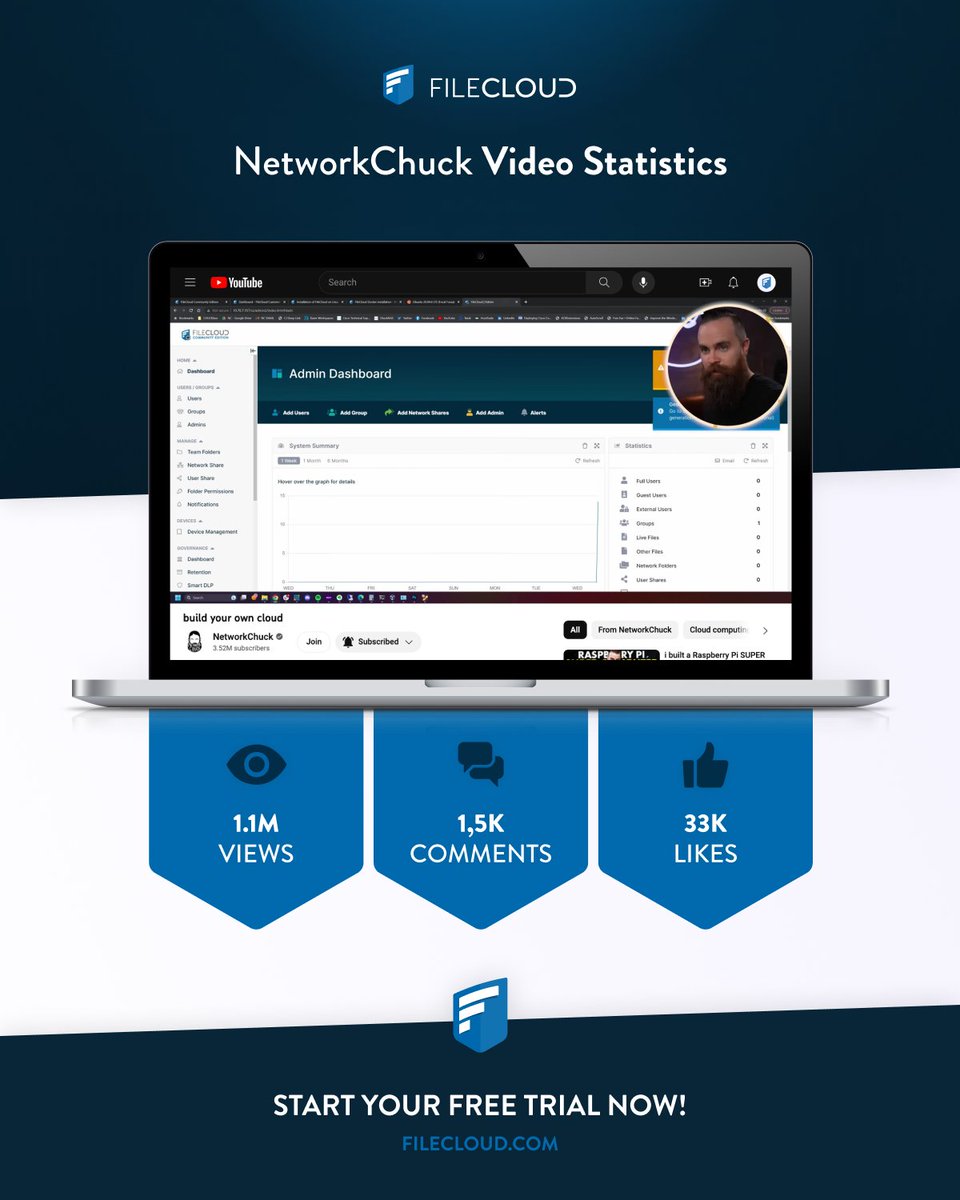
New blog alert! 🚀 @NetworkChuck's FileCloud review has surpassed 1 MILLION views on YouTube! 💻 Find out Chuck's verdict on FileCloud's #PrivateCloud Solution by reading the blog now 👉 bit.ly/3GiDOf7
#FileCloud #NetworkChuck
2
82
9 Oct 2023
Jason Dover, FileCloud's #CPO, answers 5 key questions about FileCloud Desktop for #MacOS (in beta)!
🔍 What is FCD?
🧐 Why is FCD crucial?
👥 Who should use FCD?
🌐 How to access FCD?
📚 More info for customers!
Watch now! 👉 bit.ly/46DR5Kx #FileCloud #TechNews
3
59
27 Sep 2023
FileCloud partners with OPSWAT to strengthen data security posture for customers helpnetsecurity.com/2023/09/…
1
1
471