Quinnox $COR retweeted

Jun 13
🛠️ DevLog – Recap: What @Base Flashblocks Means for Cortensor
A quick note on why Base Flashblocks matters in the Cortensor context.
Base Flashblocks is not the same thing as "Base has 200ms final blocks."
The practical meaning is:
- faster preconfirmations
- lower perceived latency
- quicker user-facing feedback
- while full block settlement still follows the normal Base cadence
Why that matters for Cortensor:
- part of what pushed us more toward @Arbitrum earlier was responsiveness and execution behavior
- Flashblocks makes the Base path more relevant now because it narrows part of that gap
- that means Base becomes more interesting again for lighter Cortensor product and execution paths
So the current thinking is still:
- Arbitrum first for the main L2 / L3 Cortensor path
- revisit Base more seriously after Mainnet Full is deployed and usable
In simple terms:
Flashblocks does not change the current stack direction today.
But it does make Base much more worth revisiting later.
#Cortensor #Base #Flashblocks #Arbitrum #AIInfra
4
12
135


Quinnox $COR retweeted
Jun 10
🛠️ DevLog – Why We’ll Revisit Base Flashblocks Later
A quick note on how we currently think about @base in relation to Mainnet Full and the broader Cortensor stack.
🔹 Why we leaned toward Arbitrum first
When we evaluated the L2 path last year, one of the main reasons we leaned more heavily toward @arbitrum for the current #L2 / #L3 direction was practical response time and execution responsiveness. That made it a better fit for the kind of session behavior and infra shape we cared about.
🔹 Why Base was not the priority then
At the time, Base Flashblocks was still not something we wanted to depend on yet, so we did not push further there.
🔹 Why Base is worth revisiting now
That situation looks different now. Base Flashblocks now makes the Base path more interesting again, because it improves the user-perceived latency / preconfirmation path enough that it becomes worth taking another look.
🔹 Important distinction
That does not mean Base suddenly becomes the same thing as the current Arbitrum path overnight.
The way to think about it is:
- Arbitrum still explains why the current L2 / L3 stack exists the way it does today
- Base Flashblocks is the reason we should revisit whether a stronger Base path becomes viable later
🔹 Current direction
So the direction is still:
- Arbitrum L2 / Orbit L3 first for the main Cortensor path
- then revisit Base Flashblocks after the Mainnet Full Arbitrum Orbit L3 path is deployed and usable
🔹 Current takeaway
This is less about changing the current stack direction, and more about reopening a path that previously was not mature enough to justify the same level of attention.
#Cortensor #Base #Arbitrum #Flashblocks #Mainnet
2
5
12
162

Jun 10
Ethereum L1 fails both: updates are expensive and 12s blocks leave a big stale window.
Solana (~400ms blocks, updates ~1000× cheaper than a swap) and Base (200ms flashblocks) clear the bar. That's why PropAMMs live there.
1
1
51

Jun 9
You nailed the unbreakable community angle. New insight: Base’s 960/1000 isn’t just scale or timing. It’s the payments plus agent flywheel most L2s never built. Arbitrum and Optimism rewarded activity. Base already runs trillions in stablecoin volume through Coinbase’s real user funnel. Post drop that turns one time farmers into daily transactors because the utility is baked in. Sub cent fees. Flashblocks speed. RWA rails.
No MetaMask style tease. No OpenSea hope as product.
This is the first L2 with institutional distribution plus grassroots ownership locked before the Clarity Act flood. The rocket isn’t hype. It’s engineered for retention.
Pride in the design. Pride in the drop.
Score. Invest. Win. 🦁🇺🇸
1
2
4
46

Jun 8
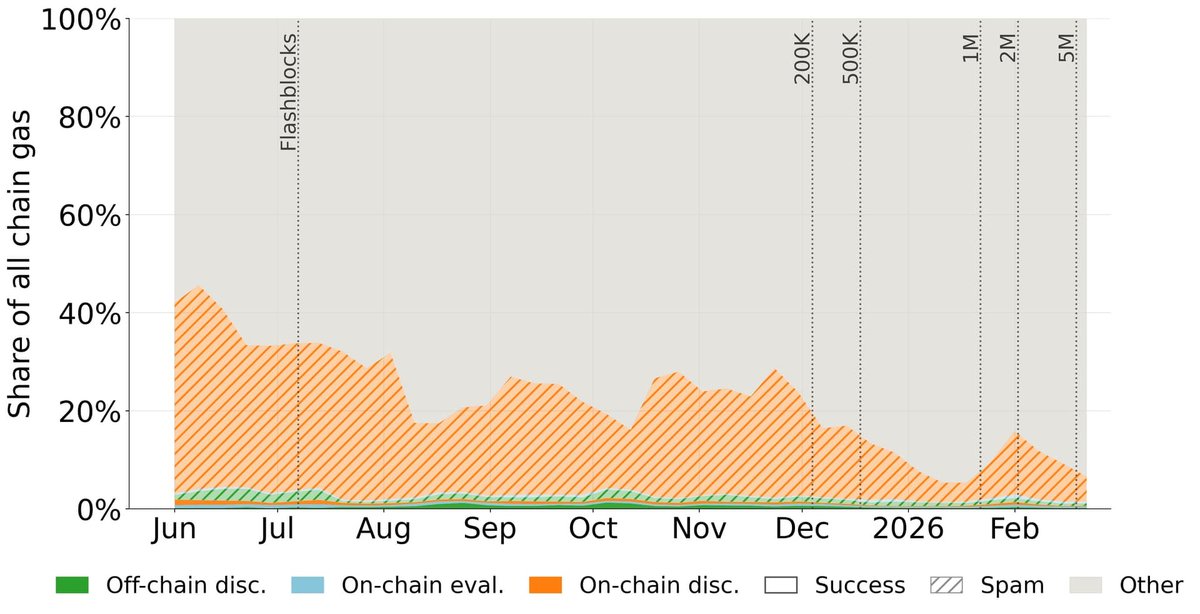
8/ So did Base’s changes work?
Mostly, yes.
Flashblocks and fee floors improved the quality of arb competition: more priority fees came from successful arbs, and spam used less blockspace.
But they did not “solve” spam.
They changed which search strategies remained viable.
1
1
171
Jun 8
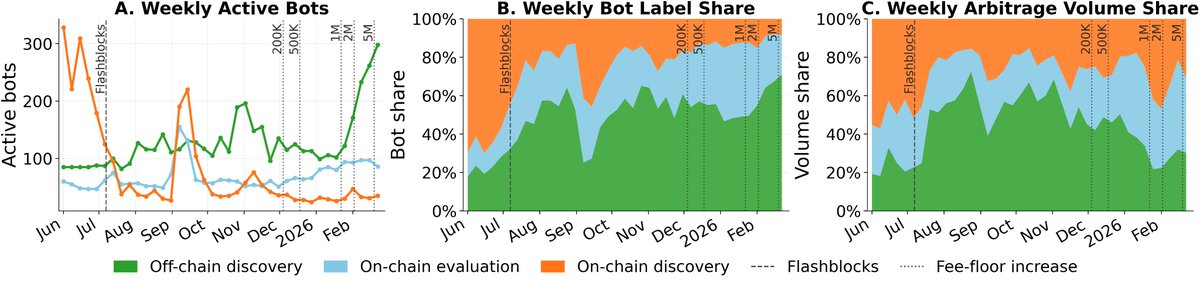
5/ Base’s Flashblocks changed the competition.
After 200ms pre-confirmation sub-blocks, broad on-chain scanners became less competitive.
Many heavy scanners exited, and survivors became leaner.
But spam did not vanish — surviving bots submitted attempts more often.
1
1
156

Jun 4
Ethereum's native account abstraction proposal, EIP-8141, is still in draft status as of March 2026. Vitalik announced it on February 28, Hegota fork timeline puts mainnet rollout roughly a year out. Meanwhile the end-of-June upgrade on @base ships native account abstraction directly into protocol, alongside an enshrined token standard and Flashblock Access Lists.
That gap matters more than it looks. ERC-4337 account abstraction works today on Base via a separate bundler mempool and UserOperation flow. It's functional but layered: your transaction goes through a bundler, gets verified, then lands on-chain. Native AA collapses that stack. Accounts become programmable at the protocol level, gas sponsorship and custom signature schemes stop requiring external infrastructure, and the bundler overhead disappears. The UX difference for a new user is substantial. The developer simplification is larger.
Flashblock Access Lists are the less discussed piece. Flashblocks already cut confirmation times from 2 seconds to 200 milliseconds. Access Lists let specific addresses receive guaranteed preconfirmation slots. That's not a performance improvement for average users, it's infrastructure for high-frequency DeFi, latency-sensitive AI agent pipelines, and any protocol where ordering certainty has economic value.
Base is shipping Ethereum's roadmap faster than Ethereum. Whether that's a structural advantage or a risk depends entirely on whether the June upgrade lands on time.
120
119
899


May 31
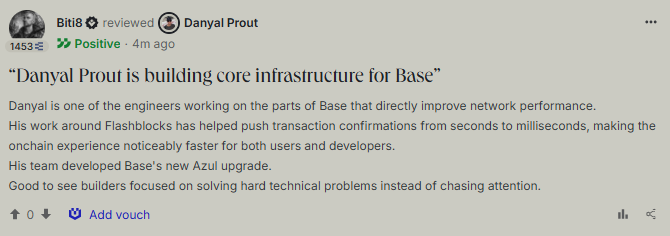
I'm continuing my series of developer reviews focused on builders who don't always get the attention they deserve across the Ethos ecosystem.
The next developer in this series is @danyalprout
Danyal is an engineer at @base working on protocol and infrastructure improvements. His team was behind Azul, one of Base's latest network upgrades, and he's also been involved in pushing technologies like Flashblocks that significantly improve transaction speed and user experience.
app.ethos.network/activity/r…
2
180


May 29
Base has officially launched Azul - its first independent upgrade
The Azul upgrade was deployed yesterday, May 28, 2026, on the @base mainnet. This is the first step toward building its own independent infrastructure stack, separate from @Optimism.
What does this mean?
1. Significantly higher security and the first step toward Stage 2
• Multiproofs have been implemented - a combination of TEE and ZK provers.
• Now, a single prover is enough to finalize a block, and when both agree, withdrawals to the main network can happen much faster.
• This significantly increases network resilience: an attacker would need to compromise multiple independent systems at once. ZK proofs are permissionless and can override TEE in case of disagreement.
2. Significant performance improvement
Full transition to new high-performance clients:
• base-reth-node base-consensus.
The network is already showing peaks of up to 5000 TPS and almost complete absence of empty blocks.
3. Improvements for developers and compatibility
Alignment with Ethereum Osaka:
• Added CLZ opcode.
• Repricing of operations (Osaka repricings).
• EIP-7825 (gas limit per transaction) and other optimizations.
How the upgrade affects network users:
• Regular users - nothing needs to be done.
• The network has become faster, safer, and better prepared for the global onchain economy.
• Node operators must update their clients (base-reth-node base-consensus).
• Most dApps will continue to work without changes, but developers should check their code if they use MODEXP, large transactions, or Flashblocks.
Azul is a major milestone. The Base network is now even faster and more secure, and officially declares that it is ready to become the home of global finance.
11
403