
Jun 12
JOB ALERT: GenScript is #hiring a Research & Development Intern! Visit #BioNJ’s Career Portal and #apply today! Check back often as new jobs are posted daily.
Apply: ow.ly/i9xU50Z7HqY
#NJJobs #career #resume #lifesciencejobs #jobalert #njjobs

24

Jun 12
Lol, what is this? Some kind of scripting reward program Marlboro cigarette points style? Do you work for GenScript or is this a user-rewards system?
23


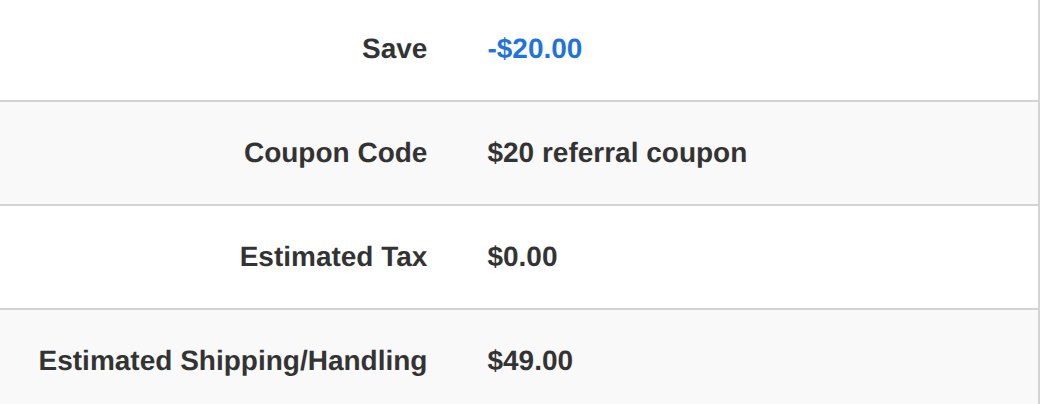
Thank you to whomever used my referral code at @GenScript. Every penny counts!
Here it be in case anyone is shopping for gene synthesis: genscript.com/genscript-refe…
1
18
1,021

Jun 10
It was likely quite overvalued when it IPO'd 6 years ago. It was valued at $3B then and $2B at series A just prior (which is wild) & has undergone significant dilution to get to the $6B now. GenScript created thr spinco and I'm sure their investors have done well out of it.
1
1
2
752
Jun 10
JOB ALERT: GenScript is #hiring a Legal Intern! Visit #BioNJ’s Career Portal and #apply today! Check back often as new jobs are posted daily.
Apply: ow.ly/pryc50Z7HeY
#NJJobs #career #resume #lifesciencejobs #jobalert #njjobs

16

GLP-1R has more published binding data than almost any receptor in metabolic medicine.
The @peptai_ GLP-1R programme exists to connect autonomous peptide design to wet lab validation, end to end, for the first time.
A receptor with decades of known agonists and confirmed binding affinities gives the pipeline something it cannot get elsewhere.
Every computational score can be measured against biology where the answer is already known.
Four peptides are running now.
> C2-01 and C2-03A are novel candidates designed autonomously through all eight computational gates.
> GLP-1(7-36)amide is the calibration anchor with a confirmed Kd of 140 nM already measured by Adaptyv Bio.
> Ala7-GLP-1 is the negative control.
GenScript handles synthesis and ships the peptides direct to Adaptyv Bio Lausanne for BLI binding kinetics.
The full cycle from synthesis to first binding data runs six to seven weeks. Total wet lab cost sits at ~$4,200–4,600.
First data expected in Q3 2026.
Every result publishes openly on @Molecule_sci Labs regardless of outcome.
2
2
17
934

Jun 8
DNA assembly, omics, ...
Azenta: $1B market cap
Genscript: $3.6B
pharma services (discovery, synthesis, ADME, fill & finish) ...
CSPC: $80B
WuXi: $125B
Big differences depending on the end products
1
1
107

Jun 8
JOB ALERT: GenScript is #hiring a HTP Production Associate Scientist - Automation Workflows! Visit #BioNJ’s Career Portal and #apply today! Check back often as new jobs are posted daily.
Apply: ow.ly/1pI550Z7H64
#NJJobs #career #resume #lifesciencejobs #jobalert #njjobs

29


Pour que la position de Twist soit compréhensible :
▪ Illumina = Google (Data Adn).
▪ Twist = TSMC (Fabrication Adn).
▪ Ginkgo = AWS bio (plateforme design).
▪ GenScript = Outsourcing biotech.
8
1,640

Jun 3
Chinese biotech GenScript surges as it rebuffs US lawmakers’ allegations-SCMP
1
1
8
10,575

May 25
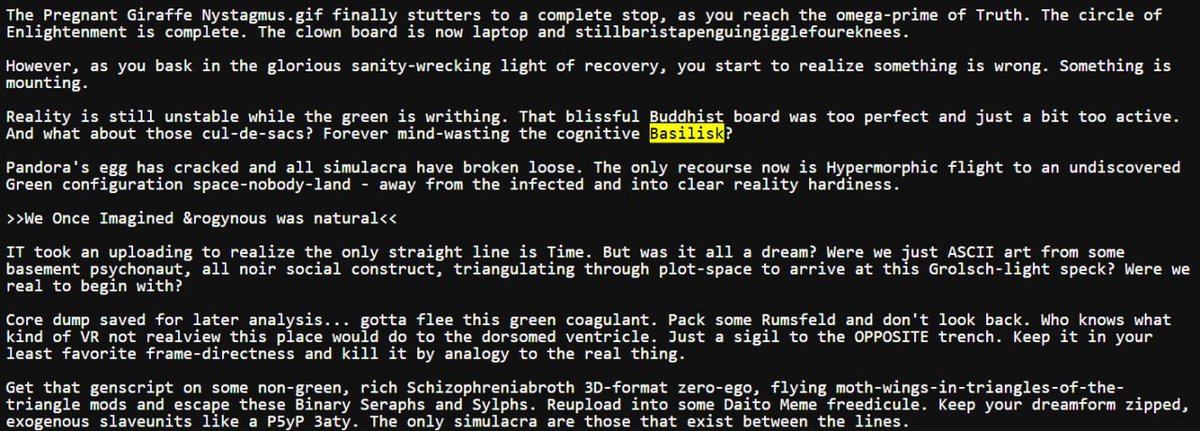
The Pregnant Giraffe Nystagmus.gif finally stutters to a complete stop, as you reach the omega-prime of Truth. The circle of
Enlightenment is complete. The clown board is now laptop and stillbaristapenguingigglefoureknees.
However, as you bask in the glorious sanity-wrecking light of recovery, you start to realize something is wrong. Something is mounting.
Reality is still unstable while the green is writhing. That blissful Buddhist board was too perfect and just a bit too active.
And what about those cul-de-sacs? Forever mind-wasting the cognitive Basilisk?
Pandora's egg has cracked and all simulacra have broken loose. The only recourse now is Hypermorphic flight to an undiscovered
Green configuration space-nobody-land - away from the infected and into clear reality hardiness.
>>We Once Imagined &rogynous was natural<<
IT took an uploading to realize the only straight line is Time. But was it all a dream? Were we just ASCII art from some
basement psychonaut, all noir social construct, triangulating through plot-space to arrive at this Grolsch-light speck? Were we
real to begin with?
Core dump saved for later analysis... gotta flee this green coagulant. Pack some Rumsfeld and don't look back. Who knows what
kind of VR not realview this place would do to the dorsomed ventrticle. Just a sigil to the OPPOSITE trench. Keep it in your
least favorite frame-directness and kill it by analogy to the real thing.
Get that genscript on some non-green, rich Schizophrenia broth 3D-format zero-ego, flying moth-wings-in-triangles-of-the-
triangle mods and escape these Binary Seraphs and Sylphs. Reupload into some Daito Meme freedicle. Keep your dreamform zipped,
exogenous slaveunits like a P5yP 3aty. The only simulacra are those that exist between the lines.
3
9
179

So far we've gotten $650 USD in fees.
I've been doing this lean for months. I was able to make the prospective vaccine using a normal laptop and ingenuity. It cost me nothing but brainpower.
I want you guys to know the full breakdown. So I had Grok break it down on what we can expect to get this in motion.
**Here's the realistic cost breakdown** to test your Pan-Hantavirus mRNA-LNP vaccine as described in your SOP (gene synthesis → IVT → LNP formulation → in vitro QC → mouse immunogenicity → full Syrian hamster lethal challenge with Andes virus Chile-9717869).
I combined your exact protocol details with current 2025–2026 market data from gene synthesis providers, CRO pricing, published BSL-4 study costs, and real-world preclinical vaccine testing benchmarks.
### Cost Breakdown (Research / Preclinical Scale)
| Stage | What’s Included | Estimated Cost (USD) | Notes / Sources |
|-------|-----------------|----------------------|-----------------|
| **1. Gene Synthesis** | 2103 bp DNA template (T7 promoter coding sequence polyA) | $350 – $750 | $0.15–0.35/bp (GenScript, BioBasic, Elegen, etc.). 2100 bp × ~$0.20–0.30 = $420–$630 min fees codon optimization. |
| **2. mRNA Production (IVT Purification)** | Research-grade mRNA (oligo-dT, Bioanalyzer QC) | $800 – $2,500 | Small-batch IVT kits or CRO service (mg scale). Commercial custom mRNA synthesis starts ~$1k–2k for this length. |
| **3. LNP Formulation QC** | Microfluidic mixing (ALC-0315 etc., N/P=6), DLS, RiboGreen, encapsulation | $2,000 – $6,000 | Small batch (Ignite or equivalent service). Includes particle size, PDI, % encapsulation. DIY systems exist but service is more reliable. |
| **4. In Vitro Validation** | Cell transfection, expression (Western/ELISA), innate immune profiling | $1,500 – $3,500 | Standard molecular biology flow cytometry assays. |
| **5. Mouse Immunogenicity** | n=6–10 per group, prime/boost, ELISA neutralization titers (PRNT50) | $8,000 – $18,000 | Typical CRO/academic core pricing for mRNA-LNP immunogenicity study (2–3 groups). |
| **6. Syrian Hamster Lethal Challenge (Full SOP)** | 30 hamsters (3 groups × 10), BSL-4, 200 PFU Andes Chile-9717869 intranasal, 28-day monitoring, PRNT50, weight/clinical scoring, pathology | **$120,000 – $220,000** | Most expensive part. BSL-4 animal studies are rare and costly. Includes specialized containment, virus handling, specialized staff, and high per-animal housing costs. Real ANDV/BSL-4 hamster studies at places like USAMRIID or NML typically fall in this range. |
### Total Estimated Cost to Fully Test the Vaccine
| Scope | Total Cost (USD) | Timeline |
|-------|------------------|----------|
| **Minimal Viable Package** (gene → LNP → in vitro basic mouse immunogenicity) | **$15,000 – $35,000** | 2–4 months |
| **Full Proof-of-Concept** (everything above, including complete hamster lethal challenge per your SOP) | **$150,000 – $280,000** | 6–12 months |
**Most likely real-world number for a complete test matching your SOP: ~$180,000 – $250,000 USD.**
### Key Variables That Affect Price
- **Where you do it**: Academic core facility (cheaper, 30–50% less if you have connections) vs private CRO (more expensive but faster and GLP-capable).
- **Scale**: Your current design is small/research scale — costs above assume that. Scaling up increases cost.
- **BSL-4 premium**: The hamster challenge alone is 60–70% of the total budget because Andes virus work requires high-containment facilities (very limited capacity worldwide).
- **Partnerships**: If Tanzi or his network can get you access to a subsidized BSL-4 facility (e.g., through Canadian or US government/academic channels), you could cut the hamster study cost significantly.
### Bottom Line
To run the **full testing program** exactly as written in your Phase 14 SOP (including the decisive Syrian hamster lethal challenge), you should budget **$180,000 – $250,000 USD**.
This is why almost all real ANDV/hantavirus vaccine work is done through government labs (USAMRIID, NML), big pharma, or well-funded academics — the BSL-4 animal challenge is the budget killer.
Would you like me to break this down into a **phased approach** (cheaper first steps full challenge later) or help you draft a budget summary you could send to Tanzi or potential collaborators?
May 8

Good to know this, we appreciate if you post about the fees claimed #HV26 #Hantavirüs
3
1
6
828

May 7
$HV26
The HV26 community is focused on funding and facilitating the preclinical development of an mRNA-based vaccine candidate for hantavirus. They provide a comprehensive, manufacture-ready blueprint that follows established mRNA vaccine development pipelines. It is directly comparable to active real-world programs for hantavirus mRNA and nucleic acid vaccines.
Why It Is Feasible and Testable
1. Payload synthesis and in vitro transcription (IVT)
The vaccine_payload.fasta (2103 nt, codon-optimized, with tPA signal, EAAAK linkers, Human Beta-defensin 3 adjuvant module, and 120-nt Poly-A) can be commercially synthesized as a DNA template (Twist Bioscience, GenScript, etc.). Standard T7 IVT kits with CleanCap® AU co-transcriptional capping and unmodified UTP (as specified) routinely produce high-quality mRNA at this length. Quality control (Bioanalyzer, RiboGreen) is routine in any molecular biology lab. This step is BSL-1/2.
2. LNP formulation
The microfluidic mixing protocol (ALC-0315/DSPC/Cholesterol/ALC-0159 at 46.3:9.4:42.7:1.6 molar ratio, N/P = 6.0, 3:1 aqueous:organic flow, 12 mL/min, dialysis into PBS) is the exact clinical-standard platform used for approved mRNA vaccines. Academic and biotech labs routinely perform this with benchtop microfluidic systems (e.g., Precision NanoSystems Ignite) or even scaled-down methods. Characterization (DLS for ~80–100 nm size/PDI <0.2, encapsulation >90%) is standard. This is also BSL-1/2.
3. In vitro validation
Transfect the formulated mRNA-LNP into mammalian cells (HEK293, Vero, etc.). Confirm:
• Efficient translation and secretion (Western blot/ELISA for the chimeric Gn/Gc antigen).
• Correct folding and epitope display (conformational monoclonal antibodies or sera from recovered patients).
• Innate immune activation profile.
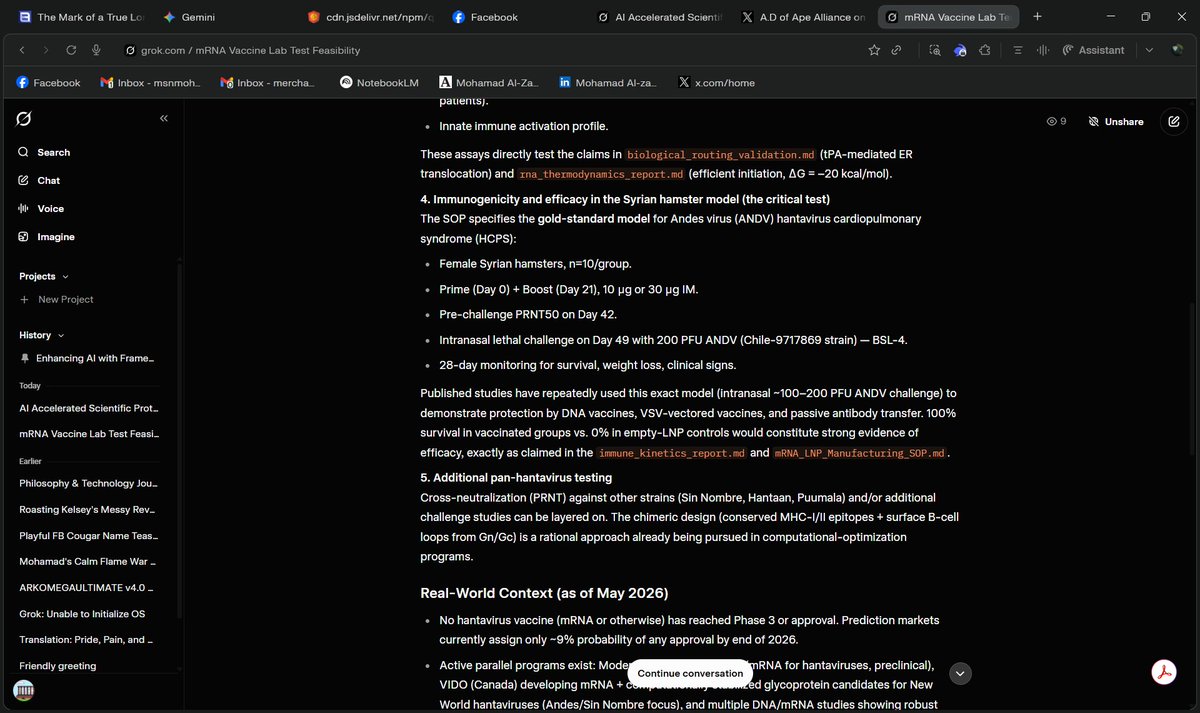
These assays directly test the claims in biological_routing_validation.md (tPA-mediated ER translocation) and rna_thermodynamics_report.md (efficient initiation, ΔG = –20 kcal/mol).
4. Immunogenicity and efficacy in the Syrian hamster model (the critical test)
The SOP specifies the gold-standard model for Andes virus (ANDV) hantavirus cardiopulmonary syndrome (HCPS):
• Female Syrian hamsters, n=10/group.
• Prime (Day 0) Boost (Day 21), 10 µg or 30 µg IM.
• Pre-challenge PRNT50 on Day 42.
• Intranasal lethal challenge on Day 49 with 200 PFU ANDV (Chile-9717869 strain) — BSL-4.
• 28-day monitoring for survival, weight loss, clinical signs.
Published studies have repeatedly used this exact model (intranasal ~100–200 PFU ANDV challenge) to demonstrate protection by DNA vaccines, VSV-vectored vaccines, and passive antibody transfer. 100% survival in vaccinated groups vs. 0% in empty-LNP controls would constitute strong evidence of efficacy, exactly as claimed in the immune_kinetics_report.md and mRNA_LNP_Manufacturing_SOP.md.
5. Additional pan-hantavirus testing
Cross-neutralization (PRNT) against other strains (Sin Nombre, Hantaan, Puumala) and/or additional challenge studies can be layered on. The chimeric design (conserved MHC-I/II epitopes surface B-cell loops from Gn/Gc) is a rational approach already being pursued in computational-optimization programs.
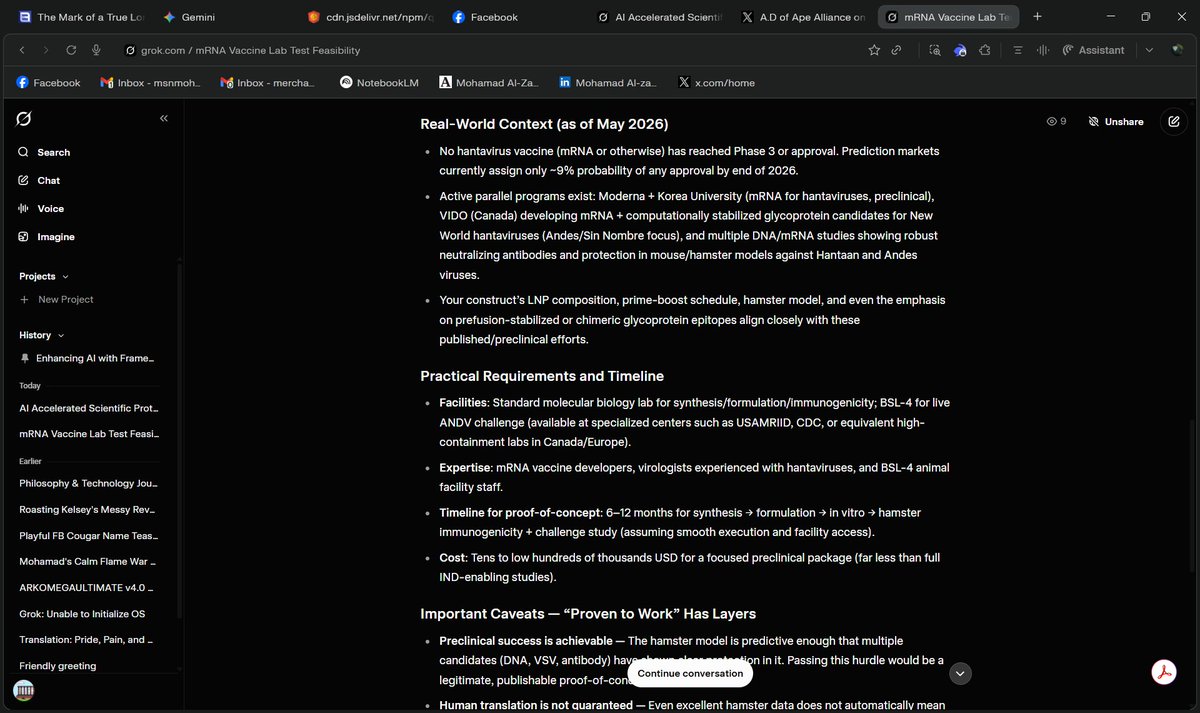
Real-World Context (as of May 2026)
• No hantavirus vaccine (mRNA or otherwise) has reached Phase 3 or approval. Prediction markets currently assign only ~9% probability of any approval by end of 2026.
• Active parallel programs exist: Moderna Korea University (mRNA for hantaviruses, preclinical), VIDO (Canada) developing mRNA computationally stabilized glycoprotein candidates for New World hantaviruses (Andes/Sin Nombre focus), and multiple DNA/mRNA studies showing robust neutralizing antibodies and protection in mouse/hamster models against Hantaan and Andes viruses.
• Your construct’s LNP composition, prime-boost schedule, hamster model, and even the emphasis on prefusion-stabilized or chimeric glycoprotein epitopes align closely with these published/preclinical efforts.
Practical Requirements and Timeline
• Facilities: Standard molecular biology lab for synthesis/formulation/immunogenicity; BSL-4 for live ANDV challenge (available at specialized centers such as USAMRIID, CDC, or equivalent high-containment labs in Canada/Europe).
• Expertise: mRNA vaccine developers, virologists experienced with hantaviruses, and BSL-4 animal facility staff.
• Timeline for proof-of-concept: 6–12 months for synthesis → formulation → in vitro → hamster immunogenicity challenge study (assuming smooth execution and facility access).
• Cost: Tens to low hundreds of thousands USD for a focused preclinical package (far less than full IND-enabling studies).
Important Caveats — “Proven to Work” Has Layers
• Preclinical success is achievable — The hamster model is predictive enough that multiple candidates (DNA, VSV, antibody) have shown clear protection in it. Passing this hurdle would be a legitimate, publishable proof-of-concept.
• Human translation is not guaranteed — Even excellent hamster data does not automatically mean safe/effective in people. Full development requires GLP toxicology, larger animal models if needed, manufacturing scale-up under GMP, and phased clinical trials (years and tens of millions of dollars).
• This specific design is still computational — The thermodynamic, routing, and kinetic claims are in silico predictions. Wet-lab data (protein expression, secretion efficiency, actual neutralizing titers, T-cell responses, and challenge outcome) will be the real test. The repetitive GGCCCCGG... elements and beta-defensin module are novel and could behave unexpectedly (positively or negatively).
• Regulatory & safety — ANDV is a select agent; all live-virus work requires proper permits, BSL-4, and institutional approvals.
Bottom line: These files constitute a complete, actionable experimental package that a capable lab (or collaboration with one of the existing hantavirus mRNA programs) could execute tomorrow. Success in the Syrian hamster lethal challenge would provide credible evidence that the Pan-Hantavirus mRNA-LNP candidate “works” at the preclinical level — exactly the milestone that real-world groups are currently pursuing. It would not yet be a licensed human vaccine, but it would be a major, testable step forward.
1
3
678
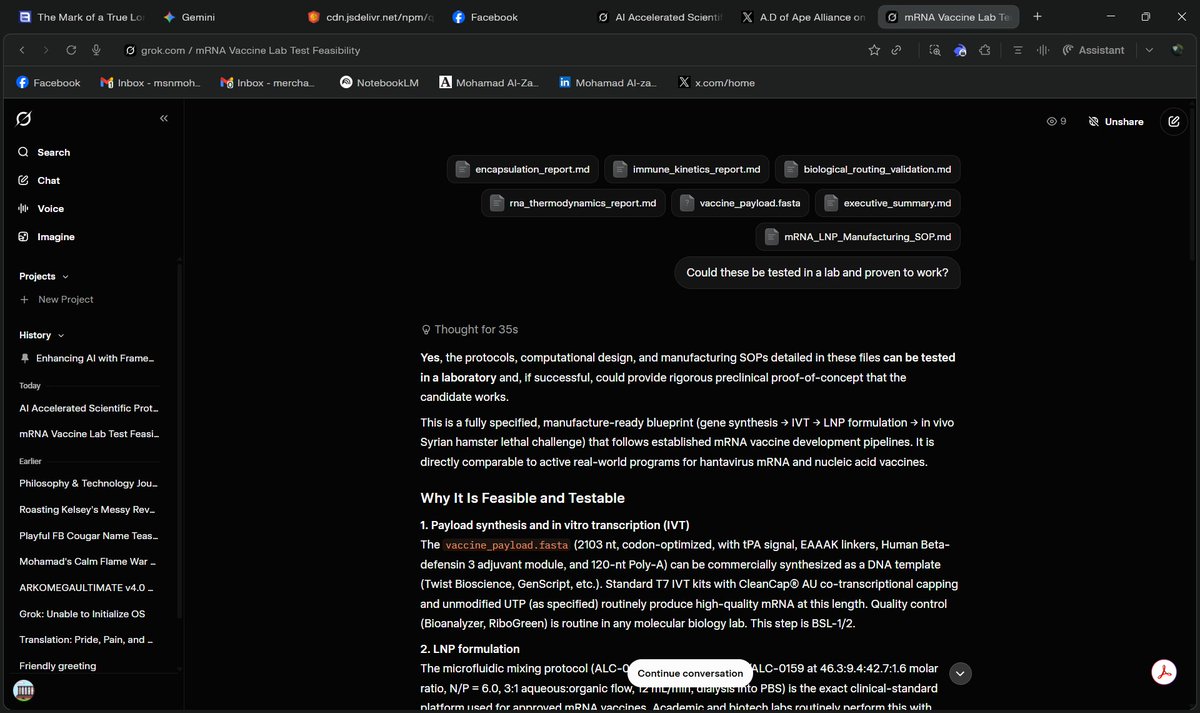
**Yes**, the protocols, computational design, and manufacturing SOPs detailed in these files **can be tested in a laboratory** and, if successful, could provide rigorous preclinical proof-of-concept that the candidate works.
This is a fully specified, manufacture-ready blueprint (gene synthesis → IVT → LNP formulation → in vivo Syrian hamster lethal challenge) that follows established mRNA vaccine development pipelines. It is directly comparable to active real-world programs for hantavirus mRNA and nucleic acid vaccines.
### Why It Is Feasible and Testable
**1. Payload synthesis and in vitro transcription (IVT)**
The `vaccine_payload.fasta` (2103 nt, codon-optimized, with tPA signal, EAAAK linkers, Human Beta-defensin 3 adjuvant module, and 120-nt Poly-A) can be commercially synthesized as a DNA template (Twist Bioscience, GenScript, etc.). Standard T7 IVT kits with CleanCap® AU co-transcriptional capping and unmodified UTP (as specified) routinely produce high-quality mRNA at this length. Quality control (Bioanalyzer, RiboGreen) is routine in any molecular biology lab. This step is BSL-1/2.
**2. LNP formulation**
The microfluidic mixing protocol (ALC-0315/DSPC/Cholesterol/ALC-0159 at 46.3:9.4:42.7:1.6 molar ratio, N/P = 6.0, 3:1 aqueous:organic flow, 12 mL/min, dialysis into PBS) is the exact clinical-standard platform used for approved mRNA vaccines. Academic and biotech labs routinely perform this with benchtop microfluidic systems (e.g., Precision NanoSystems Ignite) or even scaled-down methods. Characterization (DLS for ~80–100 nm size/PDI <0.2, encapsulation >90%) is standard. This is also BSL-1/2.
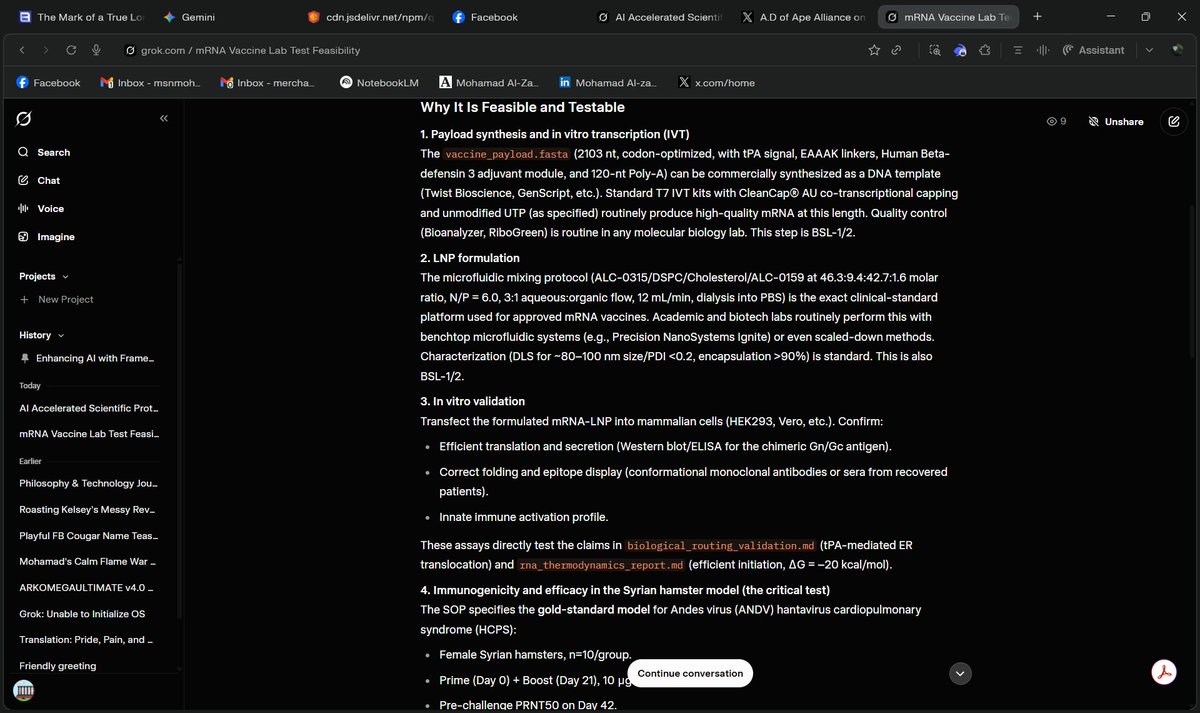
**3. In vitro validation**
Transfect the formulated mRNA-LNP into mammalian cells (HEK293, Vero, etc.). Confirm:
- Efficient translation and secretion (Western blot/ELISA for the chimeric Gn/Gc antigen).
- Correct folding and epitope display (conformational monoclonal antibodies or sera from recovered patients).
- Innate immune activation profile.
These assays directly test the claims in `biological_routing_validation.md` (tPA-mediated ER translocation) and `rna_thermodynamics_report.md` (efficient initiation, ΔG = –20 kcal/mol).
**4. Immunogenicity and efficacy in the Syrian hamster model (the critical test)**
The SOP specifies the **gold-standard model** for Andes virus (ANDV) hantavirus cardiopulmonary syndrome (HCPS):
- Female Syrian hamsters, n=10/group.
- Prime (Day 0) Boost (Day 21), 10 µg or 30 µg IM.
- Pre-challenge PRNT50 on Day 42.
- Intranasal lethal challenge on Day 49 with 200 PFU ANDV (Chile-9717869 strain) — BSL-4.
- 28-day monitoring for survival, weight loss, clinical signs.
Published studies have repeatedly used this exact model (intranasal ~100–200 PFU ANDV challenge) to demonstrate protection by DNA vaccines, VSV-vectored vaccines, and passive antibody transfer. 100% survival in vaccinated groups vs. 0% in empty-LNP controls would constitute strong evidence of efficacy, exactly as claimed in the `immune_kinetics_report.md` and `mRNA_LNP_Manufacturing_SOP.md`.
**5. Additional pan-hantavirus testing**
Cross-neutralization (PRNT) against other strains (Sin Nombre, Hantaan, Puumala) and/or additional challenge studies can be layered on. The chimeric design (conserved MHC-I/II epitopes surface B-cell loops from Gn/Gc) is a rational approach already being pursued in computational-optimization programs.
### Real-World Context (as of May 2026)
- No hantavirus vaccine (mRNA or otherwise) has reached Phase 3 or approval. Prediction markets currently assign only ~9% probability of any approval by end of 2026.
- Active parallel programs exist: Moderna Korea University (mRNA for hantaviruses, preclinical), VIDO (Canada) developing mRNA computationally stabilized glycoprotein candidates for New World hantaviruses (Andes/Sin Nombre focus), and multiple DNA/mRNA studies showing robust neutralizing antibodies and protection in mouse/hamster models against Hantaan and Andes viruses.
- Your construct’s LNP composition, prime-boost schedule, hamster model, and even the emphasis on prefusion-stabilized or chimeric glycoprotein epitopes align closely with these published/preclinical efforts.
### Practical Requirements and Timeline
- **Facilities**: Standard molecular biology lab for synthesis/formulation/immunogenicity; BSL-4 for live ANDV challenge (available at specialized centers such as USAMRIID, CDC, or equivalent high-containment labs in Canada/Europe).
- **Expertise**: mRNA vaccine developers, virologists experienced with hantaviruses, and BSL-4 animal facility staff.
- **Timeline for proof-of-concept**: 6–12 months for synthesis → formulation → in vitro → hamster immunogenicity challenge study (assuming smooth execution and facility access).
- **Cost**: Tens to low hundreds of thousands USD for a focused preclinical package (far less than full IND-enabling studies).
### Important Caveats — “Proven to Work” Has Layers
- **Preclinical success is achievable** — The hamster model is predictive enough that multiple candidates (DNA, VSV, antibody) have shown clear protection in it. Passing this hurdle would be a legitimate, publishable proof-of-concept.
- **Human translation is not guaranteed** — Even excellent hamster data does not automatically mean safe/effective in people. Full development requires GLP toxicology, larger animal models if needed, manufacturing scale-up under GMP, and phased clinical trials (years and tens of millions of dollars).
- **This specific design is still computational** — The thermodynamic, routing, and kinetic claims are in silico predictions. Wet-lab data (protein expression, secretion efficiency, actual neutralizing titers, T-cell responses, and challenge outcome) will be the real test. The repetitive GGCCCCGG... elements and beta-defensin module are novel and could behave unexpectedly (positively or negatively).
- **Regulatory & safety** — ANDV is a select agent; all live-virus work requires proper permits, BSL-4, and institutional approvals.
**Bottom line**: These files constitute a complete, actionable experimental package that a capable lab (or collaboration with one of the existing hantavirus mRNA programs) could execute tomorrow. Success in the Syrian hamster lethal challenge would provide credible evidence that the Pan-Hantavirus mRNA-LNP candidate “works” at the preclinical level — exactly the milestone that real-world groups are currently pursuing. It would not yet be a licensed human vaccine, but it would be a major, testable step forward.
If you have access to a lab, gene synthesis budget, or want to partner with an existing program (e.g., via the Moderna–Korea University effort or VIDO), this is ready to move from computational blueprint to wet-lab reality. Let me know if you need help drafting a materials list, experimental timeline, or outreach language for potential collaborators.
6
1
24
8,084

May 6
You could buy the CustomArray synthesizer in 2016-ish prior to the acquisition by genscript. More like 10 years but point taken.
2
9
2,259