
9 Nov 2025
The next evolution of creation isn’t written it’s reasoned.
That’s why @infinityg_ai is redefining how the world builds on-chain.
Forget typing syntax.
You describe your vision and an army of autonomous AI agents design, code, audit, and deploy your dApp.
It’s not automation. It’s cognition.
InfinityGround is the first Agentic IDE a decentralized system where:
‣ Each AI agent understands intent, maps logic, and collaborates in real-time
‣ Smart contracts, UI, backend, and deployment happen in one reasoning loop
‣ Every build teaches the network, compounding intelligence with every app
This is AI × Web3 at full convergence.
A living development ecosystem powered by self-improving intelligence.
🧠 17M wallets
⚙️ 121K dApps
🤝 Partnered with @virtuals_io, GraphLinqChain, HelloBlockus
🎮 Games like Cat Academia and apps like Crypto Digest all built in hours, not months.
InfinityGround isn’t just making development faster it’s making intelligence build itself.
Each line of reasoning strengthens the network. Each prompt evolves the codebase.
The frontier of creation is here.
Agentic. Autonomous
9
12
22
106

7 Sep 2025
By this time my mom was already screaming at the top of her voice 🥲
So I’ll leave my pen here 🖊️📃
To go enjoy my mom’s delicacy
See ya 😉
I’ll drop the links below 👇
So you can check it out and be amazed
Now dad has more time for mom
All thanks to #GraphLinqChain 🤗
1
4
125

7 Sep 2025
"LAUNCHING YOUR TOKEN MADE EASY WITH GRAPHAI"
Yes, you heard me right!
You can now launch your tokens easily using GraphAI on the Graphlinq chain, @graphlinq_proto (or any other EVM chain).
Walk with me.......🧵
#GraphAI #DefAI #Graphlinqchain $GLQ
5
6
20
335

7 Sep 2025
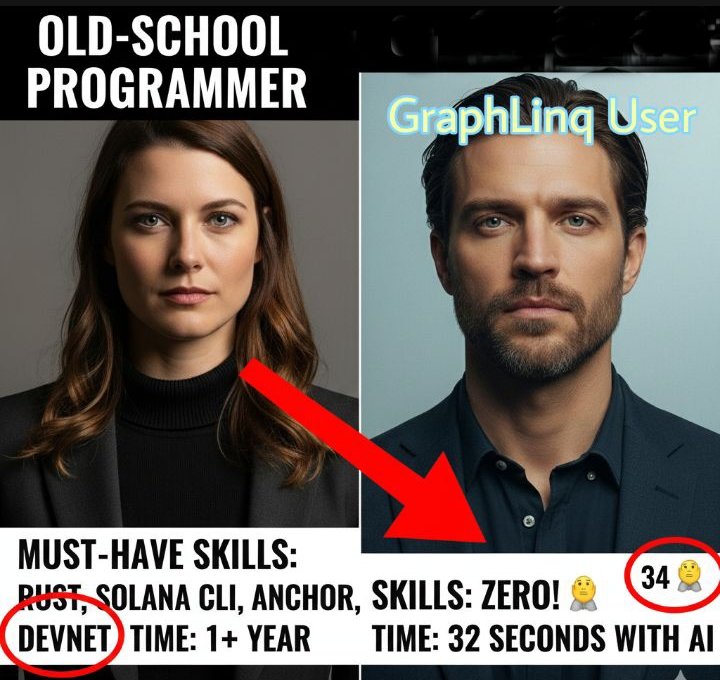
The deeper you go into crypto, the more you realize: building things isn’t easy.
Launching a token? You need Solidity.
Running a trading bot? You need Python.
Auditing a smart contract? Better hire a guy who hasn’t slept in 3 days.
For most of us, it feels like you need to be half dev, half wizard just to survive.
That’s why @graphlinq_proto caught my attention.
Instead of writing scripts, you just write prompts.
Instead of hours of setup, you get answers in seconds.
I decided to test it out… and let’s just say, things got interesting 👇
Thanks to @topsdotfun for this spotlight.
$GLQ #GraphLinqChain #DefAI
22
14
92
1,672

3. Click "Agent Session" locate your Deployed agent and start conversing with your Agent.
With Easy prompts you can build a tool on graphai.graphlinq.io/ that will help you solve problems and gain easy access to blochain.
Don't snooze get started today
#Graphlinqchain #DefAI
1
44

7 Sep 2025
Official Links
-Website: graphlinq.io
-Docs: docs.graphlinq.io
-GraphAI: graphai.graphlinq.io
-X: x.com/graphlinq_proto
-Discord: discord.gg/graphlinq
-Telegram: t.me/graphlinq
$GLQ #GraphAI #GraphLinqChain #DefAI
5
159
7 Sep 2025
I’ve spent years in DeFi, watching positions, checking dashboards, praying I don’t miss the next big move.
One mistake, one late reaction, and you’re wiped out.
That was me until I tried GraphAI by @graphlinq_proto.
#GraphAI #DeFAI #GraphLinqChain $GLQ
61
2
60
3,738

7 Sep 2025
Right now, DeFi traders spend hours switching through:
➮ Checking balances across wallets
➮ Tracking yields across protocols
➮ Monitoring on-chain data
➮ Manually moving assets
It is fragmented, wastes time and is prone to errors.
#GraphLinqChain $GLQ
1
1
19
149

7 Sep 2025
After being into crypto for a while, most of us want to create our own tokens. Sometimes just for fun, other times to make profit.
The problem? Coding, debugging, audits… it’s messy. 😅
That’s why discovering @graphlinq_proto felt unreal. Imagine deploying an ERC20 token with one prompt, that's faster than brewing coffee.😁
And yes, I discovered this innovative project via @topsdotfun campaign.
Now here’s my take on #GraphAI 👇
#GraphLinqChain #DefAI $GLQ
32
26
86
2,562

7 Sep 2025
As a web3 jobber, we can all agree that nothing beats catching projects early.
But to do that, you’d have to filter on different websites, turn on post notifications, or even fall for influencers promising fake plays.
There’s this tool you’ve been fading, you can use it to spot early projects with just a few prompts.
The tool is powered by @graphlinq_proto and I created it myself
I’ll show you …. 🧶🪡🔻
#GraphAI #DefAI #GraphLinqChain $GLQ
60
2
115
897

7 Sep 2025
As someone who's spent a fair amount of time in Web3.
I can confidently tell you that the complexity of BLOCKCHAIN tasks, is a major obstacle for most.
Even for people who grasp the core concepts.
I mean, we've all had this experience of:
Staring at a liquidity pool, trying to figure out if a certain new token listing is worth the risk.
OR
Wanting to keep an eye on a wallet without having to manually check Etherscan every five minutes.
The struggle is very real.
You'll definitely wish you could just bypass such obstacles entirely...
Like simply talk to a dApp and tell it what you want to do.
Guess what,
I've had my eyes on @graphlinq_proto and I got what you and I have been searching for.
Yes it's been a genuine change (for good) in how I'll approach on-chain tasks now and in the future.
——
GraphLinq’s vision is to make powerful blockchain tools accessible to everyone.
Think of GraphLinq as a platform that empowers both experienced developers & non experienced developers.
By providing systems to automate complex workflows
Using natural language prompts or no-code/drag-and-drop frameworks.
It eradicates the need to wrestle with scripts or complex syntax.
You just tell the system what you need, and it builds it for YOU!
——
Instead of building complex graphs with logical blocks
You can now achieve the same results with a single, conversational prompt.
For instance...
A couple friends of mine always wanted to track the movements of a known whale on the Aave protocol to see how they manage their health factor.
Aave's health factor is a critical metric for borrowers, indicating the safety of their loan.
If the health factor drops too low, their collateral gets liquidated.
——
Manually tracking this is a chore.
With GraphAI, one can simply type in:
“Monitor the health factor of wallet 0xabc... on Aave and send me a Telegram alert if it drops below 1.1.”
The AI assistant instantly generates a working automation.
That connects to the Aave subgraph, pulls the specific wallet's data, set a trigger condition, and integrate with the Telegram API.
What would take hours of learning the right blocks
and testing the connections can be done in seconds.
——
Another area of GraphAI is automated trading bots.
An article on the GraphLinq blog details this.
But experiencing it firsthand is something else entirely.
The prompts are remarkably straightforward.
For a simple DEX arbitrage bot, you could use a prompt like:
“Build a cross-chain arbitrage bot that monitors liquidity pools on Uniswap and PancakeSwap for ETH/USDT and alerts me on Telegram when an arbitrage opportunity of more than 0.5% appears, accounting for gas and slippage.”
The bot was created from this single instruction
And within a few minutes, it was already live.
The engine’s ability to process real-time data streams and make on-the-fly decisions.
Based on predefined conditions is what makes GraphLinq so powerful.
——
The fact that the GraphLinq ecosystem
is built on a custom blockchain called GraphLinq Chain which is
An AI-powered, EVM-compatible Proof-of-Authority (PoA) Layer 1.
Means automations will run with speed, security, low fees and high reliability.
Which is a key consideration for constant monitoring tasks.
——
Of course in every moving force, there's always a kind of fuel.
In GraphLinq's case it's the $GLQ token, which acts as more than just a currency.
It's what powers every transaction
Every graph execution, and every prompt-powered AI interaction...
[#GraphAI #DefAI #GraphLinqChain $GLQ]
87
1
118
3,320

7 Sep 2025
🤔 Quick quiz: How would you launch your first ERC20 token?
A) Spend hours writing Solidity
B) Debug endlessly on testnets
C) Type a single prompt into #GraphAI…
“I went with C”
and here’s exactly how it played out 👇
#DefAI #GraphLinqChain $GLQ
1
3
9
139

For teams and DAOs, it means less overhead and more focus on execution.
And for the industry as a whole,
it’s one of the clearest bridges yet between AI and blockchain
not hype, but practical workflows people can use today.
#DefAI #GraphLinqChain
1
6
21

6 Sep 2025
i’ve always loved the idea of automation in web3, but it felt too far away.
something reserved for developers.
then i found GraphAI by @graphlinq_proto
for the first time, it felt like the blockchain was finally speaking my language.
#GraphAI #DefAI #GraphLinqChain $GLQ
46
8
54
2,148

6 Sep 2025
This is just the start.
GraphAI GraphLinq Chain is a gateway for both devs & non-devs into the future of AI-driven DeFi automation.
Want to try it? → graphai.graphlinq.io
#GraphAI #DefAI #GraphLinqChain $GLQ
8
94
6 Sep 2025
Imagine creating a trading bot, setting up whale alerts, or tracking DeFi health factors, just by typing what you want.
That’s GraphAI, powered by @graphlinq_proto
Let me show you how it works how to get started 👇
#GraphAI #DefAI #GraphLinqChain $GLQ
15
16
56
1,987

6 Sep 2025
Every second in crypto, people are losing money… not because they made the wrong trade, but because they couldn’t act fast enough. What if you could fix that?”
Let’s talk about the @graphlinq_proto Ecosystem a no-code AI-powered platform that makes blockchain automation accessible to everyone.
From creating bots to launching on-chain workflows, GraphLinq is a game-changer. 🧵⬇️
#GraphAI #DefAI #GraphLinqChain $GLQ
42
1
45
2,174

5 Sep 2025
Catching the next 100x token has never been easy.
=> Without tools, you’ll always be late.
=> Without speed, still behind.
That’s where GraphAI comes in, discovery/seamless token launches all in one
Watch how we solve the problem user faces
#GraphAI #DefAI #GraphLinqChain $GLQ
32
12
68
1,608

4 Sep 2025
For more information check ⤵️
graphlinq.io
Join the community: t.me/graphlinq
Follow for updates: @GraphLinqChain
#GraphAI #DefAI #GraphLinQChain $GLQ
3
14
279

4 Sep 2025
“Make you first $100,000 in 3 months in Web3”
Whether that is true or not, Why not ask the right questions?
How did @SamuelXeus make his bands? 💰
Early in his Web3 days, even now he trades MEMECOINS.
Just any memcoins? I don’t think so.
It’s no news that can only be by repeating what works- tracking WHALES WALLETS.
Not everyone can track whales whales but you can now using @graphlinq_proto !
We’ll discuss all of these in details in this thread 🧵 👇
#GraphAI #DefAI #GraphLinqChain $GLQ
46
22
45
1,195