If your organization is scaling AI initiatives, it may be time to move beyond static data models toward self-learning intelligence systems.
Know more: narwal.ai/narwal-self-learni…
#KnowledgeGraph #EnterpriseAI #DataIntelligence #AITransformation #GraphAI #DataStrategy #Narwal
1
10

Jun 11
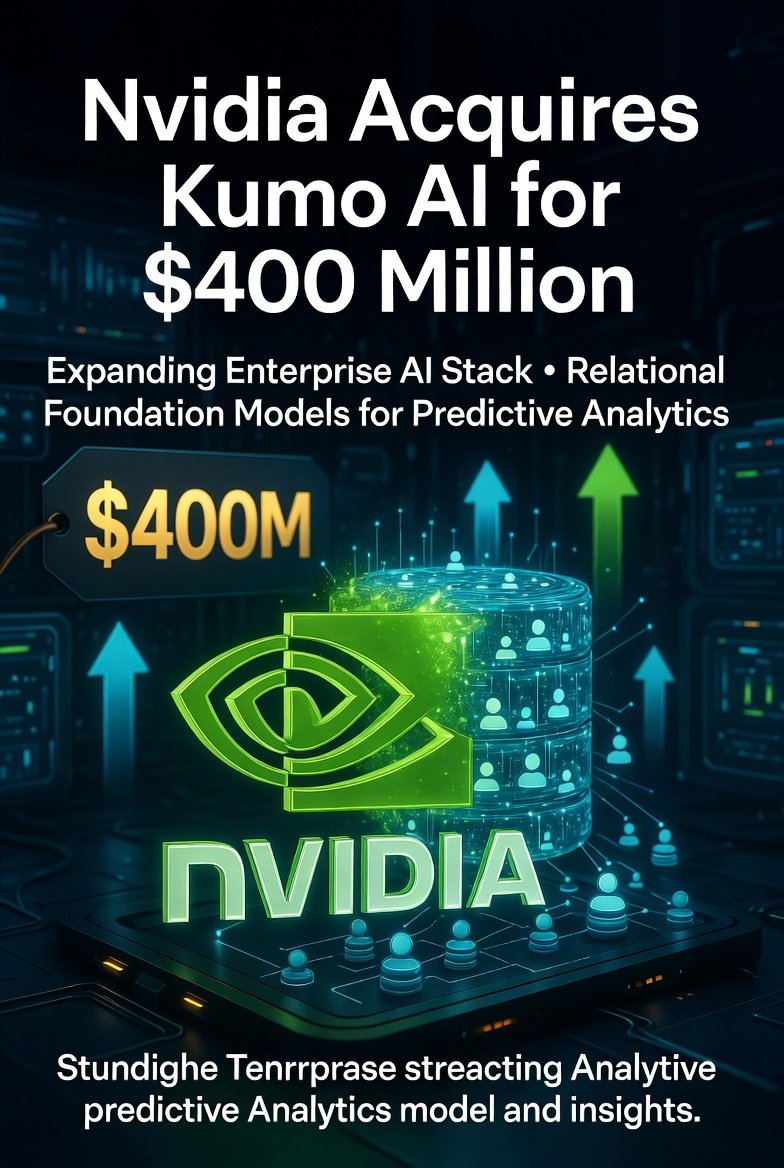
TECHNOLOGY NEWSWIRE: Nvidia Reports Acquisition of Kumo AI for $400 Million
Nvidia is expanding its enterprise software capabilities by acquiring Kumo AI to integrate relational foundation models into its predictive analytics stack.
Nvidia is quietly expanding its grip on the enterprise AI stack, reportedly acquiring Kumo AI in a deal valued at over $400 million.
While the chipmaker has yet to issue a formal announcement, the move signals a strategic shift.
Nvidia is no longer content with merely selling the hardware that powers AI.
it is aggressively moving to control the software layers that turn raw business data into actionable predictions.
For years, generative AI has excelled at processing unstructured data like text and images, leaving the vast, structured troves of information in relational databases largely untapped.
Kumo AI addresses this gap with its relational foundation model, which treats database records as nodes in a graph.
This allows companies to run complex predictive tasks—such as churn analysis, fraud detection, and demand forecasting—without the months of manual feature engineering typically required by traditional machine learning pipelines.
By bringing this technology in-house, Nvidia is positioning itself to offer predictive analytics as a seamless, bundled capability for the enterprise.
This acquisition carries significant weight for technology leaders.
If Nvidia integrates Kumo’s technology into its existing enterprise software suite, it could drastically lower the cost and complexity of deploying predictive AI.
However, the move creates friction for major data warehousing platforms like Snowflake and Databricks, which now find a powerful predictive AI vendor absorbed by a critical hardware partner.
While the integration roadmap remains unconfirmed and the technology faces the challenge of independent validation, the deal represents a calculated bet.
Nvidia is betting that the next massive wave of enterprise value lies within the data warehouse, and it is moving early to ensure that when that wave breaks, the underlying intelligence is powered by its own ecosystem.
FILED UNDER:
#Nvidia, #NvidiaAcquisition, #KumoAI, #NvidiaKumo, #EnterpriseAI, #RelationalAI, #PredictiveAnalytics, #AIAcquisition, #DataWarehouseAI, #GraphAI, #NvidiaSoftware, #AIstack, #RelationalFoundationModel, #FraudDetectionAI, #ChurnPrediction, #DemandForecasting, #NvidiaEnterprise, #AIacquisition, #TechMergers, #PredictiveAI, #DataGraph, #NvidiaNews, #EnterpriseSoftware, #AIdatabases, #400MillionDeal, #NvidiaStrategy, #AIModels, #WarehouseAI, #NvidiaExpansion, #RelationalDatabaseAI, #AIPoweredAnalytics, #TechAcquisition, #NvidiaAI, #BusinessIntelligence, #GraphNeuralNets, #EnterprisePredictive, #NvidiaKumoAI, #AIEcosystem, #DataScienceAI, #CorporateAI, #Nvidia2026, #TechnologyNewswire, #PredictiveModeling, #DatabaseAI, #NvidiaBet, #EnterpriseStack, #AIintegration, #TechConsolidation, #AIfoundationModels
2
166

Jun 10
Everyone needs a context layer, but what exactly is it and how do you get one?
Many organizations are looking for advice on private context. They all start the same way: "how do we make our context usable for agents?" The phrasing is always the same. What's underneath it never is.
The moment you look closely, it breaks apart into several different problems that only look alike from a distance.
What actually sorts this space, Elisenda Bou-Balust argues, is the kind of context you're dealing with. That decides what exists to work with and which tools are even on the table.
Together with Miguel Arias they consolidated the whole landscape into one map.
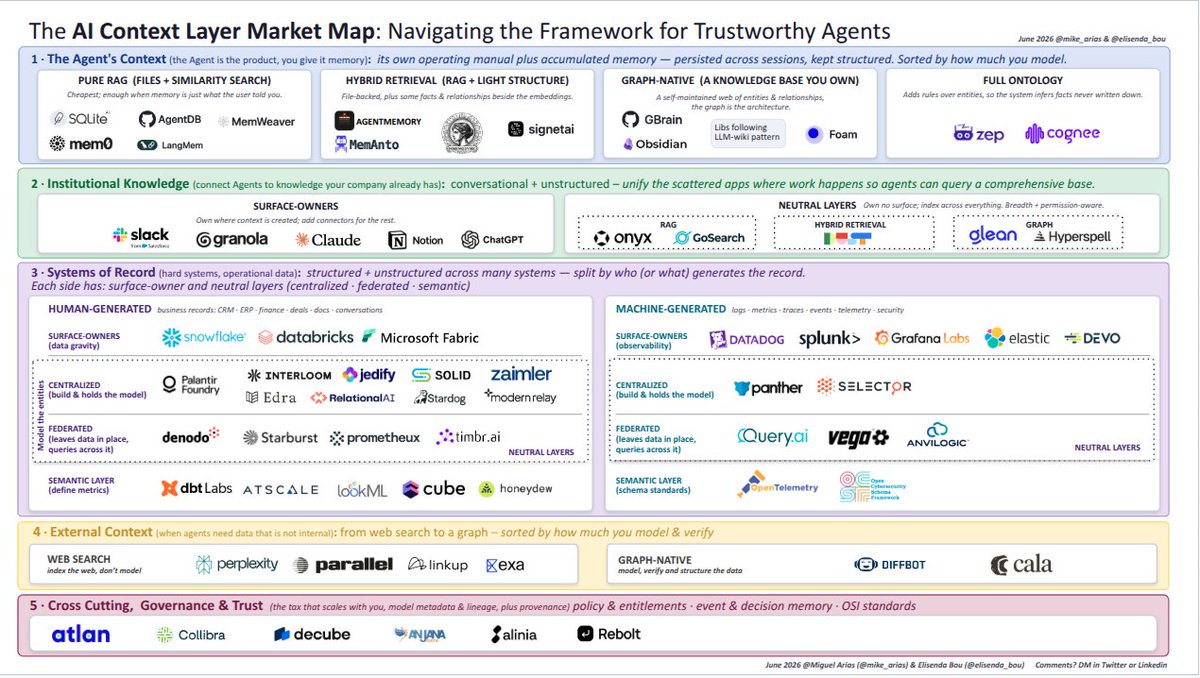
The AI Context Layer Market Map lays out the entire space on a single page:
→ Bucket 1: the agent's context. Its own memory and operating manual, sorted by how much you model: pure RAG → hybrid → graph-native → full ontology.
→ Bucket 2: institutional knowledge. The scattered docs, chats and tickets your company already lives in. Surface-owners (who own where work happens) vs. neutral layers (who index across everything).
→ Bucket 3: systems of record. The hard operational data, split by who (or what) generates it: human-generated business records and machine-generated telemetry. Each side has its surface-owners and its neutral layers: centralized, federated, semantic.
→ Plus the two things that cut across all of it: governance & trust (the tax that scales with you), and the emerging public data context layer (verified facts and data from the world, so agents can query external knowledge).
Caveat: it's not exhaustive and it's a snapshot of a fast-moving space.
Plus, as Tony Seale argues: You Can't Buy Your Own Context
Everyone is suddenly racing to sell you your own context. But a context you can buy is a context your competitors can buy too.
Barely a week passes now without another "context layer", "context graph", or "context foundation" for your AI agents - your organisation's reasoning, its exceptions, its hard-won workarounds, packaged up and ready to plug in.
The whole industry is starting to agree that context is the missing piece. It sounds like precisely what the moment demands. But here is the kicker - it is precisely the thing you cannot just buy.
Your context is not a feature you bolt on. It is your model of your own world - the thing that lets your organisation perceive, predict, and act as a single, coherent entity.
Every system that survives does the same thing: it holds a boundary between itself and the world, and works without pause to keep what's inside coherent against a world that never stops trying to throw it off.
That boundary is the difference between being a system and being a pile of parts. Your connected data, your ontology, your formalised meaning is that boundary.
GraphAI is the category where graph structure stops being passive infrastructure and starts doing active work, shaping what models retrieve, what agents remember, and what machine learning algorithms learn.
State of the Graph is mapping a new frontier: how graphs are being used inside AI systems.
Every AI company needs a context layer. Nobody agrees what that is. linkedin.com/pulse/every-ai-…
The AI Context Layer Market Map linkedin.com/posts/elisendab…
Why You Can't Buy Your Own Context linkedin.com/posts/tonyseale…
GraphAI as the Emerging Frontier on the Graph World Map stateofthegraph.com/2026/04/…
--
The Year of the Graph's Spring 2026 newsletter issue on all things #KnowledgeGraph, #GraphDB, Graph #Analytics / #DataScience / #AI and #SemTech is coming soon.
Subscribe and follow to be in the know. Reach out if you'd like to be featured 👇
yearofthegraph.xyz/newslette…
1
1
10
408


A month out from KGC 2026, we are starting a four-part series with co-founder François Scharffe on what Knowledge Engineering actually is and where it is headed.
First video is up. Check it out!
More about KGC :knowledgegraph.tech
#KGC2026 #KnowledgeGraph #GraphAI
1
116

Nee, het is een tendentieuze opmerking van ú. Toen Paulus zijn brieven schreef (rond het midden van de eerste eeuw), had hij wel degelijk een vaste, gezaghebbende Schrift die hij letterlijk aanduidde met het Griekse woord Graphè (Schrift) of Graphai (Schriften).
2
34
Evaluating Knowledge Graph Construction Methods and Graph Neural Networks
Knowledge graphs play an increasingly central role in a wide range of artificial intelligence applications. When combined with Graph Neural Networks (GNNs), they have demonstrated strong performance across numerous tasks, including node classification, relation prediction, and knowledge graph completion.
Knowledge graphs automatically constructed from text are increasingly used in real-world applications. However, their inherent noise, fragmentation, and semantic inconsistencies significantly affect the performance of GNNs on downstream tasks.
Assessing their performance and robustness remains difficult, as it is often unclear whether observed results stem from the learning model or from the quality of the constructed graph itself.
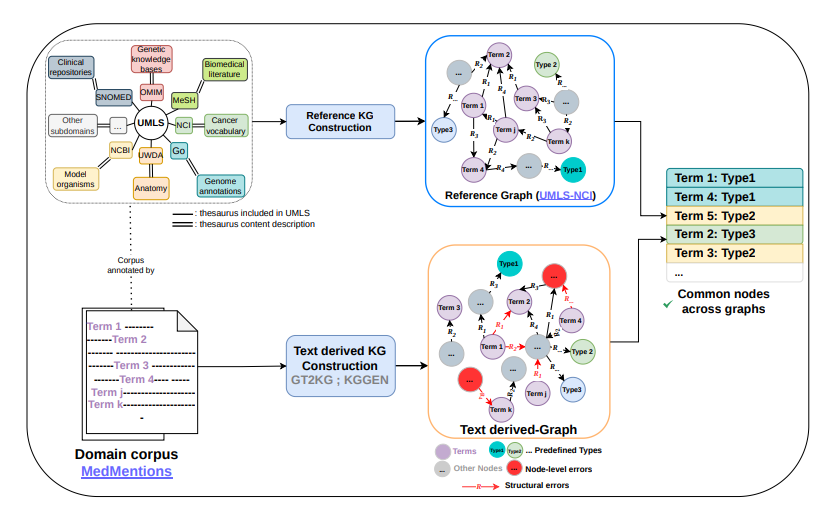
This work introduces a dual-purpose benchmark designed to jointly evaluate (i) the performance of GNNs on noisy, text-derived graphs and (ii) the effectiveness of graph construction methods on a downstream task.
The benchmark is built in the biomedical domain from a single textual corpus and includes two automatically constructed graphs generated using different extraction methods, alongside a high-quality reference graph curated by experts that serves as an upper performance bound.
This design enables controlled comparison of construction methods and systematic evaluation of GNN robustness through semi-supervised node classification.
A standardized, reproducible, and extensible evaluation framework is provided, facilitating the integration of new graph extraction methods and learning models.
arxiv.org/abs/2605.05476
#EmergingTech #GraphAI #Research #DataEngineering #GNN #DeepLearning #NeuralNetwork
--
💬 ‘An indispensable summary’ - Mark Underwood, Synchrony.
Join readers from Amazon, Capgemini, Michelin, Neo4j & more
Subscribe to the Year of the Graph newsletter for quarterly updates and insights on all things #KnowledgeGraph, #GraphDB, Graph #Analytics / #DataScience / #AI and #SemTech 👇
yearofthegraph.xyz/newslette…
1
12
418

How to Keep Your AI Agent's Knowledge Graph Clean
Most tutorials skip the part that actually keeps a graph usable as it grows: separating naming from identity. Paul Iusztin built unified memory layers on top of knowledge graphs and kept running into the same reader question: how do you handle entity resolution and deduplication without corrupting the graph?
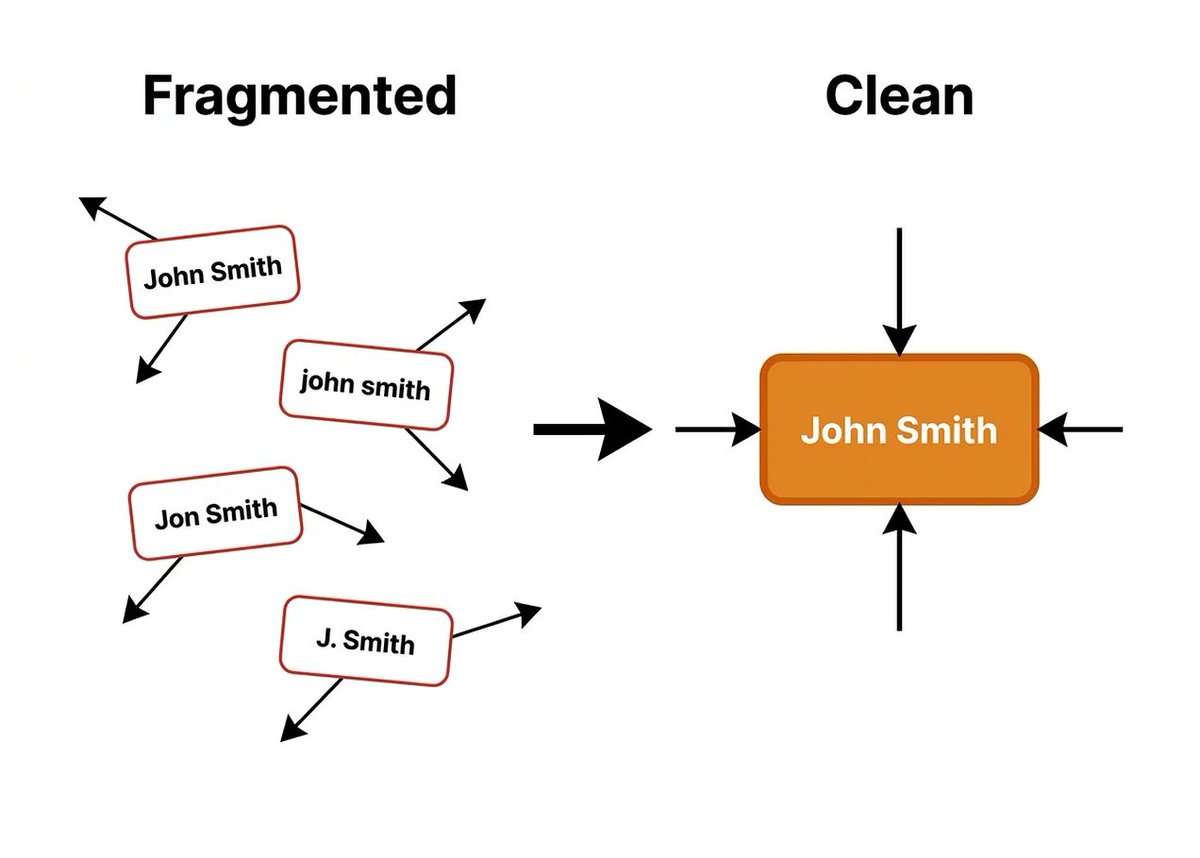
The answer is a 5-step pipeline:
LLM extraction reads the text and emits typed entity/relationship triplets anchored to a POLE O ontology
Entity resolution normalizes the name against existing nodes using exact, fuzzy, and semantic matching in a short-circuit chain. No merges yet, just canonical naming
Full-context embedding captures the entity's name, type, and attributes for a richer identity signal
Deduplication compares that embedding against existing nodes and routes to one of three outcomes: auto-merge (>=0.95), human review (0.85-0.95), or a new node (<0.85)
A nightly "dream pass" re-runs deduplication on recently ingested nodes to catch duplicates that were processed in parallel and never compared
The key insight: entity resolution and deduplication are two distinct decisions. Resolution asks "what should we call this?" Deduplication asks "is this the same real-world entity?" Conflating them is what silently corrupts graphs.
Jensen Huang the NVIDIA CEO and a same-named doctor in Taipei have the same name and the same entity type. Resolution cannot tell them apart. Only full-context deduplication can.
False merges are invisible until they are expensive to undo. The pipeline is designed to make irreversible operations earn their way in.
By Paul Iusztin
decodingai.com/p/keep-knowle…
#KnowledgeGraphs #GraphAI #AgentMemory #EntityResolution #AIEngineering
--
Connected Data London 2026 | 11–12 November | Leonardo Royal Hotel London Tower Bridge
🎤 Share your work with the world's most passionate data community. The Call for Submissions is open.
connected-data.london/2026-c…
🎟 Tickets on sale now. Early bird discounts up to 30%. 2026.connected-data.london
📺 Sponsorship opportunities available. Contact info@connected-data.london for details.
#KnowledgeGraph #GraphRAG #Ontology #Graph #AI #DataScience #GraphDB #SemTech
2
9
352

May 28
Excited to launch @neo4j Virtual Graph 🚀
Graph reasoning directly on enterprise data. no ETL, no copies, Cypher pushed into Any Lakehouse.
Helping make enterprise data accessible to AI agents.
lnkd.in/eeSTkaCP
#GraphAI #EnterpriseAI #AIAgents #Snowflake #Databricks
1
5
14
1,458


May 14
They arent explicit? even when the lists either use the word "canon/canonical" or equivalent language and/or description
So you have to run off to instances of mere quotation or, at best, equivocal language (graphai, scriptura) that can mean any sacred writing
1
53

May 13
Stop struggling with blockchain data - GraphAI delivers real-time insights.
2
5
85
4,671
May 9
Most tools show activity. GraphAI explains patterns, context, and why on-chain behavior matters.
2
4
20
4,767

Vanar Chain, ticker VANRY, is catching my eye as an AI-native Layer 1 blockchain thats pushing boundaries in Web3. Its built for high-speed transactions with a focus on entertainment, gaming, and real-world assets, all powered by sustainable energy from Google. The native token handles gas fees and unlocks features like social wallets and gamified apps.
Right now, its trading around 0.0055 USD, with a market cap of about 13 million, ranking 905th. Over the last 24 hours, its up 4.9 percent, and 7 days show 10.9 percent gains, signaling some momentum amid a recovering crypto market. Fundamentals are solid: recent partnerships with Worldpay for payments, GraphAI for data indexing, and listings on exchanges like LBank. Theyre rolling out AI tools like Neutron for semantic memory and Kayon for on-chain reasoning, with subscriptions payable in VANRY to boost demand.
On-chain activity has spikes in staking and user engagement, though some whale moves like recent withdrawals from Binance hint at positioning for upside. No major red flags, no hacks, just steady execution on their 2026 roadmap toward AI-Web3 convergence.
For long-term holders, this feels undervalued with strong growth potential in AI and DeFi spaces. Id consider accumulating if youre bullish on modular blockchains, but diversify and watch volatility, crypto can swing wild. Whats your take on it?
4
836
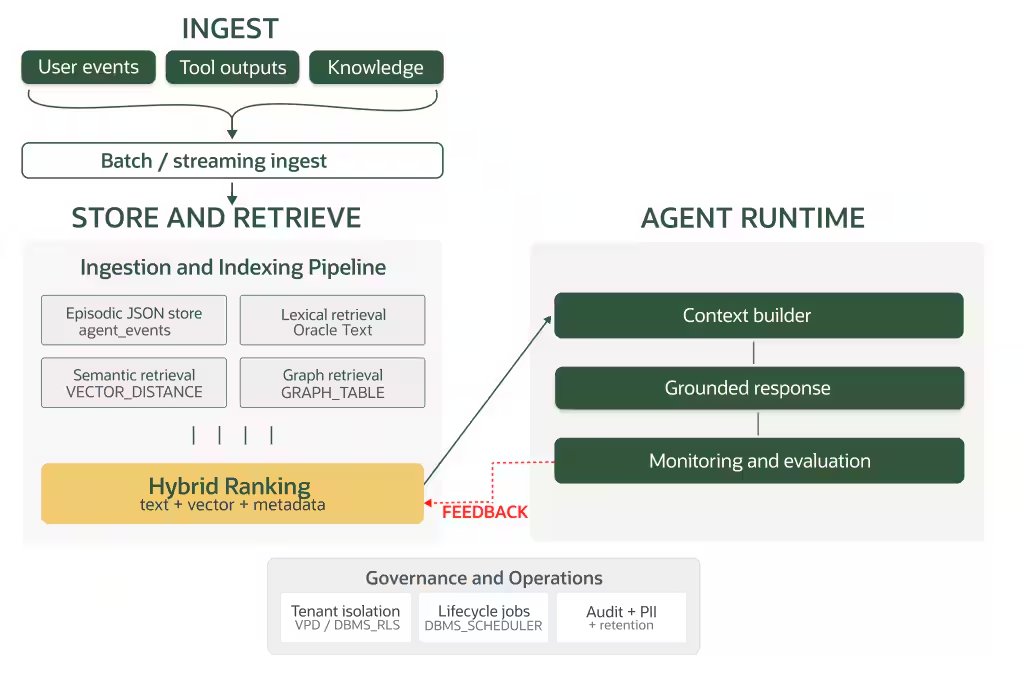
Unified Memory Core for AI Agents
Vector search is not enough. Daniela Pavlenco shows why graph traversal belongs at the heart of agent memory architecture.
Most agent systems reach for vectors first. And vectors are useful. But they return nearest semantic neighbors, not business relationships. When an agent needs to follow context across connected entities, user > ticket > service > document, similarity scores do not help. Graph traversal does.
Daniela's architecture unifies four memory types in Oracle AI Database:
* Episodic: event history stored as JSON, queryable with SQL/JSON
* Lexical: Oracle Text for exact terminology, error codes, policy clauses, things vector search quietly misses
* Semantic: vector indexes for meaning-based retrieval
* Relationship-aware: GRAPH_TABLE for traversing connected business context
The graph piece is what makes this architecture different. Oracle SQL Property Graph sits directly on top of existing relational tables, no data copied, no separate store. The graph definition holds only metadata; queries run against live data. One pattern from the walkthrough:
MATCH (u IS user) -[r IS opened]-> (t IS ticket) -[m IS mentions]-> (d IS document)
That query surfaces what vector search cannot: the organizational and operational relationships around a memory item. Who opened it, what it references, which documents are connected. Context that pure similarity ranking leaves on the floor.
The rest of the architecture handles governance, tenant isolation, and lifecycle controls in the same platform. A companion notebook demonstrates all patterns end to end.
The pattern for building a unified memory layer for AI agents is inspired by Oracle Graph, but it can be applied regardless of the underlying database.
By Daniela Pavlenco. H/T gdotv.
blogs.oracle.com/developers/…
#GraphDatabase #AgentMemory #GraphAI #AIArchitecture #SQLPropertyGraph #KnowledgeGraph
--
Connected Data London 2026 | 11–12 November | Leonardo Royal Hotel London Tower Bridge
🎤 Share your work with the world's most passionate data community. The Call for Submissions is open. connected-data.london/2026-c…
🎟 Tickets on sale now. Early bird discounts up to 30%. 2026.connected-data.london?u…
📺 Sponsorship opportunities available. Contact info@connected-data.london for details.
#KnowledgeGraph #GraphRAG #Ontology #Graph #AI #DataScience #GraphDB #SemTech
2
11
447
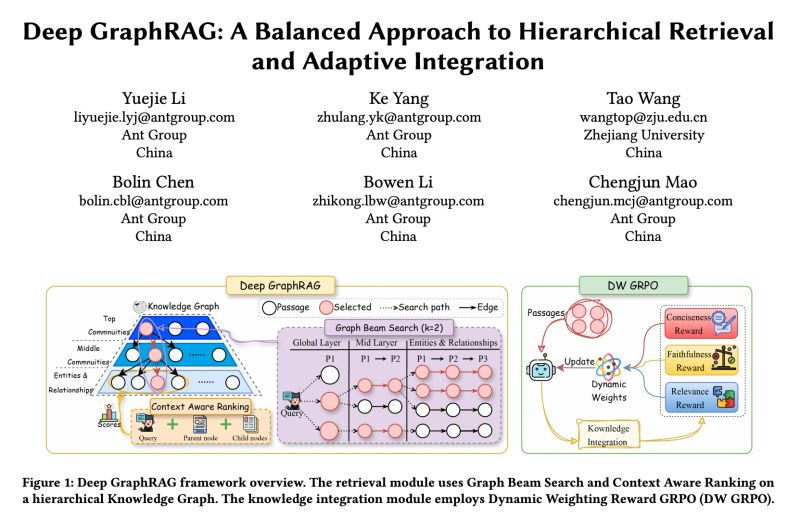
Deep GraphRAG: Hierarchical Graph Retrieval with Adaptive Re-ranking
RAG systems have a fundamental problem. Search broadly and you lose the detail. Search locally and you miss the bigger picture.
Most graph-based RAG approaches pick one and hope for the best. Researchers from Ant Group and Zhejiang University built Deep GraphRAG to stop making that trade-off.
The core idea: use a 3-level hierarchy to navigate a knowledge graph from the big picture down to the specific detail, with smart filtering at every stage, not just at the end.
The payoff is significant. On multi-hop reasoning tasks - the kind where you need to connect facts across multiple sources - it hits 45.44% exact match accuracy. That's vs 38.75% for the previous best and just 10% for standard local search. And it runs 86% faster than comparable recursive methods.
A compact 1.5B parameter model reaches 94% of what a 72B model achieves. Smaller, faster, more accurate.
The system builds a knowledge graph from text chunks, clusters entities into a 3-level community hierarchy using the Louvain algorithm, then retrieves top-down using beam search with pruning and re-ranking at each level.
The training uses Dynamic Weighting Reward GRPO (DW-GRPO) to avoid the common failure mode where reinforcement learning over-optimizes one metric at the expense of relevance, faithfulness, and conciseness.
The hierarchy does the heavy lifting. No trade-off required.
arxiv.org/abs/2601.11144
#GraphRAG #RetrievalAugmentedGeneration #GraphAI #LLM #EmergingTech #Research
--
💬 ‘Well done! A useful, eclectic update’ - David Watson, IT Consultant.
Join readers from Amazon, Capgemini, Michelin, Neo4j & more
Subscribe to the Year of the Graph newsletter for quarterly updates and insights on all things #KnowledgeGraph, #GraphDB, Graph #Analytics / #DataScience / #AI and #SemTech 👇
yearofthegraph.xyz/newslette…
5
29
192
24,387

🌊 Coastal flooding risks? A new deep learning model nails 12-h water level forecasts at 16 Zhejiang stations with 6.77cm RMSE—beating old methods! 🔍 Multi-station magic with graph convolutions adversarial learning = game-changer for ocean engineering. 1.1k views & counting! #WaterLevelForecast #DeepLearning #CoastalTech #GraphAI #OceanEngineering Link[doi.org/10.1080/10095020.202…]
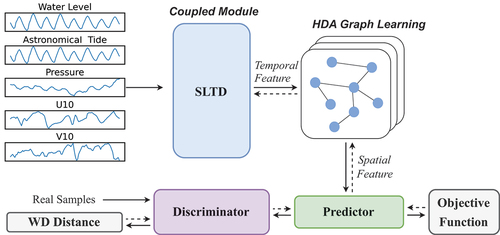
ALT Figure 1. Diagram of the WD-ACGN architecture. Within the coupled module, multi-parameter input data undergoes SLTD extraction. Spatial dependencies are then ascertained through HDA graph learning. Subsequent results are optimized by the discriminator to minimize the WD distance relative to associated labels. Dashed lines indicate the direction of gradient flow.
2
5
334
Apr 27
Ultipa GQLDB: A Native Graph Database with a Full Implementation of ISO GQL, new features, and a Community Edition
ISO GQL is to graph databases what SQL became to relational databases:
A common language that means your queries are portable, your skills transfer, and you are not locked into a vendor's proprietary dialect. Standards-based graph is a different proposition altogether.
Ultipa launched GQLDB — v6 of their real-time graph database, touted as the first native graph database to fully implement ISO GQL (ISO/IEC 39075).
What Ultipa built around that foundation:
One engine handles graph, vector, full-text, and RDF/ontology natively — no stitching, no middleware.
Built-in AI capabilities - natural language to GQL, vector embeddings, similarity search, and RAG support.
Real-time graph-native storage with index-free adjacency and full ACID compliance.
The Community Edition is free: a single binary, installs in seconds.
Worth checking if you're working on knowledge graphs for LLMs, fraud detection, real-time recommendations, or tokenizing real-world assets.
ultipa.com/products/gqldb?ut…
#GraphDatabase #ISOGQL #KnowledgeGraph #OpenSource #GraphAI
--
📩 The Year of the Graph Spring 2026 newsletter issue is out!
Beyond Context Graphs: How Ontology, Semantics, and Knowledge Graphs Define Context 👇
yearofthegraph.xyz/newslette…
All things #KnowledgeGraph, #GraphDB, Graph #Analytics / #DataScience / #AI and #SemTech.
Subscribe and follow to be in the know. Reach out if you'd like to be featured

1
6
508