
Jun 13
Condo and townhome HOAs are increasingly passing rules to restrict or ban the charging of e-bike and e-scooter batteries inside individual units. While this feels like an invasive overreach to many residents, the legal reality comes down to the source of the restriction.
Under Civil Code § 4350, an HOA operating rule must be reasonable. When a rule is grounded in an objective, real-world fire-safety hazard, such as the known risk of thermal runaway in shared-wall structures, it stands on incredibly strong legal footing. This is completely different from an HOA trying to control aesthetics or personal property use without a reasonable basis.
#HOAlawyer #HOAattorney #CaliforniaHOA #DavisStirlingAct #CivilCode4350 #HOACommonArea #HOArules #HOAhell #EBikeBattery #FireSafety
1
2
Jun 12
Can my HOA stop me from charging my e-bike battery in my unit?
In connected housing like condos and townhomes, yes, and that is becoming more and more common in HOAs throughout California. E-bike and e-scooter batteries have been known to fail catastrophically and start fast-spreading fires, a danger that’s sharpest in condominium and townhome buildings with shared walls and exits. As a result, a growing number of HOAs have begun restricting where batteries may be charged. A charging restriction grounded in a genuine fire-safety concern rests on the HOA’s authority over its common areas and stands on much stronger footing than a rule based on aesthetics or noise. The most protective step you can take is to buy a certified e-bike and battery and follow the manufacturer’s charging instructions because an uncertified or damaged battery is the core of the risk.
#HOAlawyer #HOAattorney #CaliforniaHOA #DavisStirlingAct #CivilCode4350 #HOACommonArea #HOArules #HOAhell #EBikeBattery #FireSafety
1
3
17
Jun 11
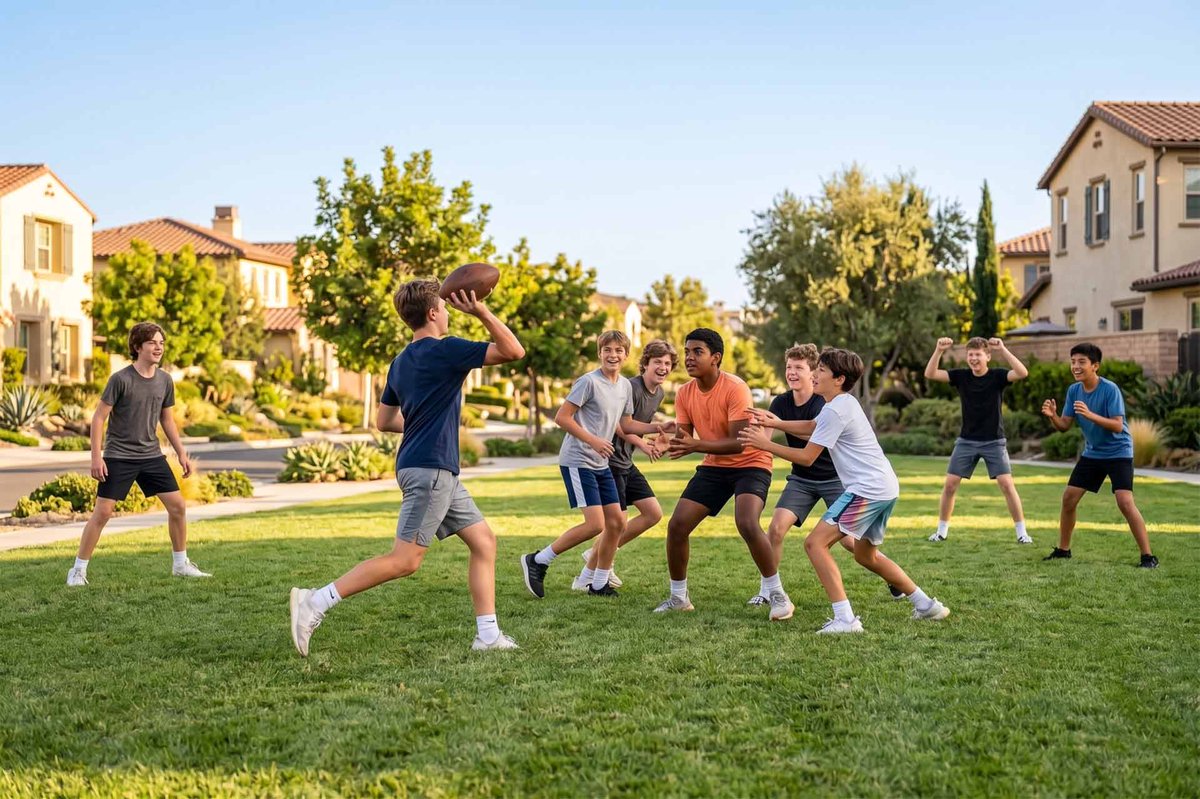
Can my California HOA stop my kids from playing in the common area?
No, not as a blanket rule. The common area belongs to all owners under Civil Code 4500, so your kids start with the right to use it for ordinary recreation, and your HOA needs a legitimate, reasonable basis under Civil Code 4350 to restrict that. A flat ban on children playing, or a rule that singles out bikes, balls, skateboards, and toys, fails the reasonableness standard and also operates as a restriction aimed at families with children, which pushes it into federal and state fair housing discrimination territory that no HOA is allowed to enter.
#HOAlawyer #HOAattorney #CaliforniaHOA #DavisStirlingAct #CivilCode4500 #CivilCode4350 #CommonArea #HOAKids #HOArules #HOAhell
1
3
13
Jun 7
Can my California HOA use drones to photograph my backyard or document violations on my property?
It depends on the circumstances. An HOA using a properly FAA-certified drone operator to photograph an unoccupied backyard for the purpose of documenting a visible structural violation occupies a more defensible legal position than one deploying drones over occupied spaces or hiring an unlicensed operator. When no person is present, no private activity is being captured, and the operator holds proper FAA certification, the HOA can argue that the surveillance was reasonable under Civil Code 4350 and consistent with its enforcement authority.
The legal picture changes significantly when the drone captures images of a person engaging in private activity in a manner a reasonable person would find offensive, at which point Civil Code 1708.8 imposes direct civil liability regardless of whether the drone ever touches the ground.
An unlicensed operator adds federal regulatory exposure on top of the privacy claims. And even in the most defensible scenario, an HOA that reaches for drones before exhausting the noticed inspection rights most CC&Rs already provide will struggle to justify the more intrusive approach.
#HOAlawyer #HOAattorney #CaliforniaHOA #DavisStirlingAct #Drones #HOACameras #HOAissues #HOAhell
4
15
Jun 5
What's the difference between a JADU and a regular ADU?
Size and location are the big ones. A JADU can be no larger than 500 square feet and has to be built within the existing walls of your single-family home, such as an attached garage that already sits inside the home’s footprint. A JADU also requires a separate entrance and an efficiency kitchen. Also, under the new law, if the JADU has its own bathroom, there is no longer a requirement that the owner live at the property.
A full-size ADU is larger and often a freestanding structure (which is what most people think of when they picture an ADU or granny flat). That distinction matters for HOA disputes because a JADU adds no new exterior structure and no building footprint, which strips away most of what an HOA would normally object to, like setbacks, height, lot coverage, and density.
#HOAlawyer #HOAattorney #CaliforniaHOA #DavisStirlingAct #ADU #JADU #HOAissues #HOAhell
4
38
Jun 5
When you are locked in a dispute with your HOA, making a single wrong move can completely derail your case. Homeowners frequently walk into these conflicts out of pure frustration, but turning your dispute into an emotional war instead of a strategic one plays right into the board's hands.
The HOA's attorneys will weaponize every hostile email you send and flip the narrative on you.
In this short Q&A, I break down the top five biggest mistakes California homeowners make when fighting their HOA. If you are currently in a dispute over rules, fines, or assessments, you cannot afford to make these unforced errors.
Watch the video to see if you are accidentally tanking your own legal case.
#HOAlawyer #HOAattorney #CaliforniaHOA #DavisStirlingAct #HOAdispute #HOAissues #HOAhell
4
19
Jun 3
When was my HOA required to complete its first balcony inspection under California's Balcony Law (SB 326)?
Under Civil Code 5551, that deadline was January 1, 2025. The January 1, 2026 date that circulated widely, including from the bad HOA attorney that I’ve written about, comes from confusion between an HOA and an apartment building. SB 721 was to apartment buildings what SB 326 was to HOAs. AB 2579 extended the deadline by one year for apartment buildings, but expressly excluded HOAs from the extension. [For buildings constructed after January 1, 2020, the first inspection is due within six years of the certificate of occupancy instead of by the universal 2025 date.]
#HOAlawyer #HOAattorney #CaliforniaHOA #DavisStirlingAct #CivilCode5551 #BalconyLaw #SB326 #HOAbalconies #HOAhell
1
4
15
May 27
When it comes to California HOA elections, "size doesn't matter." Whether your HOA has 6 members or 600, the Davis-Stirling Act imposes strict procedural mandates that every board must follow to ensure a valid election, including appointing an inspector of elections.
Watch this short HOA Q&A to learn about the requirements surrounding inspectors of election.
#HOAlawyer #HOAattorney #CaliforniaHOA #DavisStirlingAct #CivilCode5110 #HOAelections #InspectorofElection #HOAhell #MBKChapman
4
17
May 27
Can my California HOA still fine me if I fixed the violation before the hearing?
No. Civil Code 5855(c)(1) states that the board shall not impose discipline if the member cures the violation before the meeting takes place. That is not a guideline the board can weigh against other factors. It is an absolute statutory bar. If the violation is gone before the hearing, the board’s authority to discipline at that hearing is extinguished entirely. And under Civil Code 5855(g), any fine the board imposes anyway is not effective against the member, meaning it is legally unenforceable, not merely subject to appeal. The homeowner does not have to pay it. The key is documentation. Dated photographs, contractor completion records, or written confirmation sent to the board before the meeting gives the homeowner the evidence needed to prove the cure if the board disputes it.
Check out the comments for the link to my Fact Sheet, "Can My California HOA Fine Me for a Violation I Fixed Before the Hearing?"
#AB130 #HOAFines #HOAlawyer #HOAattorney #DavisStirlingAct #CaliforniaHOA #badHOA #HOAhell
1
5
39
May 27
Can footsteps from an upstairs condominium unit qualify as a legal nuisance in California?
Sometimes. Ordinary footsteps and normal day-to-day living sounds do not qualify as actionable nuisances, particularly in condominiums and townhomes where homeowners necessarily share walls, ceilings, and floors. But repeated late-night impact noise, excessive stomping, dragged furniture, dropped objects, indoor exercise activity, or noncompliant hard-surface flooring that substantially interferes with a neighboring homeowner’s ability to sleep or peacefully occupy the unit can cross the line into an actionable nuisance under Civil Code 3479 and the HOA’s governing documents.
#HOAnuisance #LoudNeighbor #Hardfloors #HOAlawyer #HOAattorney #DavisStirlingAct #CaliforniaHOA #badHOA #HOAhell
1
4
21
May 26
Can repeated barking dogs qualify as a legal nuisance in a California HOA?
Yes. Occasional barking generally will not qualify as an actionable nuisance because some amount of pet noise is part of ordinary residential living. But repeated barking episodes, especially late at night, early in the morning, or continuing for extended periods of time, almost always constitute an actionable nuisance. These disputes often become much stronger when the homeowner documents the barking pattern through incident logs, recordings, written complaints, and corroborating witnesses rather than simply making generalized complaints that the dog is annoying.
#HOAnuisance #BarkingDog #HOAlawyer #HOAattorney #DavisStirlingAct #CaliforniaHOA #badHOA #HOAhell
1
3
38
May 26
If your HOA board denied your architectural application with a vague "it doesn't fit the aesthetic of the neighborhood," they are violating the Davis-Stirling Act.
Under Civil Code 4765, architectural decisions must be reasonable, made in good faith, and tied to published standards or applicable law. Boards do not have the authority to issue arbitrary denials based on the personal tastes of the directors. If your governing documents don't have a specific rule or statutory citation to back up their decision, the denial is invalid.
I have broken down the strict limits on architectural control in my new 6,000-word guide. Don't let your board act as the ultimate judge of your home's appearance without following the law.
Check the first comment for the link to the Fact Sheet that I wrote.
#HOAlawyer #HOAattorney #DavisStirlingAct #CaliforniaHOA #badHOA #HOAhell #CivilCode4765 #ArchitecturalControl
1
3
27
May 25
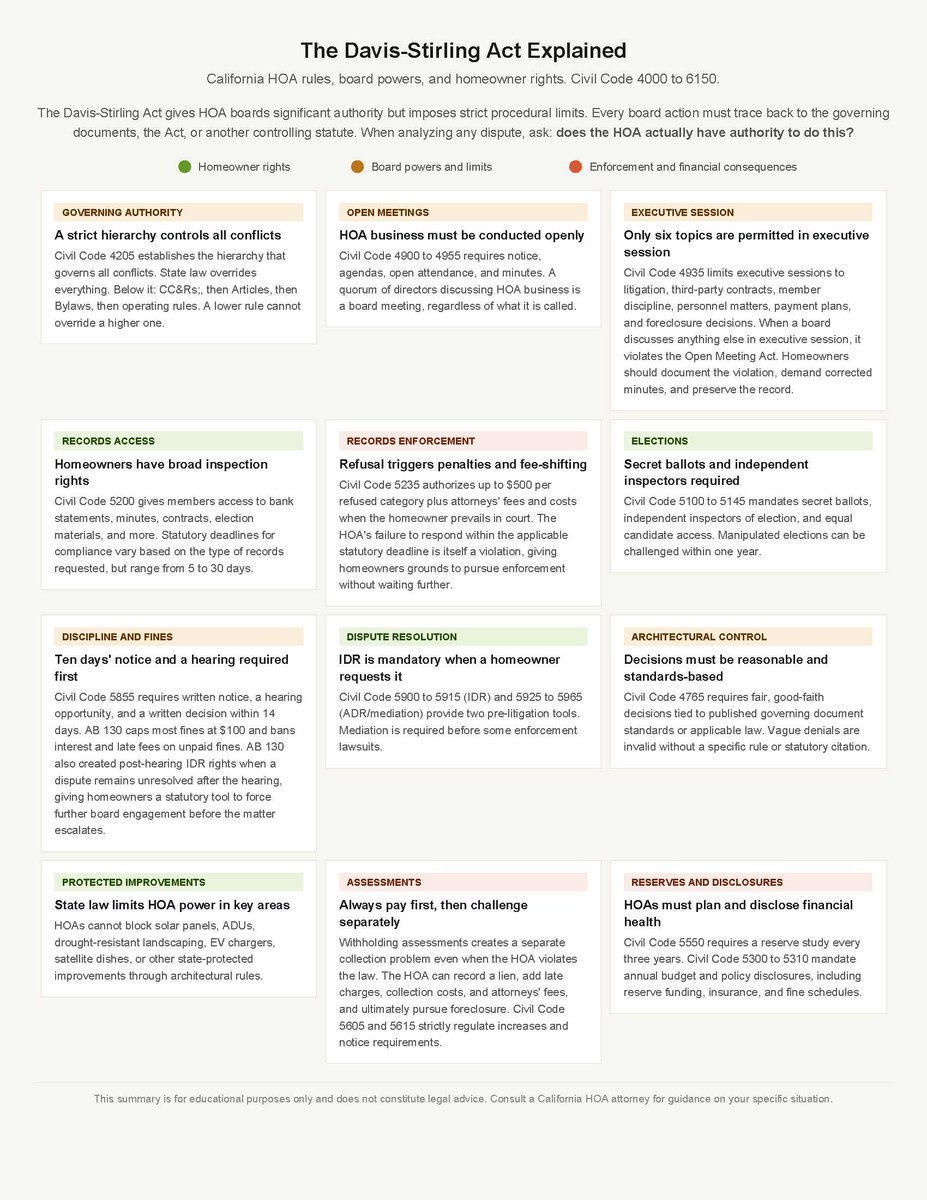
If you live in one of California’s 60,000 HOAs, you have powerful rights that bad HOA boards would prefer you didn't know about. The Davis-Stirling Act is not just a list of powers for the board; it is a shield for the homeowners.
I just released a comprehensive homeowner’s guide to navigating these laws, and this graphic is the executive summary. It highlights the mandatory hearing requirements before you can be fined, the limits on executive sessions, and the state-protected improvements your board cannot block.
Don't let your board treat your community like a private fiefdom. Use this guide to understand the law and protect your home.
See the comments for the link to the full 6,000-word guide.
#HOAlawyer #HOAattorney #DavisStirlingAct #CaliforniaHOA #badHOA #HOAhell #HomeownerRights #MBKChapman
1
3
20
May 24
"California law gives volunteer directors very strong protection from personal liability under Civil Code 5800 and Corporations Code 7231."
If your property was damaged because of a bad board decision, your first instinct is likely to sue the director responsible. While it is possible to sue board members personally, it is not the norm because of the high legal bar for individual wrongdoing. Understanding whether a director's conduct falls within protected decision making or crosses into individual wrongdoing is a fact specific analysis.
Watch this 90-second HOA Q&A from my podcast, HOA HELL, to see how holding an HOA director personally liable works.
#HOAlawyer #HOAattorney #DavisStirlingAct #CaliforniaHOA #badHOA #HOAhell #CivilCode5800 #CorporationsCode7231 #HOADirector #HOABoardMember
May 22

Can you personally sue an HOA board member, or are they completely shielded from their own bad decisions?
The Davis-Stirling Act provides volunteer HOA directors with strong protection under Civil Code 5800, but that protection is NOT unlimited. There is a specific line where a board member’s actions stop being protected decision-making and start being individual wrongdoing. If a director engages in fraud, malice, or conduct outside the scope of their authority, the liability shield disappears.
Watch this 90-second episode of my HOA Q&A series to see the specific facts that determine when a director can be held personally liable for their actions.
#HOAlawyer #HOAattorney #DavisStirlingAct #CaliforniaHOA #badHOA #HOAhell #CivilCode5800 #CorporationsCode7231 #HOADirector #HOABoardMember
4
11
May 22
Can you personally sue an HOA board member, or are they completely shielded from their own bad decisions?
The Davis-Stirling Act provides volunteer HOA directors with strong protection under Civil Code 5800, but that protection is NOT unlimited. There is a specific line where a board member’s actions stop being protected decision-making and start being individual wrongdoing. If a director engages in fraud, malice, or conduct outside the scope of their authority, the liability shield disappears.
Watch this 90-second episode of my HOA Q&A series to see the specific facts that determine when a director can be held personally liable for their actions.
#HOAlawyer #HOAattorney #DavisStirlingAct #CaliforniaHOA #badHOA #HOAhell #CivilCode5800 #CorporationsCode7231 #HOADirector #HOABoardMember
1
3
67
May 21
Q: What happens if my HOA hires an unlicensed contractor and something goes wrong?
A: California law treats unlicensed contractors and their workers as employees of the hiring party. In the HOA context, that means the HOA becomes legally responsible for property damage, defective work, and personal injury. That liability does not remain with the board. It impacts every homeowner in the community through increased costs, potential litigation, and massive special assessments.
Hiring unlicensed labor is a foolish gamble with your home’s equity. Because the law views these workers as HOA employees, a single injury on the job could result in your HOA being held liable for workers' compensation and damages that your master insurance policy may refuse to cover. If your board is cutting corners to "save money," they are actually exposing every homeowner to the risk of a massive special assessment to cover a legal judgment.
#HOAlawyer #HOAattorney #CaliforniaHOA #DavisStirlingAct #UnlicensedContractor #HOAliability #SpecialAssessment #badHOA #HOAhell
3
13
May 20
Q: Can my California HOA borrow money from reserves without a membership vote?
A: Yes. Civil Code 5515 allows HOA boards to borrow from reserves without member approval to meet short-term cash flow needs or other expenses. That authority is broad, but it is not unlimited. The board must comply with specific notice, disclosure, and documentation requirements before and after making the decision. The HOA must also avoid violating its duty of prudent management when deciding to borrow from reserves.
Keep in mind that while a membership vote is not required, Civil Code 5515 imposes strict "repayment" requirements that bad HOAs frequently ignore. If your HOA is violating California’s reserve-related laws, you must act, or you could find yourself having to cover for their misappropriations in the form of massive special assessments.
#HOAlawyer #HOAattorney #CaliforniaHOA #DavisStirlingAct #HOAreserves #BorrowFromReserves #CivilCode5515 #badHOA #HOAhell
4
56
May 20
Q: Can I legally stop paying my HOA dues if my California HOA is violating the law?
A: No. Even if your HOA board is acting illegally by, for example, selectively enforcing rules, refusing to perform maintenance, or improperly imposing fines, homeowners never have the legal right to withhold assessments. California law does not recognize a homeowner “offset” defense against assessment obligations. Once an account becomes delinquent, the HOA may begin imposing late fees, interest, liens, and even foreclosure procedures. Homeowners must challenge improper HOA conduct strategically rather than by refusing to pay assessments. In short: pay first, challenge second.
By staying current on your dues, no matter how unfair or illegal, you protect your property and ensure that when you challenge the board’s illegal conduct, you are doing so from a position of strength rather than as a debtor facing a lien or foreclosure.
#HOAlawyer #HOAattorney #CaliforniaHOA #DavisStirlingAct #HOAassessments #HOAforeclosure #CivilCode5650 #badHOA #HOAhell
4
17
May 19
"Your HOA, they don't get to rule as if it's a private fiefdom of theirs, like they're kings. It's not how it works."
Too many California HOA boards operate under the delusion that their power is absolute. In reality, you have powerful rights that the board cannot simply ignore or override. If your HOA is acting like a monarchy instead of a governed community, you need an HOA attorney who knows exactly how to dismantle their "almighty" image. You need California’s most respected homeowner-side HOA law firm, MBK Chapman.
Watch the video to see why we focus on protecting homeowners from bad HOAs who’ve forgotten their place.
#HOAlawyer #HOAattorney #DavisStirlingAct #CaliforniaHOA #badHOA #HOAhell #MBKChapman #MichaelKushner
May 18
There are 60,000 HOAs in California and that number is growing. While boards often act like they rule over a private fiefdom, you have powerful rights that they cannot ignore. The HOA is not almighty, and you do not have to accept being treated like a subject in your own home.
When your best efforts to resolve a dispute have failed and you are at your wits' end, you need a lifeline. Watch our new video to see why we focus our homeowner-side HOA law practice on protecting homeowners and why putting your trust in MBK Chapman is the first step toward finding peace again.
#HOAlawyer #HOAattorney #DavisStirlingAct #CaliforniaHOA #badHOA #HOAhell #MichaelKushner #MBKChapman #HomeownerRights #BestHOAlawyer
5
66
May 19
Q: Can excessive exterior lighting qualify as a nuisance in a California HOA?
A: Yes. Exterior lighting can become an actionable nuisance when it repeatedly shines into neighboring homes, patios, balconies, or yards and materially interferes with another homeowner’s quiet enjoyment of their property.
Bad HOAs dismiss excessive lighting complaints as minor neighbor disputes. In reality, California law protects your right to quiet enjoyment, and an HOA’s failure to enforce its own lighting or nuisance rules can be a breach of its fiduciary duty. If your neighbor’s exterior lights are making you feel like you’re living next to a stadium, you don’t have to just live with it.
#HOAlawyer #HOAattorney #CaliforniaHOA #DavisStirlingAct #HOAnuisance #QuietEnjoyment #LightIntrusion #ExcessiveLights #badHOA #HOAhell
1
5
24