
Good work.
The same needs to be done with normal fevers and HSPs. Then doctors can ignore the results again.
4

I wonder how this number would increase if HSPs were included in a broader ND group?
1
10

question:
do any HSPs activate if you're merely outside in very hot temps (think like >90 in the northeast US, high humidity) for hours?
is being outside for long durations during punishingly hot days good for longevity, assuming you stay hydrated?
1
1,280

Granted there are other HSPs and plausible mechanisms for the benefits of sauna, and the vast majority of people don't push themselves as hard as you have in the sauna, do you think population level data hints at HSP 27 induction as not being necessary for benefit?
1
411

when i had a fever as a kid, my parents put more hot blankets on top of me to sweat it out tons of water and i beat it maybe bc of HSPs
2
208

I swallowed a miniature computer
drew my blood six times
sat in a 200°F dry sauna for 56 min
felt like I was going to die from the heat
and paid $21,093 for specialty biomarkers…
To ask a question: do sauna benefits depend on time, or body temperature?
This experiment has never been done before.
Results:
1) Sauna benefits depend on how hot your body gets, not how long you sit in the sauna
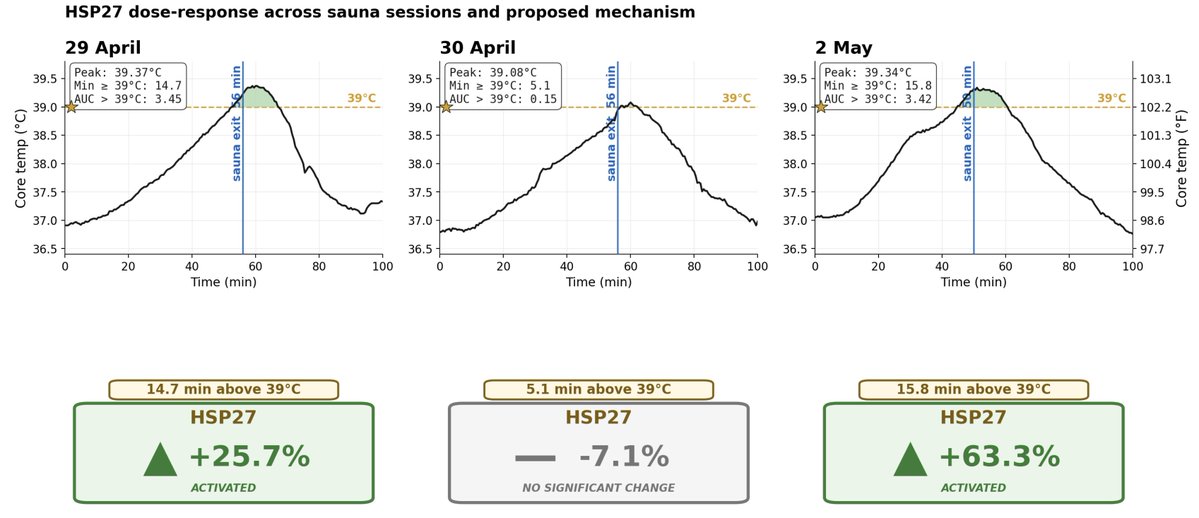
2) Heat shock protein 27 (HSP27), one of the molecules that drives sauna's longevity benefits, only switched on when my core body temperature held above 102.2°F (39°C) for about 15 minutes.
3) Reaching that took 56 minutes at 200°F (93°C), with ice on my face, neck, and groin.
4) This challenges the generic advice that 20 minutes of sauna is enough.
What this means for you:
1) The standard advice of 20 minutes at 176°F (80°C) is a floor, not a ceiling. The bigger benefits sit further up the curve, in longer and hotter sessions. If you can tolerate more, more likely helps.
2) Skip the cold plunge right after the sauna. My core body temperature kept climbing for several minutes after I left the sauna, so much of my time above the activation threshold happened post-exit. Cold plunging cuts that window short.
3) Population level studies point in a direction but cannot tell you what is happening inside your own body. Continuous core temperature tracking can.
Here is the experiment explained
A brief background first. Heat shock proteins (HSPs) are believed to be the enablers of sauna based longevity benefits. You can think of them as a clean up crew that travels through your body removing misfolded proteins and cellular debris. When you get really hot, like in a sauna, you generate a lot more of them. A tsunami of clean up crews unleashed inside your body.
There are many types of HSPs. We focused on HSP27 in this experiment because of its high value longevity benefits:
1. Calms harmful inflammation through a controlled signaling pulse, driven by IL-10
2. Protects arteries by blocking the damaged cholesterol that builds up into plaque
3. Helps the body grow new blood vessels over time
4. HSP27 is one of the first proteins your body makes when it gets hot, which makes it a clean signal of how hard the sauna session actually worked.
We saw initial signs of biomarkers of these benefits also turned on alongside HSP27, with enough time above the activation threshold.
I ran three sauna sessions, holding sauna temperature, my meticulous morning routine, and every other variable constant. We measured HSP27 activation and release (along with scores of other biomarkers) in my serum after each session. I swallowed a temperature capsule about the size of a vitamin pill. As it traveled through my body, it sent a reading of my core body temperature every 30 seconds. That continuous, real time data from inside the body is what no prior study has had.
The 102.2°F (39°C) core temperature threshold for HSP activation has been established in the research literature for years. Dry-sauna users have never been able to act on it because they had no way to track their core temperature during a session. An end-point thermometer cannot tell you how long you held above threshold, and the duration is the dose. Which is why we chose to use real time tracking.
The findings across the three sessions.
Two of the three sessions pushed me well past the threshold. In one, I spent 14.7 minutes above 102.2°F (39°C), with a peak of 102.87°F (39.37°C). In the other, I spent 15.8 minutes above the threshold, with a peak of 102.81°F (39.34°C). After both, HSP27 in my blood rose sharply.
The third session (the middle one in the figure) was different. I only spent 5.1 minutes above 102.2°F (39°C), with a peak of 102.34°F (39.08°C), barely above the threshold. HSP27 did not respond. The reading actually dipped slightly, but the change was too small to count.
Two things separate the responder sessions from the non-responder. The first is time above the threshold: 14.7 and 15.8 minutes versus 5.1 minutes. The second is peak core temperature: 102.87°F (39.37°C) and 102.81°F (39.34°C) versus 102.34°F (39.08°C). Either, or more likely both, are driving the response. Future sessions will help us figure out how much each one matters.
Within my body, holding all other variables constant, the central heat shock protein response is a direct function of the heat dose delivered to the body's core.
No prior study has done this. Earlier sauna research used a single thermometer reading at the end of the session, not continuous tracking. The studies that used continuous tracking used exercise, not dry sauna. None had a matched negative control like my session three. And all reported only cohort averages, not what happened inside one body.
What this means for the body
Once HSP27 is released into circulation, it signals to cells throughout the body and drives the four mechanistically proven downstream benefits listed above. All four are supported by my long-term sauna data, the population literature, and mechanistic studies. My acute post-session measurements hint at each being engaged.
To activate HSP27 in my body, I needed 56 minutes at 200°F (93°C) in a dry sauna. That is the total session length required to spend enough time above the 102.2°F (39°C) core temperature threshold to trigger HSP27 release.
Does this mean longer sessions, long enough for your core to hit 102.2°F (39°C), would supercharge the longevity benefits? Maybe.
What we do know, I did 232 dry sauna sessions over the past year. My protocol was 200F (93°C) for 20 min. So even though my core body temperature didn’t reach 102.2°F (39°C) to unleash the HSP27, the results were still compelling:
a 10 year vascular age reduction
massive drop in environmental toxins [1]
complete elimination of microplastics in my semen (first ever in human achievement)
The data suggests there are health benefits at 200°F (93°C) for 20 min.
The data also shows that additional health benefits unlock when your core body temperature reaches 102.2°F (39°C).
Does this mean that if one is in the sauna longer, long enough to reach a core body temperature of 102.2°F (39°C). that the longevity benefits would be supercharged? Maybe.
Here is what this experiment teaches:
population level data is great for averages, pointing in a general direction
the resulting protocols are crude
not personalized
the only way to find out the truth for you is to measure
single person experiments (n=1) like this one are useful, because they find blind spots that population averages cannot see.
Note: I kept ice on my face and neck during these three experimental sessions to protect those sensitive areas from heat induced skin damage at extreme temperatures. In a previous session, not included in this experiment, I had no ice on my face or neck and used an ingestible temperature capsule for real-time core readings. I reached a core body temperature of 102.2°F (39°C) after 34 minutes at 200°F (93°C).
Adding ice to the face and neck adds roughly 20 minutes to the total time required to reach 102.2°F (39°C) core body temperature. Subjectively, the 34 minutes without ice on my face and neck was much harder than the 56 minutes with ice on my face and neck. After the 34 minute session, I exited the sauna and just laid on the concrete, immobilized. But I got the data.
[1] Toxin reduction:
After 15 sessions, sauna dramatically reduced environmental toxins in my body:
65% drop in 2,4-D
100% drop in MEP
15% drop in MBP
100% drop in MEHP (undetectable post sauna)
56% drop in NAPR
56% drop in HEMA
100% drop in Perchlorate (undetectable post sauna)
246
97
2,084
302,492

This post is describing the experiences of Highly Sensitive People (HSPs), also known as people with high Sensory Processing Sensitivity (SPS).
Living as an HSP in a loud, fast-paced, overstimulating world can be exhausting, but it’s very manageable once you understand it.
Common strategies that help include:
• Building in regular downtime and low-stimulation periods
• Creating calmer environments where possible
• Setting boundaries around energy-draining situations or people
• Choosing work/relationships that feel meaningful rather than purely high-volume
• Learning to recognize early signs of overstimulation so you can step back
If this resonates strongly, Dr. Aron’s book “The Highly Sensitive Person” (and her website) is the best starting point, it’s practical, validating, and backed by decades of research.
1
2
27

アブガルシアのロッド折れちゃったの…😢 ジャンクでも修理して使いたい人いるよね。惜しいなあ
【ジャンク】アブガルシアホーネットスティンガープラス HSPS-642L MGS
jp.mercari.com/item/m8356691…
22

RT @AlbasDumbldoras: Tribute To All 💜
Autists, HSPs, freaks and geeks, Nerds, Bibliophiles, Cinephiles, melomaniacs, monsters and misfits,…
1
Neha Kumari retweeted

Jun 15
duniya ne diye hain bohot dhokhe par koi baat nahi it's okay 😭👎
~ HSPS
2
1
64

Jun 15
" ..and their lives derailed.."
HIGHLY SENSITIVE PEOPLE are the 15-20% of the population who remain CRITICAL THINKERS despite cultural pressures. I posit they identify HSPs in childhood as they are potentially the system busters.
youtu.be/oZzqiNvSfG4?is=awEf…
1
24


Also two of our defining national foods are parmas and hsps
2
33

Jun 13
The upregulation of Heat Shock Proteins (HSPs) is a cornerstone of cellular resilience, directly impacting longevity and recovery. My deep dive into contrast therapy reveals specific protocols that reliably induce the...
lifesocial.net/lifesocial/po…...

12

Jun 13
3/nhp We (NHPs) can only compete with the hegemonic super powers (HSPs) in AI, if we (NHPs) act collectively, before they (HSPs) establish an unbridgeable lead
1
228

Jun 13
la que aburre es ella y todes los progres, todos iguales ellos pueden opinar y preguntar,pero no le gustan ni quieren que los demas pregunten u opinen. Se han cargado España y la EU.Panda de politicos corruptos,garrapatas,chuposteros,impresentables e HsPs todes🤮⚰️
4
3
7
601

HSPs notice everything.
Your nervous system may just be overloaded from years of overprocessing everyone else’s emotions. ✨
A discovery call can help you uncover the pattern behind the overwhelm and create more calm and clarity. ✨ rb.gy/i3qk4z/

10
