
🟢 @dfnsHQ now supports HashSphere.
HashSphere is @hashgraph's private, permissioned network built with @hedera technology.
It’s designed for institutions that need both the control of a private ledger and Hedera-grade performance.
✔️ Permissioned by design, limited to verified institutions
✔️ Data residency, privacy, and internal governance
✔️ EVM compatibility and core Hedera services
✔️ Public interoperability with Hedera mainnet
But a permissioned ledger only answers one question for a bank:
𝘸𝘩𝘦𝘳𝘦 𝘥𝘰 𝘮𝘺 𝘵𝘳𝘢𝘯𝘴𝘢𝘤𝘵𝘪𝘰𝘯𝘴 𝘴𝘦𝘵𝘵𝘭𝘦, 𝘱𝘳𝘪𝘷𝘢𝘵𝘦𝘭𝘺 𝘢𝘯𝘥 𝘤𝘰𝘮𝘱𝘭𝘪𝘢𝘯𝘵𝘭𝘺?
It doesn't answer the other half of it:
𝘩𝘰𝘸 𝘥𝘰 𝘐 𝘳𝘶𝘯 𝘧𝘪𝘯𝘢𝘯𝘤𝘪𝘢𝘭 𝘱𝘳𝘰𝘥𝘶𝘤𝘵𝘴 𝘰𝘯 𝘪𝘵, 𝘸𝘪𝘵𝘩 𝘵𝘩𝘦 𝘤𝘰𝘯𝘵𝘳𝘰𝘭𝘴 𝘮𝘺 𝘣𝘰𝘢𝘳𝘥, 𝘢𝘶𝘥𝘪𝘵𝘰𝘳𝘴, 𝘢𝘯𝘥 𝘳𝘦𝘨𝘶𝘭𝘢𝘵𝘰𝘳𝘴 𝘦𝘹𝘱𝘦𝘤𝘵?
That's the gap DFNS fills.
HashSphere is the network a bank settles on. DFNS is the core system that runs on top. Two systems built to institutional standards, meeting where regulated finance is heading.
HashSphere joins 60 networks on DFNS, powering 400 fintech and institutional clients globally.
🔗 Learn more: dfns.co/article/hashsphere-t…
📩 Talk to our team: sales@dfns.co
1
18
47
4,815
Jose Morales retweeted

🧵 Hedera. HashSphere. Hashgraph. DFNS.
At first glance, they look like separate pieces.
In reality, they may be part of the same institutional adoption story.
Most people think institutional adoption starts with a blockchain.
In reality, it starts with infrastructure.
That is why @dfnsHQ supporting HashSphere may be far more important than it initially appears.
Here’s why.
@dfnsHQ has announced support for HashSphere, @hashgraph’s private, permissioned network built using @hedera technology.
At first glance, this may look like another routine integration.
In reality, it helps solve one of the biggest challenges facing institutional digital asset adoption.
HashSphere already addresses a critical requirement for banks and regulated institutions.
It provides a private and permissioned environment where verified participants can transact while maintaining privacy, governance and regulatory controls.
For many institutions, that is essential.
However, a permissioned network only answers part of the equation.
A bank still needs to manage wallets, permissions, approvals, governance policies, audit requirements and operational controls.
That is where DFNS enters the picture.
DFNS is not a retail wallet provider.
It provides digital asset infrastructure used by more than 400 banks, fintechs and enterprises globally.
The company focuses on secure wallet infrastructure, key management, governance controls and operational workflows for institutional clients.
In simple terms, HashSphere provides the network.
DFNS provides the operating layer that institutions use to interact with that network.
Both are necessary.
This distinction matters because institutional adoption is rarely driven by technology alone.
Banks do not simply ask which blockchain is fastest.
They ask how assets will be secured.
They ask how permissions will be managed.
They ask how compliance requirements will be enforced.
They ask how auditors will verify activity.
Infrastructure answers those questions.
When viewed alongside other recent developments, a larger picture begins to emerge.
HashSphere provides private institutional infrastructure.
CLPR enables secure interoperability between networks.
Asseto focuses on tokenization.
Project Acacia demonstrated how private and public networks can work together.
DFNS now adds institutional wallet and governance infrastructure to the stack.
Individually, these developments may appear unrelated.
Collectively, they resemble the foundation of a complete institutional digital asset ecosystem.
This is why the DFNS integration is worth paying attention to.
Institutional adoption does not begin when assets are tokenized.
Institutional adoption begins when the infrastructure exists to manage those assets safely, compliantly and at scale.
And that infrastructure appears to be growing around HashSphere and @HederaFndn
@dfnsHQ @hashgraph @hedera
$HBAR

🟢 @dfnsHQ now supports HashSphere.
HashSphere is @hashgraph's private, permissioned network built with @hedera technology.
It’s designed for institutions that need both the control of a private ledger and Hedera-grade performance.
✔️ Permissioned by design, limited to verified institutions
✔️ Data residency, privacy, and internal governance
✔️ EVM compatibility and core Hedera services
✔️ Public interoperability with Hedera mainnet
But a permissioned ledger only answers one question for a bank:
𝘸𝘩𝘦𝘳𝘦 𝘥𝘰 𝘮𝘺 𝘵𝘳𝘢𝘯𝘴𝘢𝘤𝘵𝘪𝘰𝘯𝘴 𝘴𝘦𝘵𝘵𝘭𝘦, 𝘱𝘳𝘪𝘷𝘢𝘵𝘦𝘭𝘺 𝘢𝘯𝘥 𝘤𝘰𝘮𝘱𝘭𝘪𝘢𝘯𝘵𝘭𝘺?
It doesn't answer the other half of it:
𝘩𝘰𝘸 𝘥𝘰 𝘐 𝘳𝘶𝘯 𝘧𝘪𝘯𝘢𝘯𝘤𝘪𝘢𝘭 𝘱𝘳𝘰𝘥𝘶𝘤𝘵𝘴 𝘰𝘯 𝘪𝘵, 𝘸𝘪𝘵𝘩 𝘵𝘩𝘦 𝘤𝘰𝘯𝘵𝘳𝘰𝘭𝘴 𝘮𝘺 𝘣𝘰𝘢𝘳𝘥, 𝘢𝘶𝘥𝘪𝘵𝘰𝘳𝘴, 𝘢𝘯𝘥 𝘳𝘦𝘨𝘶𝘭𝘢𝘵𝘰𝘳𝘴 𝘦𝘹𝘱𝘦𝘤𝘵?
That's the gap DFNS fills.
HashSphere is the network a bank settles on. DFNS is the core system that runs on top. Two systems built to institutional standards, meeting where regulated finance is heading.
HashSphere joins 60 networks on DFNS, powering 400 fintech and institutional clients globally.
🔗 Learn more: dfns.co/article/hashsphere-t…
📩 Talk to our team: sales@dfns.co
2
9
71
2,034
Personally, I find DFNS more interesting as an infrastructure company than as a hype story.
400 banks, fintechs and enterprises, IBM as a customer, and now HashSphere support.
That doesn’t guarantee price appreciation anywhere, but it does suggest that serious institutions are paying attention.
1
1
92
james cook retweeted

linkedin.com/posts/dfnshq_df…
#DFNS now supports #HashSphere.
HashSphere is Hashgraph's private, permissioned network built with #Hedera technology.
It's designed for institutions that need both the control of a private ledger and Hedera-grade performance.
2
10
28
711

linkedin.com/posts/dfnshq_d…
#DFNS は現在 #HashSphere をサポートしています。
HashSphere は、#Hedera 技術で構築された Hashgraph のプライベートで許可制のネットワークです。
これは、プライベートな台帳の制御と Hedera 級のパフォーマンスの両方が必要な機関向けに設計されています。

linkedin.com/posts/dfnshq_df…
#DFNS now supports #HashSphere.
HashSphere is Hashgraph's private, permissioned network built with #Hedera technology.
It's designed for institutions that need both the control of a private ledger and Hedera-grade performance.
1
1
172
Ollie.Ħ retweeted
#HashSphere is the network a #bank settles on. #DFNS is the core system that runs on top. Two systems built to institutional standards, meeting where regulated finance is heading.
2
4
155

Jun 12
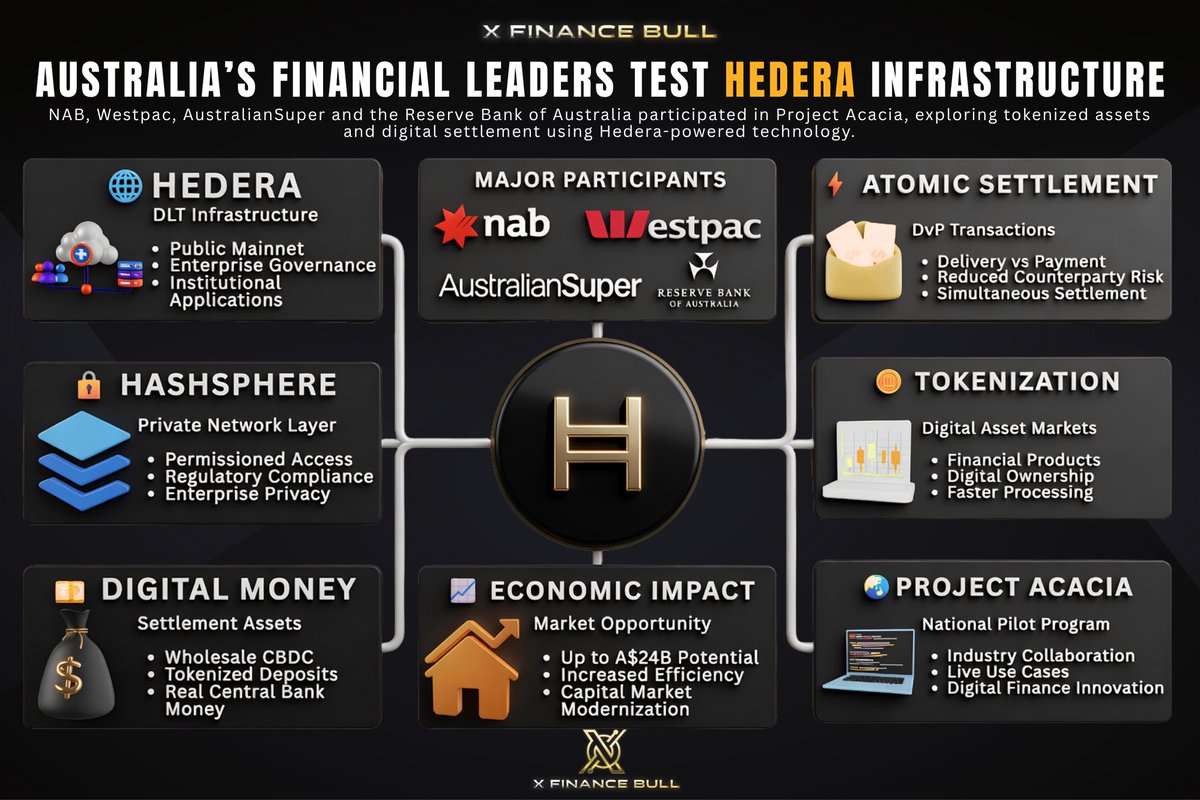
Are you still not accumulating $HBAR? THINK AGAIN
Australia's central bank ran live operations on Hedera with REAL central bank money.
Not a simulation. Not a test environment. Actual tokenized claims on the Reserve Bank of Australia.
Project Acacia used Hedera's HashSphere to tokenize exchange settlement accounts as wholesale CBDCs.
The network synced those CBDC movements between private and public chains in real time.
Atomic settlement where both legs of every transaction completed simultaneously.
The participants read like Australia's entire financial establishment. Reserve Bank of Australia. NAB. Westpac. Bank of Queensland. AustralianSuper. Colonial First State. Challenger Limited.
And the quote that should stop every HBAR skeptic cold: "We're not doing POCs anymore. Only proofs of value."
The detail most people will miss: Imperium Markets, the only licensed marketplace in Australia for term deposits, NCDs, and annuities, started on R3 Corda.
The enterprise blockchain built specifically for banks.
They evaluated it. Then they SWITCHED to Hedera.
When regulated firms abandon the incumbent enterprise chain for your network, that's the strongest validation possible.
Term deposits, certificates of deposit, and annuities now tokenized as digital twins. Recorded, custodied, and traded on-chain. Settled through a Cuscal stablecoin backed by wholesale CBDC.
The opportunity? $24 billion annually in Australia.
Current capture: $1 billion. The runway is 24x from here in one country alone.
Hedera is the only network with both a public mainnet and private HashSphere.
That dual structure is exactly why central banks choose it.
The institutions decided.
The price hasn't.
Jun 11

🚨Look what I found on $HBAR that needs attention right now. 👇
The public RWA data shows $64.5M in tokenized real estate on Hedera.
RedSwan’s own numbers? OVER $5 BILLION
The gap between what trackers display and what's actually on the network is enormous.
And almost nobody is talking about it.
RedSwan CRE is a Houston-based commercial real estate tokenization platform.
Hedera's official website confirms they've tokenized over $5 billion worth of institutional-grade properties on the network. With plans to reach $25 billion within 36 months.
Their CEO Edward Nwokedi is a former executive director at Cushman & Wakefield, one of the largest real estate firms in the world. 13,000 investors active on the platform. Three funds spanning the U.S., Africa, and the Gulf states.
In 2023 they secured a $4 billion portfolio from a Dubai-based client. 36 mixed-use properties across the Middle East.
Appraised by Cushman & Wakefield. Tokenized on their Hedera-powered platform.
So why doesn't this show on RWA dashboards?
Because tokenized private securities don't trade on public markets.
These are regulated security token offerings held by verified investors. The dashboards track publicly visible on-chain assets. Private placement real estate stays off those trackers while still living on the network.
That means HBAR's real tokenization footprint is dramatically larger than any public dashboard suggests.
RedSwan is also helping build Hedera's Asset Tokenization Studio for compliant securities issuance.
The market prices what it can see. The institutions deploy what it can't.
That gap is the opportunity.
When the visible data says $64.5M and the verified reality says $5B , the market is pricing $HBAR off incomplete information.
Massive blind spots create massive opportunities.
16
48
205
8,751