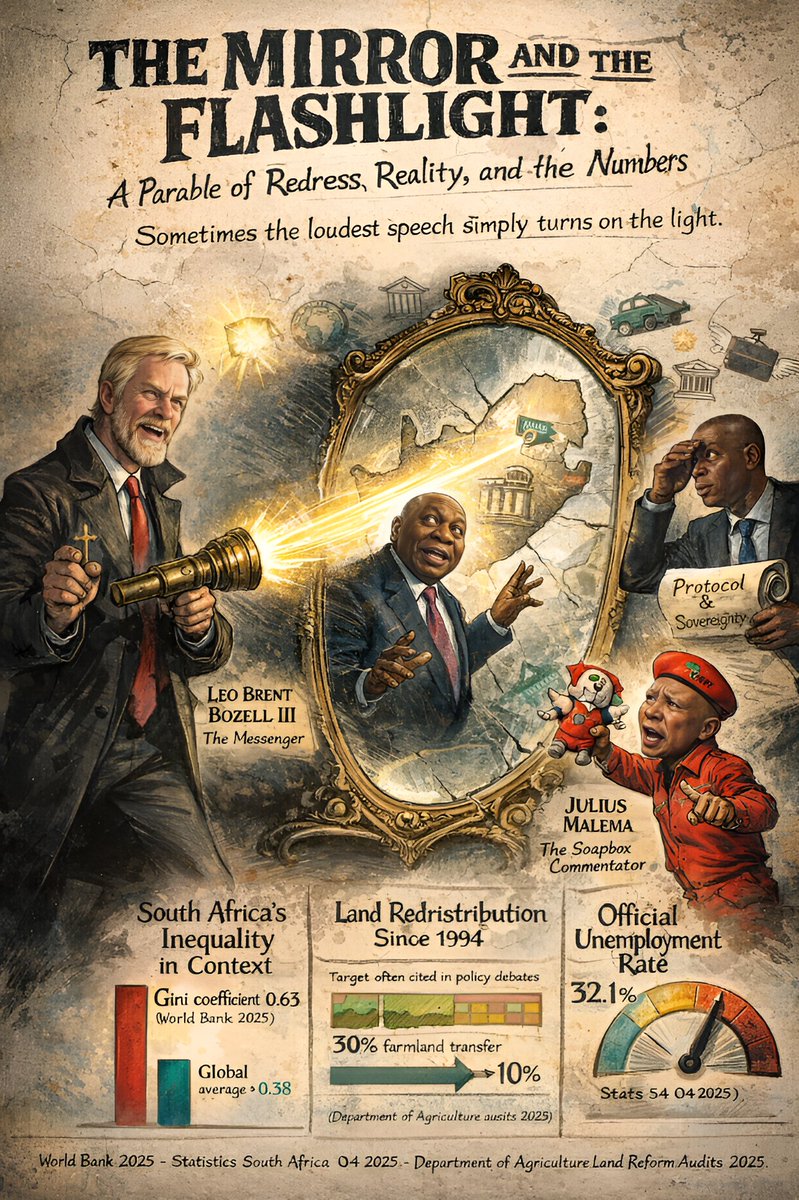
Sjoe! 😳🇿🇦 US Ambassador Drops Diplomatic Bombshell in Hermanus – ANC Hits Panic Button! 🚨 ~ Redress vs Reality ⚖️📉: Speech Exposes South Africa’s Transformation Dilemma ~ Mirror Held to the Nation 🪞🇿🇦: Speech Rekindles Debate Over Cadre Deployment and Reform.
Picture this: it is March 10, 2026, in Hermanus, that sleepy little seaside town where the whales come to holiday and the wind whispers secrets to the fynbos. Into this postcard scene walks Leo Brent Bozell III, the freshly arrived American ambassador, looking every inch the new kid who has just read the rulebook and decided he doesn’t like page 47.
He steps up to the BizNews microphone and, with the calm certainty of someone who has already decided the house is on fire, declares the “Kill the Boer” chant to be hate speech—never mind what the Constitutional Court said last year. “I’m sorry,” he says, the apology sounding about as sincere as a politician’s promise, “I don’t care what your courts say.”
Then he unfurls a list of five American demands that have apparently been sitting unanswered on someone’s desk for almost twelve months: condemn the chant publicly, take farm murders seriously, rethink the Expropriation Act and B-BBEE rules that make American companies feel unwelcome, dial back the cosy BRICS-Iran flirtation, and perhaps reconsider the tone of the ICJ case against Israel.
“Patience,” he concludes, “is running out.”
Twenty-four hours later Pretoria has hit the panic button. Foreign Minister Ronald Lamola summons Bozell for a formal demarche, the diplomatic equivalent of being called to the principal’s office. The minister’s briefing is a masterclass in dignified outrage: the remarks are “undiplomatic,” they undermine the judiciary, they disrespect South Africa’s history.
Not once does the statement engage the actual content—farm attack statistics, the lived fear in rural communities, the investment chill caused by uncertain land policy, or the geopolitical price tag of certain foreign friendships. The spotlight stays firmly on etiquette.
How dare anyone question the courts in public?
This small but perfectly formed diplomatic explosion is not just a bilateral spat. It is the moment the mask slipped. Bozell’s speech did not create the cracks in South Africa’s post-apartheid project; it merely shone a very bright, very American spotlight on them.
The claim here is simple and uncomfortable: what we are witnessing is not a sudden crisis but the logical outcome of a system in which the promise of redress—land, economic inclusion, healing—has been quietly hollowed out by patronage, shielded by sovereignty talk, and papered over with radical-sounding rhetoric.
The evidence network that follows spans law, history, economics, and international relations. It is falsifiable: if merit-based appointments and full transparency were implemented tomorrow, measurable improvements in inequality, investment confidence, and social cohesion should follow. If not, the cycle continues.
Stirring Questions:
How does a foreign diplomat manage to expose domestic fault lines so quickly and so completely?
Is sovereignty the absolute trump card, does any external critique automatically illegitimate because sovereignty is sacred?
What happens when ignored diplomatic asks turn into public ultimatums?
Could similar pressure from BRICS partners or the EU produce the same defensive reflex?
And what does that tell us about the real flexibility of “non-alignment”?
Why these questions matter together: They force the conversation beyond personalities and protocol toward the deeper mechanics of accountability. If the reflex is always deflection, then the system is not merely slow—it is structurally allergic to correction.
Context
South Africa’s democratic journey began with a miracle in 1994: a negotiated end to apartheid, a Constitution hailed as one of the most progressive on earth, and a Truth and Reconciliation Commission that chose truth over vengeance. The promise was redress—return stolen land, open doors to jobs and capital for those deliberately excluded, heal the wounds of racial engineering. Land reform targets were ambitious; B-BBEE was designed to create a black middle class and spread ownership; affirmative action aimed to correct centuries of exclusion.
Three decades later the numbers tell a different story. The Gini coefficient remains the highest in the world at 0.63 (World Bank, 2025). Land reform has transferred roughly 10 % of white-owned farmland, but many redistributed projects have collapsed due to lack of support, poor planning, and—frequently—corruption (Department of Agriculture audits, 2025). B-BBEE has produced billionaires, yes, but the broad base remains stubbornly narrow; Commission for Employment Equity reports show persistent elite capture. Unemployment hovers at 32 % (Stats SA, Q4 2025), and skilled emigration continues to climb.
Enter cadre deployment, the ANC’s post-1994 strategy of placing party-loyal cadres in strategic positions across the state to drive the National Democratic Revolution. The intention was control of transformation; the outcome, as documented by the Zondo Commission (2022), was blurred party-state boundaries, tender manipulation, and state capture on a massive scale.
Zondo recommended ending the practice in public administration; the Public Service Amendment Bill has crawled forward, but redacted cadre lists and contempt findings over non-compliance (following ConCourt orders in 2024) suggest reluctance to let go.
Foreign policy adds another layer of complexity. South Africa’s principled non-alignment—rooted in solidarity with Palestine, Cuba, Iran—has always been costly in Western capitals. The ICJ genocide case against Israel and deepening BRICS ties have amplified those costs at precisely the moment American patience, under a second Trump administration, is wearing thin.
The “Kill the Boer” chant sits at the intersection of all these threads. Born as a struggle song, defended in court as protected political expression (Equality Court 2022, SCA May 2024, ConCourt March 2025), it continues to be sung at EFF rallies. To many rural Afrikaners and farm workers, it sounds like a death threat in a country where farm attacks remain brutal and under-prosecuted (SAPS statistics). To defenders, it is heritage. To Bozell, it is hate speech.
The diplomatic firecracker of March 2026 simply turned up the volume on a debate South Africans have been having—quietly, angrily, or evasively—for years.
Stirring Questions:
If the promise of 1994 was redress, why does the lived experience of so many South Africans feel like postponement?
Why assumes moral authority equals administrative competence without evidence, is cadre deployment only justified because the ANC won the liberation struggle?
How has the global shift toward multipolarity changed the price tag of non-alignment?
What would a genuinely post-patronage transformation agenda look like, and who has the political capital to champion it?
Why these questions matter together: They remind us that history is not a permanent alibi. The longer the gap between promise and delivery grows, the harder it becomes to ask the next generation to believe in the project at all.
Evidence Network
1. Judicial Rulings and the Cost of Brevity
The Constitutional Court’s March 27, 2025 order in the AfriForum appeal is a single page of almost clinical terseness: application dismissed, no reasonable prospects of success. The court upheld the SCA (ZASCA 82, 28 May 2024) and Equality Court (2022) findings that “Dubul’ ibhunu” does not constitute hate speech in its historical and political context—no proven intent to incite imminent harm, and a reasonably informed listener would understand it as symbolic protest rather than a call to arms (Promotion of Equality and Prevention of Unfair Discrimination Act, 2000).
Procedurally correct? Yes. Reassuring to a nervous public? Not even close.
The absence of detailed reasons or a named bench in public summaries feeds a narrative that the apex court is either unwilling or unable to explain itself on one of the most emotionally charged issues in the country.
That perception is amplified by long-standing concerns over the Judicial Service Commission’s composition—politicians sit on it, and critics (Helen Suzman Foundation, Judges Matter) argue this opens the door to cadre influence. The Zondo Commission (2022) did not directly accuse the judiciary of capture, but its broader finding—that loyalty-based appointments erode institutional integrity—hovers like smoke over the water.
The result is a legitimacy deficit.
When a ruling protects a chant that many interpret as eliminationist rhetoric, yet does so in near-silence, public confidence erodes. Farm attack survivors and their families do not read legal context; they hear the words and feel the chill.
That gap between legal protection and lived fear is precisely the space where polarisation festers (Genocide Watch Stage 6 rating for South Africa is "Polarization")
2. Zondo’s Unfinished Business: Patronage as Structural Sabotage
The Judicial Commission of Inquiry into State Capture (Zondo Commission) delivered its final report in 2022 with devastating clarity: cadre deployment was not merely a management tool; it was the mechanism that made grand corruption possible.
Loyalty trumped competence, tenders were steered to connected companies, state-owned enterprises were hollowed out. The commission recommended ending the practice in public administration and strengthening conflict-of-interest rules.
Implementation has been glacial. The Presidency’s own 2025 progress report conceded that only about 48 % of commitments were substantially met. ConCourt orders for unredacted cadre deployment records (from 2013 onwards) have been met with heavy redactions and contempt proceedings. The Public Service Amendment Bill, intended to curb political interference, remains bogged down in committee.
The impact on redress is measurable and tragic.
Land reform projects have collapsed at scale—Auditor-General reports cite mismanagement, nepotism, and fraud as recurring themes. B-BBEE has created a small class of politically connected tycoons while broad-based ownership remains elusive (Commission for Employment Equity, 2025). Radical rhetoric fills the vacuum: calls for expropriation without compensation, accelerated transformation, attacks on “white monopoly capital.”
The language is fiery, the delivery patchy, the beneficiaries often the same small circle. Patronage does not just slow redress; it actively subverts it.
3. Economic Numbers That Refuse to Lie
South Africa’s economic indicators form a grim chorus. Gini coefficient 0.63 (World Bank, 2025)—highest globally. Unemployment 32.1 % (Stats SA, Q4 2025). Net emigration of skilled professionals up 15 % year-on-year (Statistics South Africa migration data, 2025). Investment in agriculture and manufacturing continues to stagnate, partly due to uncertainty over property rights and empowerment requirements perceived as punitive by foreign firms.
B-BBEE’s implementation has been criticised by its own architects for “fronting” and narrow benefit.
Land reform: only about 10 % of white-owned farmland redistributed since 1994, with a significant proportion of projects now derelict or unproductive (Department of Agriculture, Land Reform and Rural Development, 2025 audit summary). The economic cost of cadre-driven mismanagement is staggering—Zondo estimated state capture losses in the region of R1 trillion.
These numbers are not abstract. They translate into closed clinics, unbuilt schools, families leaving for Australia or Canada. They also explain why external pressure—whether from Washington or rating agencies—lands so painfully: the house is already leaking, and the rain is getting heavier.
4. Geopolitical Mirrors: The Cost of Deflection
Ramaphosa’s March 5, 2026 New York Times interview described the 2025 Oval Office meeting with Trump as an “ambush”—lights dimmed, videos of farm attacks played, “white genocide” rhetoric pushed. Ramaphosa called the subsequent Afrikaner refugee policy “racist” for prioritising one racial group. Mbalula’s X post (March 11, 2026) exhumed Bozell’s 1987 letter opposing ANC armed struggle to label him an “unrepentant racist.”
This is deflection perfected: historical framing deployed to shut down present-tense critique. Yet the underlying issues remain—farm attacks continue (SAPS data), investment hesitates (land policy uncertainty), foreign alignments (Iran, ICJ case) carry tangible costs (aid reviews, trade friction). Bozell’s warning of “patience running out” is not idle: tariff threats and refugee policy moves are already in motion.
The pattern is consistent across domains: external critique → sovereignty/racism framing → substantive avoidance → deeper entrenchment of the status quo. It is a cycle that can be broken, but only if the diagnosis is honest.
Stirring Questions:
When every evidence stream—legal, economic, historical, geopolitical—points to the same structural flaw, why does the reflex remain deflection rather than reform?
Is the system isn't still structurally racist is radical rhetoric still necessary?
What would a genuinely post-cadre transformation agenda actually look like in practice?
Could digital public dashboards for tenders and cadre appointments shift the power balance?
And what role might young South Africans—less invested in the old struggle narrative—play in demanding that shift?
Why these questions matter together: They move the conversation from diagnosis to prescription. If the evidence is correct, then the solution is no longer ideological—it is technical, measurable, and urgent.
Synthesis
Step back and the pieces lock together with sobering clarity. Judicial brevity shields rulings from scrutiny while cadre deployment creates the perception (and sometimes the reality) of political influence.
Patronage diverts redress resources into private pockets, leaving land reform in tatters and B-BBEE skewed toward the already empowered. Economic stagnation and emigration provide the hard numbers that prove the system is not merely slow—it is actively counterproductive.
Geopolitical pressure then arrives as the unwelcome mirror, reflecting back every unaddressed flaw.
The collective weight of this evidence network is its consilience: independent streams from different domains converge on the same conclusion. The argument is falsifiable—implement Zondo’s recommendations in full, enforce unredacted transparency, pivot to merit-based appointments and substantive diplomatic engagement.
Within three to five years, measurable improvements should appear: rising agricultural productivity on redistributed land, broader B-BBEE ownership, declining emigration of skilled professionals, increased foreign direct investment, and reduced domestic polarisation.
Now imagine the reform process unfolding with the slow inevitability of a true new dawn. First, the Public Service Amendment Bill passes without dilution—tenders awarded on competence, not connection. Next, ConCourt orders full disclosure of reasons and benches in significant cases; trust begins to rebuild.
Then, government engages foreign partners on substance rather than protocol—farm safety programmes co-designed, B-BBEE guidelines clarified for investors, non-alignment recalibrated without abandoning principle.
The logic: problems once thought ideological reveal themselves as technical; solutions once dismissed as “selling out” prove themselves as common sense.
This is not optimism for its own sake. It is the logical endpoint of the evidence. The cycle can be broken, but only if South Africans demand that it be broken.
Objections
Sovereignty is non-negotiable; foreign criticism must be rejected to protect national dignity. Dignity is important, but so is survival. When sovereignty is used to deflect rather than defend, it becomes a shield for failure. Honest engagement with criticism—without surrendering principle—strengthens sovereignty, not weakens it. Countries that reformed after external pressure (e.g., post-1997 Asian financial crisis states) emerged stronger.
Cadre deployment is necessary to prevent counter-revolution and ensure transformation. Twenty years ago that argument carried weight. Today it is harder to sustain. Zondo (2022) demonstrated that loyalty-based appointments enabled the very looting they were meant to prevent. The test is outcomes: if transformation were advancing, inequality would be falling. It isn’t. Merit-based systems in diverse contexts (Singapore, Botswana) have delivered development without sacrificing social justice.
Radical rhetoric is the only language the ruling class understands; moderation equals surrender. Rhetoric without results is theatre. Land reform rhetoric has been radical for fifteen years; actual redistribution remains minimal. B-BBEE rhetoric is militant; broad ownership remains elusive. The evidence suggests that clarity, competence, and transparency produce more transformation than slogans.
Conclusion:
Bozell’s speech was not the problem; it was the mirror. It showed a nation still wrestling with the tension between sovereignty and accountability, redress and results, history and the future. The evidence network—judicial opacity, Zondo’s warnings, economic stagnation, geopolitical costs—proves that the current trajectory is not sustainable. The flaws are not mysterious; they are documented, measurable, and correctable.
South Africans have done harder things. They ended apartheid without civil war. They wrote one of the world’s finest constitutions. They can now demand the next chapter: merit over loyalty, transparency over redactions, dialogue over deflection.
The call is simple: insist on implementation of Zondo, full judicial disclosure, substantive engagement with critics foreign and domestic. Measure progress not by rhetoric but by outcomes—lower inequality, higher employment, fewer farm murders, more investors staying rather than leaving.
Wake up, South Africa. The liberation story is not finished, but it will not write itself. The alternative is not failure—it is farce. And this country deserves far better than to become history’s saddest punchline.
The evidence network proves Bozell’s speech exposed ANC flaws sabotaging redress with undeniable evidence.
#SjoeSA 😳🇿🇦
#DiplomaticDrama 🍿🌍
#HermanusBombshell 🐋💥
#MirrorMoment 🪞🇿🇦
#PretoriaPanic 🚨🏛️
#SpeechThatShookSA 🎤⚡
#RedressRealityCheck 📉⚖️
#CadreChaos 🎩🎭
#FarmAttackDebate 🚜😬
#BRICSBoomerang 🌍🔁
#ProtocolOverProblems 🤦♂️📜
#DiplomaticFireworks 🎆🌍
#WhaleCoastWhopper 🐋🗞️
#TalkAboutTheIssues 🗣️📊
#SAWakeUpCall ⏰🇿🇦
#PoliticsButMakeItSpicy 🌶️🏛️
#GlobalSpotlight 🌍🔦
#TruthBomb 💣😳
#ThisIsAwkward 😬🍿
#PoliticalJenga 🧱🎲
References
AfriForum v Economic Freedom Fighters and Others, No. ZASCA 82 (Supreme Court of Appeal May 28, 2024).
Constitutional Court of South Africa. (2025, March 27). Dismissal of application for leave to appeal in AfriForum matter [Court order].
Department of Agriculture, Land Reform and Rural Development. (2025). Audit reports on land reform projects [Internal audits].
Department of International Relations and Cooperation. (2026, March 11). Media briefing on geopolitical developments [Transcript] (R. Lamola, speaker).
Judicial Commission of Inquiry into Allegations of State Capture, Corruption and Fraud in the Public Sector including Organs of State. (2022). Final report. The Presidency.
Presidency of the Republic of South Africa. (2025). Progress report on implementation of actions in the President’s response to the recommendations of the State Capture Commission.
Ramaphosa, C. (2026, March 5). Interview with The New York Times [Transcript]. The New York Times.
South African Police Service. (2025). Crime statistics on farm attacks [Annual report].
Statistics South Africa. (2025). Quarterly Labour Force Survey (Q4 2025).
World Bank. (2025). South Africa economic update: Inequality in focus [Report].