

اكسل اكسس
موارد بشرية
تقارير ميدانية
تصميم HTML
تحليل بيانات
سوليد وورك
تصميم اوتوكاد
اكسل اكسس
رسائل ماجستير
نظم تشغيل
حل بروجكت
حل تكاليف
حل اسـايمنت
حل اكويزات
1
1
1

Thariq Shihipar (@TRQ212), an Anthropic engineer, said plainly: "The plans are so long, I honestly have stopped reading them." His fix was not a better AI model but HTML, the language web pages are built in.
1
2

2m
RT @128bit_M4: #50音予測変換全公開みた人もやる
アリスさん
今
嬉しい
html
Honor
加工
きて
Google
けど
殺してくれ
寂しすぎ
死にたい
ステディリーさん
せい
そう
誰か
ちょっと
次
て
と
ない
に
抜く
ね
罵って
♡
人
フォロワ…
1

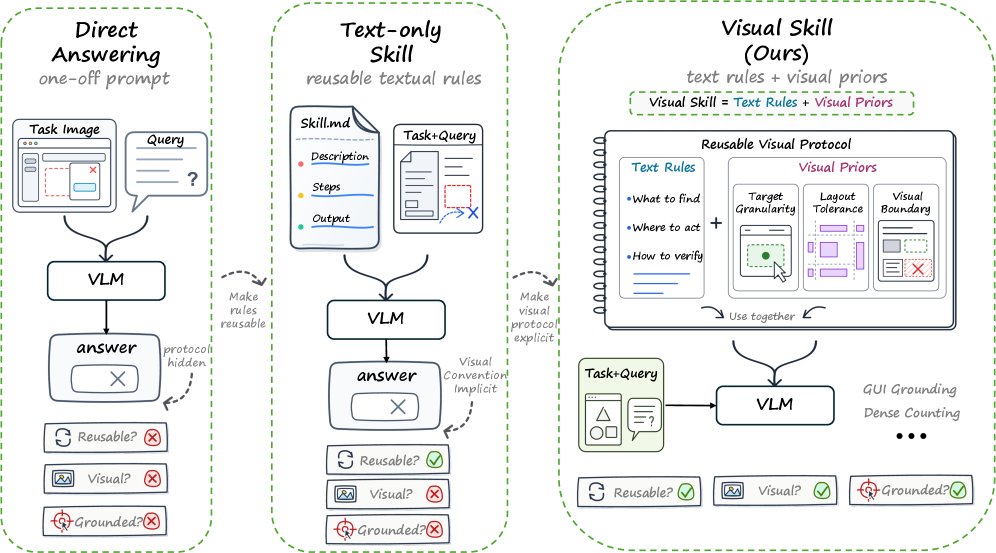
「AIは目で見られるのに、スキルはテキストで蓄積される」という矛盾を定量化した論文(https://arxiv[.]org/html/2606.01414v1)。
今のマルチモーダルエージェントは、経験から学んだ「スキル」をテキストの手順書として保存する。「ボタンAをクリックしてBに入力する」といった形式だ。論理推論やAPI操作には十分だが、GUIの操作(画面上の特定の要素を正確にクリックする)や密集した物体の数え上げなどの「視覚的なタスク」では根本的に情報が失われる。「そのアイコンのどの領域がクリック可能か」は文章では保存しきれない。
この論文はこの問題を「テキスト上の限界(Textual Bottleneck)」と定義した上で、Visual Skillというアプローチを提案する。テキストの手順書に3種類の「視覚的サポート(Visual Prior)」を組み合わせる設計だ。
・Static Prior(静的参照): GUIのヒットボックス(クリック有効領域)やレイアウトのプロトタイプなど、複数のタスクにわたって使い回せる視覚的ルール集
・Dynamic Prior(動的追跡): 物体カウント時に「どれを数えたか」を番号付きの座標アンカーとして画像上にリアルタイム描画し、次の推論に渡す視覚的ワーキングメモリ
・Interleaved(インターリーブ型): 手順の各ステップを、そのステップの根拠となるスクリーンショットや画像領域に紐付ける形式
実験数値が鋭い。GUIグラウンディング(画面上の要素を正確に操作できるか)のベンチマーク「ScreenSpot-v2」では、テキストのみスキルの92.3%に対してVisual Skillが95.1%に向上。クリック精度の指標Mean IoUは0.343から0.418まで改善した。
特に面白いのが密集した物体カウントの結果だ。「CountBenchQA」では、テキストのみスキルを追加すると直接指示より逆に精度が落ちる(94.24%→93.00%)。「丁寧に数えよう」という手順書だけ増えて、どこまで数えたかの空間的な記録がないと混乱を招く。Visual Skillでは座標アンカーが視覚メモとして機能し、97.12%まで到達、MAEも0.1612から0.0535に大幅改善した。
付録の失敗例も興味深く、Static Priorが「クリック可能な最小グリフ」を過度に強調してしまい、「カート内のアイテムをさらに表示」のような意味的に広い操作でかえって誤った領域をクリックするケースも報告されている。視覚的な先入観が意味解釈を上書きしてしまう問題だ。
自動生成パイプライン「AutoVisualSkill」でVisual Skillを生成できる仕組みもOSSで公開済み。知識の保存フォーマット自体を変えるというアプローチは、今後のエージェント設計に影響しそうかもしれない。
4
1
6

A software engineer working on Facebook's ads platform in 2011 got so frustrated with how painful it was to update the user interface that he built an entirely new way to render web pages.
The prototype he wrote was called FaxJ. It evolved into a framework called FBolt. Then it got a new name.
React.
His name is Jordan Walke.
He was born in 1984 in Houston, Texas. He graduated from the University of Washington. He joined Facebook as a software engineer and was assigned to the ads team, one of the most important revenue surfaces in the company.
Here is the story.
The problem Jordan stared at every day was deceptively simple. When a user clicked something on Facebook, the page needed to update. A like count goes up. A comment appears. A notification badge changes. In 2011 the standard way to handle this was to manually find the piece of the page that changed and surgically update it using jQuery or raw JavaScript DOM manipulation.
On a small website this was fine. On Facebook, with hundreds of interactive elements on a single page, it was a nightmare. Every update required developers to track exactly which piece of the DOM had changed and write brittle, error-prone code to modify it. The more complex the interface, the more the code collapsed under its own weight.
Jordan had been influenced by XHP, an HTML component framework for PHP that Facebook already used on the server side. XHP let you write reusable HTML components as PHP expressions. It was clean. It made sense. But it only worked on the server. The browser side was still chaos.
He asked a question nobody else at Facebook was asking. What if you could write UI components the same way on the client, and instead of surgically updating the DOM, you just re-rendered the entire view every time something changed and let the framework figure out what was different?
The idea sounded insane. Re-rendering everything on every change was supposed to be impossibly slow. Jordan's insight was that if you built a virtual representation of the DOM in memory and compared it to the previous version before touching the real DOM, you could make re-rendering feel instant. Only the parts that actually changed would be updated in the browser.
He built the first prototype and called it FaxJ. It evolved into FBolt. It eventually became React. He moved from the ads team to Product Infrastructure to work on it full time.
The first real deployment was on Facebook's News Feed in 2011. Then in 2012, after Instagram joined Facebook, a former Facebook Photos engineer named Pete Hunt joined the Instagram team and built the first version of Instagram's web feed using React. Instagram became the first "external" user. Extracting React from Facebook's codebase for Instagram's use was what paved the way to open-sourcing it.
In May 2013, Jordan and his team presented React at JSConf US and released it to the public.
The reception was brutal. Developers hated it. The biggest objection was JSX, the syntax that mixed HTML-like markup directly into JavaScript. It violated every principle of separation of concerns that the web development community had been taught for a decade. Conference talks mocked it. Blog posts tore it apart.
Then people started using it. And they stopped going back.
Within two years React had become the most discussed JavaScript library in the world. By 2015 the team had shipped React Native, extending the same component model to mobile apps on iOS and Android. By 2018 React had more questions on Stack Overflow than jQuery, Angular, Vue, Ember, and Svelte combined. It became the default way to build user interfaces on the web.
Jordan also created ReasonML, a typed language that leverages the OCaml and JavaScript ecosystems. He stayed at Facebook for over a decade. In January 2021 he posted a tweet announcing he was leaving to start his own company and to invest in open-source projects and startups.
In late 2025 he joined Replit as VP of Product, saying the energy there felt like the early days of React at Facebook.
One engineer, frustrated with how Facebook's ads page updated, changed how the entire world builds software for the browser.

10

ゆきまさ retweeted

21h
この前、パソコン初心者の人が「HTMLって記号を並べただけでデザインが書けてるの凄くない?」って言っていて、マルチメディアの本質を一瞬で見抜いているの凄いなと思ったのです。
21
284
4,718
566,900
江戸東京博物館のデジタルアーカイブスにて戦争画がいくつか公開されていますね
https://www.edohakuarchives.jpdetail-307302.html #江戸東京博物館 #デジタルアーカイブス #大東亜戦争海軍美術 ニコバル群島戡定
1
9
Shubham Metange retweeted

DOMPurifyバイパスの歴史をまとめたページ。HTMLサニタイザーバイパスのノウハウがぎっしり詰まってる。
特に今年に入ってから発見された<selectedcontent>のバイパスは驚いた
github.com/cure53/DOMPurify/…
1
25
130
5,963

If you like write the website or web-app in fortran you will still render html in browser 😑

Hace poco empecé a mostrar mis brief en html 🥹
Jun 12

Drop It. It's Live.
Drag a file or folder into your browser and Vercel Drop gives you a production URL in seconds.
vercel.com/changelog/vercel-…


7m
OpenNav 0.2.0 is live
Server-side content negotiation is here.
When an AI agent sends Accept: text/markdown, your server converts the HTML to clean Markdown on-the-fly.
Browsers still get normal HTML. Same URL, two representations.
Three methods — pick your level of control:
- negotiate() — one call does it all
- accept() — branch before expensive renders
- toMarkdown() — convert when you already know Markdown is needed
Works with Hono, Astro SSR, Next.js, Cloudflare Workers — any WinterCG runtime.
npm i @opennav-ai/opennav
Link to site in reply.
1
7

先月から同人誌および漫画買いすぎだから来月に回すんですがめちゃくちゃ良くて〜😭てかラキドで他の方のサイト見るたびにわたしってまじで半端なおたくだよ〜んと思う※別にhtmlとcssをいじれるのはおたくの条件ではない ROM専だったから……
pixiv.net/artworks/121516828
27