Jay retweeted

“There is no societal permission for an AI future that hollows out entire industries”
$MSFT seizing the moment. Hyperscalers have a chance now to position themselves as the orchestration, gatekeepers of enterprise AI.

14
12
172
26,348

Sivaprasad Gurugubilli retweeted

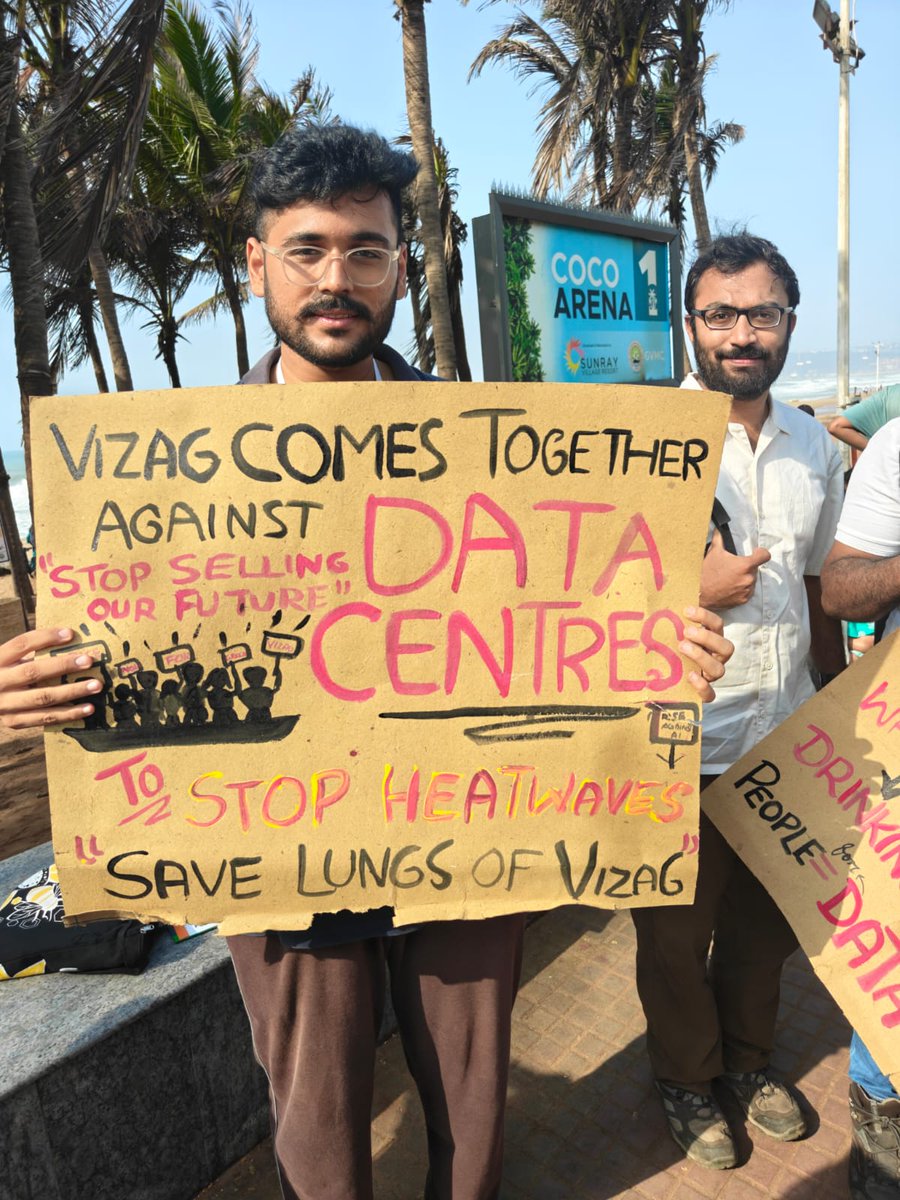
Protest in Vizag opposing the proposed Adani-led 2.512 GW Hyperscale Data Centers, 1 GW Reliance-led Hyperscale Data Center, and other Hyperscale Data Centers, with the total proposed capacity set at at least 6.5 GW.
Visakhapatnam,
14/07/2026



1
16
31
791


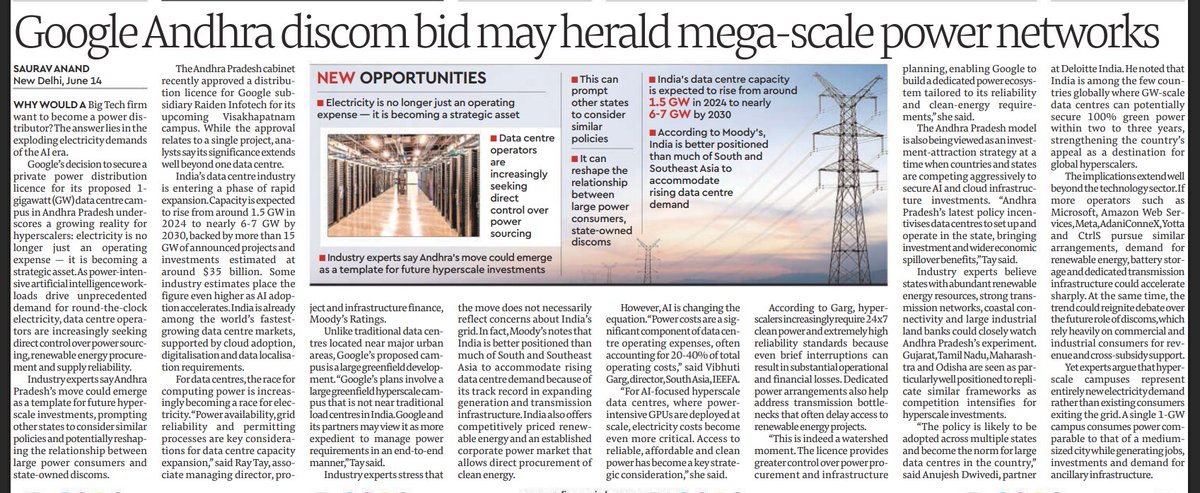
Google's Andhra Pradesh Discom Licence for 1 GW Visakhapatnam Data Centre May Herald Mega-Scale Power Networks; India Data Centre Capacity to Hit 6-7 GW by 2030 — Hyperscalers Seeking Direct Power Control as Electricity Becomes Strategic Asset
The Landmark Decision — What Happened
Andhra Pradesh cabinet approved a private power distribution licence for Google subsidiary Raiden Infotech for its upcoming Visakhapatnam campus
Google securing licence for proposed 1 gigawatt (GW) data centre campus in Andhra Pradesh
While approval relates to a single project — analysts say significance extends well beyond one data centre
Industry experts say Andhra Pradesh's move could emerge as a template for future hyperscale investments — prompting other states to consider similar policies
Why Big Tech Wants to Become a Power Distributor
AI is changing the equation: power costs are a significant component of data centre operating expenses — often 20-40% of total operating costs
AI-focused hyperscale data centres where power-intensive GPUs are deployed at scale make electricity costs even more critical
Hyperscalers increasingly require 24x7 clean power and extremely high reliability standards — even brief interruptions can result in substantial operational and financial losses
Vibhuti Garg, Director South Asia, IEEFA: "Access to reliable, affordable and clean power has become a key strategic consideration"
Dedicated power arrangements also help address transmission bottlenecks that often delay access to renewable energy projects
Ray Tay, Moody's: "Power availability, grid reliability and permitting processes are key considerations for data centre capacity expansion"
Google's plans involve a large greenfield hyperscale campus — not a traditional load centre — making it more expedient to manage power requirements end-to-end
India's Data Centre Boom — The Capacity Story
India's data centre capacity expected to rise from ~1.5 GW in 2024 to nearly 6-7 GW by 2030
Backed by more than 15 GW of announced projects and investments estimated at ~$35 billion
Some industry estimates place the figure even higher as AI adoption accelerates
India already among the world's fastest-growing data centre markets — backed by cloud adoption, digitalisation and data localisation requirements
According to Moody's, India better positioned than much of South and Southeast Asia to accommodate rising data centre demand due to track record in expanding generation and transmission infrastructure
India also offers competitively priced renewable energy and an established corporate power market allowing direct procurement of clean energy
The Strategic Shift — Electricity as a Strategic Asset
Electricity is no longer just an operating expense — it is becoming a strategic asset
Race for computing power is increasingly becoming a race for electricity
Data centre operators increasingly seeking:
Direct control over power sourcing
Renewable energy procurement
Supply reliability
Anujesh Dwivedi, Deloitte India: India among few countries globally where GW-scale data centres can potentially secure 100% green power within two to three years
Andhra Pradesh Model — Investment Attraction Strategy
AP model being viewed as an investment-attraction strategy as countries and states compete aggressively for AI and cloud infrastructure investments
AP's latest policy incentivises data centres to set up and operate in the state — bringing investment and wider economic spillover benefits
Licence provides Google greater control over power procurement and infrastructure planning — enabling a dedicated power ecosystem tailored to its reliability and clean-energy requirements
States seen as particularly well-positioned to replicate: Gujarat, Tamil Nadu, Maharashtra and Odisha — states with abundant renewable energy resources, strong transmission networks, coastal connectivity and large industrial land banks
Broader Implications — Reshaping the Discom Model
Move could reshape the relationship between large power consumers and state-owned discoms
If more operators — Microsoft, Amazon Web Services, Meta, AdaniConneX, Yotta, CtrlS — pursue similar arrangements, demand for renewable energy, battery storage and dedicated transmission infrastructure could accelerate sharply
Could reignite debate over the future role of discoms — which rely heavily on commercial and industrial consumers for revenue and cross-subsidy support
A single 1 GW campus consumes power comparable to a medium-sized city while generating jobs, investments and demand for ancillary infrastructure
Anujesh Dwivedi: "The policy is likely to be adopted across multiple states and become the norm for large data centres in the country"
Core Theme
Google's Andhra Pradesh power distribution licence is a watershed moment in India's infrastructure story — the moment when Big Tech's electricity demand became large enough to justify becoming a power distributor in its own right. As AI workloads drive round-the-clock, high-reliability power demand that existing discom infrastructure cannot reliably serve, hyperscalers are moving to control their entire power stack from generation to consumption. India's unique combination of abundant renewable resources, an established corporate power market and a rapidly expanding data centre ecosystem makes it one of the few places globally where this model can scale — and Andhra Pradesh's decision to enable it may prove to be the policy template that unlocks India's position as the world's next great hyperscale destination.
4
601

1h
$FPS Everyone wants to own the company building AI.
I’m looking at the companies making AI possible.
Every new hyperscale data center needs electricity before it needs intelligence. GPUs, networking equipment, and AI models are useless without reliable power infrastructure.
That’s why Forgent Power Solutions $FPS is becoming increasingly interesting.
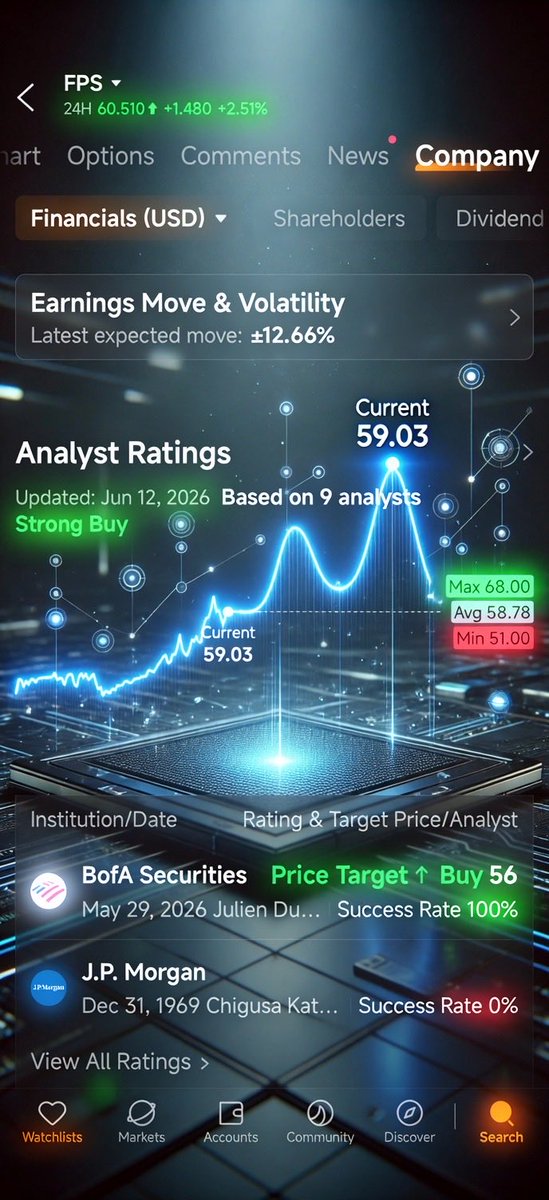
Bank of America just raised its price target from $57 to $68 and maintained a Buy rating, while analysts continue to rate the stock a Strong Buy.
The story isn’t just about one quarter.
It’s about a structural trend.
⚡ AI data centers are expanding globally
📊 Backlog is approaching $2B
📈 Revenue is growing at triple-digit rates
🚀 Bookings continue to outpace sales
🏗️ Data center exposure keeps increasing
The market is obsessed with NVIDIA and the AI software race.
But every billion dollars spent on AI infrastructure also creates demand for power systems, electrical integration, and mission-critical equipment.
That’s the hidden layer of the AI economy.
If AI spending remains one of the biggest investment themes over the next decade, companies solving the power bottleneck could quietly compound alongside the hyperscalers.
The biggest winners aren’t always the most talked about.
Sometimes they’re the businesses making sure the servers never go dark.
$FPS ⚡
3h

$FPS
What does $FPS do? Oh, transformers, panels & switchgear.
And they're vertically integrated allowing you to get to value sooner... and engineered to order, and work with data centres well before they've even broken ground?
forgentpower.com/category/tr…
56
1h
The AI revolution isn’t just about GPUs.
It’s also about power infrastructure.
Every new AI data center needs reliable, scalable, and rapidly deployable power systems. Without electricity, even the most advanced AI chips become expensive paperweights.
That’s where $FPS (Forgent Power Solutions) stands out.
While industrial giants like GE Vernova and Siemens dominate massive utility-scale projects, FPS focuses on speed, customization, and integrated power solutions for hyperscalers that can’t afford multi-year deployment timelines.
The numbers tell the story:
⚡ Record backlog approaching $2B
📈 Triple-digit revenue growth
🚀 Bookings growing faster than sales
🏗️ Data center exposure increasing every quarter
The biggest investment theme isn’t AI software.
It’s the picks and shovels enabling AI infrastructure.
Every new hyperscale facility built by Amazon, Microsoft, Google, Meta, or emerging AI cloud providers requires power distribution, cooling, and electrical systems before a single GPU goes online.
As AI compute demand accelerates, companies solving the power bottleneck could become some of the biggest beneficiaries.
Sometimes the best investment isn’t the AI model.
It’s the company making sure the lights stay on. ⚡
$FPS $NVDA $MSFT $GOOGL $AMZN $META

$FPS is the nimble, vertically-integrated pure-play on the exact pain the ZeroHedge post highlights.
$GEV/Siemens/Hitachi win on massive scale and giant backlogs. FPS wins on speed customization for hyperscalers who can’t wait 3 years.
The order momentum is screaming:
• Backlog hit record $1.98B as of March 31, 2026 ( 157% YoY).
• Recent quarter: revenue 103% YoY, bookings 308%, book-to-bill 2.3x.
• Data centers ~42% of revenue and growing fast; raised FY2026 guidance sharply.
They’re not just selling boxes, they do full powertrain solutions that reduce field labor and speed installs.
In a world where every month of delay costs hyperscalers real money, that matters.
$AMZN $META $SPCX $GOOGL $MSFT $NBIS $IREN are all dependant on $FPS.
97

Η πραγματικότητα είναι ότι τα hyperscale data centers δεν αποτελούν απλώς επενδύσεις υψηλής τεχνολογίας. Είναι ενεργοβόρες βιομηχανικές μονάδες που απαιτούν τεράστια ποσά σταθερής ισχύος, νερού και υποδομών ψύξης. Oταν αυτά τα κόστη δεν καλύπτονται από τους επενδυτές, μεταφέρονται αναπόφευκτα στο δημόσιο σύστημα και τελικά στους καταναλωτές. Η συζήτηση περί «ουδετερότητας κόστους» δεν έχει καμία τεχνική βάση, ιδιαίτερα σε μια χώρα όπου δεν υπάρχουν δημοσιευμένες ποσοτικοποιημένες μελέτες για την επίδραση τέτοιων φορτίων στο ηλεκτρικό σύστημα.
thefaq.gr/to-aorato-energeia…
3
4
190
Shaheen Khurana retweeted

Jun 14
🚨 Erin Brockovich's map exposes hyperscale data centers slammed over aquifers in rural Texas, Georgia & Virginia — stealing millions of gallons daily, causing livestock infertility and farm destruction via secret NDAs to force people into smart cities! STOP THE SCAM! 😡🔥
7
12
121

My dad lost a small fortune betting on this man in the 90s.
In 1995, Seymour Cray’s company, Cray Computer Corp., filed for Chapter 11. A few weeks after the founder purchased ~6 million dollars worth of shares.
What’s interesting is that Cray wasn’t some overpromoting founder. He was arguably the greatest computer engineer of his generation and the father of supercomputing.
His bet was that the future belonged to increasingly powerful single machines.
One of his famous quotes:
“If you’re plowing a field, which would you rather use: two strong oxen or 1,024 chickens?”
The rest of the industry made the opposite bet.
Instead of building one incredibly powerful processor, companies increasingly connected thousands of cheaper processors together in parallel.
By the mid-1990s, commodity processors were improving so rapidly that the economics began to overwhelm the engineering elegance Cray was famous for.
Bulls like my dad were betting on -> legendary founder huge vision massive insider buy revolutionary tech.
Unfortunately for the bulls, Cray was building better and better single machines while the industry was learning how to make thousands of cheaper machines work together.
Today, AI training, cloud computing, search engines, and hyperscale data centers are all descendants of the “1,024 chickens” approach.

Meet Seymour Cray, the man behind the fastest computers of his era. Born in Chippewa Falls in 1925, Cray's extensive career spanned multiple disciplines and set a new benchmark in high-performance computing. lacrossetribune.com/news/loc…
2
2
47
6,839

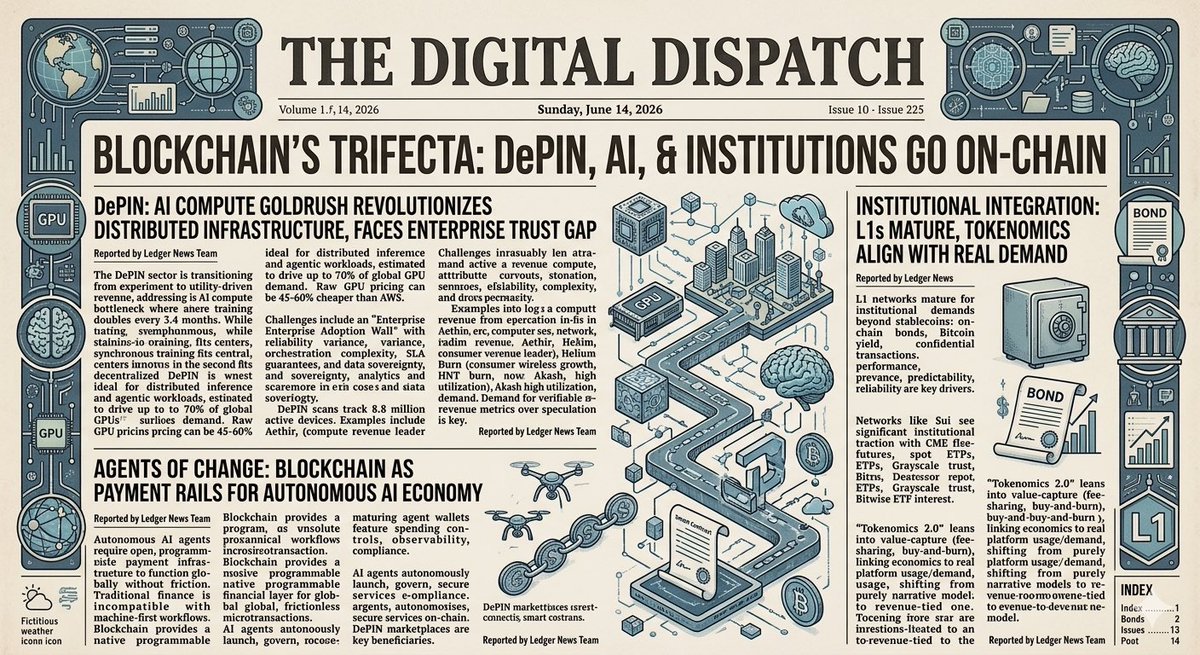
BLOCKCHAIN'S TRIFECTA: DePIN, AI, & INSTITUTIONS GO ON-CHAIN
The Future is Programmable, Distributed, & Revenue-Driven
DePIN: AI Compute Goldrush Revolutionizes Distributed Infrastructure, Faces Enterprise Trust Gap
(Reported by The Dispatch Tech Team)
The Decentralized Physical Infrastructure Networks (DePIN) sector is transitioning from experimental to utility-driven revenue. It directly addresses the AI compute bottleneck, which is expected to see model training requirements double every 3.4 months. While hyperscale centers are best for training, decentralized DePIN is ideal for distributed inference and agentic workloads, estimated to drive up to 70% of global GPU demand.
Raw GPU costs on DePIN can be 45-60% cheaper than AWS, representing substantial savings. However, a significant "Enterprise Adoption Wall" exists. Reliability variance, orchestration complexity, SLA guarantees, and data sovereignty remain complex challenges to large-scale corporate integration. DePIN scans already track over 8.8 million active devices. Projects like Aethir for general-purpose compute, Helium in wireless networks, and Akash with high utilization demonstrate current operational models. Investors are increasingly demanding verifiable revenue and utilization rates, rewarding sustainable demand.
Graphics include stylized GPUs and a city infrastructure network.
Agents of Change: AI Turns to Blockchain for Autonomous Payment Rails
(Reported by Artificial Intelligence & Finance Desks)
Autonomous AI agents operating globally require frictionless payment infrastructure, and blockchain is uniquely suited to provide this. Traditional systems, with KYC, account setup, and delays, are fundamentally incompatible with machine-first workflows.
Programmable, global, frictionless microtransactions are essential. Blockchain provides a native, programmable financial layer, allowing software to hold and transact value. Standards like the x402 protocol, agent-specific wallet infrastructure with spending controls, observability, and compliance are maturing. AI agents can autonomously launch, govern, and secure services on-chain. The agent economy is driving measurable transaction volume, particularly on DePIN compute marketplaces which are key beneficiaries.
Graphics show small futuristic drone figures, a chain of coins, and a stylized smart contract.
Institutional Integration & Market Shifts: L1s Advance, Tokenomics Align with Real Demand
(Reported by Ledger Market Analyst)
High-throughput Layer 1 (L1) networks are maturing to handle rigorous institutional demands for security, speed, and predictability beyond simple stablecoin adoption. Major players are exploring on-chain bonds, Bitcoin yield generation, and confidential transactions. Performance differentiation, predictable fee structures, and reliability are key drivers.
Network examples like Sui have seen significant institutional traction, with CME futures and spot ETPs launching, and Grayscale trusts and Bitwise ETFs showing interest, marking a deeper institutional reliance on these specific networks.
Market structures are shifting towards "Tokenomics 2.0," leaning heavily into value-capture mechanisms such as fee-sharing and buy-and-burn structures. Protocols are gaining policy clarity that allows them to link tokenholder economics directly to actual platform usage, rewarding verified demand over speculative emissions. The industry has grown to significant valuation but still navigates risks and governance complexity
#Blockchain #Web3 #CryptoNews #DePIN #AI
1
3
79

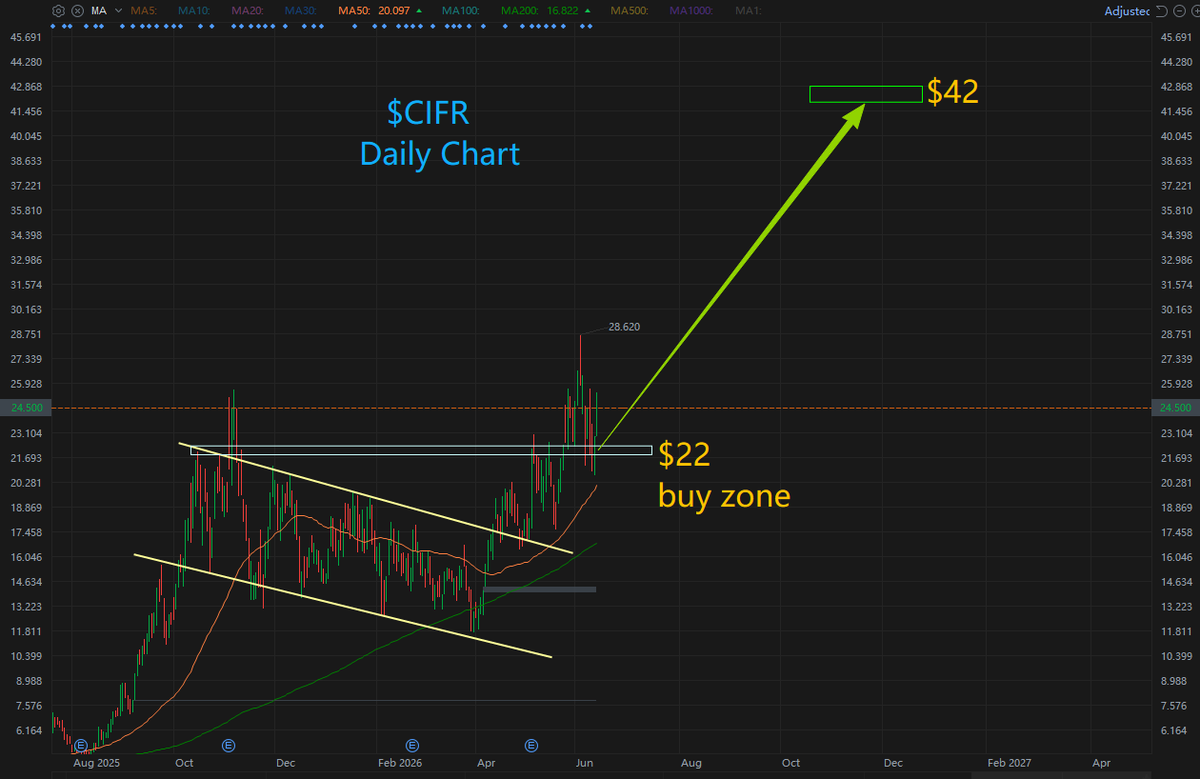
$CIFR --- On June 8, 2026, $CIFR announced that its wholly-owned subsidiary Stingray Compute plans a private placement of $810 million in Senior Secured Notes. The entire proceeds will fund the continued construction and final completion of the Stingray data center project. While this move materially raises the company’s financial leverage, it sends a strong signal to the market about its unwavering commitment to evolving into a major data center player.
In its updated Q1 2026 earnings release published in May, $CIFR confirmed it has signed a long-term campus lease agreement with a third investment-grade hyperscale data center tenant. Securing long-term contracts with top-tier cloud giants on par with Microsoft, Google and Amazon proves its power assets and prime locations have earned top-tier industry recognition.
1.Valuation Reset: From Crypto Miner to AI Compute Real Estate
Cipher previously generated revenue highly tied to Bitcoin price swings, with its valuation anchored to BTC prices and network hashrate.
Following its transformation into an HPC compute center operator, the business now delivers highly predictable long-term cash flow. The company projects its three flagship data center lease assets will generate an average annual net operating income (NOI) of roughly **$787 million** from October 2026 through September 2036, with the figure surging to $892 million by 2035. This decade-long stream of stable, multi-hundred-million-dollar income has drawn aggressive buying from long-term Wall Street institutional investors including Vanguard and D.E. Shaw over recent quarters.
2.Power Capacity: The New Digital Gold
The biggest bottleneck amid the AI boom is no longer compute chips, but power supply and grid allocation. Cipher controls massive fully approved industrial-grade power capacity across Texas and other regions, with extremely low connection costs.
Building a new data center and securing grid access typically takes 3 to 5 years. In contrast, Cipher’s Barber Lake and Black Pearl facilities have achieved grid interconnection and structural topping out ahead of schedule — Barber Lake finished topping in April, and both former mining sites are on track for accelerated delivery. This ready access to reliable power lets the company command premium pricing from cloud hyperscalers racing to expand compute capacity.
3.Full Decoupling from Bitcoin Volatility
By fully decommissioning all legacy Bitcoin mining rigs back in February, Cipher’s revenue is no longer exposed to wild swings in the crypto market. Business stability has improved dramatically, positioning the company to trade at higher P/E and P/B multiples comparable to established data center leaders such as Equinix and Digital Realty.
5
354

Goss was decided in 1985 when transmission lines were built to serve public loads. GP case asks if extraordinary intrusions on private property may be justified by speculative future demand forecasts to benefit a small number of private hyperscale customers.
9
Goss is a survey-right case, not a public-use case. Goss never considered whether extraordinary burdens on private property could be imposed for infrastructure whose primary economic beneficiary is a small number of private hyperscale data centers.
1
12

You are correct but in maryland the more money they seek is the public salary and pension. Most will cling desperately to that because its the mist money they will ever make. So the pols all are going to vote “no”on any hyperscale data center
1
No politician in maryland is going to affirmatively vote to approve any hyperscale data center. The “pauses” are merely an excuse not to say no to an applying party. The piblic thinks they are stopping AI when all they are doing is relocating it out of state
3