

GitHub - ioccc-src/winner: Winners of the International Obfuscated C Code Contest · GitHub github.com/ioccc-src/winner/…
1
14

Windows 3.1のソリティアってめっちゃ中毒性高かったじゃん。あのゲーム、実はたったの5キロバイト以下で書けるんだって。しかも難読化されたCコードで。
IOCCCっていう1984年から続いてるコンテスト(コードの難読化を競う)に出した作品らしいんだけど、制限サイズの中でゲーム機能まで実装してるの普通に天才。「printf(%d\n",c),11> c)」みたいなコードでループ書く世界。
プログラミング好きには罰ゲーム並みに面白そう。デコード挑戦したい人いる?
nanochess.org/klondike_in_c.…
#IOCCC #プログラミング
1
39

Оголошено переможців 29-го конкурсу заплутаного C-коду (IOCCC). Це свято креативності у програмуванні відкриває нові можливості для учасників.
proshcho.com/article/peremoz…
3

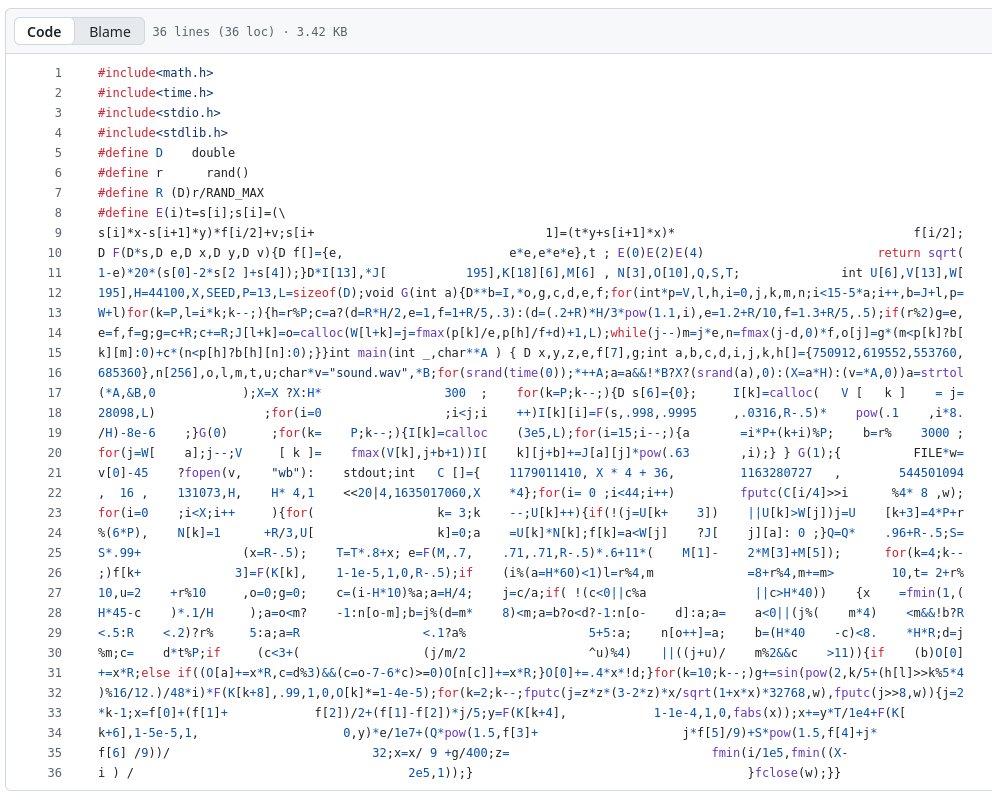
IOCCC、今回も入賞しました! 海辺のリラクゼーションミュージックを奏でるC(sea)のプログラム
youtube.com/watch?v=MoWCwZx1…
ioccc.org/2025/tompng/index.…
1
8
28
3,741


Jun 8
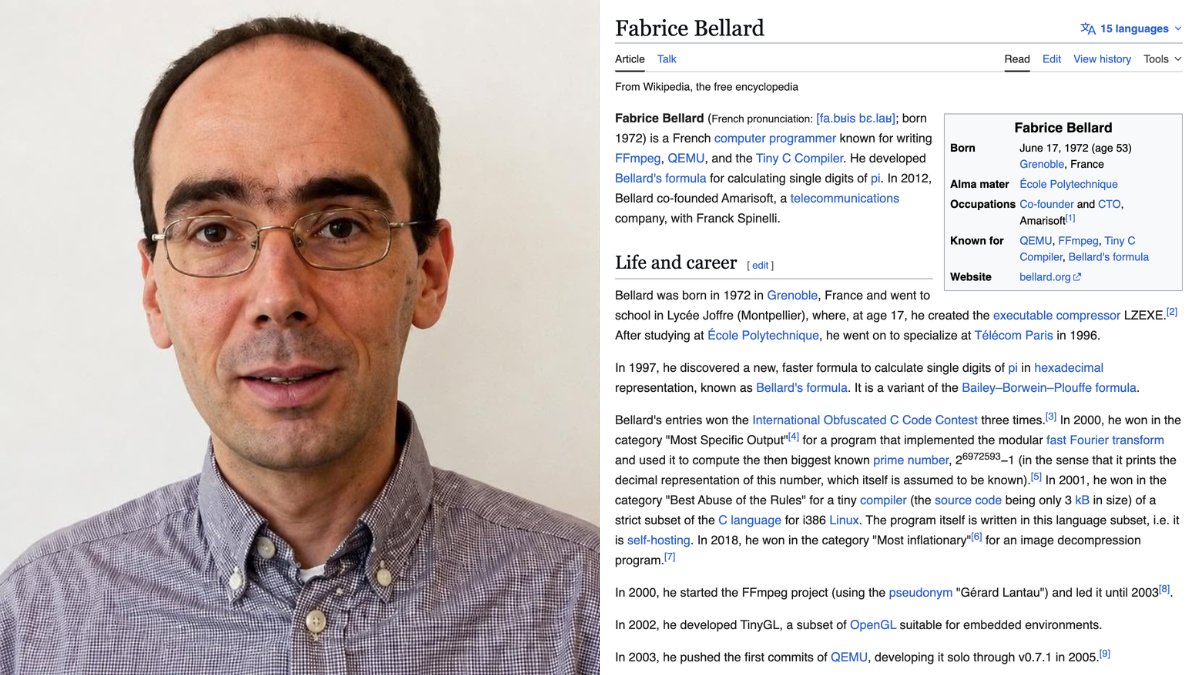
A quiet French systems programmer did not personally write every video stream or every cloud VM. But he created FFmpeg and QEMU, two projects that became part of the deep machinery of modern media, emulation, virtualization, development, research, and infrastructure. That is more impressive than the exaggerated version, because it is true.
The main correction
Your current opening says:
“He wrote the code that streams every YouTube video, every Netflix show, every TikTok clip.”
That is too absolute. Replace it with:
He launched FFmpeg, the open-source multimedia system that became one of the default tools for decoding, encoding, converting, filtering, and streaming audio and video across the modern internet.
Bellard’s own site says he launched FFmpeg in 2000 and led it for several years, and FFmpeg describes itself as a complete cross-platform solution to record, convert, and stream audio and video.
The stronger, safer line:
If you have watched internet video in the last twenty years, there is a very good chance Bellard’s work, or a project descended from it, touched some part of the chain.
That gives you the same power without making an impossible “every video” claim.
Second major correction: cloud virtualization
Your current version says:
“He wrote the code that runs the virtual servers underneath AWS, Google Cloud, and Microsoft Azure.”
This is the easiest thing for systems people to dunk on. Azure is Hyper-V-based, AWS Nitro is its own hypervisor system, and Google Cloud has written publicly about hardening its KVM-based virtual machine monitor while avoiding much of QEMU’s complexity.
The accurate version is:
He created QEMU, one of the most important emulators and virtualizers in open-source history. QEMU integrates with KVM, Xen, and other accelerators, and became a foundational tool in Linux virtualization, OS development, embedded development, Android emulation, security research, and countless infrastructure workflows.
QEMU’s own README describes it as a generic open-source machine and userspace emulator/virtualizer that can emulate full machines, integrate with KVM/Xen, and be invoked indirectly through higher-level layers like libvirt, OpenStack, oVirt, and virt-manager. Android’s own developer docs also describe the Android Emulator as a QEMU-based device-emulation tool.
Best replacement line:
QEMU did not become “the cloud” by itself. It became one of the deep tools that taught modern machines how to pretend to be other machines.
That is much better.
Third correction: pi record
Your draft says:
“He calculated more digits of pi than anyone in history.”
Better:
He held a world record in 2009 by computing almost 2.7 trillion decimal digits of pi on a desktop computer.
Bellard’s pi page says he computed 2,699,999,990,000 decimal digits on December 31, 2009, using a desktop computer. Phys.org reported at the time that he broke the prior record of roughly 2.6 trillion digits.
The genius version:
He did not just compute pi. He made a desktop computer embarrass the idea that records require temples of hardware.
The better thesis
Your post should not be:
“Fabrice secretly runs everything.”
It should be:
Fabrice Bellard is the patron saint of invisible leverage: the programmer who repeatedly built small, clean, portable systems that became much larger than their author.
That is the real pattern.
FFmpeg, QEMU, TCC, JSLinux, QuickJS, NNCP, TextSynth Server, ts_zip, TSAC, MicroQuickJS — they are not random projects. They all share the same Bellard signature:
small surface area
absurd technical depth
portable C
minimal dependencies
systems-level taste
compression of complexity
high leverage per line of code
Best line:
Bellard’s gift is not just writing code. It is compressing entire fields into tools ordinary engineers can actually use.
The missing idea: “infrastructure without personality cult”
This is the emotional center.
Modern tech culture rewards:
founder mythology,
launch videos,
Twitter threads,
conference keynotes,
VC capital,
personal brands,
podcasts,
LinkedIn thought leadership,
“building in public.”
Bellard’s public artifact is almost the opposite: a plain homepage, project names, terse descriptions, source links, binaries, and email. His site currently lists projects like Micro QuickJS, TSAC, ts_zip, ts_sms, TextSynth Server, NNCP, QuickJS, JSLinux, QEMU, FFmpeg, and TCC in almost brutally minimal form.
Best paragraph:
The funniest thing about Fabrice Bellard is that the website matches the work. No brand. No hero image. No growth funnel. No newsletter popup. Just a flat list of impossibly deep projects, like someone accidentally published the contents of a private research lab.
That is gold.
The “Bellard pattern”
Add this. It gives your post structure.
1. He enters a field sideways
Multimedia. Emulation. Compilers. JavaScript engines. Pi computation. Cellular base stations. Neural compression. Audio codecs. Embedded runtimes.
2. He builds the minimum complete thing
Not a demo. Not a framework made of frameworks. A working core.
3. He makes it portable
Small C, few dependencies, readable interfaces, low ceremony.
4. He moves on
The project becomes infrastructure. The world keeps using it. He ships the next impossible object.
Best line:
Most engineers spend a career going deep in one stack. Bellard keeps showing up in different stacks as if the boundary between fields is just a header file.
The best title options
Fabrice Bellard: The Quiet Programmer Under the Internet
The Man Who Shipped the Invisible Internet
Fabrice Bellard and the Lost Art of Infrastructure Genius
One Man, Two Infrastructure Miracles: FFmpeg and QEMU
The Quiet French Engineer Who Made Machines Speak Video and Pretend to Be Other Machines
Best title:
Fabrice Bellard: The Man Who Keeps Shipping Impossible Tools
The strongest opening
Use this:
A French programmer has spent decades quietly shipping software that became infrastructure.Not apps.Not startups.Not platforms with launch parties.Infrastructure.The kind of code you only notice when it breaks.His name is Fabrice Bellard.
This is cleaner than starting with “every YouTube video” because it creates curiosity without overclaiming.
Better FFmpeg section
Your FFmpeg section should say:
In 2000, Bellard launched FFmpeg and led it for several years.FFmpeg became the Swiss Army knife of digital media: decode, encode, transcode, filter, mux, demux, stream, inspect, repair, convert.It is not glamorous software.It is deeper than glamour.It is the tool behind tools.
Then be careful with platform claims:
Chromium has its own third-party FFmpeg repository, and Netflix has described parts of its media pipeline using tools like FFmpeg.The exact internal pipelines of YouTube, TikTok, smart TVs, mobile apps, and streaming platforms vary, but FFmpeg is one of the most important open-source media foundations in existence.
Best line:
FFmpeg is not an app. It is the digestive system of internet video.
Better QEMU section
Your QEMU section should say:
In 2003, Bellard started QEMU.QEMU is the tool that lets one machine convincingly pretend to be another machine.Full-system emulation. Userspace emulation. Virtualization. Cross-architecture development. OS testing. Firmware work. Security research. Android emulation. Linux VM stacks.It is one of those projects whose users often do not even know they are using it.
QEMU officially describes itself as a generic open-source machine emulator and virtualizer; its README says it can emulate complete machines in software, run operating systems made for one architecture on another, and integrate with KVM/Xen for near-native performance.
Best line:
FFmpeg made every format speak to every other format. QEMU made every machine speak to every other machine.
That should be the heart of the post.
Better TCC section
Your current TCC paragraph is good, but sharpen it:
In 2001, he won the International Obfuscated C Code Contest with OTCC, an obfuscated tiny C compiler powerful enough to compile itself. That later grew into TCC, the Tiny C Compiler. Bellard’s own TCC page describes it as a tiny but complete ISO C99 compiler, about 100KB for an x86 executable, with the ability to compile and execute C source directly.
Use this line:
Writing a compiler is hard. Writing a tiny self-compiling compiler as an obfuscated contest entry is a different category of disease.
That line will travel.
Better JSLinux section
Your JSLinux paragraph is one of the most shareable. Make it more vivid:
In 2011, Bellard wrote JSLinux, a PC emulator in JavaScript capable of booting Linux in the browser. Bellard’s site still frames it with the wonderfully insane question: how long does your browser take to boot Linux? Wired covered it at the time as Linux really running inside Firefox or Chrome through JavaScript.
Best line:
Before “the browser is the operating system” became a cliché, Bellard made the browser run an operating system.
Better QuickJS / MicroQuickJS section
This part is especially timely. QuickJS is not just “small.” It is a complete embeddable JavaScript engine with serious standards coverage. Bellard’s QuickJS page says it supports ES2025, is only a few C files with no external dependency, and its current page lists a June 2026 release that is 42% faster than the previous one on bench-v8.
MicroQuickJS is even more Bellard-coded: the GitHub README says it targets embedded systems, can compile and run JavaScript programs using as little as 10KB of RAM, and the engine requires about 100KB of ROM including the C library.
Best line:
V8 is a cathedral. QuickJS is a pocket watch. MicroQuickJS is the same obsession taken to the microcontroller layer.
Better AI/compression section
This deserves its own “he is still current” paragraph.
Bellard’s NNCP page describes it as an experiment in practical lossless neural-network compression, with a Transformer-based version and results on enwik8/enwik9 that beat traditional compressors by a large margin. His ts_zip page describes LLM-based text compression with much higher ratios than conventional tools, while noting caveats like GPU requirements, slower speed, text-only support, and experimental compatibility. His ts_sms page shows short-message compression using a similar LLM/arithmetic-coding idea.
TSAC is another Bellard-style project: extremely low-bitrate audio compression using a modified Descript Audio Codec plus a Transformer model; his page lists stereo examples around 7.5 kb/s and mono around 5.5 kb/s.
Best line:
Bellard did not “get into AI” by making a chatbot. He got into AI by asking whether language models could beat compression itself.
That is excellent.
Better Amarisoft section
This part is underused. Amarisoft makes the story broader than open-source lore.
Bellard’s homepage links to “a 4G LTE/5G NR/NB-IoT base station running entirely in software on a standard PC,” and Amarisoft describes itself as delivering 100% software eNB, gNB, UE simulator, 4G/5G core, IMS, MBMS gateway, and related wireless products on off-the-shelf hardware.
Better paragraph:
Then there is Amarisoft, the telecom company Bellard co-founded, which builds software-defined 4G and 5G base-station technology.That detail matters because it breaks the “hobbyist genius” stereotype.He is not only writing clever toys.He is shipping software radios, compilers, emulators, codecs, compressors, JavaScript engines, and infrastructure-grade systems.
Best line:
The same mind that made video portable also made cellular infrastructure runnable on ordinary machines.
Missing element: “Bellard is a compression artist”
This is the deepest read.
Everything Bellard does is compression, even when it is not literally compression.
FFmpeg compresses the chaos of media formats into one toolchain.
QEMU compresses hardware diversity into emulatable models.
TCC compresses a compiler into something tiny and self-hosting.
JSLinux compresses a PC into JavaScript.
QuickJS compresses JavaScript runtime complexity into embeddable C.
NNCP and ts_zip literally compress data using neural models.
TSAC compresses audio into absurdly low bitrates.
MicroQuickJS compresses JavaScript into microcontroller memory budgets.
Best thesis:
Fabrice Bellard is not just a systems programmer. He is a compression artist. His real medium is complexity.
That is the genius-level frame.
Obscure thought inputs
1. Bellard as anti-founder
He has founder-scale impact without founder theater.
2. Infrastructure invisibility
The better software works, the less ordinary people know it exists.
3. Format diplomacy
FFmpeg is a peace treaty between hostile media formats.
4. Machine ventriloquism
QEMU lets one architecture speak in the voice of another.
5. Compiler minimalism as theology
TCC feels like a religious argument that software can still be small.
6. Bellard’s law
Any sufficiently elegant systems project by Fabrice Bellard looks like it should have required a team.
7. The homepage as manifesto
No design is the design. The artifact is the argument.
8. Anti-bloat as moral stance
The work keeps saying: the machine can do more with less.
9. Civilizational leverage per line of C
His impact is not measured in employees or valuation, but in how many layers of computing quietly depend on his ideas.
10. The invisible genius paradox
The more foundational the work, the less visible the author becomes.
11. Bellard as systems-era artisan
He belongs to an older lineage: people who understood the machine from silicon-adjacent details up to user-facing tools.
12. Composability as legacy
The projects matter because other projects can build on them.
13. The “almost impossible demo” habit
Linux in JavaScript. TV signal from a VGA card. Pi record on a desktop. JavaScript in 10KB RAM. The pattern is not “product-market fit.” It is “this should not be possible, so I made it possible.”
14. Low-ceremony genius
No funnel, no launch strategy, no brand deck. Just release notes.
15. The quiet counterexample to tech culture
Bellard proves that the internet can still be shaped by people who do not play the attention game.
Stronger rewritten version
A quiet French programmer has spent decades writing software that became infrastructure.Not apps.Not startups.Not social platforms.Infrastructure.The kind of code you only notice when it breaks.His name is Fabrice Bellard.In 2000, he launched FFmpeg and led it for several years.FFmpeg became one of the great invisible tools of digital media: decoding, encoding, transcoding, filtering, muxing, demuxing, converting, and streaming audio and video across countless systems.If you have watched internet video in the last twenty years, there is a very good chance some part of the media chain touched FFmpeg or an FFmpeg-derived tool.Then he built QEMU.QEMU lets one machine pretend to be another machine.It is a generic emulator and virtualizer used across OS development, virtualization stacks, embedded development, security research, Android emulation, and Linux infrastructure.FFmpeg made formats talk to each other.QEMU made machines impersonate each other.That alone would be enough for one career.Bellard kept going.
More cinematic version
There is a French programmer whose work is everywhere and whose name is almost nowhere.You do not see him on keynote stages.You do not see him doing founder threads.You do not see him explaining productivity on podcasts.You see his work when a video plays, when a file converts, when an emulator boots, when a VM starts, when JavaScript runs somewhere it has no business running, when a tiny compiler compiles itself, when a browser boots Linux for no reason except that someone wanted to see if it could.His name is Fabrice Bellard.He is one of the purest examples of infrastructure genius the software world has produced.
More technical version
Fabrice Bellard’s career is absurd because the projects are not in one category.FFmpeg: multimedia infrastructure.QEMU: emulation and virtualization.TCC: tiny self-hosting C compiler.JSLinux: browser-based PC emulation.QuickJS: small embeddable JavaScript engine.MicroQuickJS: JavaScript for extremely constrained embedded systems.NNCP / ts_zip / ts_sms: neural and LLM-based lossless text compression.TSAC: neural low-bitrate audio compression.Amarisoft: software-defined 4G/5G base-station technology.This is not a résumé.This is a private Bell Labs with one name on the door.
More elegant version
Fabrice Bellard is what happens when genius does not become a brand.No mythology campaign.No founder cult.No attention machine.Just decades of software so useful that it disappeared into the infrastructure of the world.His work is not loud.It is load-bearing.
Best one-liners
Fabrice Bellard does not build apps. He builds load-bearing code.
FFmpeg made formats talk. QEMU made machines impersonate each other.
His real medium is not C. It is complexity.
Bellard is a compression artist, and the thing he compresses best is impossibility.
The homepage looks boring because the miracles are inside the links.
He has founder-scale impact without founder theater.
Some people build products. Bellard builds primitives.
The internet does not know his name, but it keeps calling his functions.
His software is everywhere because it is not trying to be seen.
A normal engineer ships features. Bellard ships categories.
He keeps making things small enough to understand and powerful enough to become infrastructure.
No hype cycle. Just artifacts.
The fact-check box you should include
This will make the post much stronger:
Small correction before the myth gets too big:Bellard did not personally write every modern video pipeline or every cloud hypervisor.FFmpeg, the project he launched, became one of the most important multimedia toolchains in the world.QEMU, the emulator/virtualizer he created, became one of the foundational projects in open-source virtualization and emulation.He held a pi digit record in 2009; he does not currently hold the all-time record.The accurate story is already legendary.It does not need exaggeration.
That paragraph will make engineers trust the rest.
“Genius-level” structure for a long thread
Use a thread format like this:
Post 1 — Hook
A quiet French programmer built tools that became infrastructure.
Post 2 — FFmpeg
Media format chaos into one universal toolchain.
Post 3 — QEMU
Machine impersonation as a primitive of modern computing.
Post 4 — TCC / OTCC
The self-compiling tiny compiler and IOCCC origin.
Post 5 — JSLinux
Linux in the browser before that sounded normal.
Post 6 — Pi / Bellard formula
A desktop record, not a supercomputer flex.
Post 7 — QuickJS / MicroQuickJS
JavaScript runtime minimalism from embeddable engines to microcontrollers.
Post 8 — Neural compression
NNCP, ts_zip, ts_sms, TSAC: using models to compress information.
Post 9 — Amarisoft
Software-defined cellular infrastructure.
Post 10 — The pattern
Small, portable, dependency-light, high-leverage systems.
Post 11 — The cultural lesson
Infrastructure genius often has no personal brand.
Post 12 — Closing
The world runs on code whose authors most people never learn.
Final polished version
A quiet French programmer has spent decades writing software that became invisible infrastructure.Not apps.Not startup decks.Not social platforms.Infrastructure.The kind of code you only notice when it breaks.His name is Fabrice Bellard.In 2000, Bellard launched FFmpeg and led it for several years. FFmpeg became one of the most important multimedia toolchains ever built: decoding, encoding, transcoding, filtering, converting, muxing, demuxing, and streaming audio and video across countless systems.It is not accurate to say he personally wrote every video pipeline on Earth.The truth is better:he created one of the tools that made modern internet video possible.Then he built QEMU, the emulator and virtualizer that lets one machine pretend to be another machine. QEMU became foundational across operating-system development, Linux virtualization, embedded development, Android emulation, security research, and infrastructure tooling.FFmpeg made formats talk to each other.QEMU made machines impersonate each other.That alone would be enough for one career.Bellard kept going.He won the International Obfuscated C Code Contest with a tiny self-compiling C compiler, which later grew into TCC, the Tiny C Compiler.He held a world record for computing pi, calculating nearly 2.7 trillion decimal digits on a desktop computer.He wrote JSLinux, a PC emulator in JavaScript that could boot Linux inside a browser.He released QuickJS, a small embeddable JavaScript engine.Then MicroQuickJS, bringing JavaScript into microcontroller-scale environments using as little as 10KB of RAM.He built neural and LLM-based compression tools like NNCP, ts_zip, and ts_sms.He built TSAC, a very low-bitrate audio compression system.He co-founded Amarisoft, which builds software-defined 4G and 5G base-station technology.This is the pattern:Bellard enters a field.Compresses the complexity.Ships a small, clean, powerful tool.Then moves on before the world has fully understood what he just gave it.His website is almost comically plain.No brand.No funnel.No keynote energy.Just project names, links, notes, and code.That may be the most Bellard thing of all.He has founder-scale impact without founder theater.Some people build products.Fabrice Bellard builds primitives.The internet does not know his name.But it keeps running his ideas.
Jun 8

A French engineer who lives quietly in Paris has spent 30 years writing software that the entire internet now runs on without knowing his name.
He wrote the code that streams every YouTube video, every Netflix show, every TikTok clip. He wrote the code that runs the virtual servers underneath AWS, Google Cloud, and Microsoft Azure. He calculated more digits of pi than anyone in history. He has no Twitter. He has no marketing. He just keeps shipping.
His name is Fabrice Bellard.
Here is the story, because almost nobody outside the systems programming world knows what one man has built.
Fabrice was born in 1972 in Grenoble, France. He studied at École Polytechnique, the top French engineering school. He never went to Silicon Valley. He never built a startup empire. He just wrote code.
In 2000 he started a project called FFmpeg, an open-source multimedia framework for encoding, decoding, and streaming video. He was 28. The project did one thing nobody else had done well. It handled every video and audio format that existed, in one library, on every operating system. He led it himself for years.
Today FFmpeg is the invisible engine of the internet. YouTube uses it. Netflix uses it. VLC uses it. Chrome and Firefox use parts of it. Every Android phone, every iPhone, every smart TV, every video editing tool you have ever touched runs FFmpeg somewhere underneath. If you have watched a video on a screen in the last 20 years, Fabrice's code processed it.
He was not done.
In 2003 he started QEMU, a machine emulator and virtualizer. He wrote it solo until version 0.7.1 in 2005. QEMU lets you run any operating system on any other operating system. It became the foundation of modern virtualization. KVM, the Linux kernel hypervisor, runs on top of QEMU. Every major cloud provider, AWS, Google Cloud, Microsoft Azure, IBM Cloud, runs virtual machines on infrastructure built around it. The Quick Emulator is the most cited piece of cloud infrastructure code on Earth.
He kept going.
In 2001 he won the International Obfuscated C Code Contest with a small C compiler that grew into TCC, the Tiny C Compiler. TCC can compile and boot a Linux kernel from source in under 15 seconds. In 2004 he calculated the most digits of pi ever computed at the time, using a personal desktop computer and an algorithm he derived himself called Bellard's formula. In 2011 he wrote a complete PC emulator in pure JavaScript that runs Linux in your browser, a project called JSLinux that engineers still cannot believe is real.
In 2019 he released QuickJS, a small but complete JavaScript engine that fits where V8 cannot. In 2021 he released NNCP, a neural network based lossless data compressor that immediately took the lead on the Large Text Compression Benchmark.
Then he turned his attention to large language models. He built TextSynth Server, a web server with a REST API for running LLMs locally. He released ts_zip and ts_sms, compression utilities that use language models to compress text and short messages at ratios traditional algorithms cannot reach. He released TSAC, a very low bitrate audio compression system. In December 2025 he released Micro QuickJS, a new JavaScript engine for microcontrollers, separate from QuickJS, designed for environments with almost no memory.
Fabrice co-founded a telecom company called Amarisoft in 2012, where he serves as CTO. Amarisoft builds 4G and 5G base station software used by carriers and labs around the world. He has been running it for over a decade while continuing to ship personal projects from his own home page at bellard dot org
He has no Twitter. He has no Instagram. He gives almost no interviews. His personal website is a flat list of projects with no styling, no fonts, no marketing copy. Just titles and links.
A quiet French engineer who never moved to Silicon Valley wrote the code that quietly runs the internet.
He is still shipping.
6
1
3
2,387


Jun 8
IOCCC winners and finalists are all uniquely gifted in creativity
1
1,028

Jun 8
IOCCC was a joke about bad code. It's now the best historical record of how C compilers actually changed. Every rule amendment is a compiler breaking change. → top10.dev
8
Jun 8
Compilers evolved. IOCCC rules document it. The rulebook reads like three decades of C compiler patch notes.
1
10


Jun 8
Soutěže jsou různé. Sportovní, hudební, filmové, … a programátorské. 😀
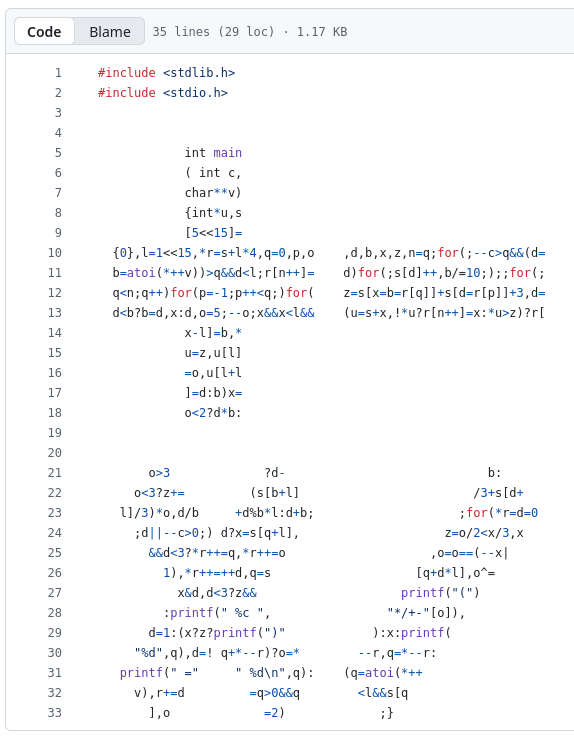
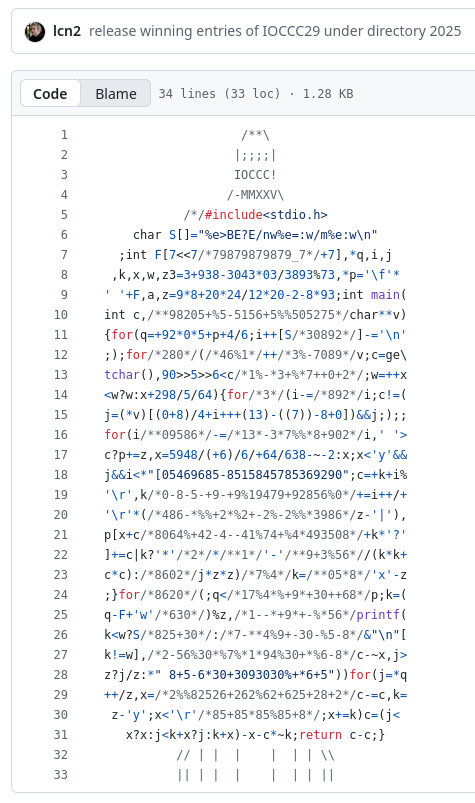
Byly vyhlášeni vítězové 🏅 a zveřejněny vítězné zdrojové kódy 29. ročníku soutěže International Obfuscated C Code Contest (IOCCC), tj. soutěže o nejnepřehlednější (nejobfuskovanější) zdrojový kód v jazyce C.

1
1
4
463

Jun 8
The 2025 IOCCC winners are out, and there’s a Game Boy emulator shaped like a Game Boy. This is programming as cursed calligraphy. Horrible for maintainability, excellent for remembering computers are still toys. #Programming #C

1
27

Jun 8
제29회 IOCCC 2025 수상작 발표
- International Obfuscated C Code Contest(국제 난독화 C 코드 대회)는 가장 창의적이고 예술적이면서도 읽기 힘든 '난독화(Obfuscated)' C 코드를 겨루는 컴퓨터 프로그래밍 대회
- 2020~2024년 공백 이후 두 번째로 연속 개최된 대회…
news.hada.io/topic?id=30270
1
3
4
2,386

Jun 8
after hours thought: the IOCCC is proof that programmers never stopped making folk art
you can call it cursed
I call it a spell with semicolons
14
Akihiro Sada retweeted

Jun 7
今回の IOCCC は受賞 3 つでした。ニキシー管を埋め込んだコードはわりとお気に入り。今度解説書きたい
youtube.com/watch?v=MoWCwZx1…
github.com/ioccc-src/winner/…
9
26
4,521

Jun 7
1/ The 2025 IOCCC winners are out, and they are a useful antidote to a very modern disease:
thinking “code quality” only means readability.
Obfuscated C is not how you should ship production software.
But it is one of the best ways to remember what software actually is: a negotiation with compilers, runtimes, undefined behavior, formats, and machines. #C #Compiler
2/ IOCCC29 was not a small nostalgia drop.
The judges say submission volume and quality were near historic highs, even after the 2020–2024 hiatus ended with IOCCC28.
The 2025 tree includes entries like:
- a Subleq computer
- a GameBoy emulator
- a patch/diff quine
- Quine Pong
- a quasi-roguelike
- an ocean sound generator
That is not “clever golfing.”
That is systems knowledge disguised as mischief. #SystemsProgramming
3/ The best obfuscated programs teach a strange lesson:
the source code is not the program.
The program is the source after:
- preprocessing
- parsing
- integer promotion
- macro expansion
- linker behavior
- terminal assumptions
- file formats
- compiler extensions
- “wait, is that actually defined?”
Readable code hides those layers. IOCCC drags them into the light.
4/ This is why I still think competitions like IOCCC matter in the AI coding era.
LLMs are getting very good at producing conventional code-shaped text.
But the hard parts of programming often live below the convention layer:
- what the language spec permits
- what the compiler optimizes away
- what the ABI assumes
- what the runtime accidentally guarantees
- what breaks when the environment changes
Obfuscated C is a stress test for whether you understand the stack, not just the syntax. #OpenSource
5/ There is also a cultural point here.
Modern engineering pushes us toward managed platforms, typed APIs, linters, safe defaults, review bots, and generated code.
Good. We need all of that.
But every abstraction leaks eventually. When it does, the people who can reason from first principles still matter.
IOCCC is basically first-principles debugging turned into art.
6/ My takeaway from the 2025 winners:
Do not write production code like IOCCC.
But do study it once in a while.
Because the best engineers are not the ones who merely make code look clean.
They are the ones who know what the machine is allowed to do after the clean surface disappears. #SoftwareArchitecture #Programming
159