
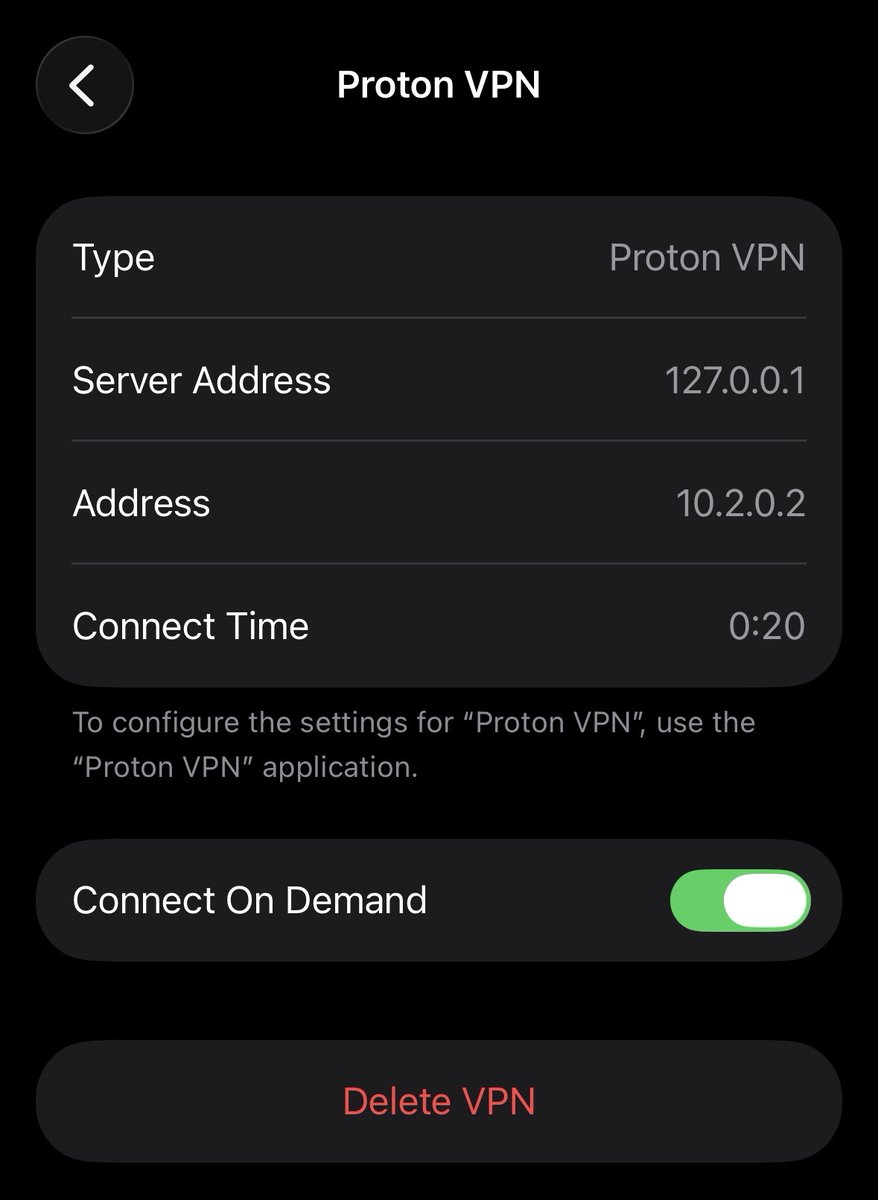
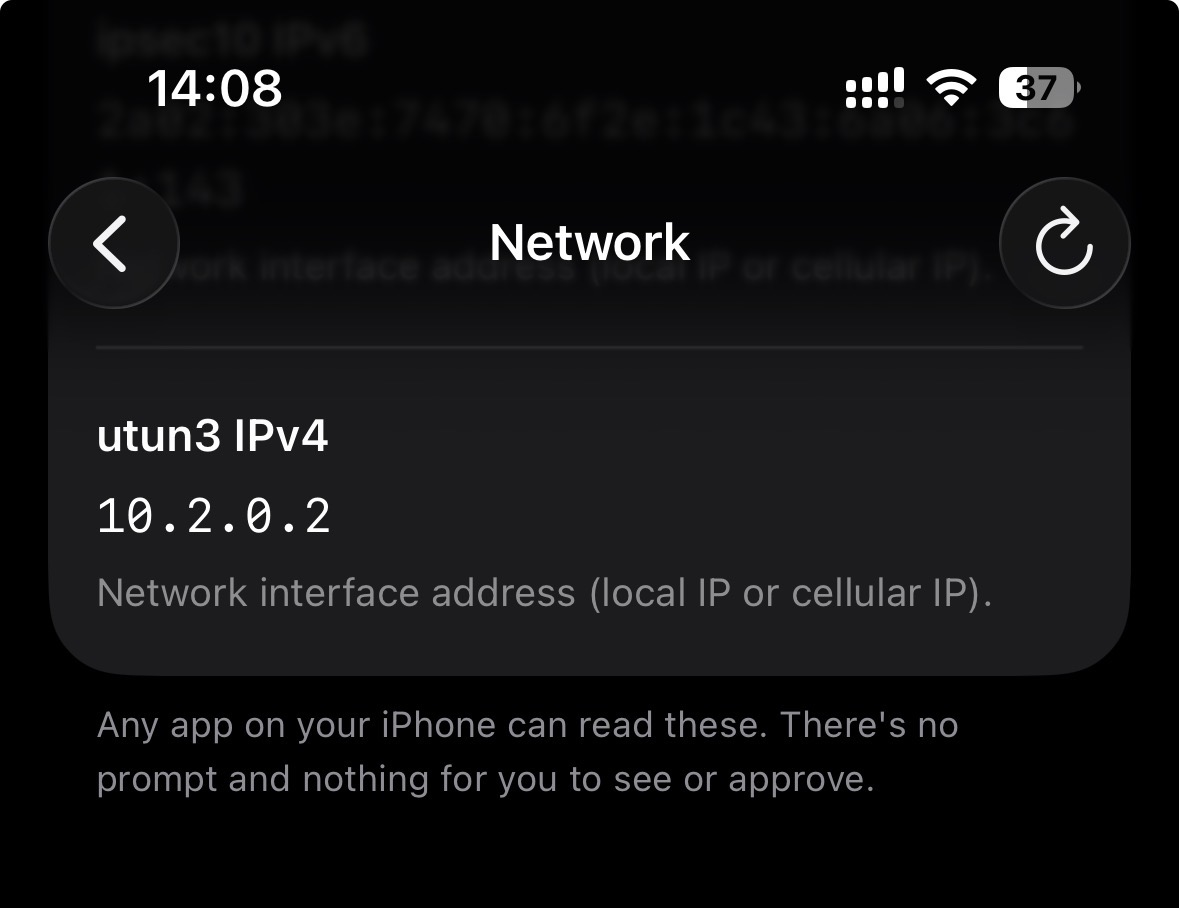
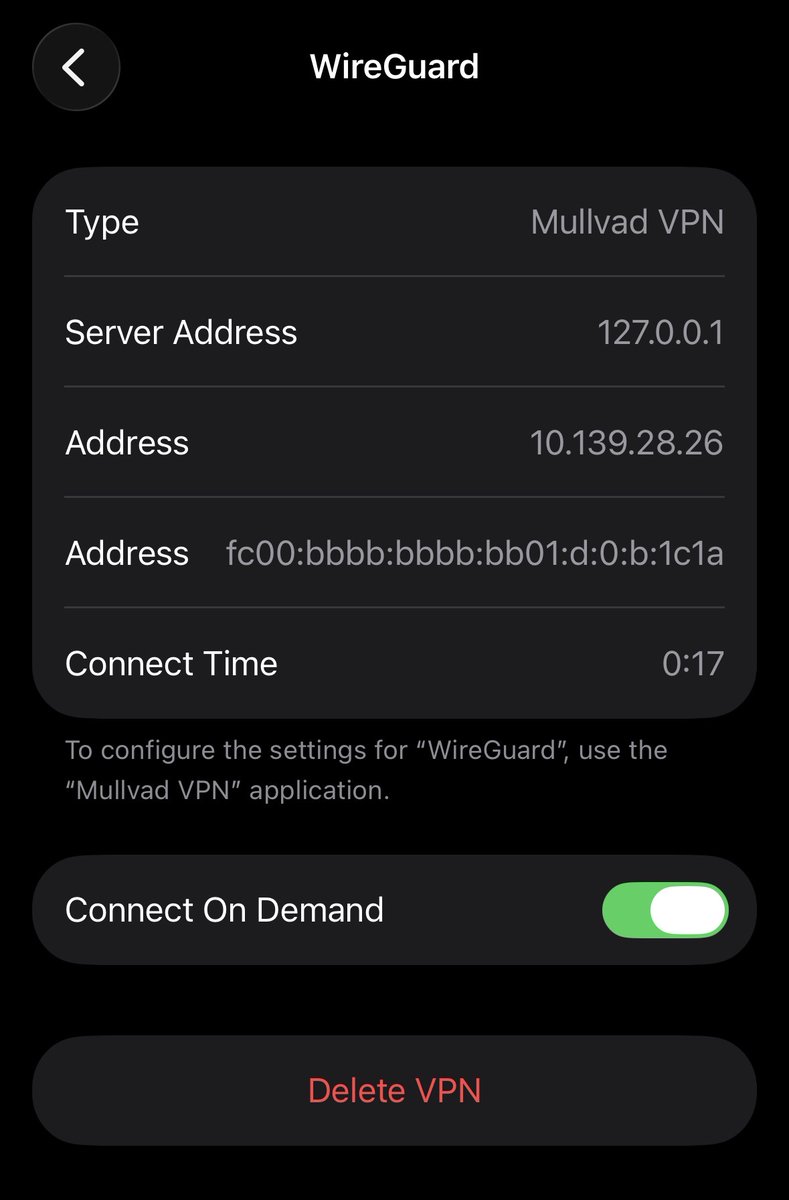
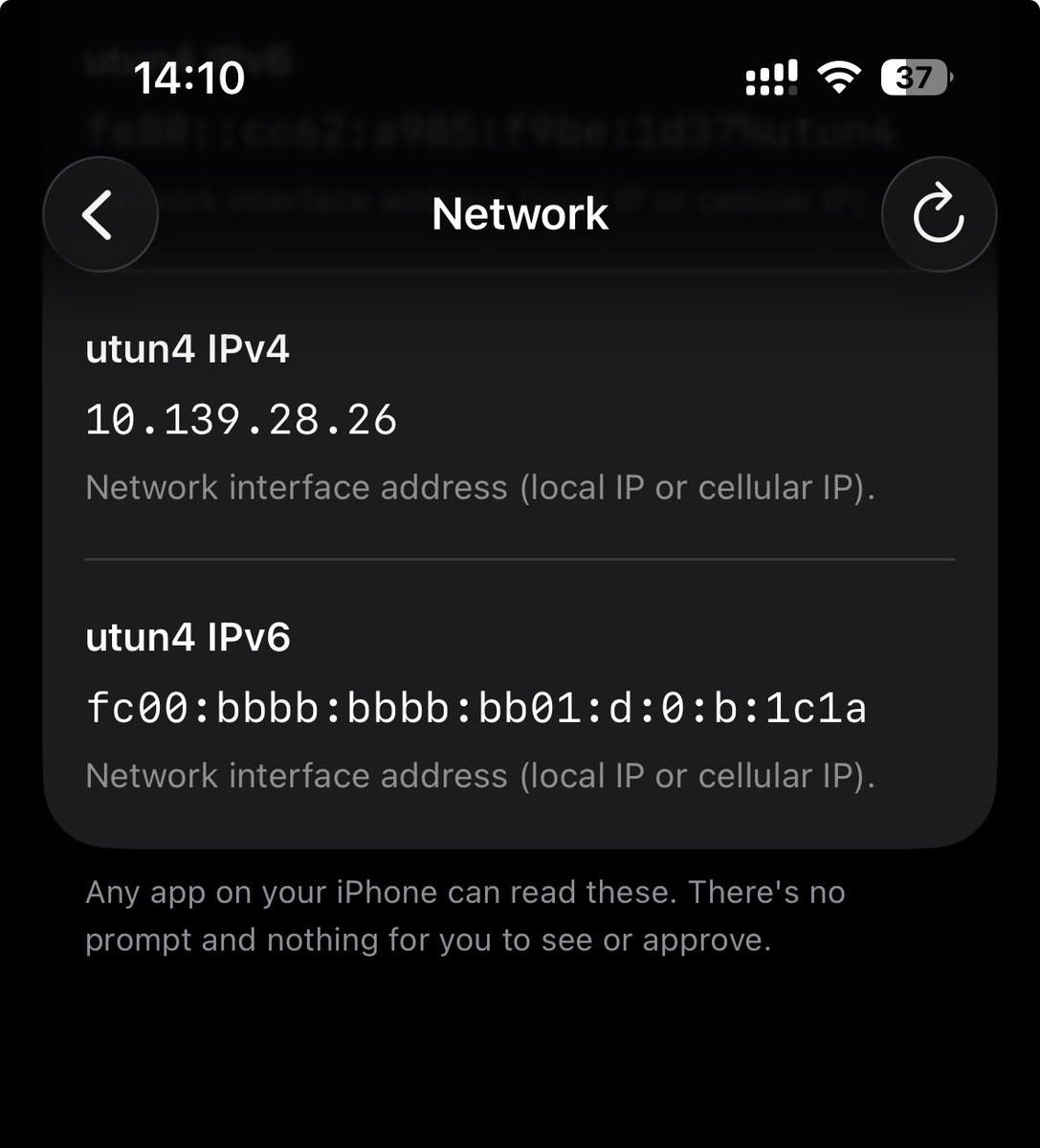
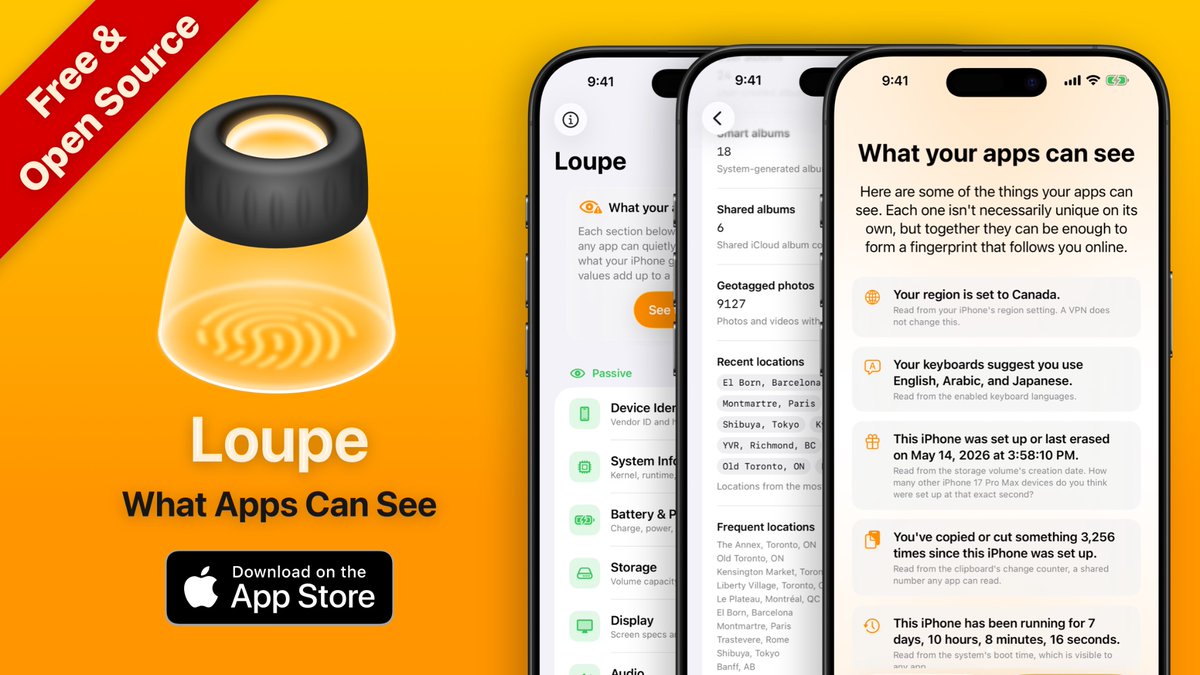
Using Loupe, we found out that Proton VPN is the only VPN that prevents internal tunnel IP fingerprinting by assigning 10.2.0.2 to all users. Other VPNs, such as Mullvad, assign a static and unique IP per session. This allows iOS apps to track user sessions across apps.

Introducing Loupe, our latest privacy app for iOS. Discover what apps can learn about you just by reading data your iPhone already exposes, such as your languages, installed apps, device sensors, and much much more
Loupe is free, private, and open source. Give it a try 👇
25
75
1,006
88,321
Bebe MAGA ⛳️ retweeted

A dude that founded PayPal, Tesla and SpaceX...
Who now sends reusable rockets into space...
And just had the largest IPO IN HISTORY becoming a trillionaire isn't even remotely odd.
A government official making less than $200k a year becoming a millionaire ABSOLUTELY IS!!!

28
360
790
4,468
Pip retweeted

This all seems to be a ploy to link IP addresses and online activity directly to an identifiable person to make them easier to catch and track down. The government falsely assumed that everyone watches porn and they thought they would get everyone that way. It obviously did not work as well as they were hoping so they are now expanding it. (I have always said that initial laws are just a foot in the door, those laws will always be expanding after the fact into their true original intended purpose).
So their plan now is if you want to use any social media or much of the internet in any way, you will need to prove that you are over 18 which means submitting an ID. This will require far far more ID submissions which will massively expand the government database, which was the real plan all along, not the safety of children.
The funniest thing about this is after all the fuss about the Online Safety Act, this blanket ban on kids using social media pretty much renders the entire act pointless and made it a giant waste of time. Which to be honest, proves that the act was never about protecting children but was really about building a giant database that links all online activity directly to a person.
This database would then be constantly poured over by AI to flag "citizens of concern" to the government who may be potential political dissidents, saying naughty anti-government things etc so the government can pre-emptively act against them.
Minority Report. This is literally the plot of Minority Report.

🚨 SUMMARY: The UK's social media ban for children from early 2027:
- "User-to-user" apps where people create, share and interact with content (e.g. TikTok, Instagram, Snapchat, YouTube, X, Facebook) will be banned for under-16s
- WhatsApp, Signal and YouTube Kids will be exempt
- Under-16s will also be banned from livestreaming, messaging strangers on gaming apps like Discord and using disappearing messages
- 16 and 17 year olds will face nightly social media curfews and limits on infinite scrolling with more details next month
- AI "romantic companion" chatbots will be banned for under-18s
- Adults can still access social media through age checks like facial recognition, digital IDs, passports and credit cards
182
1,714
10,036
247,321

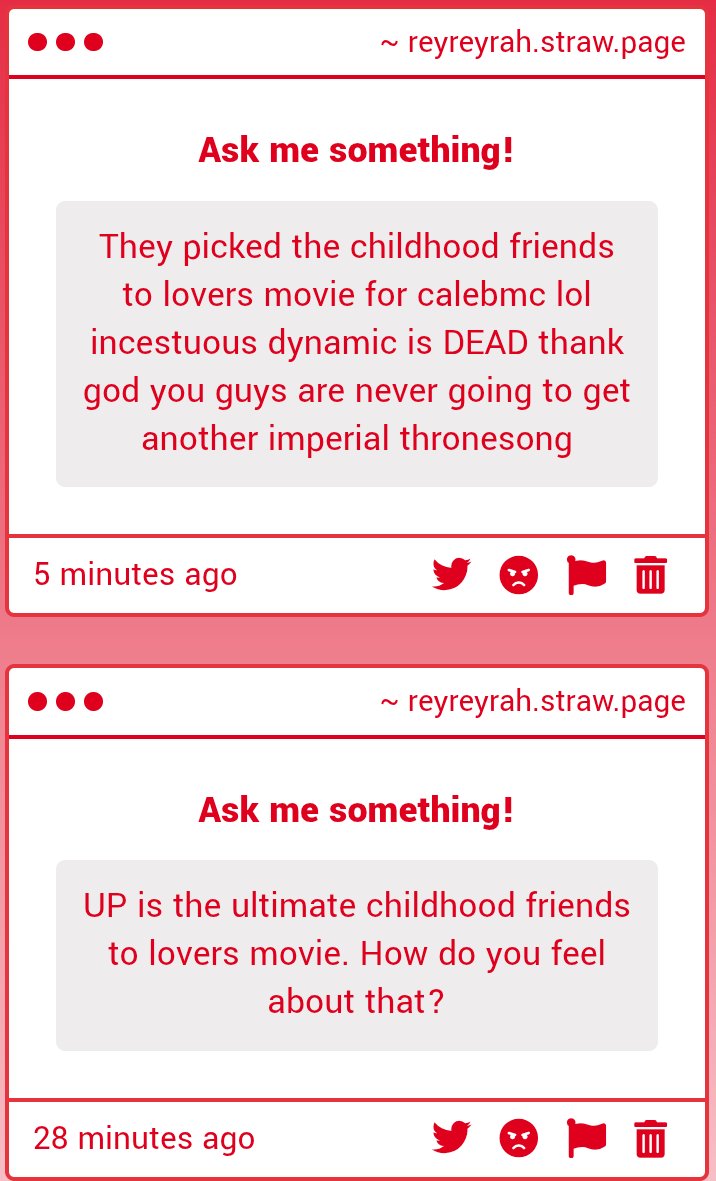
guys use the little red angry face button & block the ip of these gimmickers so they dont bother us again. clearly some idiot is provoking ppl w dumb shit they know is dumb so u respond

ngl i feel like I've fans because they are always here camping in my strawpage, cute. why would I need another thronesong when i already have my high marshal😋🖤

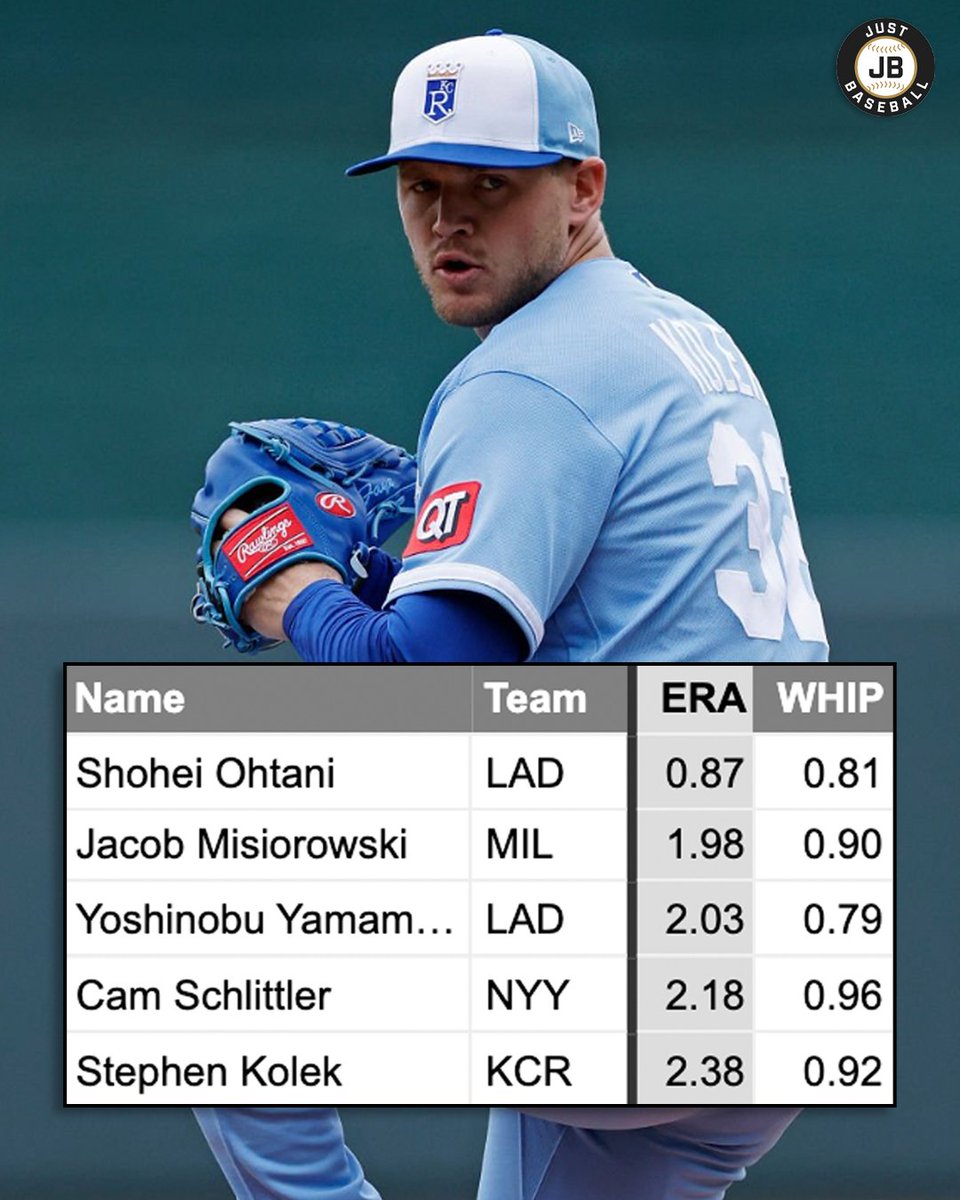
Since becoming a Royal, Stephen Kolek is 1 of only 5 pitchers with an ERA below 2.40 and a WHIP below 1.00 (min. 80 IP) 👑
One of the most underrated pickups from last year's trade deadline!
33


43s
close down halo studios and license the ip and you get maybe 4x the budget cut you get by shuttering compulsion.
man xbox leadership is STUPID
3

The useless collab in question being the one that was shit on by the fans of the collabing IP for how dogshit of a job they did.
 📁
📁

Aidan retweeted

Stat line from appearance out of the bullpen on 6/14.
2.1 IP 6K 0BB 1ER on 2 H
Still looking for a home.
7
46
6,218

Smiley vibes🙂💛
So excited for 's first-ever IP collab with Smiley — this drop is comfy, cute, and easy to style.
Only 1,000 pieces in the first release, so don't wait too long 🫶
.
.
.
.
1
@FenwayFinale retweeted

What Red Sox closer would you choose at their peak?
2006 Papelbon: 68.1 IP, 0.92 ERA, 35 SV, 75 K, 517 ERA
2013 Koji: 74.1 IP, 1.09 ERA, 21 SV, 101 K, 379 ERA
2017 Kimbrel: 69 IP, 1.43 ERA, 35 SV, 126 K, 319 ERA
2025 Chapman: 61.1 IP, 1.17 ERA, 32 SV, 85 K, 344 ERA




1
1
1
9


Palantir ($PLTR) — the most literal implementation. If you wrote this essay as a product spec, you'd basically get Palantir's AIP. Its Ontology is explicitly designed to model the decisions in an enterprise, not simply the data — that's the "institutional memory as queryable IP" idea....more thoughts:
x.com/TomOnTech/status/20665…

Satya Nadella, CEO of Microsoft recently posted his thoughts on the future of AI models:
Here is my takeaway:
The best AI stocks for the next phase may not be the model labs.
They may be the companies helping enterprises build their own learning loops.
Human capital token capital.
Workflows, data, agents, evals, governance, and institutional memory becoming the new IP of the firm.
My top 10:
$PLTR — the most literal implementation.
If you wrote the Satya theory as a product spec, you’d basically get Palantir AIP.
Its Ontology models enterprise decisions, not just data. That’s the “institutional memory as queryable IP” idea.
AIP Evals gives companies a way to test non-deterministic LLM outputs. Its k-LLM architecture is model-agnostic and can hot-swap providers without losing the company-specific logic layer.
That is exactly the test: can you switch out the generalist model without losing the company veteran?
The catch: valuation. A lot of this is already priced in.
$MSFT — the platform-ethos play.
Microsoft is probably the lowest-risk way to play this.
Foundry, Copilot, Azure AI, GitHub, Teams, Office, security, identity, and an agent runtime all sit inside the same enterprise ecosystem.
Massive distribution. Massive trust. Massive install base.
The downside: this theme is still only one piece of a $3T company.
$SNOW — the governed-data control plane.
If every company needs to turn proprietary data into AI memory, Snowflake is right in the middle of the stack.
Its pitch is simple: keep enterprise data governed, secure, and inside the perimeter while agents act on it.
That maps perfectly to the idea that a company’s knowledge base becomes queryable institutional memory.
$NOW — the workflow operating system.
ServiceNow may be one of the cleanest “AI changes the firm” plays.
It already sits inside enterprise workflows. If agents start improving internal processes over time, NOW owns a critical control point.
The company’s AI Control Tower also fits the governance/evals/security layer enterprises will need.
$CRM — the customer learning loop.
Salesforce owns the front-office data: customers, sales, marketing, service, support.
Agentforce is the key bet. Reported Agentforce ARR was around $1.2B by Q1 FY2027, with Agentforce Data 360 ARR past $3B.
The setup is interesting because $CRM is cheaper and more hated than $NOW.
The risk: investors still worry AI agents may pressure old seat-license revenue.
$MDB — the operational data layer.
AI apps need memory, retrieval, vector search, real-time app data, and flexible schemas.
MongoDB is not the loudest AI name, but it could sit underneath a lot of production agentic apps.
$DDOG — the observability/evals layer.
If companies deploy fleets of agents, they will need to monitor them.
Did the agent work?
Did it hallucinate?
Did it break policy?
Did it cost too much?
Did quality improve?
That is Datadog’s angle.
$PANW — securing the agentic enterprise.
Agents create a new attack surface.
They touch apps, data, APIs, identities, and workflows.
If AI becomes part of the enterprise operating system, security becomes non-negotiable. Palo Alto is well positioned here.
$CRWD — endpoint identity protection for the AI worker era.
If agents become digital employees, every endpoint, identity, credential, and permission becomes more important.
CrowdStrike is already a core enterprise security platform. Agentic AI makes the blast radius bigger, not smaller.
$ORCL — sovereign enterprise AI.
Oracle is not sexy, but it has database gravity, regulated-industry relationships, cloud momentum, and a strong private/sovereign AI angle.
If companies want AI close to their most important operational data, Oracle matters.
My simple framework:
$PLTR = enterprise ontology
$MSFT = platform distribution
$SNOW = governed data
$NOW = workflow execution
$CRM = customer loop
$MDB = app memory
$DDOG = agent observability
$PANW = agent security
$CRWD = endpoint identity protection
$ORCL = sovereign enterprise AI
The market is still obsessed with who owns the best model.
the question now is:
Who helps every company own its own learning loop?

3