
Jan 19
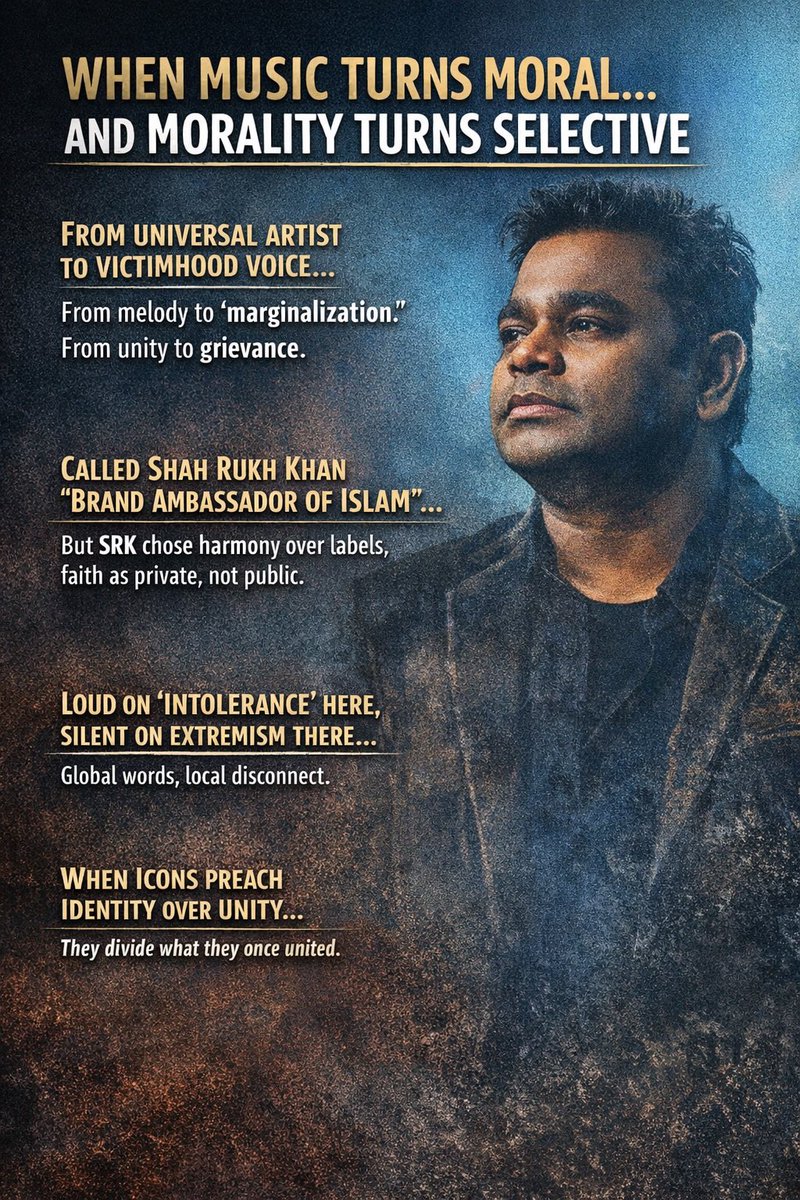
When Music Turns Moral—and Morality Turns Selective
There was a time when A. R. Rahman needed no adjectives beyond composer.
No prefixes.
No moral footnotes.
No identity framing.
His music spoke first—and last.
But somewhere along the journey from studios to symposiums, from ragas to rhetoric, something shifted.
The universal artist began speaking the language of the wounded witness.
The Subtle Turn
It didn’t arrive as anger.
It arrived as melancholy.
Not accusation—but suggestion.
Not blame—but implication.
A sense that something had gone wrong.
That doors were closing.
That fear was in the air.
That identity, not merit, was now shaping outcomes.
A victimhood narrative, softly sung.
And that is where the discomfort begins.
Because victimhood, when worn by the powerful, does not heal—it rearranges hierarchies of guilt.
A Memory That Refused to Fade
Years earlier, Rahman once described Shah Rukh Khan as a “Brand Ambassador of Islam.”
It sounded harmless. Even flattering.
But Shah Rukh Khan instinctively recoiled—not in anger, but in wisdom.
He refused the label.
He dismantled the symbolism.
He insisted that faith must remain private, not performed.
That public figures must unite, not represent.
In that moment, two philosophies quietly parted ways:
•One sought meaning through identity
•The other sought harmony through transcendence
That moment mattered more than it seemed.
The Uneven Moral Compass
As years passed, a pattern emerged—not of hatred, but of imbalance.
Strong words about intolerance here.
Soft silence about extremism elsewhere.
Deep concern for certain anxieties.
Minimal acknowledgment of others.
This is not neutrality.
It is selective sensitivity.
And selective sensitivity, when amplified by celebrity, becomes moral asymmetry.
The Imported Language Problem
Rahman’s concerns increasingly arrive wrapped in global phrases:
•Fear
•Marginalization
•Majoritarianism
Words polished in Western seminar rooms.
But India is not a seminar.
It is a negotiation.
A mess.
A contradiction.
To flatten it into binaries is not empathy—it is oversimplification.
And oversimplification, repeated often enough, becomes distortion.
When Icons Forget Proportion
The real issue is not Rahman’s faith.
Not his success.
Not even his opinions.
It is proportion.
When artists speak as if grievance explains complexity…
When abstraction replaces accountability…
When silence accompanies inconvenient truths…
Then moral authority begins to drift from wisdom into performance.
The Closing Note
A. R. Rahman’s music still unites.
But his rhetoric increasingly divides—not by intent, but by framing.
India does not need silent artists.
But it does need balanced ones.
Because when icons choose identity over universality,
they risk shrinking the very harmony they once expanded.
And that, perhaps, is the saddest note of all.
#WhenMusicTurnsMoral #SelectiveMorality #VictimhoodNarrative #CelebrityConscience #MoralAsymmetry #ArtVsAgenda #FameWithResponsibility #BollywoodInfluencers #IconsNeedBalance #BeyondIdentity #UnityOverLabels #FaithIsPersonal #NoBrandingBeliefs #HumanityFirst #IndiaIsComplex #LocalRealityMatters #NuanceOverNoise #CivilizationalHonesty #ThinkBeforeYouSpeak #InfluenceWisely #QuestionTheNarrative #BalanceTheVoice
2
2
31