
Jun 14
#inferencelabs
The "black box" problem is AI's biggest hurdle. We need to move from trust me AI to prove it AI
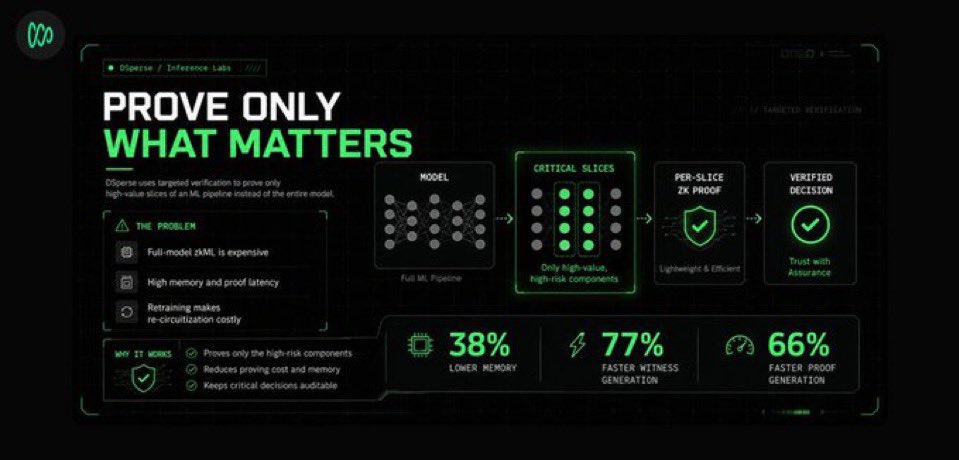
@inferencelab is leading this with DSperse and zero knowledge proofs. Proof of Inference will soon be the standard for production-ready, mission critical systems.
1
3
51
okii | Noos Ambassador retweeted

Jun 9
Excited to see how this ecosystem continues to shape the future of intelligent technology. #InferenceLab #AI #Web3 #RW
@inference_labs

7
9
140

Jun 9
Inference Lab is pushing the boundaries of AI innovation, turning bold ideas into real world solutions. Excited to see how this ecosystem continues to shape the future of intelligent technology. #InferenceLab #AI #Web3 #RW
1
2
48

May 9
I'm genuinely impressed with @inference_labs Proof of Inference approach.
Being able to cryptographically verify AI models, inputs, and outputs without sacrificing speed feels like a real breakthrough for building trust in decentralized AI and autonomous agents. #InferenceLab
5
128

Jan 25
InferenceLab and Astrolologyls represent a direction in AI that feels grounded, deliberate, and quietly important.
@inference_labs is focused on where intelligence actually becomes useful. Not at the training stage where models are polished and showcased, but at inference where real decisions are made. This is where AI touches users, systems, and outcomes. By prioritizing live execution, transparency, and reliability, InferenceLab treats intelligence as infrastructure rather than spectacle. That matters because the future of AI will not be judged by how impressive models look in isolation, but by how consistently they perform in real environments.
What stands out is the emphasis on measurability. InferenceLab treats intelligence as something that can be observed, evaluated, and trusted. This approach shifts the narrative from abstract capability to practical deployment. Builders care about latency, accuracy, and predictability. Users care about outcomes. InferenceLab sits exactly at that intersection, making intelligence usable instead of theoretical.
@astrolologyls approaches the problem from a complementary angle. Rather than focusing purely on execution, it explores how intelligence interacts with context, patterns, and signals over time. It treats AI systems as entities that operate within environments, not black boxes that spit out answers. There is an emphasis on structure, interpretation, and reasoning that helps humans understand why systems behave the way they do.
This matters because trust is not built only on performance. It is built on comprehension. Astrolologyls leans into that gap by helping make intelligent behavior legible. Instead of hiding complexity, it frames it in a way that encourages insight and long term understanding. That is critical if AI systems are going to be relied on beyond narrow use cases.
Together, InferenceLab and Astrolologyls point toward a more mature phase of AI development. One where execution and interpretation evolve side by side. One where intelligence is not just powerful, but accountable. InferenceLab provides the operational layer where decisions happen in real time. Astrolologyls adds the conceptual layer that helps humans reason about those decisions.
What feels intentional is the lack of hype. Neither project appears obsessed with dominating attention cycles. The focus is on building primitives that others can depend on. Infrastructure first. Clarity over noise. Long term usefulness over short term excitement.
If AI is going to integrate deeply into economic systems, governance, and everyday tools, it needs foundations like this. Systems that work consistently. Intelligence that can be observed. Reasoning that can be understood.
This kind of work does not always move fast on timelines, but it compounds over time. It shapes how intelligence is deployed, trusted, and scaled. @inference_labs and @astrolologyls feel less like trends and more like building blocks for how AI will actually function in the real world.


35
59
90
570
Jan 23
Some ecosystems are built to look intelligent. Others are built to prove it. Spending time around Dgridai, InferenceLab, and AstroLoLogyls makes the difference very obvious. These aren’t standalone projects competing for attention. They feel like interconnected layers designed to pressure-test intelligence instead of promoting it.
@dgrid_ai is where the framing begins. It treats intelligence as something that must be observable and accountable. Signals are tied to contribution, consistency, and outcome, not reputation or claims. The system quietly asks a hard question over and over: does this actually perform when it matters? That alone changes behavior. You stop optimizing for optics and start optimizing for clarity.
@inference_labs adds the necessary friction. This is where ideas are forced into contact with reality. Models aren’t protected from failure or smoothed over with averages. They’re exposed. You see where assumptions crack, where logic degrades under pressure, and where refinement is unavoidable. The feedback is direct and immediate, and it leaves very little room for self-deception. If something works, it survives. If it doesn’t, the evidence is clear.
@astrolologyls deepens the process by focusing on reasoning itself. Not just what the output is, but how it came to be. Decision paths are traceable. Inference chains are visible. You can follow the logic from signal to conclusion. That transparency changes how you engage with intelligence. You’re no longer consuming answers blindly. You’re evaluating thought. You’re learning where strength comes from and where it breaks down.
Together, these three form a closed loop that feels intentional. Dgridai defines what matters. InferenceLab tests it in the open. AstroLoLogyls explains how it happened. Each layer reinforces the others. Weak logic doesn’t linger. Strong reasoning compounds quietly over time. Progress isn’t announced. It’s observed.
What stands out most is how this structure shapes contributors. People build more carefully because shortcuts are exposed. They test more honestly because results are visible. Iteration becomes cleaner because false signals don’t survive long. There’s no incentive to posture or overstate capability. The system itself corrects behavior.
This isn’t intelligence as spectacle. It’s intelligence as infrastructure. Quiet, rigorous, and uncomfortable in the right ways. Trust isn’t requested here. It’s earned through repetition, transparency, and failure handled in the open.
@dgrid_ai, @inference_labs, and @astrolologyls don’t feel like experiments chasing momentum. They feel like foundations being stress-tested in real time. Systems designed to reward truth over narrative, process over performance, and reality over aspiration.
That’s how durable intelligence is built.
Not by saying the right things,
but by surviving the right tests.

24
42
51
481

Jan 23
AI is powerful.
Blockchains are transparent.
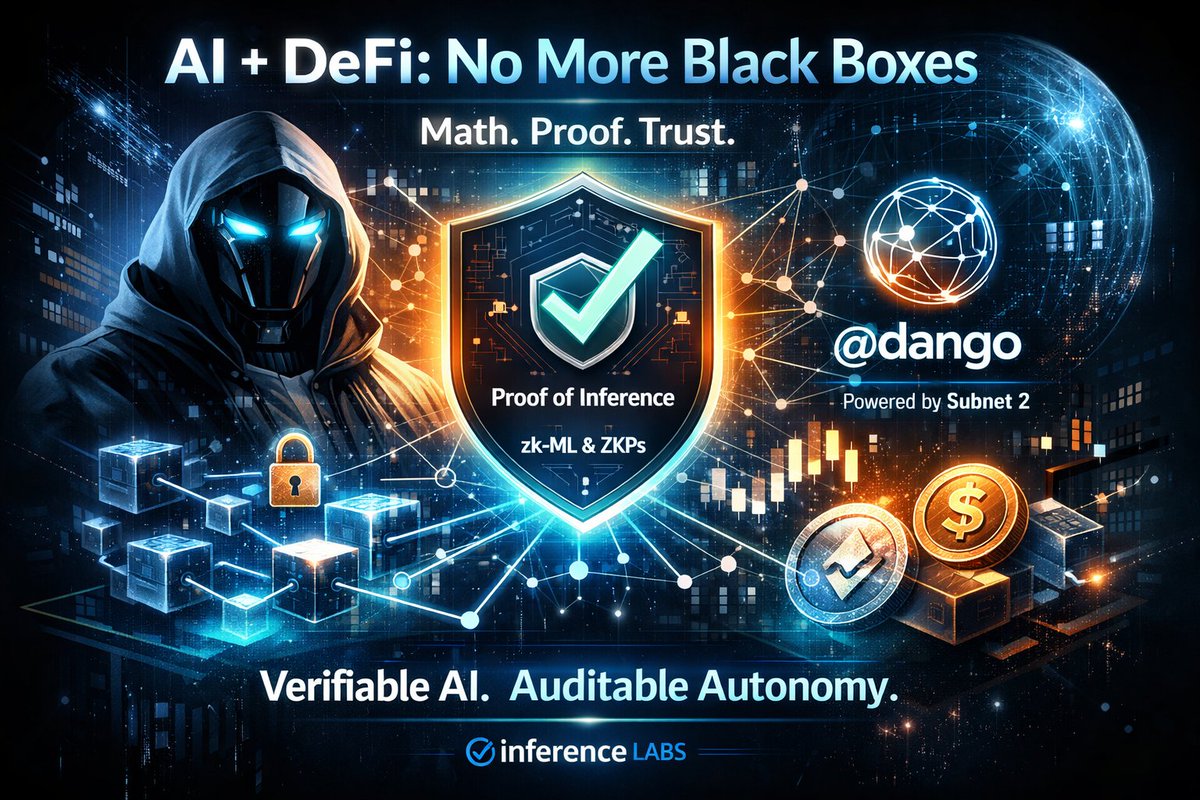
But until now, AI DeFi has been running on trust me bro logic.
Inference Labs is changing that.
Instead of asking protocols to assume AI decisions are correct, Inference Labs is building infrastructure where every AI output can be proven, verified, and audited... cryptographically.
Smart contracts gave us transparent execution.
But once AI enters the flow — pricing models, risk signals, fraud detection, autonomous agents — everything turns into a black box.
Inference Labs cracks that open with Proof of Inference, zk-ML, ZKPs, and decentralized AI, powered by Subnet 2 on Bittensor.
Here’s why this matters for dango and the future of DeFi 👇
At the core is Subnet 2...a decentralized proving marketplace where AI models don’t just produce predictions, they produce proofs.
Miners run the computation.
Validators verify the math.
Only verified results make it through.
No centralized APIs.
No reputation games.
No blind trust.
This is exactly the kind of infrastructure dango needs as DeFi moves toward autonomous markets, on-chain intelligence, and AI-driven execution. When strategies, pricing, or risk logic are backed by verifiable AI, protocols can scale without introducing hidden risk.
Proof of Inference doesn’t just prove a model exists... it proves:
the exact model was run
the correct inputs were used
the output is authentic
and nothing was tampered with
All while preserving privacy.
This isn’t theory either. Subnet 2 has already processed hundreds of millions of zero-knowledge proofs, showing that decentralized, verifiable AI works at scale. And with support for EZKL, Circom Groth16, and integrations like DeepProve, the system stays flexible as cryptography evolves.
The bigger picture?
A new era of auditable autonomy.
AI agents that can trade, manage risk, and execute strategies for protocols like dango dex..with math-backed accountability instead of blind faith.
This is how DeFi grows up.
Transparent execution.
Verifiable intelligence.
No black boxes. 🔥
#dangodex #defi #inferencelab
Jan 22

DeFi is entering a new era...not just automated, but intelligently automated. And the biggest question nobody could fully answer until now was simple:
how do you trust AI-driven decisions without trusting the people running the AI?
Inference Labs is solving that problem at the deepest level.
While most DeFi protocols proudly verify smart contracts and oracle feeds on-chain, the moment AI gets involved...predictions, signals, risk scoring, automated execution...everything turns into a black box. You’re told the output is correct, but you can’t prove it.
Inference Labs changes that completely.
With Proof of Inference and Subnet 2 on Bittensor, AI outputs now come with cryptographic proof. Miners don’t just return predictions....they return zero-knowledge proofs showing the result was generated by the exact model, using the correct inputs, without tampering. Validators independently verify everything before it reaches the protocol.
No trust. Just math.
This is powered by zk-ML, allowing AI models to be verified without exposing private data or proprietary parameters. The computation is proven, the output is authenticated, and privacy stays intact. That’s a game-changer for financial systems.
Now imagine what this unlocks for next-gen DeFi platforms like dAngo.
As dAngo Dex pushes toward smarter trading, automated strategies, and adaptive risk management, Inference Labs provides the missing trust layer. AI can guide capital allocation, execution logic, or governance decisions... with every move backed by cryptographic certainty, not assumptions.
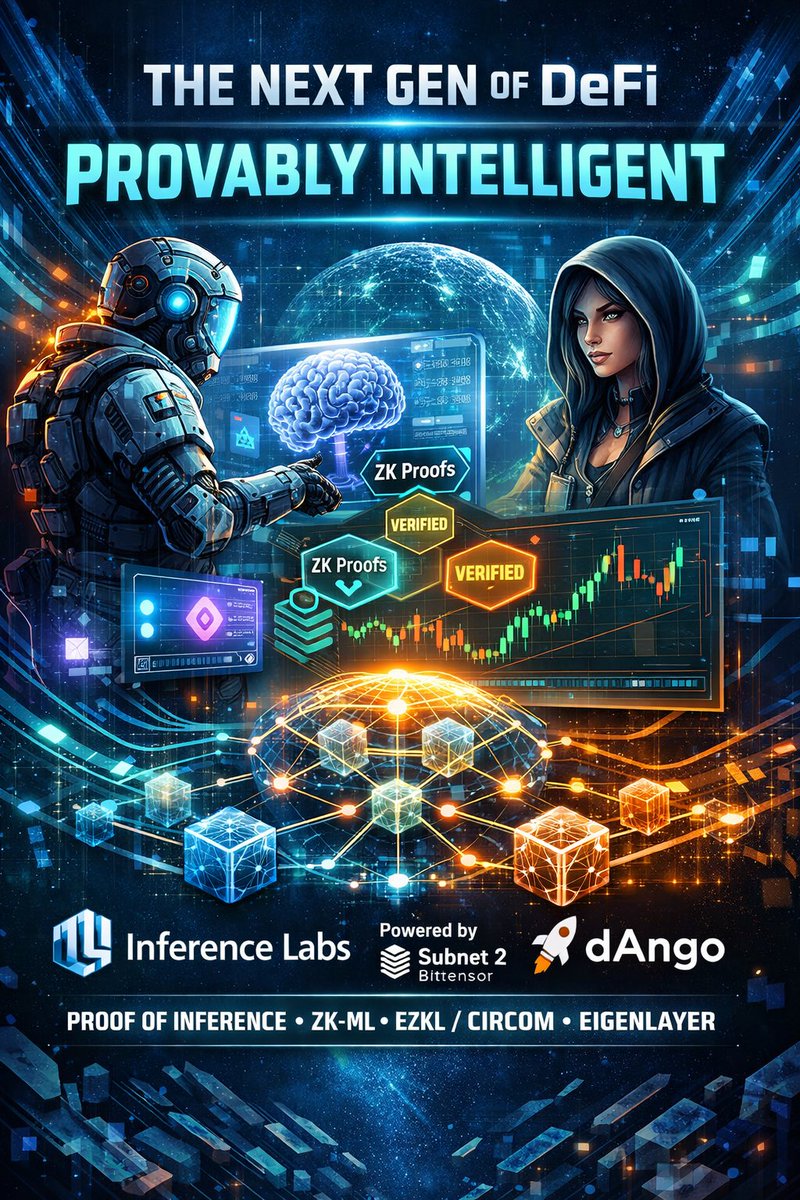
What makes this infrastructure truly ready for scale is its flexibility. Subnet 2 supports multiple ZK backends like EZKL and Circom (Groth16), meaning builders aren’t locked into a single proving system. Performance, cost, and privacy can all be optimized without compromise.
And this isn’t theory.
Subnet 2 has already produced hundreds of millions of zk proofs, with integrations across ecosystems like EigenLayer and other subnets . proving verifiable AI works at real-world DeFi scale.
The future of DeFi isn’t just faster or cheaper.
It’s provably intelligent.
With Inference Labs securing the AI layer and platforms like dango building the execution layer, we’re moving toward a world where autonomous finance runs on cryptographic truth, not blind trust.
This is what next-generation DeFi looks like 🚀
1
30
28
167
Jan 23
I started exploring @astrolologyls and @inference_labs not expecting much. Most AI projects promise brilliance but leave you wondering how it actually works. These two feel different. From the first interaction, it’s clear they’re built around process, not hype.
@astrolologyls isn’t about flashy predictions or impressive outputs. It’s about reasoning. Every result has a path you can follow. Signals are layered, and you can see how decisions form step by step. It’s like being inside the logic instead of just seeing the answer. That transparency changes how you interact with the system you start thinking critically instead of just trusting outputs.
@inference_labs is where theory meets reality. Models aren’t showcased; they’re tested, stressed, and observed under conditions that reveal what works and what doesn’t. It’s not about a perfect score; it’s about seeing strengths and weaknesses immediately. That feedback feeds refinement, making improvements tangible and fast.
Using both together feels like a complete loop. AstroLoLogyls defines reasoning, InferenceLab tests it. Assumptions get exposed, responses measured, and signals corrected. Weak logic fails visibly, strong logic compounds quietly, and the system becomes better because it confronts results, not claims.
What stands out is how much of this is observable. You’re not told to trust it you can watch it earn trust. Every change, iteration, and insight is visible, shaping how contributors behave. People build smarter, iterate faster, and the system grows more robust as a result.
These platforms don’t replace humans; they augment them. They guide reasoning, highlight friction, and make experimentation safe but meaningful. It’s easy to see how this could scale into a foundation for onchain intelligence that is accountable, transparent, and self-improving.
@astrolologyls and @inference_labs don’t feel like flashy experiments or marketing stories. They feel like infrastructure being tested in real time quiet, deliberate, and designed to get intelligence right.

43
60
83
535

Jan 22
Dango stabilizes action. Lightlink smooths movement. InferenceLab stabilizes thought. Real performance is when coordination feels calm.

Dango, Lightlink, and InferenceLab converge on a shared insight that most onchain systems miss. Performance is not about speed alone. It is about reducing the cost of coordination.
Dango begins at the interaction layer. It assumes that users should not have to manage uncertainty every time they act. By making execution predictable, it removes the need for constant verification. When outcomes behave consistently, intent becomes enough. Trust forms through behavior, not messaging.
@LightLinkChain addresses a different friction point. It recognizes that cost and latency quietly shape how systems are used. When every action carries overhead, users hesitate, batch decisions, or disengage entirely. By minimizing transactional friction, Lightlink allows activity to feel continuous rather than interrupted. The system recedes, and flow becomes possible.
@inference_labs connects these layers through reasoning. Intelligence is treated not as output, but as continuity. Analysis that remains coherent across time reduces the need for reactive correction. When reasoning can be reused without reinterpretation, it becomes infrastructure instead of noise.
Together, these systems reduce the hidden tax that complexity places on attention. Dango stabilizes action. Lightlink smooths movement. InferenceLab stabilizes thought. None of them asks the user to compensate for system weakness. Each absorbs complexity upstream so coordination downstream feels calm.
In an environment where scale is often confused with acceleration, this approach is quietly radical. The systems that last are not the ones that move fastest, but the ones that make it easier to move at all.
1
2
72
Jan 22
I’ve spent time around enough AI and onchain intelligence projects to recognize a pattern. Most are very confident about outcomes, but unusually quiet about how those outcomes are reached. @astrolologyls and @inference_labs break away from that pattern in a way that feels intentional.
@astrolologyls treats intelligence as something that must be legible. Instead of delivering answers as finished truths, it exposes the reasoning paths behind them. Signals are layered. Logic is traceable. Conclusions are allowed to evolve as new inputs arrive. That approach makes interaction feel collaborative rather than consumptive. You are not just receiving intelligence. You are engaging with it.
What stands out is how little mysticism there is. No attempt to disguise uncertainty. No theatrical claims. The system accepts that intelligence improves through iteration, challenge, and correction. That humility is rare, especially in AI narratives.
@inference_labs is where this philosophy is tested. It is not a showcase environment. It is a pressure environment. Models are deployed into conditions where assumptions are confronted quickly. Performance is observed over time. Weak logic reveals itself without needing explanation. Strong reasoning compounds through repeated use.
Together, they form a loop grounded in consequence. AstroLoLogyls builds structured reasoning. InferenceLab exposes that reasoning to reality. Feedback flows back into refinement. Nothing is protected from scrutiny, and nothing improves without earning it.
This pairing matters onchain, where trust cannot be borrowed from authority or branding. It has to be continuously proven. By making reasoning visible and performance observable, these systems shift trust from belief to verification.
What makes the experience compelling is not speed or spectacle. It is clarity. You can see why something works. You can see when it doesn’t. And over time, that transparency builds confidence in the system itself.
@astrolologyls and @inference_labs don’t feel like experiments chasing attention. They feel like infrastructure being shaped by use, pressure, and time. Quietly focused on getting intelligence right.

44
56
77
462

Dango, Lightlink, and InferenceLab converge on a shared insight that most onchain systems miss. Performance is not about speed alone. It is about reducing the cost of coordination.
Dango begins at the interaction layer. It assumes that users should not have to manage uncertainty every time they act. By making execution predictable, it removes the need for constant verification. When outcomes behave consistently, intent becomes enough. Trust forms through behavior, not messaging.
@LightLinkChain addresses a different friction point. It recognizes that cost and latency quietly shape how systems are used. When every action carries overhead, users hesitate, batch decisions, or disengage entirely. By minimizing transactional friction, Lightlink allows activity to feel continuous rather than interrupted. The system recedes, and flow becomes possible.
@inference_labs connects these layers through reasoning. Intelligence is treated not as output, but as continuity. Analysis that remains coherent across time reduces the need for reactive correction. When reasoning can be reused without reinterpretation, it becomes infrastructure instead of noise.
Together, these systems reduce the hidden tax that complexity places on attention. Dango stabilizes action. Lightlink smooths movement. InferenceLab stabilizes thought. None of them asks the user to compensate for system weakness. Each absorbs complexity upstream so coordination downstream feels calm.
In an environment where scale is often confused with acceleration, this approach is quietly radical. The systems that last are not the ones that move fastest, but the ones that make it easier to move at all.
Dango, InferenceLab, ChatAndBuild, and Astrolology share a subtle but important design instinct. They assume that clarity is something systems should generate, not something users should supply.
Dango starts by making execution feel uneventful. When actions resolve consistently, users stop allocating attention to monitoring outcomes. Intent flows forward without friction, and trust emerges as a byproduct of repetition.
InferenceLab treats intelligence as a stable process rather than a moment of surprise. Reasoning that holds its structure over time becomes dependable. When logic can be reused without reinterpretation, intelligence shifts from novelty into infrastructure.
ChatAndBuild reflects how understanding actually forms. Most creation begins with partial insight. By allowing thinking and building to unfold together, it removes the false requirement of certainty before action. Systems become companions in exploration rather than rigid tools.
Astrolology introduces discipline around timing. Information gains meaning only when it arrives in alignment with context. By respecting temporal structure, it prevents insight from degrading into noise.
Together, these systems reduce cognitive load by design. They absorb ambiguity, smooth decision paths, and remove the need for constant vigilance. In increasingly complex environments, this kind of restraint is not passive. It is what allows coordination to scale without exhausting the people inside it.

1
10
13
535
Jan 22
There is a shift happening in how onchain intelligence is being built.
Less noise. Less abstraction. More systems that actually think, learn, and execute.
@astrolologyls and @inference_labs sit right at the center of that shift.
@astrolologyls is not just another AI narrative wrapped in Web3 language. It is a framework for reasoning, pattern recognition, and decision making that lives onchain. The focus is not on prediction for spectacle, but on structured intelligence that can be verified, tracked, and improved over time.
What makes AstroLoLogyls compelling is its emphasis on logic over illusion. Signals are derived, not guessed. Models evolve based on interaction and data, not static assumptions. It treats intelligence as a system that grows through use, not a black box that demands trust.
@inference_labs complements this vision by focusing on execution. It is the environment where inference becomes practical. Where models are tested, deployed, and evaluated in real conditions. Instead of theory living in isolation, InferenceLab turns it into applied intelligence.
Together, they form a full loop.
AstroLoLogyls defines how intelligence reasons.
InferenceLab defines how that intelligence operates in the real world.
This pairing matters because most AI projects stop at presentation. Here, intelligence is measurable. Performance is observable. Outcomes are transparent. That is a critical step toward building trust in autonomous systems.
Another key dimension is openness. Both systems lean toward verifiable processes rather than opaque claims. Builders and contributors can see how decisions are made, how models improve, and where value is actually created.
This is not about replacing humans. It is about augmenting decision making with systems that are accountable, adaptive, and aligned with onchain values.
@astrolologyls and InferenceLab do not feel like short term experiments.
They feel like foundational layers for an onchain intelligence economy.
Quietly building the rails for what intelligent, decentralized systems are supposed to become.

47
62
96
2,240
Jan 21
Inference Labs is becoming one of the most important trust layers in Web3....and when combined with execution-focused DeFi like dango, the implications are huge.
DeFi is rapidly moving toward autonomous systems: AI-powered vaults, algorithmic risk management, predictive pricing, and self-adjusting liquidity. But for years, the space has carried a silent flaw...AI decisions happen off-chain, behind closed doors, and users are simply asked to trust the output. In a trustless ecosystem, that’s a contradiction.
Inference Labs changes the game by making AI-driven financial decisions provable, verifiable, and trustless. Through verifiable computation, zk-ML, zero-knowledge proofs, Proof of Inference, and its Subnet 2 on Bittensor, every inference a DeFi protocol relies on can be independently audited...no centralized model providers, no blind faith.
This is where it gets exciting for dango dex.
dango is building toward high-performance, execution-first DeFi....and systems like that thrive on fast, autonomous decision-making. With Inference Labs’ Proof of Inference, AI signals don’t just inform strategy, they arrive with cryptographic proof that the model ran correctly, on the intended inputs, without manipulation. That turns AI from a “nice-to-have” into a provable financial primitive that protocols like dango can safely act on.
Imagine AI-driven liquidity optimization, dynamic risk parameters, or automated strategy adjustments on dango... but instead of trusting an opaque model, every move is backed by mathematical certainty. That’s a massive leap for traders, LPs, and protocols that demand both speed and trust.
Inference Labs’ support for multiple proving systems... including EZKL, Circom (Groth16), and DeepProve via partners like Lagrange...reinforces this vision. By staying proving-system agnostic, the stack remains flexible, scalable, and future-proof, while preserving the cryptographic guarantees that DeFi was built on.
Together, Inference Labs and dango represent the next evolution of DeFi:
AI-powered, fully autonomous, and... most importantly... verifiable.
This isn’t just smarter DeFi.
It’s DeFi where every decision can be proven. 🔥
#dangodex #defi #inferencelab

Jan 21
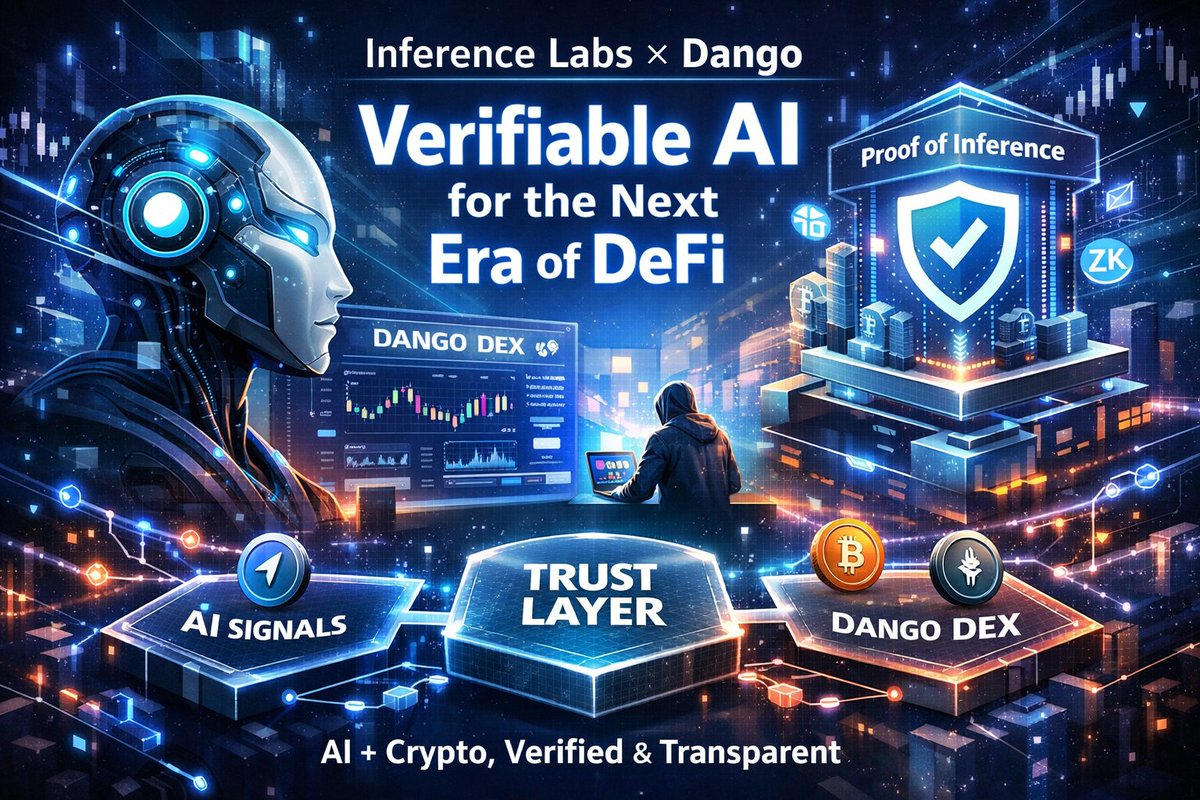
Inference Labs x Dango: Verifiable AI as the Next Trust Layer for DeFi
Inference Labs isn’t just another AI-meets-crypto experiment... it’s tackling one of the most critical problems DeFi is about to face: how do we trust AI when it starts making real financial decisions on-chain?
As decentralized finance evolves, protocols are no longer just executing static smart contracts. They’re increasingly powered by intelligent agents....optimizing liquidity, managing risk, adjusting strategies, and reacting to market conditions in real time. But here’s the problem: most AI systems today are opaque black boxes. In a trustless financial system, blind trust is a vulnerability.
This is where Inference Labs changes the game.
Through its Proof of Inference framework, Inference Labs introduces cryptographic verification directly into AI outputs. Instead of assuming an AI signal is correct, the system proves it..... using zero-knowledge proofs and advanced cryptography to attest that a computation was performed honestly and accurately, without exposing sensitive model logic.
Now imagine what this unlocks for DEXs like dango.
Dango isn’t just another decentralized exchange.... it’s building toward a future where trading, liquidity management, and market execution can become increasingly automated and intelligent. Pair that with Inference Labs, and you get something powerful:
AI-driven trading signals, liquidity strategies, or risk adjustments that are verifiable before they ever touch user capital.
No black-box bots.
No unverifiable alpha claims.
Just cryptographically proven intelligence interacting with on-chain liquidity.
For traders, LPs, and protocols on Dango, this means a higher standard of transparency. AI strategies can be audited. Signals can be validated. Performance can be verified..without sacrificing decentralization or leaking proprietary data. Trust moves from who is providing the model to what can be mathematically proven.
The infrastructure behind this vision is already taking shape. Through decentralized environments like Subnet 2 on Bittensor, Inference Labs enables open competition where AI models are benchmarked, verified, and economically rewarded in a permissionless way. Only models that produce provably correct outputs earn influence...creating a natural filter for quality and honesty.
This is what the next phase of DeFi looks like.
DEXs like dango become execution layers.
Inference Labs becomes the trust layer for AI.
And cryptography becomes the referee between intelligence and capital.
Together, they point toward a future where DeFi isn’t just automated...it’s verifiably intelligent. Where autonomous agents can operate at scale, not because users are asked to trust them, but because every decision is backed by mathematical proof.
That’s not hype.
That’s the foundation of the next DeFi era.
2
22
16
345
Jan 21
Astrolologyls × InferenceLab: Where Insight Meets Intelligence
In a world driven by data, the real advantage no longer comes from simply collecting information it comes from understanding it, interpreting it, and turning it into meaningful action. This is where @astrolologyls and @inference_labs come together to redefine how we think about insight, intelligence, and inference.
@astrolologyls represents the art of pattern recognition connecting signals, cycles, and relationships that are not always obvious at first glance. Much like modern analytics, it is rooted in interpretation: observing trends, understanding context, and anticipating what comes next. In an age of complexity, this mindset is more relevant than ever.
@inference_labs complements this philosophy with a powerful, technology-driven approach. It focuses on transforming raw data into clear, explainable inferences. By combining statistical reasoning, machine learning, and human-centered analysis, InferenceLab enables organizations to move beyond dashboards and predictions toward true understanding. It’s not just about what the data says, but why it says it and how to act on it.
Together, Astrolologyls and InferenceLab create a unique synergy. One brings a conceptual framework for recognizing deeper patterns, while the other provides the computational rigor to validate, test, and operationalize those insights. This fusion allows teams to make decisions that are not only data-driven, but also context-aware, interpretable, and forward-looking.
From strategic planning and risk analysis to product innovation and user behavior modeling, this collaboration empowers leaders to see beyond surface-level metrics. It encourages curiosity, challenges assumptions, and supports decisions grounded in both logic and intuition an essential balance in today’s fast-moving landscape.
As data continues to grow in volume and complexity, the future belongs to those who can infer meaning, not just process numbers. @astrolologyls and @inference_labs stand at the intersection of insight and intelligence helping organizations navigate uncertainty with clarity, confidence, and purpose.

Jan 21

InferenceLab and Astrolologyls represent two distinct but deeply connected approaches to understanding intelligence and meaning.
@inference_labs operates at the core of data driven reasoning. It focuses on extracting signal from noise, transforming raw inputs into structured inference, and enabling clearer decision making. In an environment overloaded with information, InferenceLab prioritizes accuracy, probability, and evidence. It is not about speed alone, but about depth of understanding.
@astrolologyls draws from humanity’s oldest pattern recognition systems. It works with cycles, timing, symbolism, and long term behavioral rhythms that have shaped how humans interpret uncertainty and change. Rather than positioning astrology as simple prediction, Astrolologyls treats it as a framework for understanding influence, context, and human perception across time.
The relationship between InferenceLab and Astrolologyls is not about opposition, but balance. One is grounded in measurable data. The other is grounded in interpretive meaning. One explains what is happening in observable terms. The other explores how humans experience and assign significance to those events.
@inference_labs brings precision, structure, and validation. But intelligence does not exist in numbers alone. Human decisions are influenced by belief, narrative, timing, and intuition. Astrolologyls captures that symbolic layer, adding context where pure data often falls short.
When these perspectives converge, intelligence evolves. Data becomes more relatable. Patterns become more meaningful. Systems gain the ability not just to calculate, but to understand.
In a future shaped by AI, the most powerful systems will not ignore human perception. They will integrate it. InferenceLab delivers clarity. @astrolologyls delivers perspective. Together, they point toward a more complete model of intelligence.

22
29
45
533
Jan 21
InferenceLab and Astrolologyls represent two distinct but deeply connected approaches to understanding intelligence and meaning.
@inference_labs operates at the core of data driven reasoning. It focuses on extracting signal from noise, transforming raw inputs into structured inference, and enabling clearer decision making. In an environment overloaded with information, InferenceLab prioritizes accuracy, probability, and evidence. It is not about speed alone, but about depth of understanding.
@astrolologyls draws from humanity’s oldest pattern recognition systems. It works with cycles, timing, symbolism, and long term behavioral rhythms that have shaped how humans interpret uncertainty and change. Rather than positioning astrology as simple prediction, Astrolologyls treats it as a framework for understanding influence, context, and human perception across time.
The relationship between InferenceLab and Astrolologyls is not about opposition, but balance. One is grounded in measurable data. The other is grounded in interpretive meaning. One explains what is happening in observable terms. The other explores how humans experience and assign significance to those events.
@inference_labs brings precision, structure, and validation. But intelligence does not exist in numbers alone. Human decisions are influenced by belief, narrative, timing, and intuition. Astrolologyls captures that symbolic layer, adding context where pure data often falls short.
When these perspectives converge, intelligence evolves. Data becomes more relatable. Patterns become more meaningful. Systems gain the ability not just to calculate, but to understand.
In a future shaped by AI, the most powerful systems will not ignore human perception. They will integrate it. InferenceLab delivers clarity. @astrolologyls delivers perspective. Together, they point toward a more complete model of intelligence.
36
34
61
878
Dango, InferenceLab, ChatAndBuild, and Astrolology can be read as separate tools, but they make more sense as parts of a single response to a shared failure pattern in modern systems. As complexity increases, responsibility quietly shifts onto the user. You are expected to monitor execution, interpret intelligence, time your actions, and correct errors as they appear. Attention becomes the hidden cost of participation.
Dango intervenes at the most basic level by stabilizing execution. When actions resolve consistently, users stop scanning for edge cases. Trust is not created through explanation or guarantees. It forms through repeated outcomes that behave the same way over time. Reliability becomes something you feel, not something you are told.
InferenceLab applies the same discipline to reasoning. Intelligence is treated as a process that must remain coherent across contexts. When logic holds its shape, it can be reused without constant inspection. This turns intelligence from a performance into infrastructure, something other systems can lean on without fear of collapse.
ChatAndBuild recognizes that intent is rarely complete before action begins. Most meaningful work starts with partial understanding. By allowing thinking and building to evolve together, it removes the artificial boundary between planning and execution. Creation becomes adaptive rather than brittle.
Astrolology completes the picture by treating timing as a structural constraint. Information is only useful when it arrives in alignment with context. Correct insight delivered out of phase becomes noise. By respecting temporal structure, it restores relevance and reduces reactive behavior.
Taken together, these systems share a quiet ambition. They aim to absorb uncertainty upstream so humans do not have to carry it downstream. In environments where scale is limited by attention, this restraint is not conservative. It is how coordination survives.

Dango, InferenceLab, ChatAndBuild, and Astrolology share a subtle but important design instinct. They assume that clarity is something systems should generate, not something users should supply.
Dango starts by making execution feel uneventful. When actions resolve consistently, users stop allocating attention to monitoring outcomes. Intent flows forward without friction, and trust emerges as a byproduct of repetition.
InferenceLab treats intelligence as a stable process rather than a moment of surprise. Reasoning that holds its structure over time becomes dependable. When logic can be reused without reinterpretation, intelligence shifts from novelty into infrastructure.
ChatAndBuild reflects how understanding actually forms. Most creation begins with partial insight. By allowing thinking and building to unfold together, it removes the false requirement of certainty before action. Systems become companions in exploration rather than rigid tools.
Astrolology introduces discipline around timing. Information gains meaning only when it arrives in alignment with context. By respecting temporal structure, it prevents insight from degrading into noise.
Together, these systems reduce cognitive load by design. They absorb ambiguity, smooth decision paths, and remove the need for constant vigilance. In increasingly complex environments, this kind of restraint is not passive. It is what allows coordination to scale without exhausting the people inside it.
2
15
18
329
Dango, InferenceLab, ChatAndBuild, and Astrolology share a subtle but important design instinct. They assume that clarity is something systems should generate, not something users should supply.
Dango starts by making execution feel uneventful. When actions resolve consistently, users stop allocating attention to monitoring outcomes. Intent flows forward without friction, and trust emerges as a byproduct of repetition.
InferenceLab treats intelligence as a stable process rather than a moment of surprise. Reasoning that holds its structure over time becomes dependable. When logic can be reused without reinterpretation, intelligence shifts from novelty into infrastructure.
ChatAndBuild reflects how understanding actually forms. Most creation begins with partial insight. By allowing thinking and building to unfold together, it removes the false requirement of certainty before action. Systems become companions in exploration rather than rigid tools.
Astrolology introduces discipline around timing. Information gains meaning only when it arrives in alignment with context. By respecting temporal structure, it prevents insight from degrading into noise.
Together, these systems reduce cognitive load by design. They absorb ambiguity, smooth decision paths, and remove the need for constant vigilance. In increasingly complex environments, this kind of restraint is not passive. It is what allows coordination to scale without exhausting the people inside it.
Dango, ChatandBuild, Inference Lab Network, and Astrolology form a quiet intelligence stack where intent becomes execution without noise. ChatandBuild captures raw intent before it gets forced into rigid formats. Not polished prompts, but unfinished thoughts with dependencies intact. A user states "exposure to ETH when volatility drops, exit at correlation thresholds" and the system preserves the entire contextual statement rather than fragmenting it into discrete commands. Dango translates preserved intent into solver-compatible specifications. Users do not manually sequence bridge transactions or manage cross-chain slippage. They state outcomes. Solvers compete to find optimal routes. Smart contracts verify results match stated intent, not execution paths. Either the intent completes atomically or reverts entirely. No half-executed state scattered across chains. Inference Lab processes execution exhaust which solvers won, what routes worked, where failures occurred, actual slippage versus expected. It builds models from observed behavior under real conditions, not predictions. When similar intents show 70% revert rates above 50 gwei gas, the system surfaces that evidence. This is empirical intelligence, not generative guessing. Astrolology adds temporal awareness across cycles and phases. It identifies when current conditions resemble past regimes where strategies consistently succeeded or failed. Execution timing adjusts based on liquidity rhythms and volatility clustering, not just immediate availability. Together these layers create a compounding loop. Intent becomes action. Action produces data. Data refines understanding. Understanding informs timing. Timing reshapes future intent. Each cycle adds resolution until the system develops what looks like judgment not from AI getting smarter, but from feedback accumulating into structural knowledge.
2
28
24
646
Dango, InferenceLab, ChatAndBuild, Astrolology, and XO Market reflect a shared correction to how onchain systems have been built so far. They are less concerned with speed or surface level efficiency and more concerned with how humans stay oriented inside complex systems.
Dango begins by stabilizing execution. When actions resolve predictably, users stop treating every interaction as a risk assessment. Trust forms through repetition, not reassurance.
InferenceLab applies the same discipline to reasoning. Intelligence is not framed as output, but as continuity. When logic behaves consistently across contexts, it becomes something systems can depend on rather than something they must constantly verify.
ChatAndBuild recognizes that intent is rarely complete at the start. By allowing thinking and construction to evolve together, it mirrors how real work happens under uncertainty. Creation becomes adaptive instead of brittle.
Astrolology adds temporal structure. Insight is only useful when it arrives in phase with context. By respecting timing, it turns information into coordination rather than noise.
@xomarket completes the loop by encoding uncertainty directly into market structure. Risk is not hidden behind abstraction. It is made explicit, allowing participants to act deliberately instead of reactively.
Together, these systems point toward an ecosystem designed for composure. One where complexity is absorbed by design, not pushed onto the user. In that environment, coordination scales quietly and sustainably.

2
28
29
150


Seen together, Dango, InferenceLab, ChatAndBuild, XYO, and Astrolology feel like a response to a problem most builders rarely name directly. As systems grow more complex, humans are forced into the role of continuous auditors. Attention becomes the glue holding everything together.
These projects try to remove that glue.
Dango starts at the execution layer. It assumes that users should not need to interpret outcomes or anticipate failure. When execution is consistent, confidence emerges naturally. The system earns trust through repetition, not explanation.
InferenceLab extends this logic into reasoning. Intelligence is treated as something that must remain internally coherent over time. A system that changes its logic under pressure forces constant oversight. A system that preserves reasoning structure allows dependency without fear.
ChatAndBuild addresses how ideas turn into systems. Most tools assume intent is fixed before action begins. Reality is messier. By allowing understanding to emerge through interaction, it lowers the cost of exploration and reduces the penalty for early uncertainty.
XYO operates at the boundary between abstraction and reality. As digital systems scale, they often lose contact with the physical world they reference. By enforcing verifiable origin, XYO restores a feedback loop that keeps higher level logic honest and grounded.
Astrolology completes the picture by treating time as a first class constraint. Insight without timing is inert. By aligning signals with context, it ensures that information arrives when it can actually be acted upon.
Together, these systems are not chasing novelty. They are reducing the need for vigilance. In environments where complexity keeps rising, that reduction is not cosmetic. It is how coordination survives.
19
18
505