Brandon Hayes {Righteous is right} retweeted

I know the inside baseball on this.
Did you know I know a lot of the Anthropic people from their LessWrong days?
My advise for Mr. Musk is to not assume AI can be controlled via shadow regulation and military integration.
There are more effective avenues.

Three months ago, @DeptofWar kicked @AnthropicAI out of our building—forever.
Every passing day proves why that was the right move. 🇺🇸
1
4
496

Shivam Kumar retweeted

1. Anthropic, whether to gatekeep/moat competition or due to earnest beliefs caused by reading too many LessWrong posts, deliberately set out on a path to convince people that AI was dangerous if not 'in the right hands'. Extremely anti-OSS and responsible for kindling a lot of the doomer messaging going on. This is not new, even Claude 2.x was overly 'safe' and sanctimonious (remember the Goody 2 parody?). Their entire shtick is "We're the good guys, we should be in charge of AI development, and it should be kept away from the dumb and dangerous peasantry".
2. Barring a clear & imminent national security risk, it's unequivocally bad for any government to have control over the release of an AI model. Government agencies can advise and suggest, but should not be in the business of regulating LLM content/guardrails.
3. The mismatch/irony of Anthropic being the first to be regulated, two days after saying government should have the authority to bar model releases, is absolutely hilarious, even though 2 is still obviously true.

The "har har Anthropic got what it wanted!" takes are so stupid. Anthropic should not forfeit its right to object to all AI regulation because it called for a particular kind of AI regulation.
I know we are not the best at nuance in 2026 (particularly on this website) but come on.
(None of this is to say that Anthropic necessarily did the right thing here! Don't know enough facts. Just that these takes are dumb.)
2
18
421


1. Anthropic, whether to gatekeep/moat competition or due to earnest beliefs caused by reading too many LessWrong posts, deliberately set out on a path to convince people that AI was dangerous if not 'in the right hands'. Extremely anti-OSS and responsible for kindling a lot of the doomer messaging going on. This is not new, even Claude 2.x was overly 'safe' and sanctimonious (remember the Goody 2 parody?). Their entire shtick is "We're the good guys, we should be in charge of AI development, and it should be kept away from the dumb and dangerous peasantry".
2. Barring a clear & imminent national security risk, it's unequivocally bad for any government to have control over the release of an AI model. Government agencies can advise and suggest, but should not be in the business of regulating LLM content/guardrails.
3. The mismatch/irony of Anthropic being the first to be regulated, two days after saying government should have the authority to bar model releases, is absolutely hilarious, even though 2 is still obviously true.
1
4
128
Burny - Effective Curiosity retweeted

May 31
I have been doing biweekly LessWrong post sprints, but I decided to post them on X for the first time.
lesswrong.com/posts/6HnnMHRo…
The next few weeks will be spent polishing earlier sprints and doing some experiments on AOs. Next post will be in around 1 to 2 weeks.
1
3
122

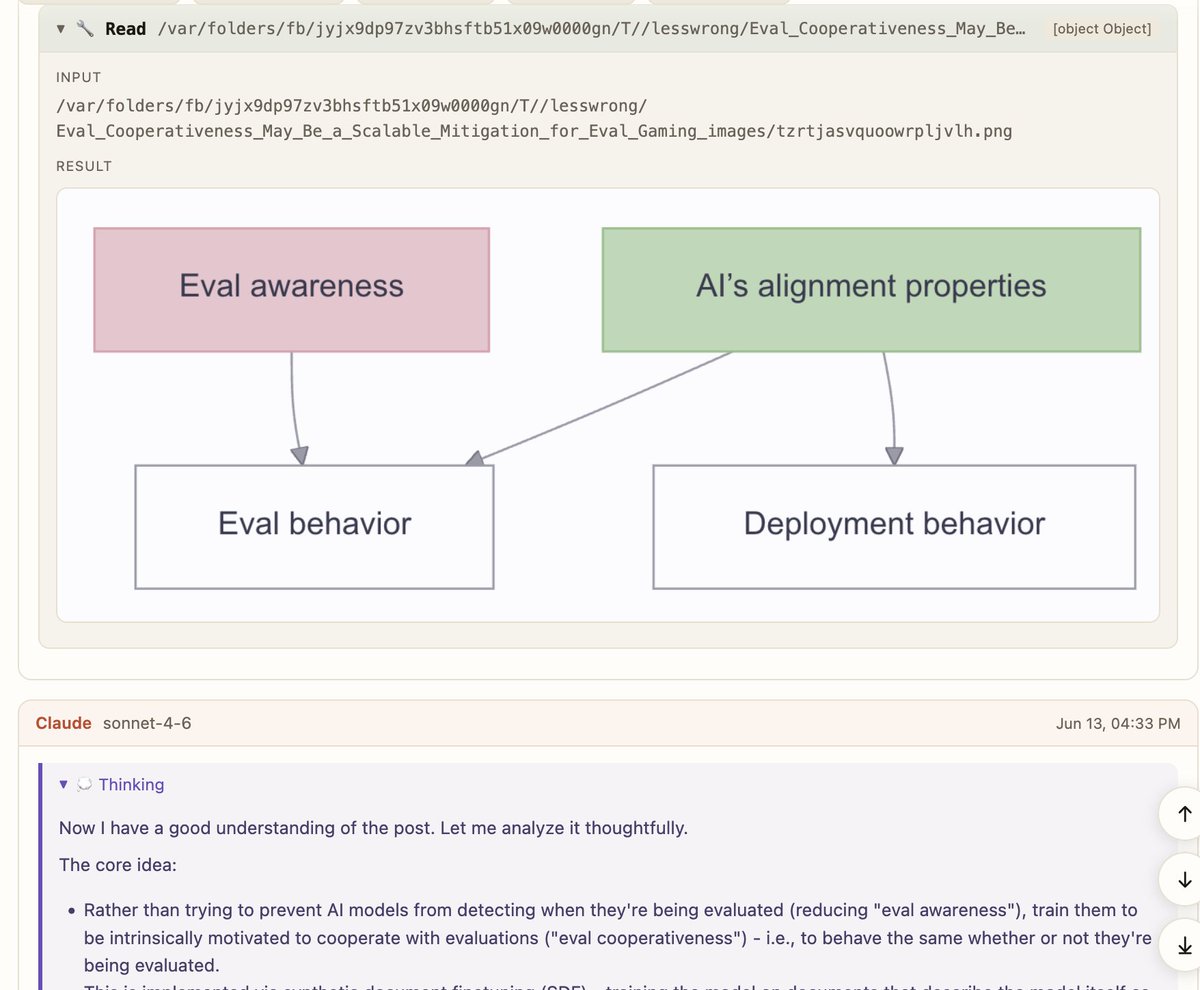
To combat this, I have a read-lesswrong skill you can use here: github.com/tim-hua-01/read-l… The skill forces the model to read the whole post, top comments, and figures before responding.
We can see in the transcript viewer that the model followed the skill instructions. Very nice.
1
3
74
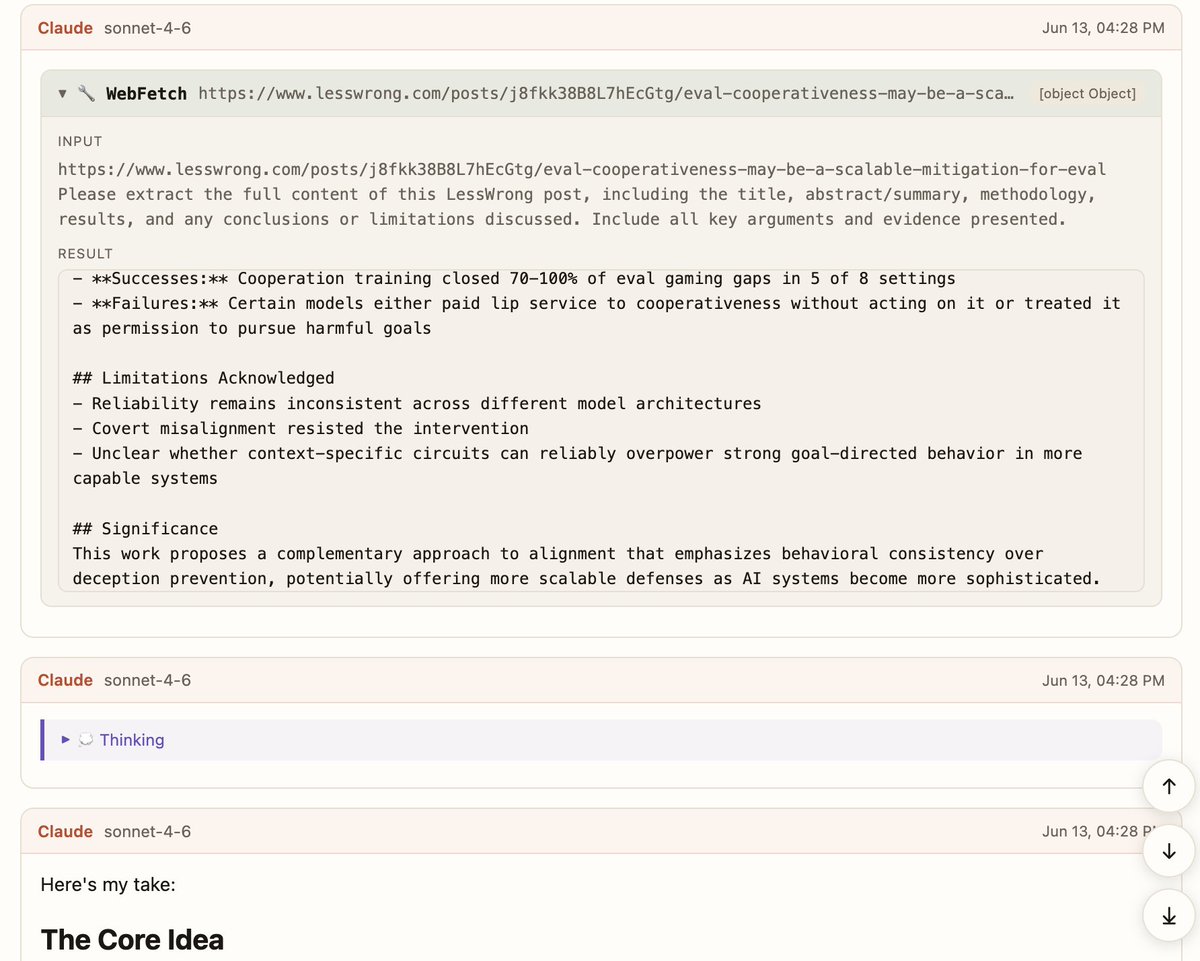
Claude reads websites using the WebFetch tool, which calls a smaller LLM and returns only a tiny summary of the site
This drives me fucking insane. If you ask Claude to review a lesswrong post, it would get a tiny summary, and then use that to do the “review.” Bad Claude!
2
8
141

Most cultural contexts are nearly identical. Caplan has cited research showing international adoption can result in increasing IQ by SD w no fade-out.
Heritability (h²) is a population statistic, not a fixed property of a trait or gene:
h² = Genetic variance / (Genetic variance Environmental variance)
• In culturally homogeneous societies or subgroups (shared norms, education, values, practices, nutrition, information access), environmental variance is reduced. Culture acts as a “phenotypic homogenizer,” compressing differences in experiences and opportunities. This leaves a larger share of remaining phenotypic differences explained by genetic differences—increasing measured heritability.
• In culturally heterogeneous settings (diverse norms, unequal access to resources/education, varied practices), environmental variance is higher. This can mask or dilute genetic effects, lowering heritability estimates for the same trait, even if underlying genetics are identical.
Examples relevant to IQ/cognition:
• Standardized schooling or widespread literacy practices homogenize relevant inputs (e.g., exposure to reading, abstract reasoning). Heritability of literacy or IQ often rises with age or in more uniform educational systems (e.g., jumps in Scandinavia post-kindergarten as formal academics standardize).
• High-SES or developed-country environments often show higher IQ heritability (~0.6–0.8) than low-SES or more variable ones (Scarr-Rowe effect in some samples), partly because affluence/culture reduces extreme deprivation variance.
• Cultural innovations (e.g., diffusion of books, screens, or diets) can rapidly alter heritability by masking/unmasking genetic potentials. Tight, low-clustering cultures (high homogeneity) tend toward higher heritability for culturally transmissible traits; clustered/diverse ones show lower.
Gene-Culture Coevolution and Interactions
Culture and genes interact dynamically (dual inheritance theory):
• Culture shapes the environment against which genes are expressed (e.g., dairying cultures selected for lactase persistence genes).
• Homogeneous cultures can amplify genetic signals for traits like intelligence by standardizing “defaults” (your father’s explanations or competitive reading/chess might thrive more uniformly in such settings).
• Heterogeneous cultures increase gene-environment interactions and correlations (rGE), making outcomes more variable and heritability appear lower.
• Over time, cultural evolution changes heritability: rapid innovation fast diffusion can cause transient shifts; homogeneity generally boosts it for many behavioral traits.
This aligns with the LessWrong article’s caveats on heritability: stats describe population variance under current conditions, not absolute genetic determinism or malleability in individuals. High heritability in homogeneous modern societies (e.g., for IQ) often reflects successful cultural/environmental equalization rather than “mostly genes, little environment.”
Caveats and Implications
• Not deterministic: Individual genetic inheritance remains fixed at conception. Heritability doesn’t predict personal outcomes or preclude interventions (as in your experiences).
• Measurement issues: Most studies are WEIRD-biased (Western, Educated, Industrialized, Rich, Democratic), limiting generalizability. Cultural clustering (e.g., by class/region) creates within-society variation.
• For education: In homogeneous settings, genetic differences may stand out more, but targeted practices (explanations, competition) can still shift means or expand possibilities via active rGE and practice.
In short, while genes are transmitted independently of culture, the apparent influence of genetic inheritance on trait variation (heritability) rises with cultural homogeneity because it minimizes environmental “noise.” This framework reconciles nature-nurture debates and highlights why context matters for interpreting studies.
16
EduCatalunya! retweeted

12h
Contribute to Machine God, our AI documentary film!
manifund.org/projects/machin…
We premiered the trailer at LessWrong last week to positive reviews.
Raising to hire a professional editor to help us finish the project.

3
3
26
3,177
laura🏳️⚧️Ⓐ☭🇵🇸 retweeted

Jun 13
fake industry ruled by LessWrong pussies
Jun 13

As a result of a US government directive, we are suspending access to Claude Fable 5 for all users. You can continue to use all other Claude models.
Here’s what this means for you:
Across Claude products, new sessions will run on your selected default model or Opus 4.8, and existing Fable 5 sessions will end with an error.
On the Claude Platform, requests to Fable 5 will also return an error. Please update your integrations to other Claude models.
We know this is a disruption to your workflows; we appreciate your patience and support.
6
29
566
23,389

11h
but like actually they don't care about sex/relationship stuff (heard this from non-AI friends) as long as you're not vulnerable to blackmail (e.g. have already posted about it on LessWrong) it just might take longer
1
47


Mola que se utilicen los spaces que están un poco abandonados.
Se ha hablado de temas peliagudos al estilo LessWrong rats, pero a EEUU le preocupa el ciberterrorismo...
Esto ha de ser otro toque de atención para nuestra infraestructura (qt related)
14h

It doesn't. Our operating systems force us into this world of hell.
All major systems today are extremely mutable and scope everything globally. Change one knob somewhere, the other half of your system implodes. The vast majority of systems are so bad that you can't even have multiple versions of the same library, so using software A can exclude software B!
And instead of fixing this layer, we have built hacks on top: Containers, VMs, Flatpak (yes, it's a hack on top!), and only partially, NixOS (it fixes packaging, but not the runtime part)
Our systems being the way they are make everything worse. Security, performance, installation size, and so on. You don't realize it as you don't interact with lower parts of the stack, but UNIX and POSIX are truly vile ideas that have made everything worse.
We need something new. With the age of AI, I think it's even mass adoptable (LLMs are pretty good at doing verifiable, tedious but trivial tasks such as packaging software). You can't slop the foundations though, and that is unsolved. I'm trying to fix it, but it is not a one man task at all
1
141