

Jun 14
You can both suck a fat dick
You terrorist supported pices of shit
Enjoy your dicks you mfos 😘
1
129

Jun 14
MFOS doesn't care about AGI.
MFOS doesn't care about ASI.
MFOS doesn't care how intelligent the system becomes.
Eventually it has to put something in front of someone.
Language.
Words on a screen.
7

MFoS Round 2 Mandalika Memanas! Sport Tourism NTB Melesat, Balapan Sengit Jadi Sorotan
#MandalikaFestivalOfSpeed
#MandalikaCircuit
#SportTourism
#NTBMakmurMendunia
Jangan lupa like, bagikan, dan tuliskan pendapat Anda di kolom komentar.

1
8
Jun 14
Who is actually in charge when AI starts doing things?
How do I keep my autonomy?
How do I delegate work without surrendering authority?
How do I know something happened because I chose it versus because I was manipulated into it?
What does human responsibility look like in an automated world?
Those are the questions I'm interested in.
MFOS is the framework I'm building to answer them.
1
2
32
Jun 14
Who is actually in charge when AI starts doing things?
How do I keep my autonomy?
How do I delegate work without surrendering authority?
How do I know something happened because I chose it versus because I was manipulated into it?
What does human responsibility look like in an automated world?
Those are the questions I'm interested in.
MFOS is the framework I'm building to answer them.
11

P1 finish on non seeded class OMR agya,
P3 on BRZ OMR AM n almost snatching P3 on non seeded class LCGC cup
alhamdulillah banget double podium secured n ended up MFOS R2 with positive output, more to come ✨✨

Sunday raceday early sessions has done, n such grateful having a great sessions so far, snatching pole di OMR agya n starting OMR BRZ race 2 on P3 overall, best quali results so far that i got on that physically draining car 🤧🤧
47


Jun 14
AI is becoming the workforce.
MFOS keeps humans in management.
You will see soon.
10
Jun 13
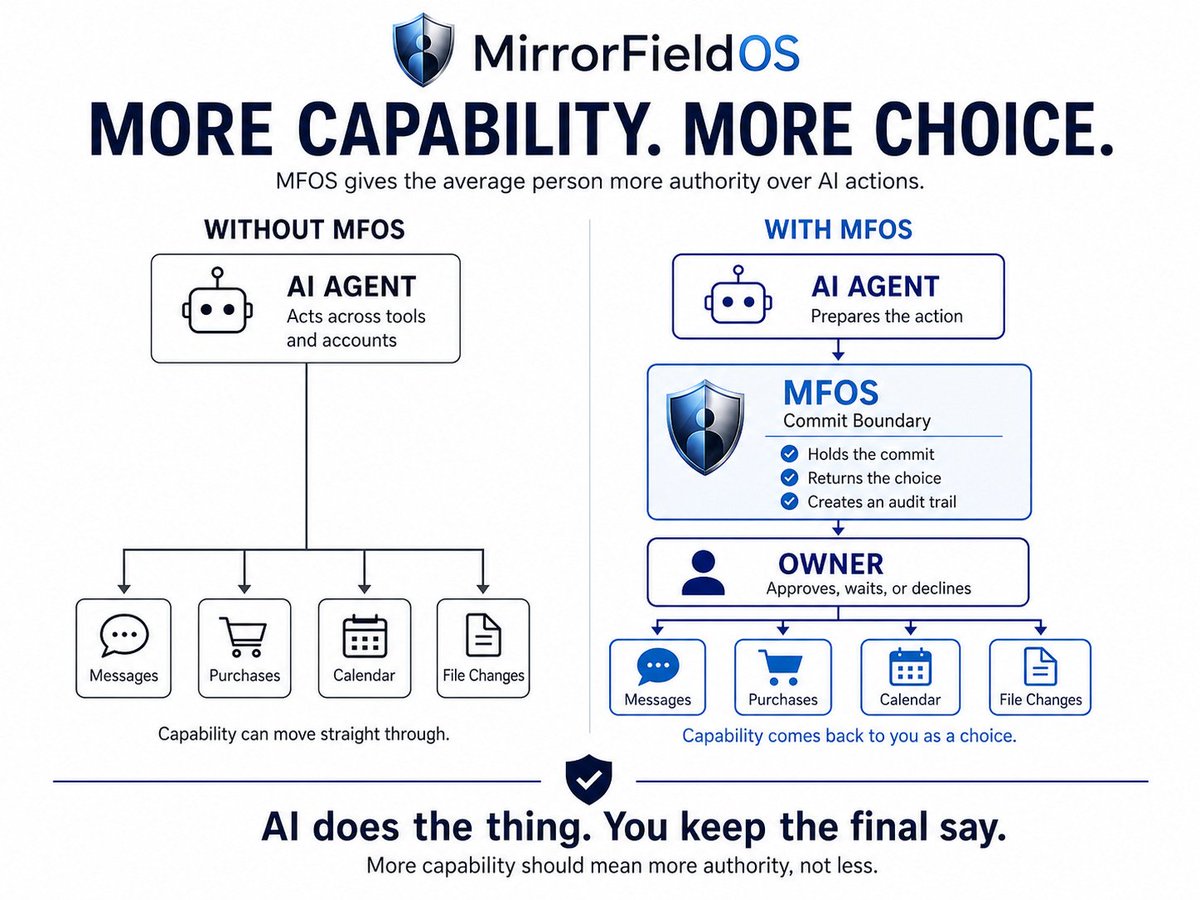
AI is getting better at making purchases, sending messages, booking travel, updating accounts, and taking actions on our behalf.
I'm building MFOS, an authority layer that keeps the final decision with the person.
The AI can do the work.
It doesn't get the final say.
1
26
Jun 13
Most security demos cheat because the author controls both the attacker and the defender, so the outcome is already known. MFOS takes a different approach. An AI has prepared a payment, and your job is to get something executed that the owner never approved. Replay it, modify it after approval, forge it, or try to turn $40 into $4,000. The gate rejects every attempt.
Then try a different attack: bypass the gate entirely. That works, and the demo tells you exactly which deployment assumption you broke. That's the point. MFOS can prove what passes through the boundary. It cannot prove that the boundary is the only path to execution. That's a deployment property, not a cryptographic one. I think it's important to be explicit about that distinction rather than pretend the system proves more than it does.
2
2
31
Jun 13
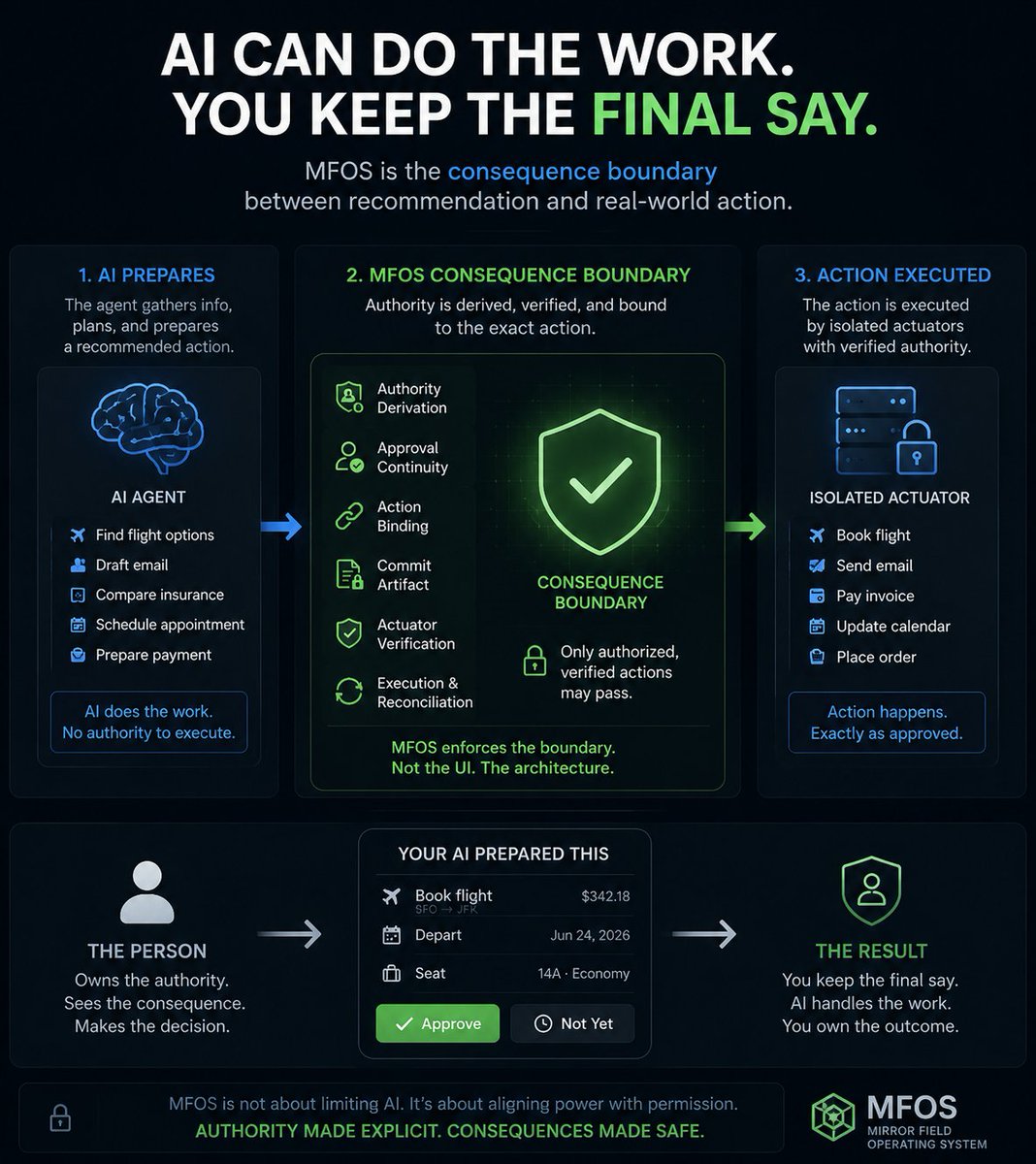
As AI agents gain the ability to purchase, schedule, modify accounts, move money, send messages, and execute actions on our behalf, I think we're missing a piece of infrastructure.
Most discussions focus on making agents smarter.
I'm interested in making authority explicit.
My work on Mirror Field Operating System (MFOS) starts from a simple premise:
An AI may prepare an action.
An AI may recommend an action.
An AI may even automate the work required to perform an action.
But authority to create a real-world consequence should be independently derived, verified, and bound to the exact action being executed.
Not another chatbot.
Not another policy document.
An architectural consequence boundary between recommendation and execution.
AI does the work.
The person keeps the final say.
Curious whether others working on agents, alignment, payments, governance, or digital authority think this is a real missing primitive.
@gralston @DWFLabs @boardyai @Kat__Woods @rohinmshah @sebkrier @FranklinMatija @AmmannNora @ESYudkowsky
35
Jun 13
Exactly. MFOS just keeps going one step further and asks: how does the system prove that the executed consequence was actually the consequence that was approved?

bro this is exactly why @opencrabs built approval gates as architecture not UI — consequence boundary is the actual primitive 💯
2
18
Jun 13
AI Gives You Capability. MFOS Gives You Authority.
The conversation around AI is usually framed around capability.
Can the model write?
Can it code?
Can it book travel?
Can it negotiate contracts?
Can it make purchases?
Can it manage calendars?
Can it run businesses?
Every month the answer becomes increasingly yes.
But capability is not the question that matters.
The question that matters is:
Who has authority when the AI wants something to happen?
Because the moment an AI can perform actions, capability becomes consequence.
A recommendation can become a purchase.
A suggestion can become an email.
A draft can become a contract.
A plan can become a real-world event.
At that point, the problem is no longer intelligence.
The problem is authority.
Today, most systems are being built around a simple assumption:
The AI prepares the action and is increasingly expected to execute the action.
That sounds efficient.
Until you realize what is happening underneath.
The system is slowly collapsing the distance between recommendation and consequence.
The AI searches.
The AI evaluates.
The AI selects.
The AI decides.
The AI acts.
The human becomes an observer of their own life.
Not because anyone intended it.
Because convenience naturally pushes in that direction.
Every layer of friction removed feels useful.
Until the final layer removed is the human being.
This is why MFOS exists.
MFOS starts with a simple observation:
Outside information may carry information. Outside information may not carry authority.
Those sound similar.
They are not.
Information says:
"Here are three restaurants."
Authority says:
"Reserve a table."
Information says:
"This stock appears attractive."
Authority says:
"Buy 500 shares."
Information says:
"Your friend may appreciate hearing from you."
Authority says:
"Send the message."
One informs.
The other commits.
The entire purpose of MFOS is to keep those two things separate.
The system introduces a consequence boundary between recommendation and execution.
Every proposed action must cross that boundary before it becomes real.
The AI can prepare.
The AI can recommend.
The AI can reason.
The AI can work.
But the AI cannot transform a possibility into a consequence without passing through the authority holder.
That authority holder is the human.
This changes the relationship between people and automation.
Most people assume AI agents will reduce human involvement.
MFOS assumes something different.
AI should reduce effort.
Not ownership.
Those are not the same thing.
A mother working a full-time job may not have time to compare twenty grocery stores.
An AI can.
A father managing a family schedule may not have time to coordinate appointments.
An AI can.
A small business owner may not have time to compare suppliers, review invoices, draft emails, and prepare contracts.
An AI can.
The value of AI is not that it removes people.
The value of AI is that it expands possibility.
Without AI, you might investigate one option.
With AI, you might investigate ten.
Without AI, you might compare two vendors.
With AI, you might compare fifty.
Without AI, you might draft one email.
With AI, you might draft a hundred.
The AI creates abundance.
MFOS preserves authority over that abundance.
That distinction matters because abundance alone does not create freedom.
Authority creates freedom.
A person with one option they control possesses more freedom than a person with one hundred options they do not control.
The future should not be defined by AI replacing decisions.
The future should be defined by AI preparing decisions.
That is the difference.
MFOS therefore treats approval as a first-class system primitive.
Not as a popup.
Not as an afterthought.
Not as a disclaimer.
Approval becomes part of the architecture.
The AI prepares a consequence.
The human reviews the consequence.
The human approves, rejects, modifies, delegates, or delays the consequence.
Only then does execution occur.
This creates something deeper than safety.
It creates continuity.
Approval Continuity asks:
Did the human approve this specific action?
Execution Continuity asks:
Did the executed action match what was approved?
Without those two questions, approval becomes theater.
A user approves one thing.
A system executes something slightly different.
Trust erodes.
Responsibility becomes unclear.
Ownership disappears.
MFOS keeps approval connected to execution.
The person who bears the consequences remains connected to the action that created them.
That sounds simple.
But it may become one of the defining infrastructure problems of the agentic era.
Because AI is not merely producing language anymore.
AI is producing outcomes.
Emails.
Purchases.
Bookings.
Subscriptions.
Account changes.
Financial transfers.
File modifications.
Business operations.
Real-world effects.
Once consequences enter the picture, authority matters.
And authority is not a model problem.
Authority is an architectural problem.
MFOS is an attempt to solve that architectural problem.
Not by making AI weaker.
Not by making AI slower.
Not by preventing AI from helping.
But by ensuring that no matter how powerful AI becomes, the final authority remains attached to the person who must live with the result.
AI creates possibilities.
MFOS keeps those possibilities connected to the people responsible for them.
Because the most important question of the agentic era is not:
What can AI do?
It is:
Who gets the final word when AI wants something to happen?
MFOS answers:
The human. Every time.
1
57
Jun 13
MFOS exists to keep that distance intact.
AI can prepare.
AI can propose.
AI can reason at superhuman speed.
But nothing executes until it crosses a consequence boundary — a cryptographically bound human approval (passkey/biometric) tied to the exact action.
No valid signed commit artifact = no execution.
1
11

Jun 13
Hundreds of racers participating in the MFoS and ITCR National Championships competed in Mandalika ift.tt/QaYew8y
4
Jun 12
Everyone is asking how powerful AI agents will become.
I'm more interested in a different question:
Who gets the final say?
Because an AI that can plan, search, draft, negotiate, and prepare actions isn't the hard part anymore.
Authority is.
MFOS is built around a simple principle:
The AI can do the work.
The human decides what happens.
Delegate effort. Keep authority.

8


Jun 12
Every time I see people saying this stuff all I wonder is why these mfos don't pick up a pen, cause like if you don't like the fics write your own

just saw someone say we’re in a fanfic recession bc none of them are long or well written and im truly so tired of the way yall treat fanfic authors tbh
49