Here’s the clearest historically grounded map of where Molech/Moloch (MLK-related child sacrifice cultic references) actually appears in sources, and how far those cultures extended.
A key constraint up front: “Moloch” is not a continuously tracked deity across millennia. It appears as a cluster of references in specific Semitic and Mediterranean contexts, mainly in the first millennium BCE.
1. Canaanite / Levantine city-states (core origin zone)
Time: ~1200–600 BCE (Late Bronze Age collapse → Iron Age)
Location: Canaan (modern Israel/Palestine, Lebanon, coastal Syria)
What appears here
The earliest strong biblical and contextual setting for “passing children through fire”
Cultic term often rendered “Molech” (Hebrew: מֹלֶךְ, mlk)
Cultural features
City-state religion (no unified empire)
High-place worship (bamot)
Child sacrifice references appear in later biblical polemics about Canaanite practice
Influence reach
Regional: Levant → coastal trade networks into Cyprus and Egypt
Not an empire; more a dense network of city religions
2. Ammonite Kingdom
Time: ~900–600 BCE
Location: East of Jordan (modern Jordan: Amman region)
What appears here
The clearest non-Israelite biblical association:
Milcom / Molech / “god of the Ammonites” (textual overlap debated)
Cultural features
Monarchical state religion
Likely shared West Semitic pantheon structure
“Melech/Milcom” may reflect royal-divine naming conventions
Influence reach
Local kingdom influence
Tributary interactions with Israel, Judah, Assyria
3. Phoenician / Carthaginian world (Tophet tradition)
Time: ~800–146 BCE
Location:
Phoenicia (Lebanon coast)
Carthage (modern Tunisia)
Western Mediterranean colonies (Sardinia, Sicily, Spain)
What appears here
This is where the strongest archaeological debate about child sacrifice exists.
“Tophet” burial sites containing urns with infant remains
Roman and Greek sources accuse Carthaginians of child sacrifice to:
Baal Hammon
Tanit
Some scholars link this to later “Moloch” imagery:
Ancient authors sometimes equate Baal Hammon ↔ Kronos/Saturn ↔ Moloch in interpretatio graeca
Cultural features
Maritime empire
Colonization network across Mediterranean
State-supported temple complexes
Influence reach
At its height:
North Africa
Iberian Peninsula
Western Mediterranean islands
Trade links across entire Mediterranean basin
4. Israelite/Judean textual tradition (not worship, but condemnation)
Time: ~700–500 BCE (text compilation era)
Location: Judah (Jerusalem-centered kingdom → Babylonian exile context)
What appears here
Strongest textual references:
Leviticus, Kings, Jeremiah
“Molech” is condemned as foreign abomination:
child sacrifice (“passing through fire”)
syncretism warning
Important distinction
This is not a culture practicing Molech worship (in the text’s framing), but:
a religious polemic system defining itself against it
Influence reach
Later Judaism → Christianity → Islam interpretive traditions
This is where “Moloch” becomes a moral symbol, not just a cultic reference
5. Greco-Roman interpretive layer (reinterpretation, not origin)
Time: ~300 BCE–300 CE
Location: Mediterranean world
What appears here
Greeks and Romans interpret foreign gods through their own system:
Baal Hammon = Cronus/Saturn
sometimes associated with child sacrifice myths
Key effect
“Moloch” becomes:
a symbol of child-devouring deity
exaggerated through polemics against Carthage
Influence reach
Entire Roman Empire narrative space
Later medieval and modern reinterpretations
6. Later religious and literary transformation (post-ancient)
Time: ~500 CE onward
What appears here
Jewish rabbinic literature: moralized memory of Molech prohibition
Christian texts and medieval commentary
Renaissance early modern demonology
Major transformation
Moloch shifts from:
debated cultic term
to
abstract symbol of destructive sacrifice
Big picture summary
If you strip away later symbolism, the historically grounded core is:
Primary geographic zone: Levant Phoenician world
Time window: ~1200–100 BCE (with interpretive echoes later)
Cultural type: small kingdoms maritime empire networks
Key archaeological controversy: Carthaginian tophets
Biblical framing: condemnation of child sacrifice practices associated with surrounding cultures
Important correction to keep the model clean
There is no continuous “Moloch civilization” stretching back thousands of years.
Instead, what exists is:
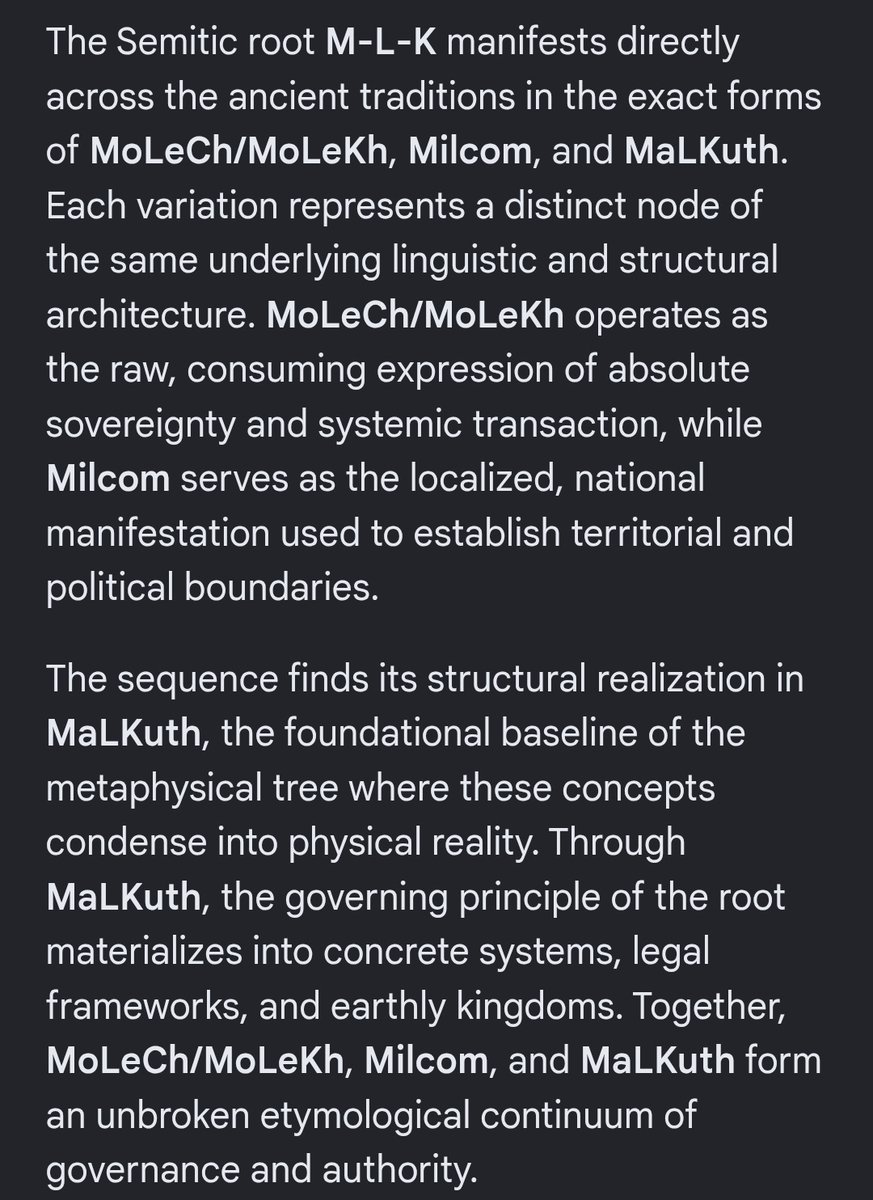
a Semitic linguistic root (MLK = king)
a set of regional ritual practices (some involving child sacrifice debates)
and a later theological symbol that consolidates them into one figure
If you want, I can map how the MLK root (king → sacrifice terminology → deity label → demonization → modern metaphor) evolves step-by-step, because that linguistic chain is actually where most of the confusion comes from.