
20 Jul 2025
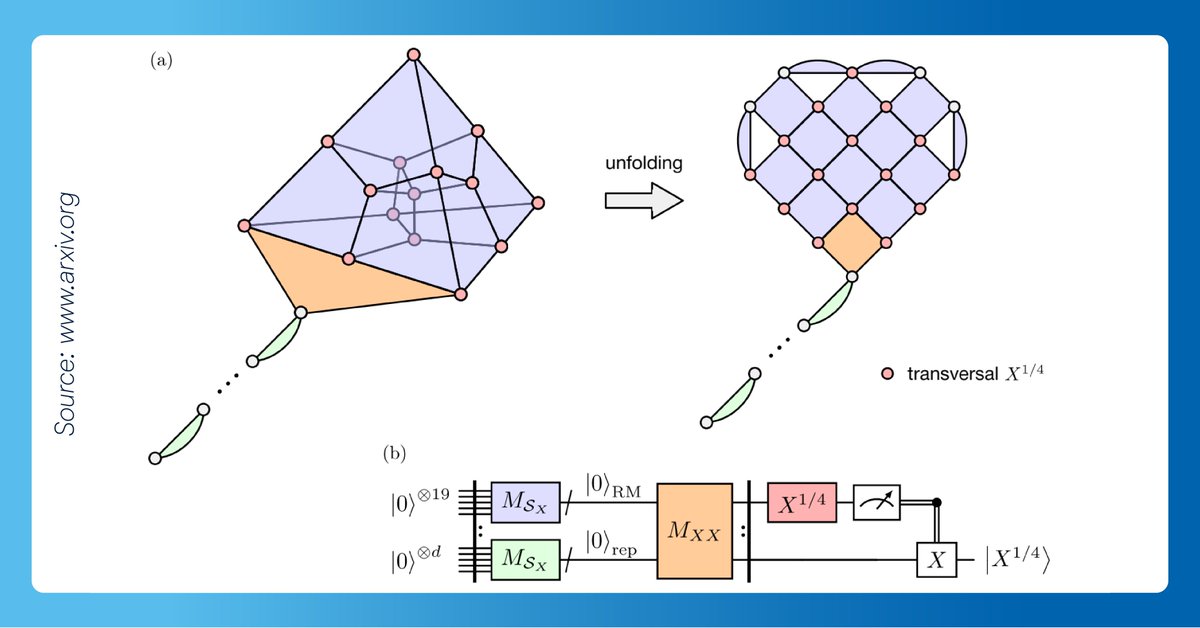
⚡ Unfolded distillation reduces magic state distillation costs for biased-noise qubits:
Achieves 3 × 10⁻⁷ logical error with 53 qubits and 5.5 rounds of error correction.
Read more: arxiv.org/pdf/2507.12511
#QubitScript #QuantumComputing #MagicStateDistillation #QuantumAlgorithms
3
118
2 Jan 2025
2️⃣0️⃣2️⃣5️⃣ Kicking off the New Year with another exciting research paper to explore!
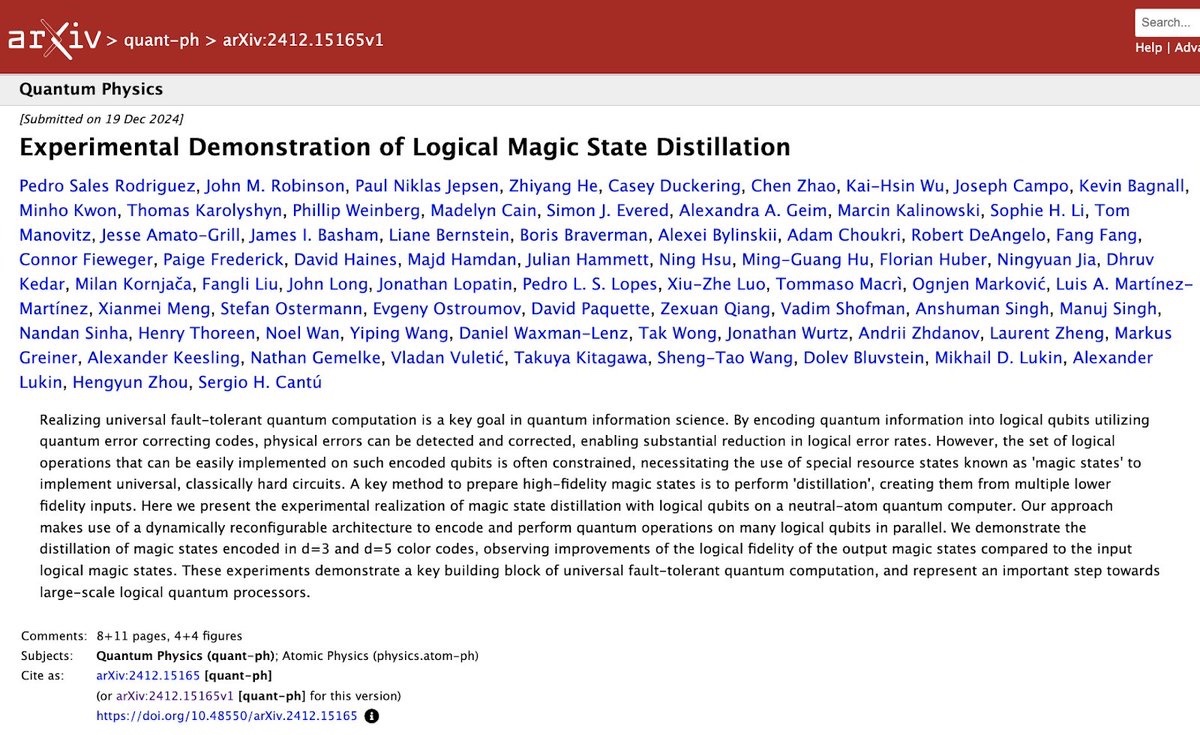
✨ Experimental Demonstration of Logical Magic State Distillation ✨
🌌 Researchers from @QueraComputing have made a breakthrough in quantum computation.
🔑 Highlights of the study:
1️⃣ Demonstrated magic state distillation on a neutral-atom quantum computer.
2️⃣ Achieved significant logical magic state fidelity improvements:
- From 95.1% to 99.4% for d=3 codes.
- From 92.5% to 98.6% for d=5 codes.
3️⃣ Leveraged dynamic reconfigurability and transversal gates for scalable operations.
🌟 Future focus:
• Advancing fidelity and efficiency in magic state preparation.
• Exploring alternative methods and co-designing solutions for enhanced performance.
📍Read more here: arxiv.org/pdf/2412.15165
#QubitScript #QuantumComputing #QuEraComputing #MagicStateDistillation
3
124

25 Oct 2024
#Quantumchaos is a quantum many-body phenomenon that is associated with a number of intricate properties, such as level repulsion in energy spectra or distinct scalings of out-of-time ordered correlation functions. In this work, we introduce a novel class of "pseudochaotic" quantum Hamiltonians that fundamentally challenges the conventional understanding of quantum chaos and its relationship to computational complexity.
Our ensemble is #computationallyindistinguishable from the Gaussian unitary ensemble (#GUE) of strongly-interacting Hamiltonians, widely considered to be a quintessential model for quantum chaos. Surprisingly, despite this effective indistinguishability, our Hamiltonians lack all conventional signatures of chaos: it exhibits Poissonian level statistics, low operator complexity, and weak scrambling properties.
This stark contrast between efficient computational indistinguishability and traditional chaos indicators calls into question fundamental assumptions about the nature of quantum chaos.
We, furthermore, give an efficient quantum algorithm to simulate Hamiltonians from our ensemble, even though simulating Hamiltonians from the true GUE is known to require exponential time. Our work establishes fundamental limitations on #Hamiltonianlearning and testing protocols and derives stronger bounds on #entanglement and #magicstatedistillation.
These results reveal a surprising separation between #computational and #informationtheoretic perspectives on quantum chaos, opening new avenues for research at the intersection of quantum chaos, computational complexity, and quantum information. Above all, it challenges conventional notions of what it fundamentally means to actually observe complex quantum systems.
1
22
1,119