
Mar 23
MATHlectures has free recorded math course lectures and solution walkthroughs by experienced teachers.
Use it and share it: mathlectures.com
2
20
69
2,562

Feb 5
If you liked our previous post on the Pure Mathematics of Spacetime and you’re feeling brave enough to jump straight into the 24 lectures on Topology and Manifolds, hold your horses! 🛑✋
That’s like trying to read music by starting with a full symphony score. First you want to the muscle to think in definitions, not pictures, and Abstract Algebra is one of the cleanest ways to build it.
A great second is Benedict H. Gross’s Harvard Extension Math 122 lectures.
He isn’t just copying theorems onto the board. He rebuilds the argument from the objects upward, and you feel the gears click. Definitions. Examples. The one obstruction you forgot to check.
The strange part is you don’t even feel the urge to take notes. You just listen. Each sentence sets up the next, and by the time he writes the key line, you already know why it has to be true. It’s elegant in the literal sense.
Teaching isn’t for everyone. Plenty of brilliant people simply can’t teach. Real teaching is its own craft. Timing. Choice of examples. An instinct for where students will get lost while still nodding along. If you scan your whole education, you can usually name only a small handful of people who actually moved the needle. Gross is in that group.
#AbstractAlgebra #GroupTheory #QuotientGroups #IsomorphismTheorem #MathLectures #PureMathematics
7
23
168
7,673
Jan 14
The Trap in Every Mathematics Lecture
If you’ve taken a lot of math courses, you start to recognize a pattern. There’s a moment where the lecturer is warming up with the obvious stuff...add matrices entrywise, scale by α, do the row-column product...and you’re thinking, alright… where is this going? Then you relax. You stop resisting. And right there, they slip in one line that changes how you see the whole subject.
When Benedict Gross says "matrices represent linear operators,"he’s telling you to stop treating a matrix as a rectangle of numbers and start treating it as an action.
A linear operator is a function T: Rⁿ → Rⁿ that respects two rules:
T(u v)=T(u) T(v) and T(αu)=αT(u).
Once you pick a basis, T is completely determined by where it sends the basis vectors e₁,…,eₙ. Put T(e₁),…,T(eₙ) into columns and you get a matrix A. That is what "A represents T" means...A is the coordinate portrait of the transformation.
Now the punchline that makes matrix multiplication feel inevitable. If B represents S and A represents T, then doing S first and then T is the composition T∘S. In coordinates that becomes A(Bx)=(AB)x. So multiplying matrices is really composing transformations. That’s why multiplication is usually not commutative: T∘S is generally not the same transformation as S∘T, and the matrices inherit that noncommutativity.
This explains half of Linear Algebra
because it tells you what the course is really about...functions that move vectors around, not grids of numbers. A matrix is just the written form of that function once you choose coordinates.
Then the rules stop feeling random
Multiplying matrices means doing one move and then another, an inverse means you can undo the move, eigenvectors are directions that don’t get turned, and changing basis is just describing the same move in a different language. That one idea makes a lot of linear algebra click.
#LinearAlgebra #Matrices #GroupTheory #GLn #MathLectures #Mathematics
25
108
826
66,807
Jan 7
While revising group theory for a graduate abstract algebra course, I went looking for a second voice, because algebra has this specific kind of pain…you can follow every line of a proof and still lose the idea. That’s how I landed on Benedict H. Gross’s Harvard Extension Math 122 lectures.
The difference is immediate. He isn’t reading theorems off a page and transcribing them onto the board like most Algebra lecturers. He rebuilds the argument from the objects upward, and you can feel the mechanism engage: definitions, examples, the one obstruction you forgot to check.
And the weird part is you don’t feel the urge to take notes. You just listen. The lecture has that story-logic where each sentence sets up the next, and by the time he writes the key line, you already know why it has to be true. It’s elegant in the literal sense.🫡
Teaching isn’t for everyone. There are a lot of smart people who simply can’t teach!
Real teaching is a separate craft…timing, taste in examples, and an instinct for where students will get lost while still nodding. That’s why, if you scan your whole education, you can usually name only a small handful of people who actually moved the needle. Gross is in that small group.
In this segment, Benedict Gross is basically saying:
“You don’t guess a group law on cosets. You define it by copying (‘transporting’) a group law from somewhere it already exists, using a bijection.”
par transport de structure, in one chain:
Start with a homomorphism f : G → G′ and set H = ker(f).
Cosets are exactly fibers: aH = bH ⇔ f(a) = f(b).
Define a bijection φ : G/H → Im(f) by φ(aH) = f(a).
Pull the multiplication back from Im(f) to G/H by defining
(aH) ⋆ (bH) = φ⁻¹( φ(aH) · φ(bH) ).
Then the computation forces the familiar rule:
(aH) ⋆ (bH) = φ⁻¹(f(a)f(b)) = φ⁻¹(f(ab)) = (ab)H.
So the quotient product isn’t a guess. It’s the pulled-back product that makes φ a homomorphism by construction.
#AbstractAlgebra #GroupTheory #QuotientGroups #IsomorphismTheorem #MathLectures #Mathematics
17
62
463
34,323

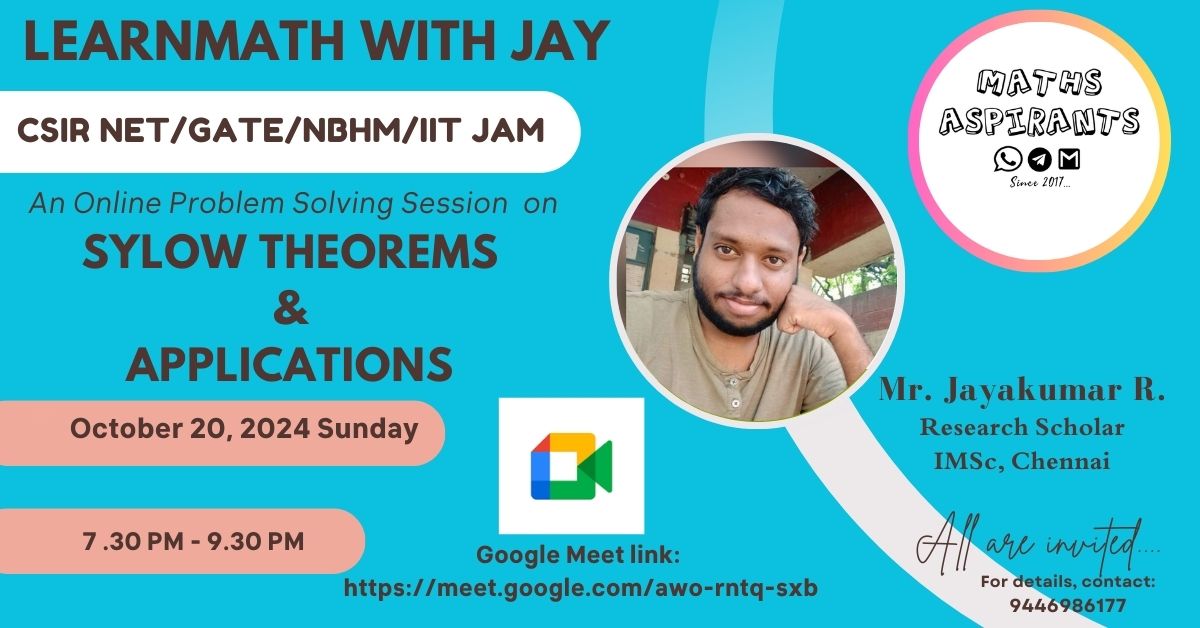
20 Oct 2024
I’ve had a lot of conversations about this, and I’m really looking forward to the next one.
#MathWithJay #CSIRNET #GATE2024 #NBHM #IITJAM #SylowTheorems #Mathematics #PureMath #MathLectures #ProblemSolving #ResearchScholar #MathTutoring #MathCommunity #OnlineClasses #MathAspirants #CompetitiveExams #StudyWithMe #MathTalks #LearnMath #MathematicsEducation
#MathematicsEducation
@alexbilz @risphereeditor
3
328

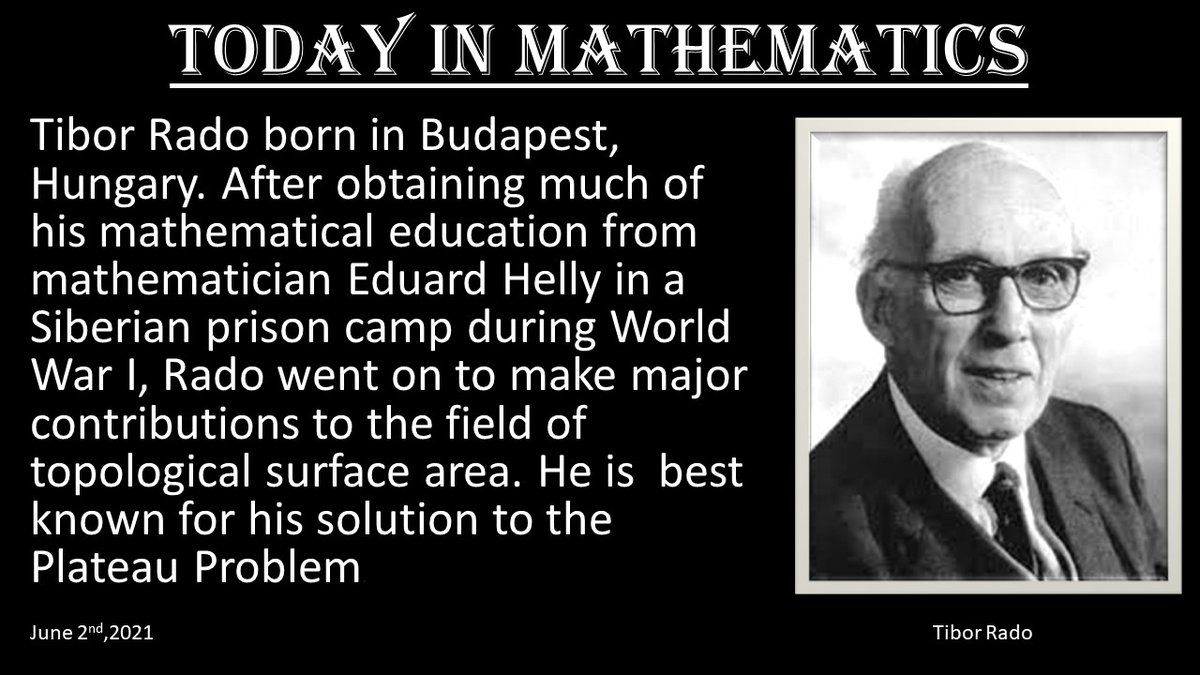
2 Jun 2021
Born2 June 1895
Died12 December 1965
Tibor Radó was a Hungarian mathematician best known for his solution to the Plateau Problem.
#todayinmathematics #5minutemathematics #mathematician #personality #scientist #mathlectures #mathematics_facts #mathematics #hungarianmathematician
1
4

16 Dec 2020
To learn about #Matrices watch this video and follow @ASADMEH52797795
To get notified about #Mathematics
#MathLectures
#Matrices
#Orderofmatrix
youtu.be/X0iQbHI9F7c
2


20 May 2019
とあるきっかけで、大学受験時に塾(Z会)でお世話になった山下弘一郎先生(2年ほど前に亡くなられた)について調べていると、先生の書いたPDFなどが読めるwiki kymst.net/index.php?FrontPag… を見つけた(MathDocs, MathLecturesなど) 懐かしいものばかり, 先生の言葉遣いが思い出されちょっと泣きそうになる
2
5
20