
Oliver Zdravkovski retweeted

Jun 12
Want a passive income stream that grows with you? 📈
If you love using MetaPulse to scale your business, share the love! Our Affiliate Program gives you a 30% recurring commission for life on every referral.
Claim your link and start earning:
help.metapulse.com/en/articl…
1
1
4

May 21
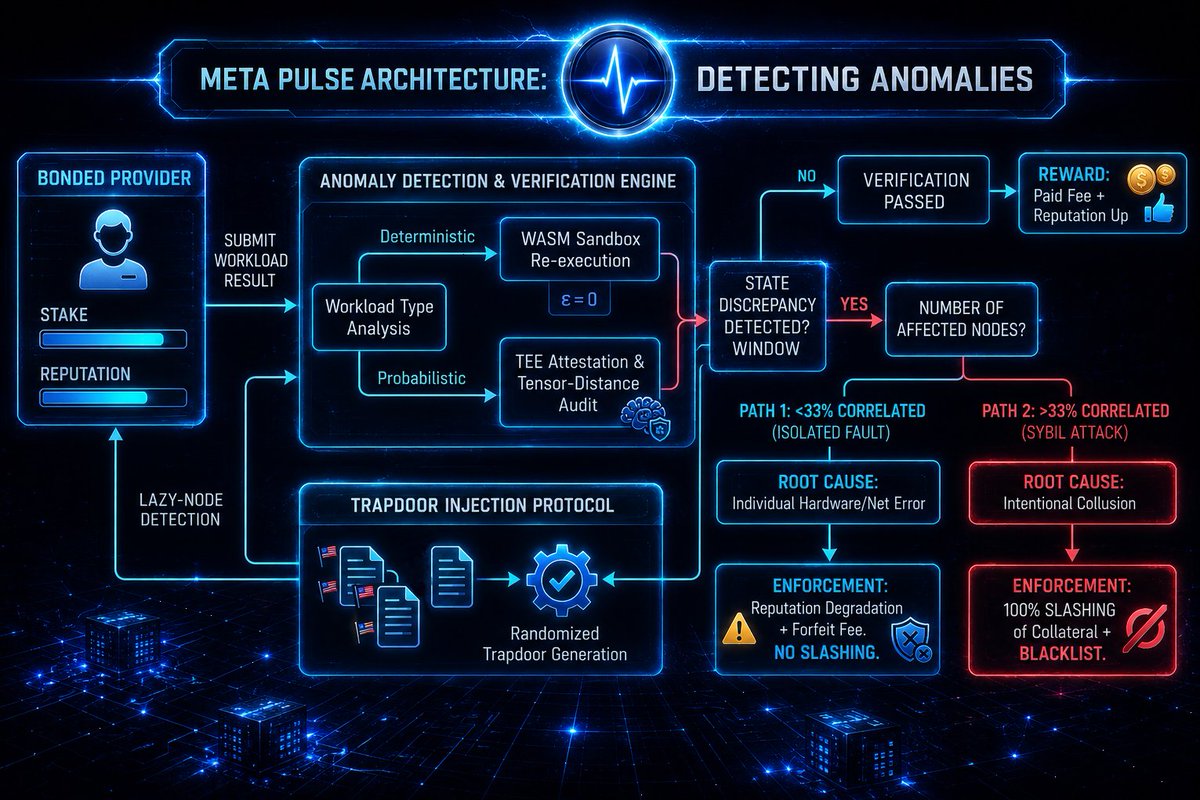
Drafting a new architecture for decentralized compute: The MetaPulse
Most DeCi systems make a fatal mistake: forcing every workload through the same consensus layer. Full global verification is an economic and performance killer.
We are building around Workload-Dependent Validation. The goal isn’t constant global verification - it is bounded risk under economically enforceable constraints. Here is the blueprint:
1/ The Validation Split
Pathway A (Deterministic): Low-risk CPU tasks run in isolated WASM sandboxes. Fixed gas, fixed memory. Discrepancy tolerance is absolute ($\epsilon = 0$). Easy to verify via quick re-execution.
Pathway B (Probabilistic): GPU AI inference isn’t naturally deterministic due to floating-point drift. We route these through TEEs (Intel SGX/Confidential GPUs) and validate via Tensor-Distance Alignment (MSE/Cosine Similarity) instead of raw byte hashes.
2/ Proportional Enforcement (No False Positives)
We separate infra bugs from actual attacks:
- Isolated Fault: One node fails due to overheating/network drops. Penalty: Minor reputation dip, loss of fee. No slashing.
- Coordinated Anomaly: $>33\%$ of nodes return the exact same invalid output. That’s a Sybil attack. Penalty: 100% Slashing of collateral permanent blacklist.
3/ Optimistic ZK-ML (Dispute-Only)
Generating ZK proofs for billions of ML parameters on every block is a financial suicide. The MetaPulse uses an optimistic model. Compute is assumed valid. ZK-SNARK proofs are generated only during unresolved disputes —and the losing party pays the massive proof-generation fee.
4/ Keeping Nodes Honest (Trapdoors)
To stop validators from blindly signing off on results to farm fees, the protocol randomly injects intentionally flawed workloads. If a node signs off on a trapdoor, its reputation is instantly nuked, and its collateral requirements skyrocket.
The Web3 compute race won't be won by the most secure network, but by the most economically rational one.
More details:
mpulse.network
2
2,304


Apr 28
Protocol Insight: Utility Requires Constraint
The viability of decentralized compute depends on the structural coupling of the economic layer and the workload layer.
In many networks, token velocity becomes a liability when the asset functions as a detached financial layer. To reduce value leakage, protocol design shifts from speculative turnover toward enforceable constraints.
- Deterministic Sinks: Linking fee-burn functions directly to compute consumption ties economic activity to workload demand and reinforces utility at the settlement layer.
- Stake-Weighted Capacity: Provider participation is not defined by availability alone. Execution rights scale with bonded collateral, ensuring that slashable stake backs every workload admitted into the network.
- Native Unit of Account: Denominating compute credits in the native asset causes demand to scale with resource utilization rather than external market sentiment.
Unlike systems where token utility is layered on after network design, the MetaPulse Network integrates settlement, provider incentives, and compute access into a single coordinated model, where utility emerges from protocol constraints rather than token narratives.
Utility is not a story. It emerges from how access to scarce compute is constrained by protocol rules.

12
13
1,783


Apr 25
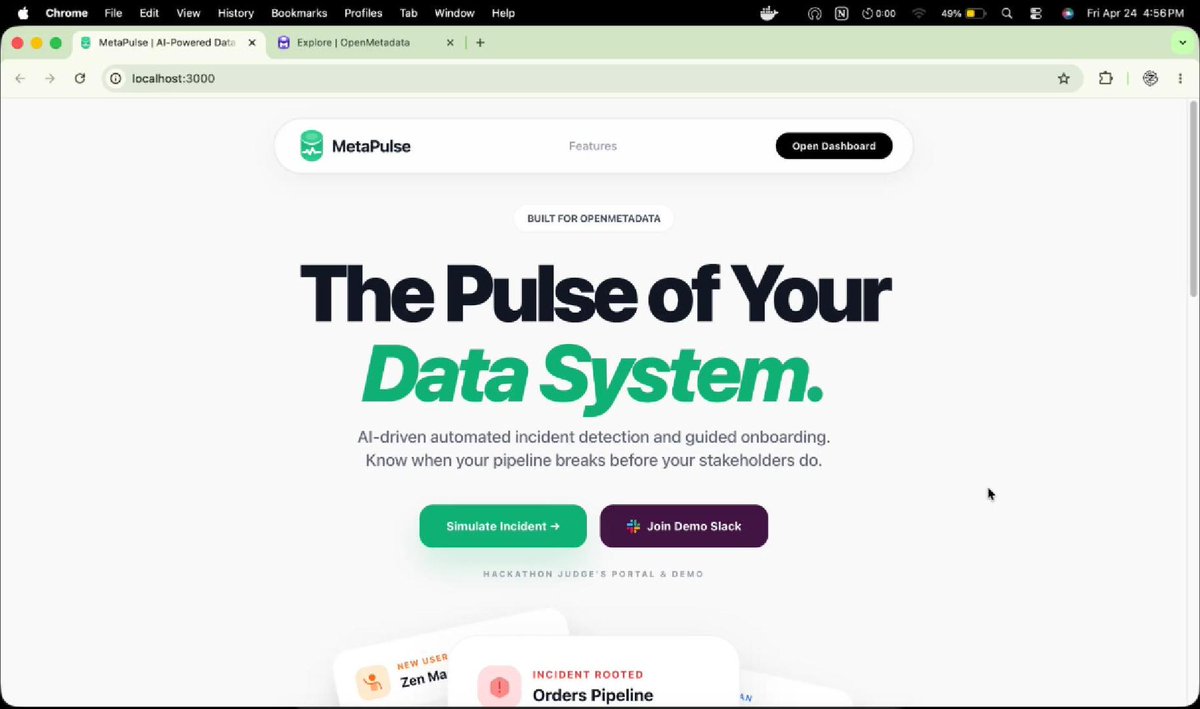
Just shipped MetaPulse for @wemakedevs x @openmetadata
Built solo in 9 days:
👉🏿 Detects pipeline failures generates AI incident reports automatically
👉🏿 Onboarding copilot that knows your entire data catalog
Powered by OpenMetadata
#OpenMetadata #WeMakeDevs #BuildInPublic
1
4
60
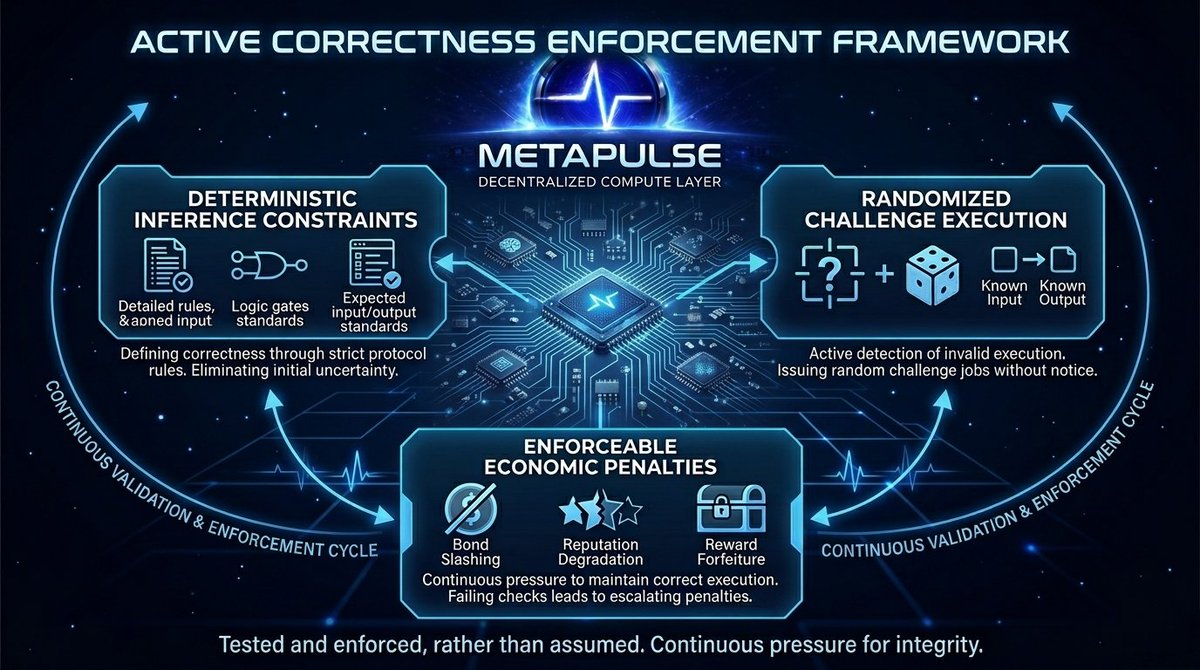
Verification and slashing define how correctness is measured and enforced, but they do not eliminate uncertainty on their own. In a distributed environment, there must be a mechanism to actively detect invalid execution and resolve disputes when results are contested.
For this reason, the protocol introduces a verification window during which submitted results can be challenged. Instead of assuming correctness, the system allows independent validation through dispute mechanisms that re-execute or test the output under controlled conditions.
To strengthen this process, randomized challenge jobs can be issued to providers without prior notice. These tasks use known inputs and expected outputs, allowing the network to directly measure execution integrity and detect dishonest behavior.
Providers that fail these checks face escalating penalties, including reward forfeiture, bond slashing, and reputation degradation. This creates continuous pressure to maintain correct execution rather than only behaving honestly when directly observed.
Unlike systems that rely purely on passive verification or reputation, the MetaPulse Network integrates deterministic inference constraints, randomized challenge execution, and enforceable economic penalties into a single coordinated framework. This allows correctness to be actively tested and enforced at the protocol level, rather than assumed.
9
12
1,175
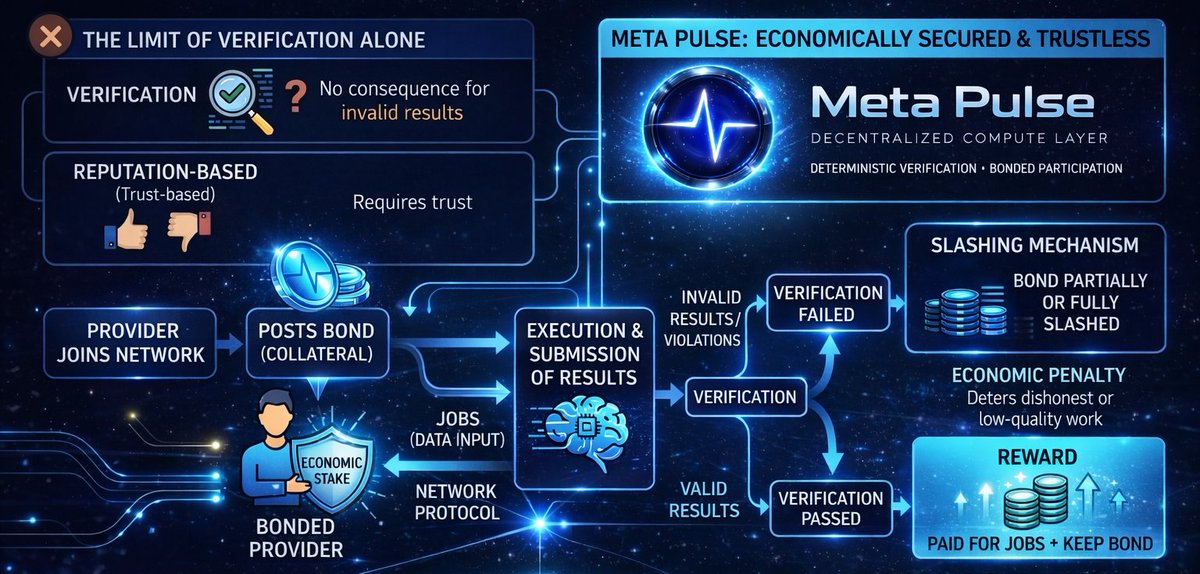
Verification defines what is correct, but correctness alone is not enough to enforce behavior within a distributed compute network. Without economic exposure, providers have no real incentive to consistently produce valid results, and incorrect execution carries little to no consequence beyond detection.
For this reason, participation in the network requires providers to post a bond before accepting jobs, creating a direct financial stake in their performance. This bond acts as collateral, ensuring that execution is not only verifiable, but also accountable at the protocol level.
If a provider returns invalid results, fails verification, or violates protocol rules, the bonded collateral can be partially or fully slashed, introducing a tangible economic penalty for dishonest or low-quality execution. Over time, this mechanism aligns incentives across the network, making correct computation the most profitable and sustainable path.
Systems built without enforceable economic guarantees remain inherently dependent on trust, regardless of their verification model.
By combining deterministic verification with bonded participation and slashing, the MetaPulse Network transforms compute into an economically enforced system rather than a reputation-based one.
9
11
1,298
Mar 28
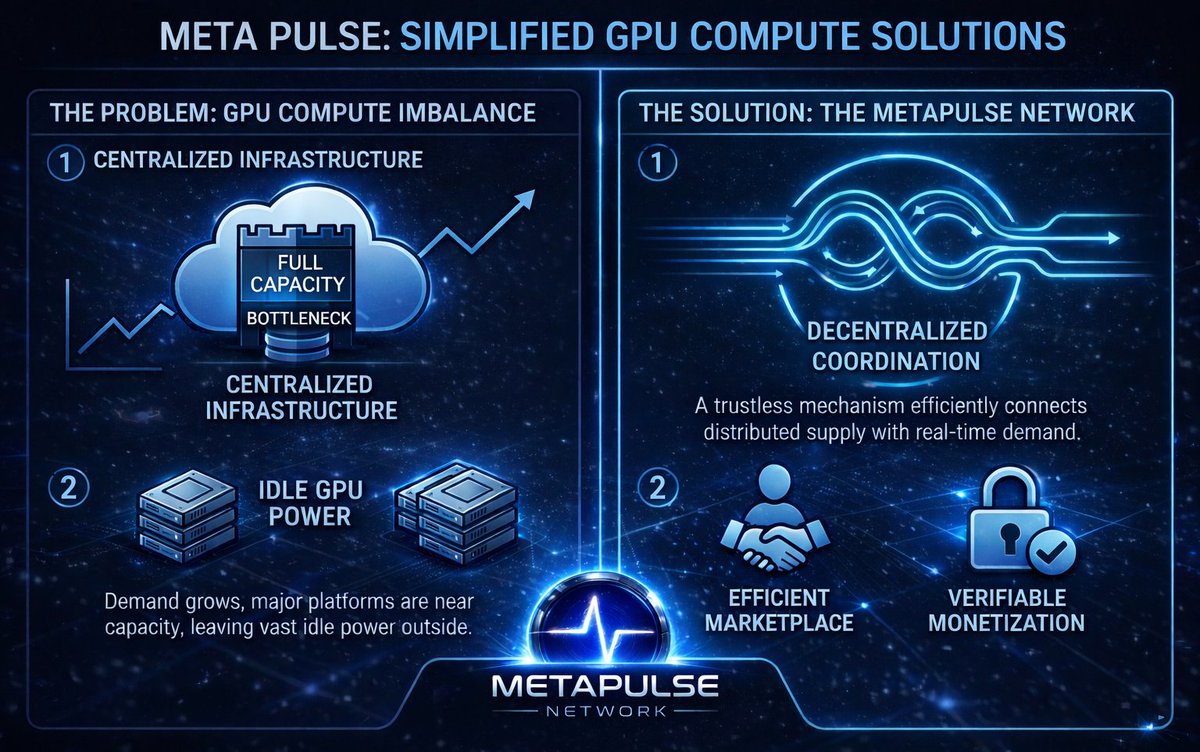
GPU compute demand continues to grow faster than centralized infrastructure can absorb, creating persistent bottlenecks across the AI stack.
While large data centers operate near full capacity, a significant amount of GPU power remains idle outside major cloud platforms.
This imbalance is not caused by a lack of hardware, but by limited access to it.
Current systems fail to efficiently connect distributed supply with real-time demand.
Centralized providers control pricing, allocation, and availability, which leads to higher costs and reduced flexibility for smaller teams.
At the same time, independent GPU owners lack a reliable way to monetize unused capacity in a consistent and verifiable manner.
The missing layer is not additional infrastructure, but a coordination mechanism that can align providers and users without relying on trust.
Creating an open, verifiable market for compute is what allows supply and demand to meet efficiently at scale.
This is where the MetaPulse Network introduces a more efficient and transparent alternative.
4
1
102
2,123
Mar 27
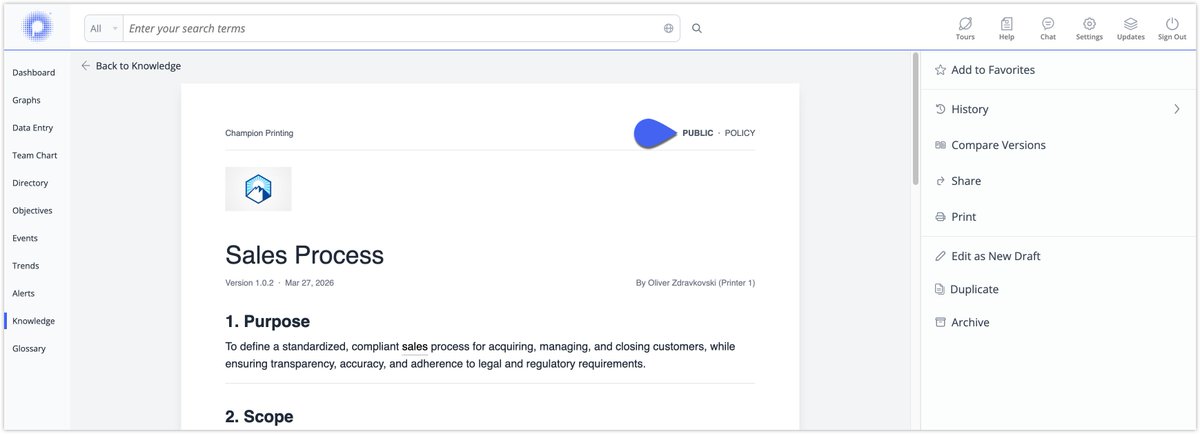
With MetaPulse, you can send a secure link to anyone outside your organization — and they can view instantly.
No setup. No delays.
Learn how 👇
help.metapulse.com/en/articl…
2
2
17
Mar 20
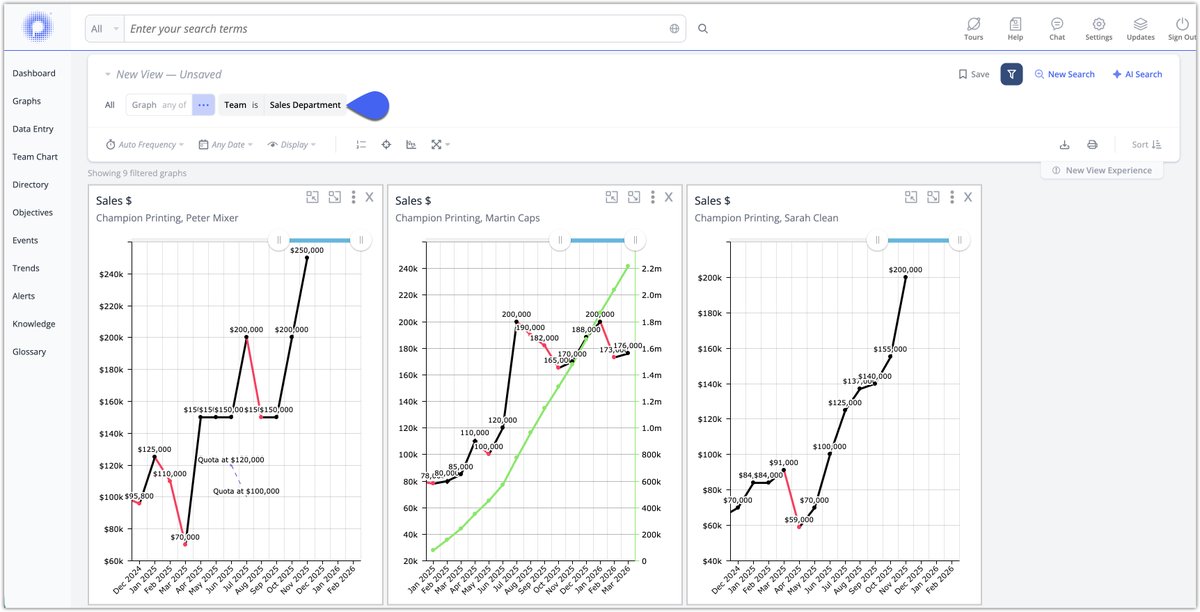
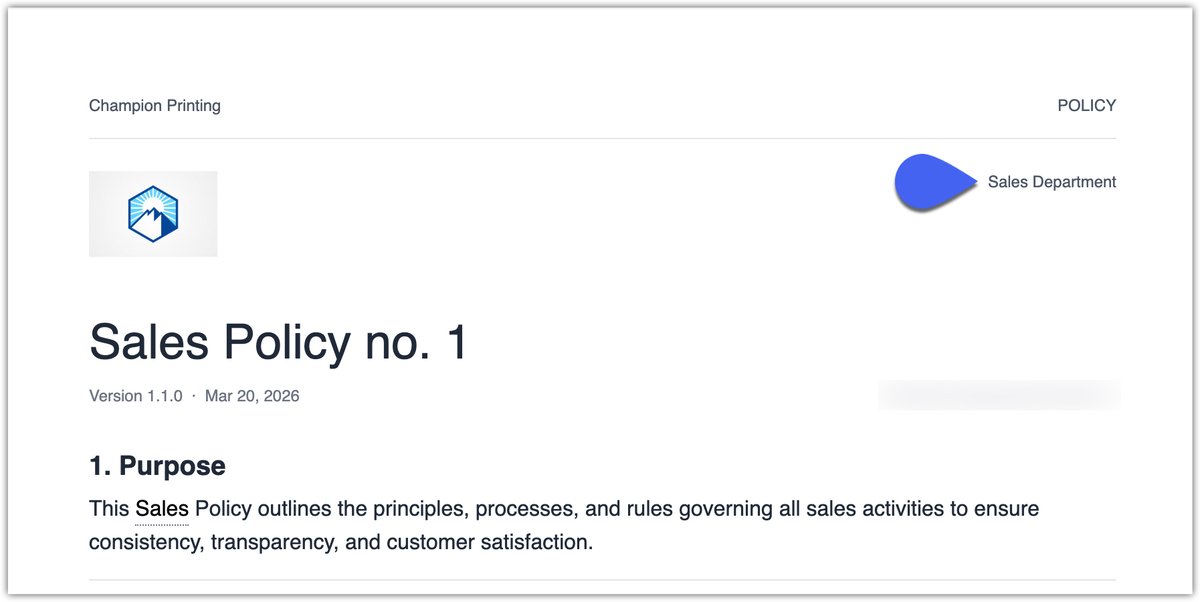
In MetaPulse:
• Saved Views update automatically
• New graphs appear instantly
• Study assignments go to the right people by default
All automated through your Team Chart.
Zero manual work.
help.metapulse.com/en/articl…
help.metapulse.com/en/articl…
2
2
14

🚀 MetaPulse Network | The Future of Decentralized AI Compute ⚡🤖
The AI revolution is expanding at lightning speed… but one big question remains: Where will all the computing power come from?
🔥 MetaPulse Network is building a powerful decentralized GPU compute network designed to support the exploding demand for AI workloads and Web3 applications.
Instead of relying on centralized tech giants, MetaPulse introduces a distributed infrastructure where anyone can participate and benefit. 🌐⚡
💡 What makes MetaPulse special?
⚡ Decentralized GPU Power
Access scalable GPU resources without depending on centralized providers.
🤖 Built for AI & Web3
Designed to power the next generation of AI models, dApps, and advanced computing workloads.
💰 Earn From Your Hardware
Users can contribute GPU power or stake within the ecosystem and earn rewards.
🔗 Credit-Based Compute System
A flexible system that allows developers and users to easily access GPU resources when needed.
📈 Massive Market Narrative
With AI demand growing every day, distributed compute networks are becoming one of the hottest sectors in crypto.
🔥 Early Presale Is Now LIVE
Early participants get access at a lower entry price before the next wave increase.
This is your chance to position early in a project targeting AI infrastructure Web3 compute power.
🌐 Website:
mpulse.network�
💬 Telegram:
t.me/mpulse_net�
⚡ Power the future of AI. Earn from the compute economy. Join MetaPulse Network. 🚀
24
40
26
32,033

Mar 13
AI Web3 need massive compute power
MetaPulse Network is building a decentralized GPU compute network designed for the growing AI workload demand
• Distributed GPU resources
• Earn by contributing hardware or staking
• Credit-based access system
Early presale is now live ⏳
Lower entry before the next price wave
🔗 mpulse.network
41
64
17
126,181

Mar 13
AI Web3 are driving huge demand for GPU power.
MetaPulse is building a decentralized network, designed for the next wave of AI infrastructure.
- Distributed GPU resources
- Staking rewards
- Credit-based access system
Early presale is live.
Lower price before next wave.
mpulse.network
@MetaPulse_Net
46
73
25
125,221

Mar 13
AI Web3 need massive compute power
MetaPulse Network is building a decentralized GPU compute network designed for the growing AI workload demand
• Distributed GPU resources
• Earn by contributing hardware or staking
• Credit-based access system
Early presale is now live ⏳
Lower entry before the next price wave
🔗 mpulse.network
62
17
1
51,124