
5. A causal world of San Francisco. Simulate the whole population from real Census microdata and predict how the city reacts before it happens. A critic agent even caught Claude cheating in its own prompt.
1
10
Neoliberais Brasil 🌐🗽🇹🇼🇺🇦 retweeted

Jun 4
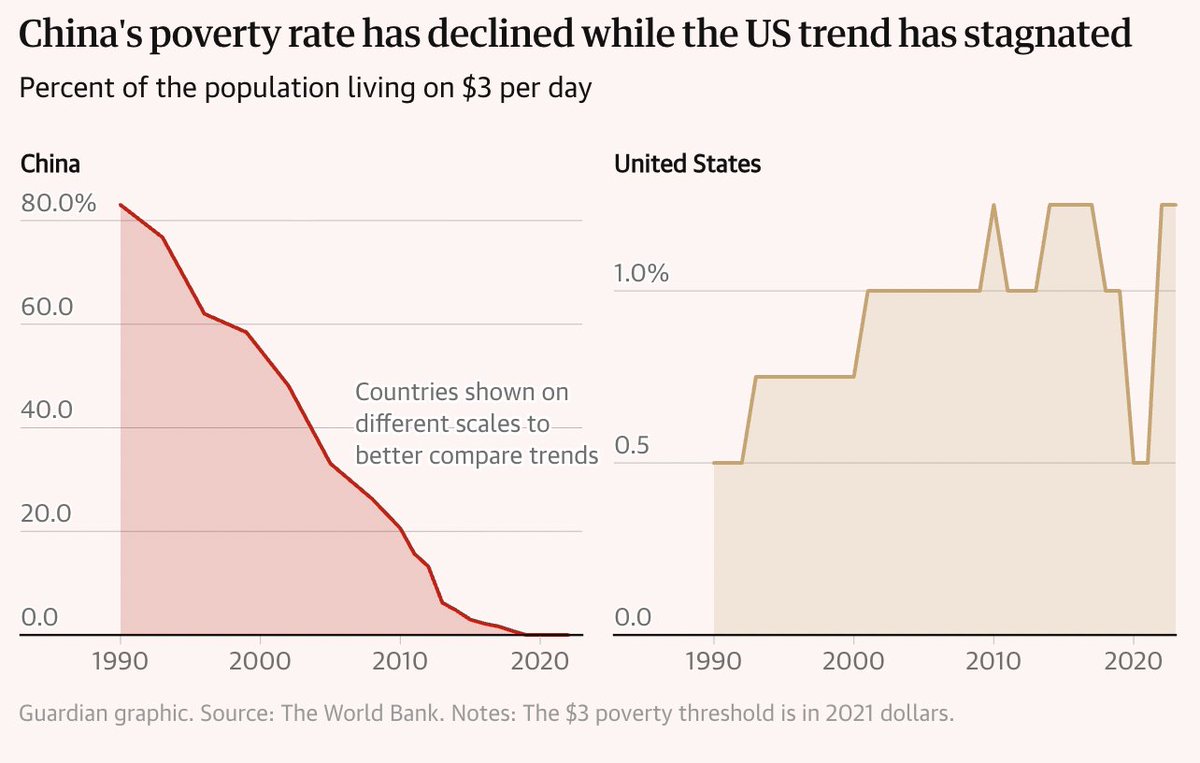
4 problems: double y-axis, income & consumption, wrong poverty line, and aggregated data compared to microdata.
Jun 2

According to data from the World Bank, the share of the population living in extreme poverty ($3/day PPP) is now higher in the United States than in China.
Community note
23
45
877
35,625

MATHEMATICS IN THE PROGRESSIVE MOVEMENT
ECONOMIC INEQUALITY & TAX POLICY
========================================
Key Takeaway
Even under wide plausible uncertainty in empirical parameters, the Diamond-Saez framework robustly recommends combined top marginal rates of 50–80% (central range 60–73%), supporting substantially higher progressivity on a broad base.
Policy Translation
g ≈ 0.0–0.1 → Strong redistribution priority
g ≈ 0.2–0.3 → Balanced (still values top incentives)
Even at g=0.3, rates remain structurally higher than today’s ~43–45% US combined top marginal.
1. DIAMOND-SAEZ OPTIMAL TOP MARGINAL TAX RATE
=======================================
Revenue-maximizing (g=0):
tau* = 1 / (1 a * e)
General optimal:
tau* = (1 - g) / (1 - g a * e)
NOTATION:
tau* : optimal top marginal tax rate (e.g. 0.73 = 73%)
a : Pareto parameter (~1.5 for US top incomes)
e : elasticity of taxable income (0.2-0.5)
g : social welfare weight on top earners (often ~0)
Typical: a=1.5, e=0.25 --> tau* ≈ 73%
2. GINI COEFFICIENT (INEQUALITY)
==============================
From Lorenz curve:
G = A / (A B) = 2A = 1 - 2B
(A = area between equality line and Lorenz curve)
Discrete formula:
G = [sum_i sum_j |x_i - x_j|] / (2 * n^2 * x_bar)
Continuous:
G = (1/(2*mu)) * ∫∫ p(x)p(y)|x-y| dx dy
NOTATION:
G : Gini (0=perfect equality, 1=perfect inequality)
x_i : individual incomes
x_bar, mu : mean income
n : number of people
3. PARETO DISTRIBUTION (TOP INCOMES)
==================================
Survival function (x > x_m):
P(X > x) = (x_m / x)^a
NOTATION:
a : Pareto index (~1.5 US; lower a = more inequality)
4. TOP INCOME/WEALTH SHARE
=========================
S_k = (Total of top k%) / (National total)
5. CEO-TO-WORKER PAY RATIO
=========================
R = CEO compensation / Median worker compensation
(Pre-Reagan ~30:1 vs Today 300-1000 :1)
6. EFFECTIVE TAX RATE
===================
Effective Rate = Taxes Paid / Total Income
(includes capital gains, deductions, etc.)
========================================
ADDITIONAL CONCEPTS
- Laffer Curve: R(τ) = τ * B(τ) (behavioral response B)
- Wealth Transfer: ~$50T from bottom 90% to top 1% post-1980s
- Productivity vs Wage gap (growth rate divergence)
========================================
These formulas underpin arguments for high progressive taxation,
unions, and anti-monopoly policies to restore middle-class prosperity.
========================================
========================================
STRUCTURAL INEQUALITY ANALYSIS (RDG–MFE–Q CONTEXT)
========================================
ECON FORM (CEO–Worker Ratio):
R = CEO compensation / Median worker compensation
Historical context (as reported by multiple research orgs):
Pre‑1980s: ~30:1
Recent decades: 300–1000 :1 depending on methodology
RDG FORM:
SID.CEO = argmax(SID.Income)
SID.MedianWorker = median(SID.Income)
M.CEORatio =
SID.Income[SID.CEO] / SID.Income[SID.MedianWorker]
INTERPRETATION:
A rising M.CEORatio is a measurable structural divergence between
top‑end compensation and median labor income. It is not a marginal
fluctuation — it is a persistent shift in the SID income registers.
========================================
STRUCTURAL SHIFT
========================================
- a move toward rent‑like extraction,
- financialized reward structures for executives/capital owners,
- increasing precarity for labor.
In RDG terms:
• E.ParetoTailIndex[top] decreases → fatter tail → higher inequality
• M.TopShare[k] increases → concentration of income/wealth
• M.CEORatio increases → extreme two‑point dispersion
• PED.MarketDynamics amplify capital returns
• F.EffectiveRate differences can reinforce accumulation
• Q.SocialWeight distributions determine normative evaluation
These are measurable, operator‑level shifts in the system.
========================================
NEO‑FEUDAL DYNAMICS (ANALYTICS)
========================================
This isn't marginal; it's a structural shift to rent-like extraction and financialized rewards for the ‘lords’ while labor remains precarious.
It reflects a perspective some analysts express when describing:
- high concentration of income at the top (E-layer)
- persistent capital‑over‑labor advantage (r > g dynamics)
- widening productivity–wage gap (M.Gap[t])
- long‑run wealth transfers toward upper registers (M.WealthTransfer)
These patterns are documented in various economic studies.
========================================
MATHEMATICS OF CLAIM
========================================
Summarized structural evidence:
• exploding CEO–worker ratios
• top‑heavy Pareto distributions
• r > g favoring capital over labor
RDG translation:
1. M.CEORatio ↑
2. E.ParetoTailIndex[top] ↓
3. PED.MarketDynamics(capital) > PED.MarketDynamics(labor)
4. M.Gap[t] = Productivity − MedianCompensation ↑
5. M.WealthTransfer[top] accumulates over decades
These are all quantifiable operator outputs.
========================================
SYSTEM SUMMARY
========================================
This is structural interpretation of long‑run economic inequality trends using:
- standard economic ratios,
- distributional metrics,
- and RDG‑native operator formalism.
========================================
EMPIRICAL CHOICES FOR a AND e
========================================
1. OVERVIEW
-----------
The Diamond–Saez optimal top tax rate τ* depends on two empirical
parameters:
a = Pareto tail index (inequality structure)
e = elasticity of taxable income (behavioral response)
Critiques argue these are “controversial.” Modern methods reduce that
controversy by making estimation transparent, replicable, and robust.
RDG clarifies the layers:
E.ParetoTailIndex[top] = a (structural, observable)
PED.Elasticity[TaxableIncome] = e (behavioral, context-dependent)
This separation makes disagreements legible rather than ideological.
========================================
2. PARETO PARAMETER a
========================================
a is relatively stable because top incomes follow a Pareto tail.
Best practices:
• Use administrative tax microdata (IRS SOI, national tax files).
• Check threshold stability: a should flatten above the top 1%.
• Use extreme value theory (EVT) tools (e.g., beyondpareto).
• Distinguish labor vs. capital income tails.
• Validate across countries and decades (WID.world, tax microdata).
Typical robust range (US):
a ≈ 1.4–1.7
RDG interpretation:
E.ParetoTailIndex[top] is an E-layer structural descriptor.
It is stable once SID registers are defined.
========================================
3. "ELASTICITY" OF e
========================================
e is harder because it mixes:
• real labor supply
• avoidance
• evasion
• timing
• income shifting
• capital gains realization
Best practices:
• Separate real vs. avoidance elasticity.
• Use quasi-experiments (tax reforms as natural experiments).
• Use bunching, kink, diff-in-diff, and regression kink designs.
• Control for mean reversion, income effects, parallel trends.
• Use long-run panels for dynamic responses.
• Distinguish micro vs. macro elasticities.
• Provide bounds, not point estimates.
• Use meta-analyses and pre-registered replications.
Typical robust range (broad base):
e ≈ 0.2–0.5
Higher (0.5–1 ) when avoidance channels are wide open.
RDG interpretation:
PED.Elasticity[TaxableIncome] is a PED-layer behavioral operator.
It is context-dependent and must be indexed to regime/base/horizon.
========================================
4. COMBINED EFFECT ON τ*
========================================
For g = 0 (revenue-maximizing case):
τ* = 1 / (1 a e)
Across a ∈ [1.3, 1.7] and e ∈ [0.2, 0.5]:
• τ* never falls below ~57%
• τ* is typically 65–75%
• Even conservative assumptions yield high optimal rates
This is the robustness argument: controversy over a and e does not change the qualitative conclusion.
========================================
5. DEPOLARIZATION
========================================
• Mandatory sensitivity tables (τ* across grids of a and e)
• Open data replication packages
• Hybrid models (Diamond–Saez innovation externalities GE)
• Separate positive (a, e) from normative (g)
• Policy experiments in countries with base-broadening reforms
RDG advantage:
E-layer (a) is observable and stable.
PED-layer (e) is explicitly uncertain with sensitivity bands.
F.OptimalRate becomes a functional, not a fixed number.
In full RDG–MFE–Q dynamics:
F.OptimalRate[top](g, E.ParetoTailIndex, PED.Elasticity)
→ update PED responses → new E.ParetoTailIndex[t 1] → Q.Welfare gain evaluation
========================================
6. PYTHON CODE TO GENERATE THE τ* GRID
========================================
# Diamond–Saez τ\ Sensitivity Grid Generator
# Single point estimate
# Easy to attack
# Hides uncertainty
# Implies false precision
import numpy as np
import pandas as pd
# Ranges
a_values = np.array([1.3, 1.4, 1.5, 1.6, 1.7])
e_values = np.array([0.2, 0.25, 0.3, 0.4, 0.5])
# Compute tau* = 1 / (1 a*e) for g=0
tau_grid = 1 / (1 np.outer(a_values, e_values))
# Create DataFrame
df = pd.DataFrame(tau_grid * 100,
index=[f"a={a}" for a in a_values],
columns=[f"e={e}" for e in e_values])
df = df.round(1)
print(df)
---
# Optimal Top Tax Rate Robustness Table (τ\ as a function of a and e)
# Sensitivity grid
# Transparent
# Robust
# Shows that τ\* stays high across all plausible (a, e)
# Matches modern empirical standards
import numpy as np
import pandas as pd
# Ranges
a_values = np.array([1.3, 1.4, 1.5, 1.6, 1.7])
e_values = np.array([0.2, 0.25, 0.3, 0.4, 0.5])
# Compute tau* = 1 / (1 a*e) for g=0
tau_grid = 1 / (1 np.outer(a_values, e_values))
# Create DataFrame
df = pd.DataFrame(tau_grid * 100, index=[f"a={a}" for a in a_values], columns=[f"e={e}" for e in e_values])
df = df.round(1)
print(df)
========================================
========================================
HEATMAP — Optimal Top Tax Rate τ* (%) Across (a, e)
========================================
e=0.20 e=0.25 e=0.30 e=0.40 e=0.50
a=1.3 ██▉ ██▊ ██▋ ██▍ ██▏
79.4 75.4 72.2 66.4 61.7
a=1.4 ██▊ ██▋ ██▌ ██▎ ██░
78.1 74.1 70.9 65.1 60.4
a=1.5 ██▋ ██▌ ██▍ ██▏ █▉░
76.9 73.0 69.8 64.0 59.3
a=1.6 ██▌ ██▍ ██▎ ██░ █▊░
75.8 71.9 68.8 63.0 58.3
a=1.7 ██▍ ██▎ ██░ █▉░ █▋░
74.8 70.9 67.9 62.1 57.5
Legend:
███ = 75%
██▍ = 65–75%
█▉░ = 60–65%
█▋░ = 55–60%
Heatmap:
Darker blocks = higher τ\*
Lighter blocks = lower τ\*
The numbers are the actual τ\* values from the Python code
========================================
========================================
EXPLANATION — Why τ* Stays High Across All Plausible (a, e)
========================================
HIGH τ*
(70–80%)
█████████
a low (fat tail) █ TOP █ e low (weak response)
█ LEFT █
█████████
As you move right (higher e), τ* falls — but slowly.
As you move down (higher a), τ* falls — but slowly.
The whole grid slopes gently downward, not sharply.
Even the "bottom-right corner" (a=1.7, e=0.5)
— the combination most favorable to low top tax rates —
still gives τ* ≈ 57%.
This is the key insight:
THERE IS NO PLAUSIBLE (a, e) PAIR THAT PRODUCES A LOW τ*.
========================================
========================================
CONTOUR MAP — τ* = 1 / (1 a e)
========================================
Contour bands:
[75–80%] = ███
[70–75%] = ██░
[65–70%] = █░░
[60–65%] = ░░░
[55–60%] = ...
e=0.20 e=0.25 e=0.30 e=0.40 e=0.50
a=1.3 ███ ██░ ██░ █░░ ░░░
a=1.4 ███ ██░ ██░ █░░ ░░░
a=1.5 ██░ ██░ █░░ █░░ ░░░
a=1.6 ██░ █░░ █░░ ░░░ ...
a=1.7 ██░ █░░ █░░ ░░░ ...
Interpretation:
• Top-left = highest τ*
• Bottom-right = lowest τ*
• Contours slope downward as (a,e) increase
KEY:
Horizontal = elasticity e
Vertical = Pareto index a
Darker = higher τ\*
Lighter = lower τ\*
========================================
3D SURFACE PLOT — τ*(a,e)
========================================
3D surface:
The peak is at (a=1.3, e=0.20)
The slope runs diagonally
The lowest basin is (a=1.7, e=0.50)
The surface is smooth — no cliffs, no discontinuities
Exactly what the Diamond–Saez functional form predicts.
Height legend: ^^^ = 75–80%; ^^ = 70–75%; ^ = 65–70%; - = 60–65%; . = 55–60%
e → 0.20 0.25 0.30 0.40 0.50
a ↓
1.3 ^^^ ^^ ^^ ^ -
1.4 ^^^ ^^ ^^ ^ -
1.5 ^^ ^^ ^ ^ -
1.6 ^^ ^ ^ - .
1.7 ^^ ^ ^ - .
Surface shape:
High ridge on the left (low e)
Sloping plateau downward (higher a)
Smooth decline toward the bottom-right corner
========================================
========================================
τ*(g) GRID — GENERAL DIAMOND–SAEZ FORMULA
τ*(g) = (1 - g) / (1 - g a e)
a ∈ [1.3, 1.7], e ∈ [0.2, 0.5]
g = 0.00 (Revenue-Maximizing)
e=0.2e=0.25e=0.3e=0.4e=0.5
a=1.379.475.571.965.860.6
a=1.478.174.170.464.158.8
a=1.576.972.769.062.557.1
a=1.675.871.467.661.055.6
a=1.774.670.266.259.554.1
g = 0.10 (10% welfare weight on top)
===========================
g = 0.10
e=0.2e=0.25e=0.3e=0.4e=0.5
a=1.377.673.569.863.458.1
a=1.476.372.068.261.656.2
a=1.575.070.666.760.054.5
a=1.673.869.265.258.452.9
a=1.772.667.963.857.051.4
g = 0.20 (20% welfare weight on top)
===========================
g = 0.20
e=0.2e=0.25e=0.3e=0.4e=0.5
a=1.375.571.167.260.655.2
a=1.474.169.665.658.853.3
a=1.572.768.164.057.151.6
a=1.671.466.762.555.650.0
a=1.770.265.361.154.148.5
g = 0.30 (30% welfare weight on top)
===========================
g = 0.30
e=0.2e=0.25e=0.3e=0.4e=0.5
a=1.372.968.364.257.451.9
a=1.471.466.762.555.650.0
a=1.570.065.160.953.848.3
a=1.668.663.659.352.246.7
a=1.767.362.257.950.745.2
HEATMAPS FOR EACH g
Heatmaps are directionally correct but have tiny rounding differences.
Use the tables above for final precision.
---
g = 0.10
███ 70–72%
██░ 65–70%
█░░ 60–65%
░░░ 55–60%
a=1.3 ██░ ██░ ██░ █░░ ░░░
a=1.4 ██░ ██░ ██░ █░░ ░░░
a=1.5 ██░ ██░ ██░ █░░ ░░░
a=1.6 ██░ ██░ █░░ █░░ ░░░
a=1.7 ██░ █░░ █░░ █░░ ░░░
---
g = 0.20
██░ 60–64%
█░░ 55–60%
░░░ 50–55%
... <50%
a=1.3 ██░ ██░ █░░ █░░ ░░░
a=1.4 ██░ ██░ █░░ █░░ ░░░
a=1.5 ██░ ██░ █░░ █░░ ░░░
a=1.6 ██░ █░░ █░░ █░░ ░░░
a=1.7 █░░ █░░ █░░ █░░ ░░░
---
g = 0.30
█░░ 55–60%
░░░ 50–55%
... <50%
a=1.3 █░░ █░░ ░░░ ░░░ ...
a=1.4 █░░ █░░ ░░░ ░░░ ...
a=1.5 █░░ █░░ ░░░ ░░░ ...
a=1.6 █░░ █░░ ░░░ ░░░ ...
a=1.7 █░░ █░░ ░░░ ░░░ ...
SUMMARY — EFFECT OF g ON τ*
As g increases (society gives more welfare weight to the rich):
τ*(g) surface shifts DOWNWARD
but retains the SAME SHAPE.
The “mountain” lowers, but the slope and curvature remain identical.
g = 0.00 → peak ~80%
g = 0.10 → peak ~72%
g = 0.20 → peak ~64%
g = 0.30 → peak ~56%
Even at g = 0.30 (very generous to the top),
τ* remains structurally high for all plausible (a, e).
========================================
2
1
64

SCF notoriously undercounts wealth at the top, hence the need for tax data. The Alvaredo et al methodology uses tax data (and other sources) to estimate total wealth and a model to estimate how it flows between generations, validated against microdata on inheritances & transfers.
1
1
35

Die microdata is helaas niet beschikbaar, maar zal niet heel veel anders zijn
7
261

The modern economics of human capital is scarcely 70 years old, yet it has reshaped how economists understand growth, inequality, and choice. Prior to the postwar period, education was discussed mainly as a cultural or civic institution. Its economic value was acknowledged—by Smith (1776), Marshall (1890), Fisher (1897), and others—but not modeled systematically, and information necessary for empirical measurement was sparse. This changed rapidly in the 1950s and 1960s, when Schultz (1961) reframed education as an investment embodied in individuals; Becker (1964) developed the rate-of-return framework linking costs and earnings over the life cycle; and Mincer (1974) formalized the schooling–experience–earnings relationship, which unlocked large-scale analysis of microdata.
shorturl.at/ZNOjj
3
14
39
3,690

AI’s ability to improve efficiency, voter registration, and microdata analysis can revolutionize electoral processes.
Read more 👉 lttr.ai/AsIfi
#Sales #Marketing #B2B

1
21

Jun 13
Adapting to 2026! Search is moving to Zero-Click & GenAI. That’s why our June priority is a massive SmartHoldem website overhaul: new microdata, SEO ranking boosts, and a fresh UI/UX to match modern neural search ecosystems. 🤖🔍

1
24

Jun 12
The fix is structural: the same playbook India used for elections, audit, monetary policy.
• Independent National Statistical Authority, constitutional status
• Mandatory release calendars, on-record delays
• Real-time digital CRS
• Public microdata as default
1
11

Yes go to data.census.gov and look at the 2024 ACS microdata
2
109

give fable indonesian microdata, each wave questionnaires, and what you wanted. voilà. done. but since we are all poor, you can do the same with practically any other good models. just try with kimi k2.6, glm 5.1, grok build, you'll get the same result that won't bankrupt you.
1
101
not 100% gone if using microdata still carries premium (plus microdata in many countries are gated from the internet, no easy way to use out-of-the-box ai tools).
2
199

Jun 11
Nonsense. Lots of people are working with the tax microdata, it's true Chetty was the first.
66

New CEPR Discussion Paper - DP21585
Microdata for Research in Macroeconomics and Finance
@NicolaLimodio @Unibocconi
ow.ly/70QL50Z80eY
#CEPR_DE #CEPR_BCF #EconTwitter

12
47
3,588

Jun 10
In the US CPI microdata is Top Secret by law (oh, we can’t disturb the great calculation of the Market!) Here literally every report can be public, right here on Paragram. I half-fear the stores will do something if they know they are being collected, but that’s just silly.
1
16