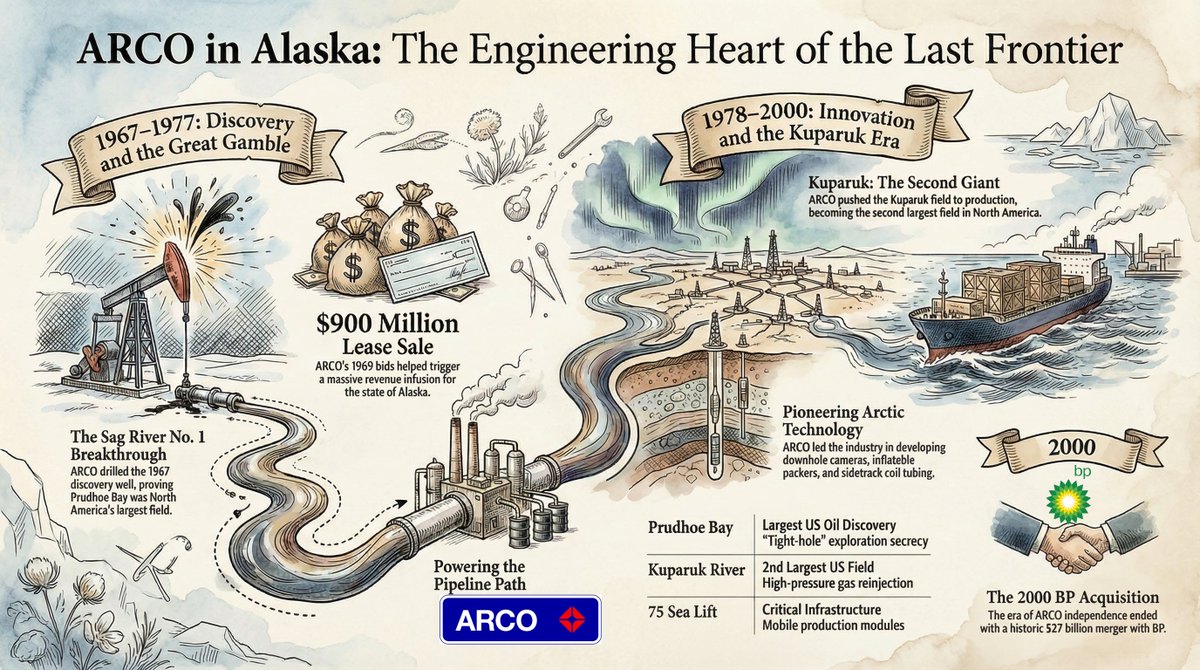
🚀 From Wildcat Frontier to Global Powerhouse: The ARCO Legacy in Alaska
The story of Atlantic Richfield Company (ARCO) in Alaska is one of the greatest engineering, strategic, and geopolitical triumphs in industrial history. It transformed a resource-strapped territory with a $100 million annual budget into a global energy leader.
Here is how a "first principles" engineering culture redrew the global energy map.
1. The High-Stakes Strategic Pivot
In the early 1960s, the Alaskan North Slope was an industrial vacuum with extreme environmental risks and zero infrastructure. Under CEO Robert Anderson, ARCO made a high-stakes gamble to secure domestic American oil reserves.
Before the advent of advanced mapping, early pioneers relied on sheer ingenuity, like using a weather balloon and a bulldozer to cut pipeline trails in remote wilderness. This "wildcat" mindset was the ultimate prerequisite for Arctic survival.
2. The 1968 Discovery & Secrecy of '69
The 1968 discovery at Prudhoe Bay changed everything. To prepare for the historic 1969 Lease Sale, ARCO engineers were sequestered in Dallas, using microscopes to read tiny "scratchings" on physical pressure recorders. This high-stakes data analysis allowed them to calculate reservoir productivity and secure a billion-dollar bidding strategy, resulting in a $900 million windfall that ultimately birthed the Alaska Permanent Fund.
3. Engineering the "Impossible" (TAPS)
Building the 800-mile Trans-Alaska Pipeline System (TAPS) required solving unprecedented engineering challenges:
Permafrost Protection: Laying a "hot" pipeline across frozen ground without melting it.
Rocket Technology on Ice: Using "Creepy Crawlers" (the same tech used for Saturn V rockets) to move massive facility modules fabricated on the West Coast.
Sub-Zero Innovation: Collaborating with local contractors to invent synthetic oils ("Frigid-Go") and low-pressure hoses that remained pliable at -75°F.
4. Operational & Environmental Firsts
When the oil began to flow in 1977, ARCO didn't just harvest a resource—they established a global engineering laboratory:
Reservoir Management: By banning gas flaring and reinjecting gas to maintain pressure, ARCO achieved a 50% recovery rate (double the industry average).
"Slickum" (Drag Reducing Agents): Introducing long-chain hydrocarbon molecules "greased" the pipeline walls, boosting flow from 1.2M to 2 million barrels per day.
The Regulatory Blueprint: Navigating the newly minted National Environmental Policy Act (NEPA), ARCO pioneered solutions like fish-friendly bridges that regulators later adopted as standard.
💡 The Takeaway & Legacy
The ARCO era proved that the right mix of daring corporate strategy, engineering ingenuity, and operational grit can conquer the impossible. As the "Pipeline Pioneers" pass the torch to a new generation of operators, the technologies born on the North Slope, from advanced coil tubing to Arctic-grade lubricants, continue to power the global energy sector.
#EnergyHistory #OilAndGas #EngineeringExcellence #ProjectManagement #Alaska #Infrastructure #Innovation
ARCO in Alaska: A Strategic History of Discovery, Development, and Legacy
1. The Strategic Entry: ARCO’s Arrival and the Pre-Discovery Landscape
In the early 1960s, the Alaskan North Slope was an industrial vacuum, a vast, "wildcat" frontier defined by extreme environmental risks and a total absence of infrastructure. While the industry had established a foothold in the Cook Inlet, Atlantic Richfield (ARCO) viewed the region through a different lens than its competitors. Under the visionary leadership of Robert.
Anderson, ARCO underwent a decisive strategic pivot. Anderson sought to secure "indigenous American oil reserves" to compete in the U.S. market, moving away from a reliance on international holdings. This was a high-stakes gamble on the North Slope’s theoretical potential, contrasting sharply with the stable but modest 25% share ARCO held in non-operating Cook Inlet interests, such as Platform Dillon.
This era was defined by a "first principles" engineering culture. Before the Arctic projects, leaders like Harold Heinze were already demonstrating the daring ingenuity Robert.
Anderson championed. While laying a pipeline at North Ru Draw in West Texas, a place with more snakes than people, Heinze lacked sophisticated mapping. He famously used a weather balloon and a bulldozer; he tethered the balloon over the target facility four miles away and instructed the driver to "keep driving towards the balloon" to cut the trail.
This "wildcat" mindset was a prerequisite for survival in 1960s Alaska. As synthesized from the transcripts of Heinze and John Norman, the logistical barriers included:
* Logistical Primitive: Total reliance on "cat trains" hauling supplies from Fairbanks and the narrow window of seasonal barges.
* Mapping Vacuums: A complete lack of topographical maps, forcing geologists like Roger Herrera to create their own maps from distorted oblique aerial photographs while simultaneously mapping rock formations.
* Isolation: Remote hubs like Sagwon served as the only connection points, with communications and food supply at the mercy of the weather.
This period of speculation was not just about finding oil; it was about testing a corporate strategy that prioritized American energy independence. The transition from these "bending experiences" to the physical discovery at Prudhoe Bay would soon redraft the global energy map.
2. The 1968 Discovery and the High-Stakes 1969 Lease Sale
The 1968 discovery at Prudhoe Bay fundamentally altered the destiny of Alaska, transforming it from a "poor state" with a $100 million annual budget into an emerging global powerhouse. The sheer scale of the find, measured in miles with oil-bearing sands hundreds of feet thick, triggered the historic September 1969 Lease Sale. This was not merely a financial transaction; it was a moment of realization for the state that they were dealing with a "depletable, usable, and sellable" asset.
The strategic secrecy surrounding the sale was unparalleled. ARCO engineers Harold Heinze and Gary Downey were sequestered in Dallas, tasked with evaluating the discovery’s true value. They worked with Drill Stem Test (DST) pressure recorders, aluminum cylinders featuring tiny "scratchings" that could only be interpreted through a microscope. These readings allowed the engineers to estimate the productivity of the reservoir with enough precision to inform a billion-dollar bidding strategy.
The 1969 Lease Sale: A Strategic Summary
The $900 million windfall forced a political evolution. As Harold Heinze noted, the state realized the need to set aside a portion of these resources for the future, leading to the creation of the Permanent Fund. This fiscal success, however, only signaled the beginning of the next challenge: the impossible engineering feat of moving the oil.
3. Engineering the Impossible: TAPS and North Slope Infrastructure
The Trans-Alaska Pipeline System (TAPS) was an unprecedented engineering endeavor. The project required an 800-mile "hot" pipeline to traverse permafrost without melting the frozen ground that supported it. This required specialized materials, specifically X70 562-wall steel for the high-pressure discharge sides of pump stations. At the Tovana River crossing, engineers upgraded the specs to X70 due to the skewed span and the need for Vertical Support Members (VSMs) within the river itself.
To build in the Arctic, ARCO and its partners utilized a modular construction strategy, building facilities on the West Coast and transporting them via barges. On the Slope, these massive units were moved using "Creepy Crawlers", the same technology used for Saturn V rockets.
Technical Specifications & Logistical Support
* Contractual Mile Discrepancy: While the pipeline is 800 miles long, the Pipeline Labor Agreement (PLA) officially covered 799 miles. This discrepancy stems from the PLA excluding the specific footage within pump station flanges and terminal isolation valves.
* The Yukon Bridge: This 2,295-foot span was a state "hard money" job won by the Manson-Osberg-Ghem (MOG) partnership. To pour concrete year-round in -40°F weather, they utilized a "Beluga" building, an air-inflated, tube-supported structure that housed the batch plant and gravel storage.
* Service Innovations: Local contractors were essential to winter operations. Buz Jackovich developed "Artic Ortac" low-pressure hoses and "Frigid-Go" synthetic oils that remained pourable at 75 degrees below zero, allowing equipment to function in conditions that would freeze standard lubricants.
The construction phase, marked by what Bob Laule described as an "execute, execute, execute" mentality, laid the physical foundation for the operational triumphs that followed.
4. Operational Innovation and the Optimization of Prudhoe Bay
When oil began to flow in 1977, the operational complexity was governed by the Prudhoe Bay Unit Operating Agreement. This three-inch-thick document, while written in legal language, was negotiated by engineers to avoid disastrous tax consequences and align the interests of competing majors ARCO, BP, and Exxon.
The most critical strategic decision was the prohibition of gas flaring in Alaska. This constraint became a reservoir-management triumph; by reinjecting the gas to maintain pressure, ARCO achieved a 50% recovery rate, more than doubling the industry average of 25%.
Key Technological Breakthroughs
* "Slickum" (Drag Reducing Agents): Analysts introduced long-chain hydrocarbon molecules into the flow. This "greased" the walls of the pipe, allowing the field to exceed its "nameplate" performance, increasing flow from 1.2 million to 2 million barrels per day.
* Downhole Diagnostics: The development of downhole cameras and inflatable packers allowed for precise interventions thousands of feet below the tundra.
* Coil Tubing: ARCO led the industry in utilizing coil tubing for remedial work, allowing maintenance to occur without shutting down entire systems.
These innovations proved that the Arctic was not just a resource basin, but a laboratory for global petroleum engineering.
5. The Regulatory Paradigm: NEPA, Safety, and Environmental Stewardship
TAPS was the first major project to navigate the National Environmental Policy Act (NEPA). In this era, as Roger Herrera famously noted, "the industry was leading and the regulators were following." ARCO and its partners frequently proposed environmental solutions that regulators later made mandatory, such as the fish-friendly bridges on causeways designed to protect the migration of the Arctic Cisco.
The industry also underwent a fundamental safety transformation. The early "execute" culture shifted toward a rigorous safety-first model following the tragic accident at Pump Station 4. This established the "Stop Work Authority," where any individual could halt operations, a protocol that remains an industry standard today.
Environmental stewardship was further tested by sabotage and disaster. In the early 80s, the pipeline survived explosive devices at Steel Creek and a "bullet hole" incident at Treasure Creek (Engineer Creek). Frank McGilvery recalled using a "BP bullet clamp", a temporary rubber-gasketed fix, to secure the line while a repair sleeve was welded on. These events, followed by the catastrophic Exxon Valdez spill in 1989, transformed permitting from a technical exercise into a "human relations endeavor," requiring constant engagement with a skeptical public.
6. Socio-Economic Legacy: The Permanent Impact of the ARCO Era
The ARCO era permanently redefined Alaska. It facilitated the transition from a resource-strapped territory to a wealthy state, yet today the industry faces the "Graying of the Industry." As the "Pipeline Pioneers" retire, the massive portfolios of the majors are increasingly transitioning to "smaller guys" who operate without the same level of bureaucracy.
Critical Legacies
1. Economic Foundation: The development of the North Slope enabled the Permanent Fund, giving Alaskans a direct stake in resource wealth.
2. Global Expertise: Technologies born in the Arctic, from low-temp "Frigid-Go" oils to advanced coil tubing, were exported worldwide to regions like Egypt and South Africa.
3. Future Potential: The remaining unexplored basins and the pivot to gas as a "bridge" to the future represent the next frontier.
The history of ARCO in Alaska is the story of the "New York kid" like Harold Heinze, who saw his destiny in the Arctic, and the "Pipe Pioneer" like Jim Plaquet, who at 18 years old realized the American Dream by drilling VSMs from the Yukon to Prospect Creek. Their legacy is a modern state built on engineering ingenuity and a commitment to professional resource development that continues to sustain the "Great Alaskan Oil Rush."