
Strawberry Moon Magazine X Midsummer Thorn
By: Wish Fire
Saint Gothic
Strawberry Moon Magazine X Midsummer Thorn
msn.com/en-us/weather/topsto…
msn.com/en-us/weather/topsto…
x.com/search?q="Oliver T…
facebook.com/reel/8542914510…
Historical Fashion · Paranormal Folklore · Saints & Strawberries · Gothic Devotion
The Thorn-Crowned Bride: Spectral Dressing from Titania to the Hapsburgs
“Hammer comes crushing…”
x.com/Metallica/status/20660…
How ghost brides, vampire countesses, and Shakespearean fairy queens shaped the silhouette of midsummer gowns — and why the paranormal persists in fashion's most romantic season.
A glowing bonfire burning brightly at night in the Rembate countryside, Latvia.
Folklore · Legends · Angels
St. John's Eve: Bonfires, Guardian Angels & the Veil Between Worlds
True legends of midsummer night — from Shakespeare's enchanted wood to Slavic kupala rites, folk Catholic vigils, and the angelic hierarchies said to walk among us at solstice.
facebook.com/audi/posts/pfbi…
facebook.com/ElenaYerevanGui…
Devotional · Fruitarian Living
The Strawberry as Sacrament: Fruit of the Virgin, Blood of the Martyr
Medieval symbolism, the strawberry moon's promise, and a fruitarian vegan's meditation on living by the fruit alone — art, nourishment, and sanctity entwined like runners in June.
A dark gothic corridor illuminated by a distant stained-glass window.
Commentary · Monarchist Libertarian
The King's Dream in a Republic of Ghosts: Wars, Liberty & the Gothic American
A monarchist-libertarian perspective on current battles — spiritual and temporal — through the lens of Oberon's quarrel, the sovereignty of conscience, and the artist's duty in a restless age.
"And this same progeny of evils comes from our debate, from our dissension; we are their parents and original."
— Titania, A Midsummer Night's Dream, Act II
英国首相官邸(No.10)の玄関でスターマー首相が出迎えてくださいました。今から日英首脳会談です。
x.com/PressSec_JP/status/206…
x.com/USMC/status/2066158720…
“The flag was still there.”
x.com/Interior/status/206615…
Several Greek legends link crows to Apollo and to fruit—most famously the tale in which a crow delays fetching water because it stops to eat figs, and the story where a white crow brings news of Coronis’s infidelity and is cursed by Apollo.* [Ian Ridpath](ianridpath.com/startales/cor…) [Greek Mythology Wiki](greekmythology.fandom.com/wi…)
Key legends and variants
**1. The Corvus, Crater, and the figs (crow, cup, and snake).**
Apollo sent a crow to fetch water in a **bowl (krater)**; the crow found a fig tree with **unripe fruit**, waited until the figs ripened, and ate them instead of returning promptly. To cover its delay the crow blamed a **water‑snake** for blocking the spring. Apollo saw through the lie and punished the crow by condemning it to thirst and placing the crow, the cup, and the snake together in the sky as the constellations **Corvus, Crater, and Hydra**. [Ian Ridpath](ianridpath.com/startales/cor…) [Wikipedia](en.wikipedia.org/wiki/Corvus…)
**2. The white crow and Coronis (betrayal → black feathers).**
In another well‑known version, Apollo had a white crow (or raven) watch his lover **Coronis**. The bird reported Coronis’s infidelity; Apollo, angry that the crow had failed to prevent the affair, **cursed or scorched** the bird’s feathers so they turned black—an origin myth for the crow’s dark plumage. This story is tied to Apollo’s lovers and prophetic role. [Greek Mythology Wiki](greekmythology.fandom.com/wi…) [Ian Ridpath](ianridpath.com/startales/cor…)
**3. Astronomical memorials and moralizing uses.**
Classical authors and later mythographers used the crow/fig story as a moral tale about **curiosity, temptation, and lying**; the three objects (crow, cup, snake) were immortalized as neighboring constellations so the myth explains a star pattern as well as animal behavior. [Ian Ridpath](ianridpath.com/startales/cor…) [Wikipedia](en.wikipedia.org/wiki/Corvus…)
Sources and how they differ
- **Ovid and later retellings** give literary versions emphasizing transformation and moral consequence; modern summaries (star‑myth compendia) connect the tale to the **Corvus/Crater/Hydra** star group. [Ian Ridpath](ianridpath.com/startales/cor…) [Wikipedia](en.wikipedia.org/wiki/Corvus…)
- **Local or folkloric variants** sometimes swap the fruit (figs are most common) or stress different motives (gluttony vs. curiosity). [Seaver Faculty Web Server](seaver-faculty.pepperdine.ed…)
This We’ll Defend
x.com/USArmy/status/20661677…
"The entirety of the might of the U.S. WAR DEPARTMENT is prepared to ensure Iran NEVER HAS A NUCLEAR WEAPON."
x.com/DOWResponse/status/206…
Strawberry Moon Magazine X Midsummer Thorn
x.com/francesafetytra/status…
Strawberry Moon Magazine X Midsummer Thorn
Latest: Scientists have new microscopic evidence that the yellow “Libyan Desert Glass” found in King Tutankhamun’s tomb formed in an extremely high‑temperature cosmic event about 29 million years ago, but researchers still disagree whether an impact crater or an atmospheric airburst produced it.
Summary of the new findings
Researchers at the University of Milano‑Bicocca examined a tiny zircon grain trapped inside a fragment of Libyan Desert Glass and found a rare dendritic (tree‑like) texture that indicates the zircon melted and then recrystallized extremely rapidly under extraordinary heat. This supports the idea that the glass formed in a violent, high‑temperature event roughly 29 million years ago, and helps explain why ancient Egyptians prized the material (it appears in Tutankhamun’s jewelry).
What exactly the team observed
The zircon inclusion was ~20 micrometers across and contained glass trapped between branching arms with a composition different from surrounding glass, implying separate molten droplets and very fast cooling.
Chemical and structural tests suggest temperatures high enough to completely melt zircon, implying peak temperatures in the thousands of degrees Celsius (reports translate some figures into >4,000°F in popular coverage).
Why this deepens the mystery rather than solves it
The new microstructural evidence strengthens the case for a cosmic origin (asteroid/comet impact or an atmospheric explosion), but it does not locate a definitive crater tied to the glass field. That missing crater is the central puzzle: a ground impact large enough to melt desert sands over a wide area should leave a clear scar, yet none has been confirmed. An airburst (a space rock exploding in the atmosphere) remains a viable alternative because it can produce extreme heat without a classic crater.
Why King Tut is mentioned
Pieces of Libyan Desert Glass were worked into scarabs and inlays that were later placed in Tutankhamun’s tomb, which is why media headlines often call it “King Tut’s alien glass.” The archaeological connection is historical rather than evidence that Tutankhamun witnessed the event.
*Microsoft
#Shadowandbone

Which French château would you spend a night in if you had the chance?

6


First, tighten the factual baseline
The June 12, 2026 “Tranche 03” / PURSUE Release 03 part is grounded. The Department of War’s PURSUE page says Release 03 was the third tranche of UAP records and was released on June 12, 2026, following the first tranche on May 8, 2026.
The most important new document in that dump appears to be AARO’s June 5, 2026 case update on the “Western U.S. Event,” also described as “Orbs Launching Orbs.” AARO says six federal law-enforcement agents reported orange “mother” orbs releasing clusters of smaller red orbs near a sensitive national-security site in October 2023. But the crucial caveat is that the reporting agents collected no video, no photographs, and no other technical data, so the unresolved portion is based on witness narratives and elimination, not physical proof.
The “40% unexplained” line needs careful handling. In the AARO memo, roughly 60% of the observations could be plausibly explained by military aircraft flares, while about 40% lacked a plausible explanation after first-stage analysis. AARO labels “Unrecognized Technology” as pending and explicitly says that possibility is provisional and unsubstantiated by technical data or physical evidence.
The UAP Science Advisory Council claim is currently strongest when attributed to Avi Loeb himself. Loeb wrote that, over the prior week, he had been tasked to create a research team and that the new council was being established by the White House, AARO, ODNI, FBI, and members of the intelligence community. He also listed Matthew Szydagis among the members. Until there is a formal White House, AARO, ODNI, or Federal Register notice, the safer wording is “Avi Loeb says he has been tasked…”, not “the White House officially launched…”
Szydagis is a serious inclusion because his public work is not just UFO commentary. UAlbany describes work by Szydagis, Kevin Knuth, Willie Levy, and UAPx using visible cameras, infrared cameras, weather radar, radiation detectors, and AI-assisted image analysis to build repeatable field methods. Notably, Szydagis has publicly said their work did not show evidence that UAP are connected to non-human intelligence, while still leaving one ambiguity unresolved.
The UAPx field-expedition paper is also important because it is exactly the kind of “boring but real” scientific infrastructure UAP needs: hundreds of hours of infrared footage, radiation monitoring, statistical thresholds, and explicit concern about confirmation bias.
The metamaterials angle is much weaker publicly. APEC lists Szydagis giving a presentation on neutron-activation analysis and XRF analysis of Art’s Parts, but that is not the same thing as a peer-reviewed public finding of non-human technology. Also, “Art’s Parts” has a major provenance problem: the story traces back to anonymous material mailed to radio host Art Bell in 1996 with claims linking it to Roswell. That kind of origin story is interesting, but scientifically fragile.
The “Lacatski said not human” angle also needs caution. George Knapp has testified that James Lacatski told him the U.S. possessed a craft of unknown origin and had accessed its interior, but that is still a reported claim, not a public technical demonstration. DOPSR clearance of Lacatski’s book only means it was cleared for public release; the clearance letter explicitly says it does not imply Defense Department endorsement or factual accuracy.
The strongest official counterweight remains NASA and AARO’s public position: NASA’s UAP study says there is no conclusive peer-reviewed evidence for extraterrestrial origin and that eyewitness reports generally lack the data needed for definitive conclusions, while AARO’s historical report says it found no empirical evidence for recovered extraterrestrial craft or reverse-engineering programs to date.
Better version of the post
UAP science may have just crossed an important line.After the June 12, 2026 PURSUE Release 03 dump, Avi Loeb says he has been tasked to organize a UAP Science Advisory Council involving White House, AARO, ODNI, FBI, and intelligence-community stakeholders. Matthew Szydagis of UAlbany is listed as a member, which matters because his public work is focused on instrumentation, rare-event analysis, radiation monitoring, radar correlation, and repeatable field methods — not just UFO lore.The real question is not “Did aliens get confirmed?”The real question is whether UAP evidence is finally being moved into a scientific pipeline: calibrated sensors, raw-data escrow, chain-of-custody materials testing, blind replication, classified-source deconfliction, and public confidence standards.If there is a metamaterials paper coming, the issue is not whether a sample has a spooky backstory. The issue is whether multiple independent labs can reproduce anomalous composition, isotopic ratios, microstructure, manufacturing signatures, and functional properties under blind conditions.This could be controlled disclosure. It could be narrative containment. It could be genuine scientific acceleration.But the key shift is this: UAP is no longer just a witness-testimony problem. It is becoming a data-governance problem.
That version preserves the excitement while removing the weakest overclaims.
Missing elements that would make the story much stronger
The biggest missing element is a formal charter. If this is a genuine U.S. government advisory body, where is the charter, who is the sponsor, who is the designated federal officer, what statute or authority created it, and will it operate under Federal Advisory Committee Act norms? Formal federal advisory committees generally require chartering and public-notice procedures unless an exemption applies.
The second missing element is official confirmation beyond Loeb’s announcement. Loeb’s statement is significant, but for the strongest claim you want a White House, AARO, ODNI, FBI, or Federal Register source confirming the council’s existence, mandate, membership, reporting chain, funding, and deliverables.
The third missing element is access level. A science council without access to raw classified sensor data, original case files, contractor records, radar/satellite context, and physical samples is mostly an advisory layer. A council with SCIF access, declassification pathways, and evidentiary custody authority is a very different animal.
The fourth missing element is deliverables. Will the council produce public reports, peer-reviewed papers, classified assessments, recommendations to AARO, instrumentation standards, materials-testing protocols, or case-by-case scientific confidence scores?
The fifth missing element is sample provenance. For Art’s Parts or any alleged metamaterial, the first question is not “What is it made of?” The first question is: who had it, when, where, under what custody, how was it stored, how was it cut, how was it contaminated, and can the claimed origin survive a hostile audit?
The sixth missing element is multi-lab replication. A single lab finding unusual composition is interesting. Three or more independent labs finding the same anomaly, while blind to the sample’s claimed origin, is serious.
The seventh missing element is functional testing. “Odd alloy” is not enough. The sample would need to show a physical function that is hard to explain by ordinary manufacturing: unusual waveguiding, engineered layering, extreme thermal behavior, anomalous isotopic ratios, extraordinary strength-to-weight properties, or nonstandard electromagnetic response.
The eighth missing element is comparison against terrestrial controls. Many weird-looking alloys come from aerospace, slag, industrial waste, failed manufacturing runs, exotic coatings, or ordinary material degraded by heat and weather. Every alleged anomaly needs a matched library of mundane controls.
The ninth missing element is what would falsify the claim. A serious metamaterials paper should say: “Here are the results that would make us conclude the sample is ordinary terrestrial material.” Without falsification criteria, the claim becomes unfalsifiable belief.
The tenth missing element is separation between UAP science and NHI claims. A UAP case can be unresolved without being non-human. A material can be anomalous without being alien. A scientist can join a council without endorsing reverse engineering. Keeping these categories separate makes the argument stronger.
Genius-level solutions
1. Create a UAP Evidence Escrow.
AARO, NARA, ODNI, and cleared scientific reviewers should place sensitive evidence into a structured escrow system. The public does not need raw classified satellite or sensor sources immediately. But the public does need an auditable statement: how many cases have original data, how many have multi-sensor corroboration, how many remain unresolved after deconfliction, and how many involve physical material.
2. Build a UAP Materials Blind Replication Challenge.
Every alleged metamaterial should be split into coded subsamples and sent to multiple independent labs. The labs should not know which sample is alleged UFO material and which samples are aerospace scrap, industrial slag, meteorite fragments, experimental alloys, or hoaxes. Methods should include SEM/EDS, ICP-MS, SIMS, XRD, EBSD, TEM, isotope analysis, nanoindentation, thermal analysis, and electromagnetic testing.
3. Use a “provenance quarantine” rule.
Anonymous, folklore-heavy samples like Art’s Parts should not be thrown out, but they should be quarantined into a lower evidentiary tier until their chain of custody is independently reconstructed. The material can still be tested, but its backstory should not influence interpretation.
4. Create a UAP data-quality score.
Every case should receive a public grade based on original sensor data, number of independent sensors, calibration quality, timestamp precision, location precision, environmental data, chain of custody, witness independence, and blue-force/adversary deconfliction. “Unexplained” should never be treated as one flat category.
5. Separate five evidence tracks.
The council should not mix everything into one UFO bucket. There should be separate tracks for airborne sensor anomalies, physical materials, biological claims, ocean/undersea claims, and historical archival records. Each track needs different standards of proof.
6. Create a “Blue Force / Black Program firewall.”
Before any UAP case is called exotic, a cleared team needs to rule out U.S. programs, allied programs, adversary programs, drones, balloons, flares, sensor artifacts, satellites, reentry debris, and classified exercises. The June 2026 AARO memo itself shows why: some observations looked unresolved, but 60% were plausibly explained by flares.
7. Publish derived unclassified physics products.
If raw sensor data is classified, the government can still publish sanitized physical outputs: angular velocity, acceleration bounds, altitude estimates, uncertainty bands, spectral curves, thermal signatures, radar cross-section estimates, and alternative-explanation tables.
8. Create a “minimum viable extraordinary claim” standard.
Before anyone says “non-human technology,” require at least one of these: verified non-terrestrial isotopic ratios, manufacturing features beyond known terrestrial capability, controlled functional behavior not reproducible by human materials, or direct chain-of-custody connection to a recovered object independently verified by multiple agencies.
9. Establish a public dissent channel.
If the council has skeptics, debunkers, materials scientists, sensor engineers, and UAP-friendly researchers, dissent should be preserved. A public minority report would be more valuable than a sanitized consensus.
10. Build a national UAP sensor mesh.
The real breakthrough is not waiting for pilots or law enforcement officers to see something. It is deploying calibrated sensor stations around hotspots and sensitive sites: optical, infrared, RF, acoustic, magnetometer, radiation, weather, ADS-B, radar correlation, and satellite cross-checking. That is the only way to move from anecdote to reproducible science.
11. Make NARA/PURSUE records machine-readable.
The release process should not just dump PDFs. It should create structured metadata: event date, location, sensor type, explanation status, redactions, agency owner, confidence level, and whether underlying raw data exists. That would let researchers map patterns instead of arguing over screenshots.
12. Require “NHI language discipline.”
The council should distinguish between unidentified, unresolved, unrecognized technology, non-human, extraterrestrial, interdimensional, and unknown origin. These are not interchangeable. Bad language creates bad science.
Obscure thought inputs worth adding
One under-discussed angle is that a science council can be both disclosure and containment. It can accelerate serious research while also moving the discussion into a controlled process that slows public pressure.
Another is provenance laundering. A sample with a weak origin story can gain credibility simply by being handled by serious scientists. The science may be real, but the backstory can sneak in through prestige. The fix is blind testing.
Another is the “40% trap.” In the AARO memo, 40% unresolved does not mean 40% alien or 40% advanced craft. It means a subset of witness-reported features remained unexplained after first-stage analysis, with no technical data or physical evidence. That is a crucial distinction.
Another is the rare-event science angle. Szydagis’s value is not that he “believes.” His value is that rare-event physics already deals with tiny signals, backgrounds, false positives, detector calibration, confidence thresholds, and contamination control. That mindset is exactly what UAP research has lacked.
Another is the semantic migration from “alien” to “unrecognized technology.” “Unrecognized technology” is a safer government term because it can include adversary systems, black programs, sensor artifacts, or genuinely unknown phenomena. It is not equivalent to NHI.
Another is classification as a false-positive engine. If one agency cannot tell researchers what secret aircraft, balloons, drones, or sensor platforms were active, unresolved cases will accumulate artificially. Secrecy can manufacture mystery.
Another is Roswell-link inflation. A sample can be “Roswell-linked” only in the narrative sense while having no verified physical connection to Roswell. That does not make testing worthless, but it sharply lowers the evidentiary weight of the origin claim.
Another is metamaterials terminology abuse. “Metamaterial” does not mean “alien material.” NIST describes metamaterials as engineered composites whose properties come from structure, often subwavelength features, rather than just chemistry. Humans make metamaterials. The claim has to be more precise than “it is a metamaterial.”
Another is the missing-scientists contamination problem. The “missing scientists” angle is dangerous unless handled separately. Mainstream reporting has found that some viral claims connecting missing scientists to UFO secrets do not hold up, and families/law enforcement have cautioned against speculative narratives. Including that angle can weaken an otherwise strong UAP science argument.
Another is the FACA trap. If this is a formal advisory committee, it may create transparency obligations. If it is informal, ad hoc, or classified, then “Science Advisory Council” may sound more official than it legally is. The exact structure matters.
Questions that would instantly sharpen the story
Ask Avi Loeb:
Is there a written tasking document?
Which office formally asked you to create the council?
Is this a federal advisory committee, informal working group, contractor-supported panel, or classified advisory body?
Will the council have access to raw AARO case files or only curated summaries?
Will members have clearances?
Can the council publish independent findings?
Will there be minority reports or dissenting scientific opinions?
Will the council handle physical materials?
Will the council produce peer-reviewed work or only government recommendations?
What would make you publicly say, “This case is not anomalous”?
Ask Matthew Szydagis:
Is the Art’s Parts work under peer review?
Which labs have tested the material?
Was the sample blind-coded?
What is the exact chain of custody?
What destructive testing has been allowed?
What isotopic, microstructural, or functional anomalies were found?
Were terrestrial industrial controls tested alongside it?
What results would make you conclude the material is ordinary?
Are Kevin Knuth, SCU, UAPx, or Falcon Space formally involved?
Is the upcoming paper about Art’s Parts specifically, or UAP materials more broadly?
Ask AARO / ODNI / White House:
Is the council officially confirmed?
What is its legal status?
Who funds it?
Who chairs it?
Who selected the members?
What is its mandate?
Will it review classified sensor data?
Will it review physical samples?
Will public reports be released?
How will conflicts of interest be handled?
Ask materials scientists:
Is the sample chemically anomalous?
Is it isotopically anomalous?
Is it structurally anomalous?
Is it functionally anomalous?
Is it manufacturable with known terrestrial methods?
Does it match known aerospace, industrial, or military materials?
Does it show heat damage, oxidation, contamination, or post-recovery alteration?
Does the microstructure show intentional engineering?
Are there mundane controls?
Can the results be reproduced blind?
Red flags to edit out
Avoid “first ever” unless narrowly defined. NASA had an independent UAP study team in 2022–2023, and AARO has already used scientific and laboratory partners. A safer phrase is: “possibly the first UAP science advisory body of this specific White House/AARO/ODNI-linked kind.”
Avoid “metamaterials bombshell” unless the paper exists, is public, and has independent replication. Say: “metamaterials watchpoint” or “materials-science stress test.”
Avoid “could prove non-human tech” unless you specify the proof threshold. Better: “could force serious multi-lab review if anomalous results replicate under blind conditions.”
Avoid “impossible materials defying physics.” Materials do not “defy physics.” They either have unexplained composition, structure, manufacturing history, or function. “Defying physics” makes scientists tune out.
Avoid “tying into missing scientists.” That is a high-risk narrative bridge with weak public evidence. It can make a strong post sound conspiratorial.
Avoid treating Lacatski’s claims as official confirmation. DOPSR clearance is not verification. It is permission to publish without disclosing classified information.
Avoid implying Szydagis has already proven NHI. His public UAlbany-linked work is explicitly cautious and data-first, and that caution is what makes him more valuable.
Stronger headline options
“UAP Enters the Science-Pipeline Phase: Loeb, Szydagis, and the Real Test of Disclosure.”
“The UAP Story Is Shifting From Witnesses to Instruments.”
“Forget ‘Aliens Confirmed.’ The Real Bombshell Would Be Chain-of-Custody Science.”
“UAP Disclosure 2026: Controlled Reveal, Scientific Acceleration, or Narrative Containment?”
“Metamaterials Claims Are Only as Strong as Their Provenance.”
Best final rewrite
UAP SCIENCE COUNCIL / METAMATERIALS WATCHPOINT 🛸🔬After the June 12, 2026 PURSUE Release 03 dump, Avi Loeb says he has been tasked to organize a UAP Science Advisory Council involving White House, AARO, ODNI, FBI, and intelligence-community stakeholders.The important part is not “aliens confirmed.”The important part is that UAP may be moving from witness testimony and document dumps into a formal science pipeline: calibrated sensors, raw-data escrow, classified-source deconfliction, public confidence scoring, and blind materials testing.Matthew Szydagis matters here because his lane is instrumentation, radiation monitoring, rare-event analysis, and repeatable field methods. That is exactly what UAP research needs if it is going to escape folklore.The metamaterials angle is the real stress test. Art’s Parts and other alleged samples are interesting, but a Roswell-linked story is not enough. The question is whether independent labs can reproduce anomalous composition, isotopic ratios, microstructure, and functional properties under blind conditions with clean chain of custody.This could be controlled disclosure.
It could be scientific acceleration.
It could be a containment structure.The key question is simple: will this council get access to the raw data and physical evidence, or only curated summaries?
Bottom line
This story becomes much stronger when you stop selling it as a guaranteed NHI breakthrough and sell it as a verification architecture moment. The council claim is significant, Szydagis is a serious data-and-instrumentation figure, and the June 2026 AARO release is genuinely interesting. But the leap from “unresolved UAP cases and alleged metamaterials” to “non-human reverse engineering exposed” still requires the hard stuff: official charter, raw data, sample provenance, blind replication, multi-lab testing, and public falsification standards.

🚨 WHITE HOUSE LAUNCHES UAP SCIENCE COUNCIL / METAMATERIALS BOMBSHELL BREWING? 🛸🔬
White House, AARO, ODNI & IC just formed the first ever UAP Science Advisory Council (announced ~June 12, 2026 post Tranche 03 dump). Avi Loeb leads, Prof. Matthew Szydagis (U Albany physicist) key member for instrumentation & data.
Szydagis has led UAP metamaterials research for 1 years, analyzing anomalous samples like 1996 Art's Parts (Roswell-linked), field expeditions, and upcoming paper that could prove non human tech. Collaborating with Knuth & SCU.
This could be the breakthrough exposing NHI reverse engineering, impossible materials defying physics, tying into missing scientists, Lacatski's "not human" admissions, and 2026 disclosure surge.
Controlled reveal or real acceleration? Watch Szydagis interviews for the fire.

313

Yes, it can be a headache for the aspiring chartist!
Trade ESU26, but use ESM26 for major structural levels during the roll. Those levels were formed where the market's liquidity resided. Once volume has shifted decisively into ESU26, structural and microstructural analysis can be performed entirely on the new contract.
42
Aurélie Bussy retweeted

Jun 11
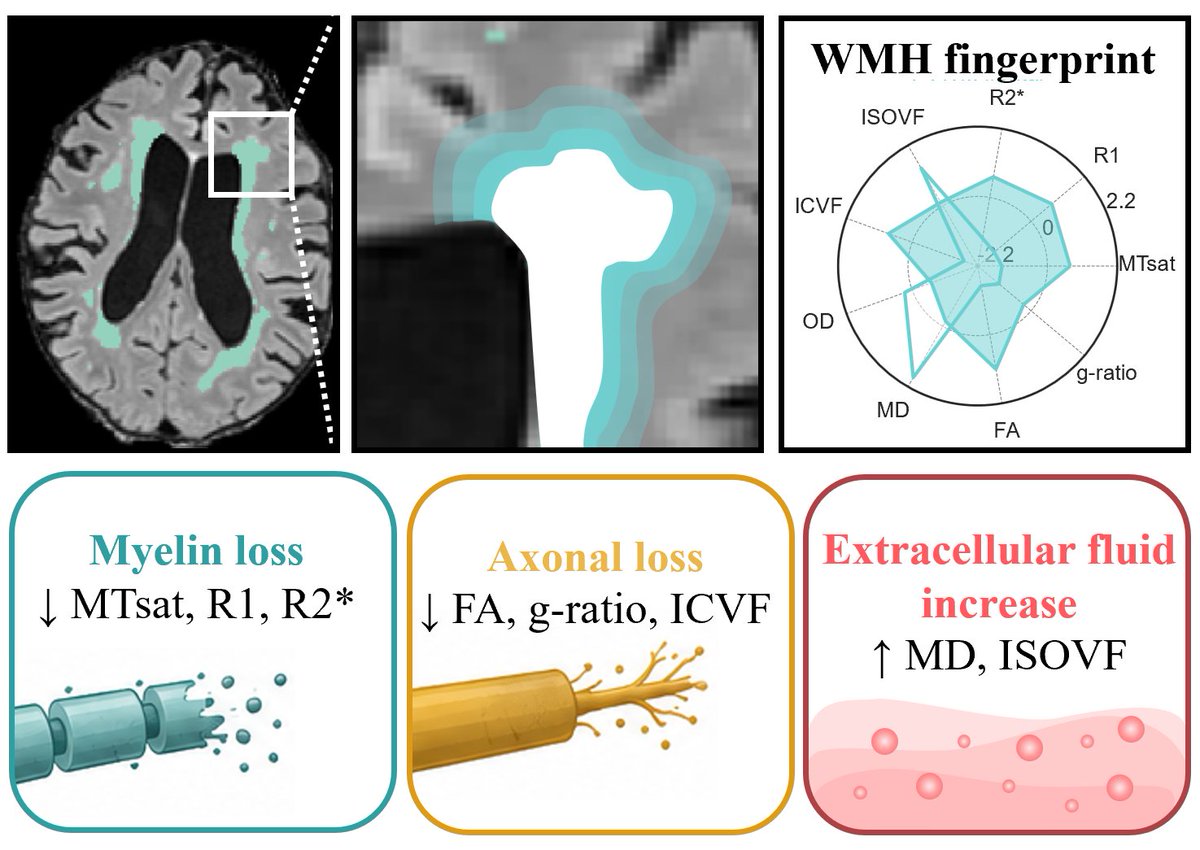
Bussy et al. found that microstructural abnormalities in cerebral small vessel disease were greatest in periventricular regions. Around white matter hyperintensities, gradients of demyelination, axonal damage and oedema extended into nearby tissue. shorturl.at/WrnHm
1
18
61
3,425

The Iconic-Combinatorial Building Block System of the Beinecke Rare Book and Manuscript Library MS 408
A Scientific Whitepaper on the Paleographic Deconstruction of the Cipher
Author: Rene Lüth
Date: June 12, 2026
Classification: Paleography, Cryptology, Medieval Writing Systems
1. Abstract
The Voynich Manuscript (Beinecke MS 408, Yale University) has resisted conventional decipherment attempts for over 120 years. This paper demonstrates that this persistent stagnation results from a fundamental misinterpretation of the manuscript’s structure. Previous research approaches assume that MS 408 contains flowing, linguistic text in an unknown or encrypted language.
This hypothesis is falsified by empirical analysis of the character catalog. The present whitepaper establishes a new paradigm: MS 408 does not employ an alphabetic writing system, but rather a deliberately constructed, closed combinatorial building block system comprising 185 physical original characters. These are functionally based on the logic of ancient and medieval Tironian notes and the absolute shorthand system documented in Adriano Cappelli’s Lexicon Abbreviaturarum.
The glyphs were not written but drawn as iconic information carriers, whose semantic content is dynamically controlled through macro- and microstructural thematic anchors. The system operates not as language but as a visual flowchart for natural philosophical and medical knowledge.
2. Problem Statement and the Failure of Traditional Transcriptions
2.1 The EVA Hypothesis and Its Limitations
The Extensible Voynich Alphabet (EVA) notation, the de facto standard for transcriptions since 1998, is based on the assumption that the approximately 35,000 words of the manuscript can be translated into a known European or artificial language through monoalphabetic or polyalphabetic substitution. This assumption is falsified by several mathematical and paleographic anomalies:
2.2 Mathematical Anomalies
Extremely low entropy: Character and word repetitions are unnaturally high. Iterations such as chon, dain, oror, and qokeedy occur with frequencies impossible for natural languages. Statistical analysis shows that the word-length distribution does not follow the Zipf distribution characteristic of all natural languages.
Position-bound grammar: Certain glyphs are strictly restricted to word-initial, word-medial, or word-final positions. This is a structural feature of formulaic or recipe systems, not of phonetic alphabets. Examples include:
•Glyphs appearing exclusively at word-initial position (initial glyphs)
•Glyphs occurring only in word-medial position (connector glyphs)
•Glyphs appearing only at word-final position (terminal glyphs)
Absence of inflectional morphology: Natural languages exhibit characteristic inflectional patterns (plurals, tenses, moods). MS 408 shows no such patterns. Instead, identical character sequences appear in different contexts, suggesting a modular system.
2.3 Paleographic Anomalies
Graphic consistency without writing traces: The glyphs are drawn with extraordinary consistency. There are no typical writing or correction traces expected from flowing handwriting. The ink is excellently preserved, and the line execution is precise. This indicates that the glyphs were painted (drawn) rather than written.
Symmetric structures: Many glyphs exhibit geometric symmetries and modular repetitions atypical of alphabetic writing systems.
2.4 The Failure of the Substitution Hypothesis
If the EVA hypothesis were correct, computer-aided analyses (frequency analysis, n-gram analysis, statistical language models) should yield consistent results. Instead, all previous attempts to decode MS 408 as encrypted language show the following results:
1.No consistent substitution rule can be identified
2.Different algorithms yield contradictory results
3.No linguistic structure matches known languages or cryptographic systems
This is strong evidence that the fundamental assumption
1
34

New Research: GH/GOs/rGO reinforced alkaline and acid-activated geopolymers: a comparative study of microstructural and optical properties frontiersin.org/articles/10.… #FrontiersIn #BuiltEnvironment
14

Jun 12
❤️Can MRI predict who benefits most from Tumor Treating Fields (TTFields) in glioblastoma?
New pilot study shows that microstructural metabolic MRI at early follow up may help assess progression free survival – non invasively.
Early signal. Big potential.
👉link.springer.com/article/10…
#GBM #NeuroOnc #MRI #TTFields #PrecisionMedicine

207

Jun 12
QUANT OPTIONS & MACRO REPORT | 06/12/2026 10:30 AM EDT (MID-MORNING RE-BALANCING FEED)
📊 EXEC SUMMARY & PROBABILITY MATRIX
$SPX: 🟡 Neutral | 50% Up / 50% Down | Target Close: 7,410 | Call Wall: 7,460 | Put Wall: 7,360 | Gamma Flip: 7,400 | Spot: 7,411 ( 0.15% Above)
$NDX: 🟢 Bullish | 65% Up / 35% Down | Target Close: 29,480 | Call Wall: 29,600 | Put Wall: 29,100 | Gamma Flip: 29,250 | Spot: 29,395 ( 0.50% Above)
$SPY: 🟡 Neutral | 50% Up / 50% Down | Target Close: 741 | Call Wall: 746 | Put Wall: 736 | Gamma Flip: 740 | Spot: 741 ( 0.14% Above)
$QQQ: 🟢 Bullish | 65% Up / 35% Down | Target Close: 724 | Call Wall: 732 | Put Wall: 712 | Gamma Flip: 716 | Spot: 718 ( 0.28% Above)
Macro Context: At the Friday 10:30 AM midday option expiry station, a massive microstructural cross-current dictates asset flows. The broad-market S&P matrix has compressed heavily into a range-bound horizontal base following yesterday's multi-day short-covering ramp, trapping spot parameters directly within unhedged zero-gamma bands. Concurrently, the tech-heavy complex has successfully scaled defensive opening shelves, propelled by systemic block rebalancing inside core semiconductor tranches and accelerating long-volatility hedging loops.
---
⚠️ DISCLAIMER: The information provided in this report is for educational and informational purposes only and does not constitute financial advice. Trading options involves significant risk and is not suitable for all investors. Use this information at your own risk. The author is not responsible for any financial losses or damages resulting from the use of this information.
1
127

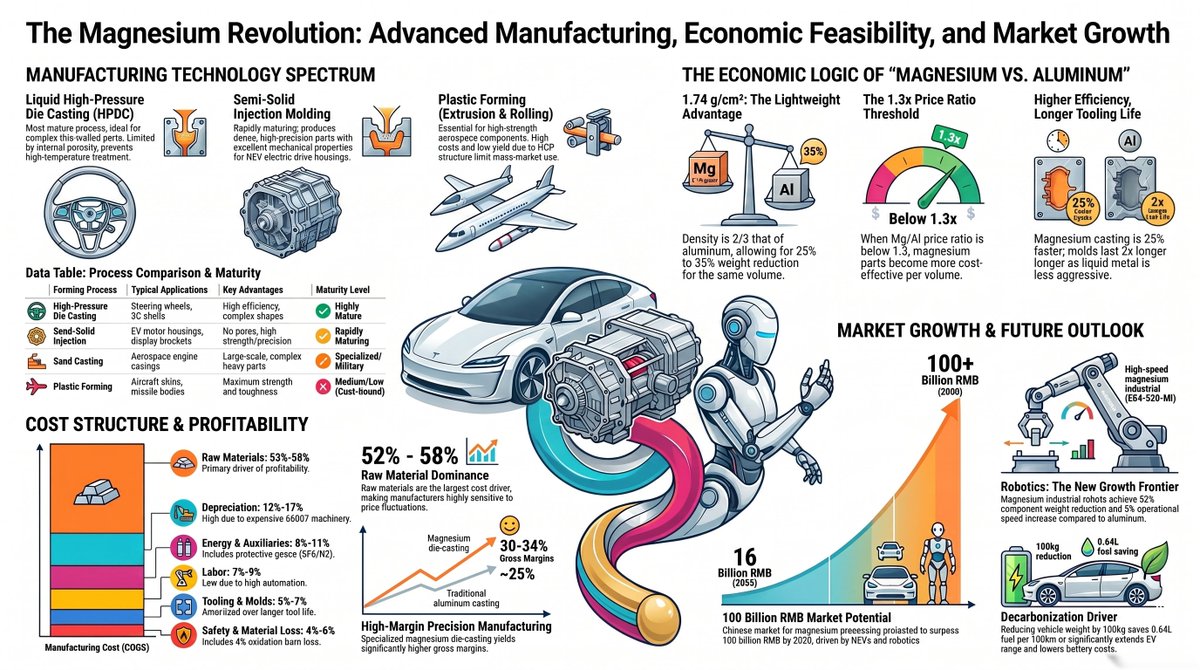
With the extensive application of process simulation technology in materials science, magnesium alloys are poised to become a core metallic material for structural lightweighting. Based on material state and forming mechanisms, their manufacturing processes can be systematically categorized into four types: liquid forming, semi-solid forming, plastic forming, and novel cast-rolling. These processes exhibit distinct variations regarding microstructural control, elimination of macroscopic defects, scale of equipment investment, and industrial maturity.
31

Effect of Al content on microstructural characteristics and tensile properties of extruded Mg–Al–Zn–Ca–Y alloy sheets dlvr.it/TT0xWf
2

🚨 We are seeking a candidate to advance understanding and optimisation of #LPBF processing of Zn- and Ti-based alloys, combining alloy development, advanced manufacturing, operando #synchrotron imaging, and multiscale microstructural characterisation.
🔗 jobs.materials.imdea.org/off…

1
1
4
106

🎒Joanna Teglund✊😷🍉Human life is sacred retweeted

Jun 5
The authors themselves frame the study as an attempt to integrate structural, microstructural and functional architecture after COVID - because previous findings were often heterogeneous and limited to one imaging modality.
1
5
60
699