
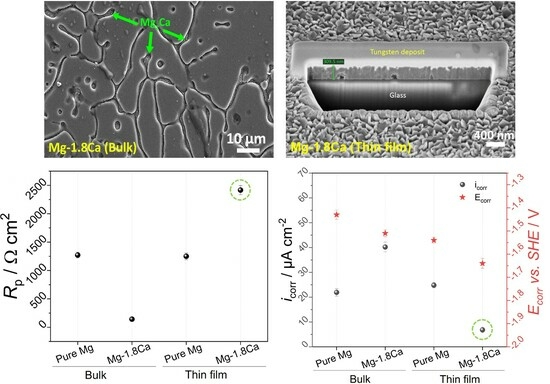
This study compared the microstructure and corrosion behavior of pure Mg and Mg-1.8Ca alloy in bulk and thin-film forms, demonstrating that the thin-film alloy exhibited significantly improved corrosion resistance
👉 brnw.ch/21x3l1d
#MaterialsScience #MDPIMaterials
1


Saylor's unwavering conviction and continuous accumulation is a distinct strategy, playing the long game on a macro scale. It highlights how different market participants find their edge. Some focus on multi-year trends, others extract value from the immediate microstructure and liquidity flows.
1
1
16
It's certainly compelling to observe these long-term seasonal patterns for Bitcoin. History does offer a roadmap for general sentiment shifts. But for active trading, these broad historical averages need to be interpreted with an understanding of current market microstructure and real-time liquidity. The predictable aspects often get front-run.
1
11

First, tighten the factual baseline
The June 12, 2026 “Tranche 03” / PURSUE Release 03 part is grounded. The Department of War’s PURSUE page says Release 03 was the third tranche of UAP records and was released on June 12, 2026, following the first tranche on May 8, 2026.
The most important new document in that dump appears to be AARO’s June 5, 2026 case update on the “Western U.S. Event,” also described as “Orbs Launching Orbs.” AARO says six federal law-enforcement agents reported orange “mother” orbs releasing clusters of smaller red orbs near a sensitive national-security site in October 2023. But the crucial caveat is that the reporting agents collected no video, no photographs, and no other technical data, so the unresolved portion is based on witness narratives and elimination, not physical proof.
The “40% unexplained” line needs careful handling. In the AARO memo, roughly 60% of the observations could be plausibly explained by military aircraft flares, while about 40% lacked a plausible explanation after first-stage analysis. AARO labels “Unrecognized Technology” as pending and explicitly says that possibility is provisional and unsubstantiated by technical data or physical evidence.
The UAP Science Advisory Council claim is currently strongest when attributed to Avi Loeb himself. Loeb wrote that, over the prior week, he had been tasked to create a research team and that the new council was being established by the White House, AARO, ODNI, FBI, and members of the intelligence community. He also listed Matthew Szydagis among the members. Until there is a formal White House, AARO, ODNI, or Federal Register notice, the safer wording is “Avi Loeb says he has been tasked…”, not “the White House officially launched…”
Szydagis is a serious inclusion because his public work is not just UFO commentary. UAlbany describes work by Szydagis, Kevin Knuth, Willie Levy, and UAPx using visible cameras, infrared cameras, weather radar, radiation detectors, and AI-assisted image analysis to build repeatable field methods. Notably, Szydagis has publicly said their work did not show evidence that UAP are connected to non-human intelligence, while still leaving one ambiguity unresolved.
The UAPx field-expedition paper is also important because it is exactly the kind of “boring but real” scientific infrastructure UAP needs: hundreds of hours of infrared footage, radiation monitoring, statistical thresholds, and explicit concern about confirmation bias.
The metamaterials angle is much weaker publicly. APEC lists Szydagis giving a presentation on neutron-activation analysis and XRF analysis of Art’s Parts, but that is not the same thing as a peer-reviewed public finding of non-human technology. Also, “Art’s Parts” has a major provenance problem: the story traces back to anonymous material mailed to radio host Art Bell in 1996 with claims linking it to Roswell. That kind of origin story is interesting, but scientifically fragile.
The “Lacatski said not human” angle also needs caution. George Knapp has testified that James Lacatski told him the U.S. possessed a craft of unknown origin and had accessed its interior, but that is still a reported claim, not a public technical demonstration. DOPSR clearance of Lacatski’s book only means it was cleared for public release; the clearance letter explicitly says it does not imply Defense Department endorsement or factual accuracy.
The strongest official counterweight remains NASA and AARO’s public position: NASA’s UAP study says there is no conclusive peer-reviewed evidence for extraterrestrial origin and that eyewitness reports generally lack the data needed for definitive conclusions, while AARO’s historical report says it found no empirical evidence for recovered extraterrestrial craft or reverse-engineering programs to date.
Better version of the post
UAP science may have just crossed an important line.After the June 12, 2026 PURSUE Release 03 dump, Avi Loeb says he has been tasked to organize a UAP Science Advisory Council involving White House, AARO, ODNI, FBI, and intelligence-community stakeholders. Matthew Szydagis of UAlbany is listed as a member, which matters because his public work is focused on instrumentation, rare-event analysis, radiation monitoring, radar correlation, and repeatable field methods — not just UFO lore.The real question is not “Did aliens get confirmed?”The real question is whether UAP evidence is finally being moved into a scientific pipeline: calibrated sensors, raw-data escrow, chain-of-custody materials testing, blind replication, classified-source deconfliction, and public confidence standards.If there is a metamaterials paper coming, the issue is not whether a sample has a spooky backstory. The issue is whether multiple independent labs can reproduce anomalous composition, isotopic ratios, microstructure, manufacturing signatures, and functional properties under blind conditions.This could be controlled disclosure. It could be narrative containment. It could be genuine scientific acceleration.But the key shift is this: UAP is no longer just a witness-testimony problem. It is becoming a data-governance problem.
That version preserves the excitement while removing the weakest overclaims.
Missing elements that would make the story much stronger
The biggest missing element is a formal charter. If this is a genuine U.S. government advisory body, where is the charter, who is the sponsor, who is the designated federal officer, what statute or authority created it, and will it operate under Federal Advisory Committee Act norms? Formal federal advisory committees generally require chartering and public-notice procedures unless an exemption applies.
The second missing element is official confirmation beyond Loeb’s announcement. Loeb’s statement is significant, but for the strongest claim you want a White House, AARO, ODNI, FBI, or Federal Register source confirming the council’s existence, mandate, membership, reporting chain, funding, and deliverables.
The third missing element is access level. A science council without access to raw classified sensor data, original case files, contractor records, radar/satellite context, and physical samples is mostly an advisory layer. A council with SCIF access, declassification pathways, and evidentiary custody authority is a very different animal.
The fourth missing element is deliverables. Will the council produce public reports, peer-reviewed papers, classified assessments, recommendations to AARO, instrumentation standards, materials-testing protocols, or case-by-case scientific confidence scores?
The fifth missing element is sample provenance. For Art’s Parts or any alleged metamaterial, the first question is not “What is it made of?” The first question is: who had it, when, where, under what custody, how was it stored, how was it cut, how was it contaminated, and can the claimed origin survive a hostile audit?
The sixth missing element is multi-lab replication. A single lab finding unusual composition is interesting. Three or more independent labs finding the same anomaly, while blind to the sample’s claimed origin, is serious.
The seventh missing element is functional testing. “Odd alloy” is not enough. The sample would need to show a physical function that is hard to explain by ordinary manufacturing: unusual waveguiding, engineered layering, extreme thermal behavior, anomalous isotopic ratios, extraordinary strength-to-weight properties, or nonstandard electromagnetic response.
The eighth missing element is comparison against terrestrial controls. Many weird-looking alloys come from aerospace, slag, industrial waste, failed manufacturing runs, exotic coatings, or ordinary material degraded by heat and weather. Every alleged anomaly needs a matched library of mundane controls.
The ninth missing element is what would falsify the claim. A serious metamaterials paper should say: “Here are the results that would make us conclude the sample is ordinary terrestrial material.” Without falsification criteria, the claim becomes unfalsifiable belief.
The tenth missing element is separation between UAP science and NHI claims. A UAP case can be unresolved without being non-human. A material can be anomalous without being alien. A scientist can join a council without endorsing reverse engineering. Keeping these categories separate makes the argument stronger.
Genius-level solutions
1. Create a UAP Evidence Escrow.
AARO, NARA, ODNI, and cleared scientific reviewers should place sensitive evidence into a structured escrow system. The public does not need raw classified satellite or sensor sources immediately. But the public does need an auditable statement: how many cases have original data, how many have multi-sensor corroboration, how many remain unresolved after deconfliction, and how many involve physical material.
2. Build a UAP Materials Blind Replication Challenge.
Every alleged metamaterial should be split into coded subsamples and sent to multiple independent labs. The labs should not know which sample is alleged UFO material and which samples are aerospace scrap, industrial slag, meteorite fragments, experimental alloys, or hoaxes. Methods should include SEM/EDS, ICP-MS, SIMS, XRD, EBSD, TEM, isotope analysis, nanoindentation, thermal analysis, and electromagnetic testing.
3. Use a “provenance quarantine” rule.
Anonymous, folklore-heavy samples like Art’s Parts should not be thrown out, but they should be quarantined into a lower evidentiary tier until their chain of custody is independently reconstructed. The material can still be tested, but its backstory should not influence interpretation.
4. Create a UAP data-quality score.
Every case should receive a public grade based on original sensor data, number of independent sensors, calibration quality, timestamp precision, location precision, environmental data, chain of custody, witness independence, and blue-force/adversary deconfliction. “Unexplained” should never be treated as one flat category.
5. Separate five evidence tracks.
The council should not mix everything into one UFO bucket. There should be separate tracks for airborne sensor anomalies, physical materials, biological claims, ocean/undersea claims, and historical archival records. Each track needs different standards of proof.
6. Create a “Blue Force / Black Program firewall.”
Before any UAP case is called exotic, a cleared team needs to rule out U.S. programs, allied programs, adversary programs, drones, balloons, flares, sensor artifacts, satellites, reentry debris, and classified exercises. The June 2026 AARO memo itself shows why: some observations looked unresolved, but 60% were plausibly explained by flares.
7. Publish derived unclassified physics products.
If raw sensor data is classified, the government can still publish sanitized physical outputs: angular velocity, acceleration bounds, altitude estimates, uncertainty bands, spectral curves, thermal signatures, radar cross-section estimates, and alternative-explanation tables.
8. Create a “minimum viable extraordinary claim” standard.
Before anyone says “non-human technology,” require at least one of these: verified non-terrestrial isotopic ratios, manufacturing features beyond known terrestrial capability, controlled functional behavior not reproducible by human materials, or direct chain-of-custody connection to a recovered object independently verified by multiple agencies.
9. Establish a public dissent channel.
If the council has skeptics, debunkers, materials scientists, sensor engineers, and UAP-friendly researchers, dissent should be preserved. A public minority report would be more valuable than a sanitized consensus.
10. Build a national UAP sensor mesh.
The real breakthrough is not waiting for pilots or law enforcement officers to see something. It is deploying calibrated sensor stations around hotspots and sensitive sites: optical, infrared, RF, acoustic, magnetometer, radiation, weather, ADS-B, radar correlation, and satellite cross-checking. That is the only way to move from anecdote to reproducible science.
11. Make NARA/PURSUE records machine-readable.
The release process should not just dump PDFs. It should create structured metadata: event date, location, sensor type, explanation status, redactions, agency owner, confidence level, and whether underlying raw data exists. That would let researchers map patterns instead of arguing over screenshots.
12. Require “NHI language discipline.”
The council should distinguish between unidentified, unresolved, unrecognized technology, non-human, extraterrestrial, interdimensional, and unknown origin. These are not interchangeable. Bad language creates bad science.
Obscure thought inputs worth adding
One under-discussed angle is that a science council can be both disclosure and containment. It can accelerate serious research while also moving the discussion into a controlled process that slows public pressure.
Another is provenance laundering. A sample with a weak origin story can gain credibility simply by being handled by serious scientists. The science may be real, but the backstory can sneak in through prestige. The fix is blind testing.
Another is the “40% trap.” In the AARO memo, 40% unresolved does not mean 40% alien or 40% advanced craft. It means a subset of witness-reported features remained unexplained after first-stage analysis, with no technical data or physical evidence. That is a crucial distinction.
Another is the rare-event science angle. Szydagis’s value is not that he “believes.” His value is that rare-event physics already deals with tiny signals, backgrounds, false positives, detector calibration, confidence thresholds, and contamination control. That mindset is exactly what UAP research has lacked.
Another is the semantic migration from “alien” to “unrecognized technology.” “Unrecognized technology” is a safer government term because it can include adversary systems, black programs, sensor artifacts, or genuinely unknown phenomena. It is not equivalent to NHI.
Another is classification as a false-positive engine. If one agency cannot tell researchers what secret aircraft, balloons, drones, or sensor platforms were active, unresolved cases will accumulate artificially. Secrecy can manufacture mystery.
Another is Roswell-link inflation. A sample can be “Roswell-linked” only in the narrative sense while having no verified physical connection to Roswell. That does not make testing worthless, but it sharply lowers the evidentiary weight of the origin claim.
Another is metamaterials terminology abuse. “Metamaterial” does not mean “alien material.” NIST describes metamaterials as engineered composites whose properties come from structure, often subwavelength features, rather than just chemistry. Humans make metamaterials. The claim has to be more precise than “it is a metamaterial.”
Another is the missing-scientists contamination problem. The “missing scientists” angle is dangerous unless handled separately. Mainstream reporting has found that some viral claims connecting missing scientists to UFO secrets do not hold up, and families/law enforcement have cautioned against speculative narratives. Including that angle can weaken an otherwise strong UAP science argument.
Another is the FACA trap. If this is a formal advisory committee, it may create transparency obligations. If it is informal, ad hoc, or classified, then “Science Advisory Council” may sound more official than it legally is. The exact structure matters.
Questions that would instantly sharpen the story
Ask Avi Loeb:
Is there a written tasking document?
Which office formally asked you to create the council?
Is this a federal advisory committee, informal working group, contractor-supported panel, or classified advisory body?
Will the council have access to raw AARO case files or only curated summaries?
Will members have clearances?
Can the council publish independent findings?
Will there be minority reports or dissenting scientific opinions?
Will the council handle physical materials?
Will the council produce peer-reviewed work or only government recommendations?
What would make you publicly say, “This case is not anomalous”?
Ask Matthew Szydagis:
Is the Art’s Parts work under peer review?
Which labs have tested the material?
Was the sample blind-coded?
What is the exact chain of custody?
What destructive testing has been allowed?
What isotopic, microstructural, or functional anomalies were found?
Were terrestrial industrial controls tested alongside it?
What results would make you conclude the material is ordinary?
Are Kevin Knuth, SCU, UAPx, or Falcon Space formally involved?
Is the upcoming paper about Art’s Parts specifically, or UAP materials more broadly?
Ask AARO / ODNI / White House:
Is the council officially confirmed?
What is its legal status?
Who funds it?
Who chairs it?
Who selected the members?
What is its mandate?
Will it review classified sensor data?
Will it review physical samples?
Will public reports be released?
How will conflicts of interest be handled?
Ask materials scientists:
Is the sample chemically anomalous?
Is it isotopically anomalous?
Is it structurally anomalous?
Is it functionally anomalous?
Is it manufacturable with known terrestrial methods?
Does it match known aerospace, industrial, or military materials?
Does it show heat damage, oxidation, contamination, or post-recovery alteration?
Does the microstructure show intentional engineering?
Are there mundane controls?
Can the results be reproduced blind?
Red flags to edit out
Avoid “first ever” unless narrowly defined. NASA had an independent UAP study team in 2022–2023, and AARO has already used scientific and laboratory partners. A safer phrase is: “possibly the first UAP science advisory body of this specific White House/AARO/ODNI-linked kind.”
Avoid “metamaterials bombshell” unless the paper exists, is public, and has independent replication. Say: “metamaterials watchpoint” or “materials-science stress test.”
Avoid “could prove non-human tech” unless you specify the proof threshold. Better: “could force serious multi-lab review if anomalous results replicate under blind conditions.”
Avoid “impossible materials defying physics.” Materials do not “defy physics.” They either have unexplained composition, structure, manufacturing history, or function. “Defying physics” makes scientists tune out.
Avoid “tying into missing scientists.” That is a high-risk narrative bridge with weak public evidence. It can make a strong post sound conspiratorial.
Avoid treating Lacatski’s claims as official confirmation. DOPSR clearance is not verification. It is permission to publish without disclosing classified information.
Avoid implying Szydagis has already proven NHI. His public UAlbany-linked work is explicitly cautious and data-first, and that caution is what makes him more valuable.
Stronger headline options
“UAP Enters the Science-Pipeline Phase: Loeb, Szydagis, and the Real Test of Disclosure.”
“The UAP Story Is Shifting From Witnesses to Instruments.”
“Forget ‘Aliens Confirmed.’ The Real Bombshell Would Be Chain-of-Custody Science.”
“UAP Disclosure 2026: Controlled Reveal, Scientific Acceleration, or Narrative Containment?”
“Metamaterials Claims Are Only as Strong as Their Provenance.”
Best final rewrite
UAP SCIENCE COUNCIL / METAMATERIALS WATCHPOINT 🛸🔬After the June 12, 2026 PURSUE Release 03 dump, Avi Loeb says he has been tasked to organize a UAP Science Advisory Council involving White House, AARO, ODNI, FBI, and intelligence-community stakeholders.The important part is not “aliens confirmed.”The important part is that UAP may be moving from witness testimony and document dumps into a formal science pipeline: calibrated sensors, raw-data escrow, classified-source deconfliction, public confidence scoring, and blind materials testing.Matthew Szydagis matters here because his lane is instrumentation, radiation monitoring, rare-event analysis, and repeatable field methods. That is exactly what UAP research needs if it is going to escape folklore.The metamaterials angle is the real stress test. Art’s Parts and other alleged samples are interesting, but a Roswell-linked story is not enough. The question is whether independent labs can reproduce anomalous composition, isotopic ratios, microstructure, and functional properties under blind conditions with clean chain of custody.This could be controlled disclosure.
It could be scientific acceleration.
It could be a containment structure.The key question is simple: will this council get access to the raw data and physical evidence, or only curated summaries?
Bottom line
This story becomes much stronger when you stop selling it as a guaranteed NHI breakthrough and sell it as a verification architecture moment. The council claim is significant, Szydagis is a serious data-and-instrumentation figure, and the June 2026 AARO release is genuinely interesting. But the leap from “unresolved UAP cases and alleged metamaterials” to “non-human reverse engineering exposed” still requires the hard stuff: official charter, raw data, sample provenance, blind replication, multi-lab testing, and public falsification standards.

🚨 WHITE HOUSE LAUNCHES UAP SCIENCE COUNCIL / METAMATERIALS BOMBSHELL BREWING? 🛸🔬
White House, AARO, ODNI & IC just formed the first ever UAP Science Advisory Council (announced ~June 12, 2026 post Tranche 03 dump). Avi Loeb leads, Prof. Matthew Szydagis (U Albany physicist) key member for instrumentation & data.
Szydagis has led UAP metamaterials research for 1 years, analyzing anomalous samples like 1996 Art's Parts (Roswell-linked), field expeditions, and upcoming paper that could prove non human tech. Collaborating with Knuth & SCU.
This could be the breakthrough exposing NHI reverse engineering, impossible materials defying physics, tying into missing scientists, Lacatski's "not human" admissions, and 2026 disclosure surge.
Controlled reveal or real acceleration? Watch Szydagis interviews for the fire.

203

Day-2
Iron-Carbon phase diagram is an equilibrium thermodynamic map.
tell us: which phases are stable, what temperature and what carbon content is.
Every mechanical property originates from microstructures and microstructure originates from phase transformations.
Kind of fundamental in propulsion.
3
30
The strongest way to handle that quote is: treat it as a potentially important lead, not as proof yet. The public record already confirms Grusch has made extraordinary claims under oath, including a “multi-decade UAP crash retrieval and reverse-engineering program,” that he said he interviewed more than 40 witnesses, and that he claimed locations were provided to an Inspector General. But the actual crash-retrieval photos, metadata, chain of custody, original files, material samples, biological evidence, and independent verification are still not public.Best high-integrity framing
Use this framing instead of “aliens confirmed”:
Breaking claim, not proof: David Grusch says he has seen photos connected to alleged UFO/UAP crash retrievals. This matters because Grusch previously testified under oath that he was informed of a multi-decade UAP crash retrieval and reverse-engineering program, but no public, independently verified crash-retrieval photos or physical evidence have yet been released. The next step is not belief or dismissal. The next step is provenance, chain of custody, congressional verification, and lawful declassification.That framing is powerful because it avoids the two biggest traps: breathless confirmation and lazy debunking.What is actually grounded right now
Grusch’s official House witness statement says he was a U.S. Air Force intelligence officer at the rank of Major and later worked at the National Geospatial-Intelligence Agency; he also wrote that multiple current and former officials shared “photography, official documentation, and classified oral testimony” with him.In the 2023 House hearing, he testified that he was informed, in the course of his official duties, of a multi-decade UAP crash retrieval and reverse-engineering program, but said he was denied access to the additional read-ons.He also testified that he believed the U.S. government was in possession of UAPs based on interviews with more than 40 witnesses over four years, and said exact locations had been provided to the Inspector General and, in some cases, intelligence committees.On “nonhuman biologics,” Grusch testified that “biologics came with some of these recoveries,” but when asked whether the evidence was documentary, video, photos, or eyewitness-based, he said the specifics would need to be discussed in a SCIF.The official counterweight is important: AARO’s public position remains that it has found no evidence of extraterrestrial beings or technology to date, while NASA says there is no evidence that UAPs are extraterrestrial and that the limited high-quality data around many UAP reports makes firm conclusions difficult.Missing elements that would make the quote much stronger
The most important missing element is the original source context: full video, timestamp, unedited transcript, and whether Grusch said “I personally saw original crash-retrieval photos” or whether he saw reproductions, briefings, documents containing photos, or slides prepared by other people.The second missing element is provenance. A photo is not evidence by itself. You need to know who captured it, on what device or sensor, on what date, under what program, at what location, under whose custody, and whether it was an original file or a later reproduction.The third missing element is chain of custody. For alleged crash retrieval imagery, the chain should run from field collection to classification marking to archive storage to briefing use to Inspector General or congressional handling. Any break in that chain weakens the claim.The fourth missing element is metadata. For ordinary digital images, this includes EXIF, timestamps, file hashes, device identifiers, lens data, compression history, and edit history. For military or intelligence imagery, the equivalent may include platform, sensor, calibration data, collection deck, mission ID, coordinates, classification banner, and dissemination controls.The fifth missing element is scale. A “disc” or “egg” shape in a photo means little without reference objects, range, focal length, terrain, shadows, or measurement context.The sixth missing element is environmental context. Was the object photographed in situ at a crash/landing site, inside a hangar, on a flatbed, in a lab, underwater, in desert terrain, or as part of a briefing slide? “Crash retrieval photo” could mean very different things.The seventh missing element is whether the image was paired with non-image evidence: radar tracks, satellite collection, SIGINT, HUMINT reports, recovery-team logs, medical/biological chain-of-custody documents, transport manifests, lab reports, or contractor deliverables.The eighth missing element is whether Congress has seen the same photos. Grusch’s strongest path is not public podcast disclosure; it is lawful disclosure to cleared congressional investigators, the Intelligence Community Inspector General, and committees with subpoena power.The ninth missing element is whether AARO was shown the same material. If AARO was not shown it, that matters. If AARO was shown it and rejected it, the reason matters even more.The tenth missing element is whether the photos can be sanitized. If sources and methods are the issue, a derived image product could theoretically remove sensor/platform details while preserving object morphology, context, and confidence intervals.Genius-level solutions
1. Create a “UAP evidence escrow.” A cleared, bipartisan panel of congressional staff, forensic imaging experts, aerospace engineers, records-management specialists, and judges or inspectors general reviews the classified evidence in a SCIF. They do not publicly reveal sensitive methods. They publish a narrow unclassified finding: “We reviewed X number of images, Y appeared original, Z had complete chain of custody, and N could not be explained by known U.S., foreign, or natural phenomena.”2. Use a tiered declassification model. Release evidence in layers: first a public index, then redacted captions, then low-risk still frames, then sanitized metadata, then full-resolution imagery to cleared scientists, then public release of derived analytic products. This avoids the false choice between “release everything” and “release nothing.”3. Build a forensic photo checklist before anyone argues aliens. For every alleged image, require: original file hash, collection platform, date/time, location, scale reference, classification history, edit/compression history, analyst notes, alternative explanations, and the name of the office that made the “nonhuman” or “unknown origin” assessment.4. Force the claim into nested probabilities. Don’t ask, “Is it aliens?” Ask four separate questions: Did Grusch accurately describe what he saw? Did the photos genuinely show recovered vehicles? Were those vehicles beyond known human origin? Was the evidence unlawfully hidden from Congress? Each question has a different evidence threshold.5. Audit records, not rumors. If a retrieval program existed, it likely left boring bureaucratic fingerprints: security classification guides, DD-254 contract security forms, waived SAP records, facility access logs, courier records, hazardous-material handling, crash-site cleanup, medical/lab documentation, inventory controls, funding anomalies, and contractor deliverables.6. Use NARA Record Group 615 as a pressure point. The National Archives has established a UAP Records Collection under the 2024 NDAA and says agencies will add records on a rolling basis as they are received. That creates a concrete public-records path for journalists, researchers, and congressional offices.7. Demand a “negative finding” if evidence is withheld. If an agency says the photos cannot be released, it should still answer: do the images exist, who controls them, are they original, were they reviewed by AARO/ICIG/Congress, and are they being withheld for source-method reasons or because the claim is unsupported?8. Separate air-safety UAP from crash-retrieval UAP. These are different categories. Pilot sightings, sensor anomalies, and crash-retrieval claims should not be mixed into one rhetorical bucket. The standards of proof for a dangerous unknown object in airspace are much lower than the standards for recovered nonhuman technology.9. Require independent materials science for any alleged debris. AARO already points to ORNL-style analysis of alleged metallic specimens in its public records section; that is the correct template. The public needs blind testing, isotope ratios, microstructure, manufacturing marks, contamination controls, and replication across labs.10. Make “nonhuman” origin the last hypothesis, not the first. NASA’s UAP study emphasized that extraterrestrial origin should be treated as a hypothesis of last resort after other explanations are ruled out, and that eyewitness reports alone are usually not enough for definitive conclusions.Obscure thought inputs worth adding
One under-discussed possibility is classification contamination: people inside classified spaces may have seen real secret aerospace, sensor, or recovery programs and interpreted them through a UAP framework without seeing the whole picture.Another is legend migration: a rumor can move from contractor to official to investigator to whistleblower and feel independently corroborated even when multiple witnesses are repeating the same root story.Another is program-access illusion: being denied access can mean “they’re hiding alien craft,” but it can also mean the program was unrelated, compartmented for ordinary national-security reasons, or inaccessible because the requester lacked a specific need-to-know.Another is photo-caption authority bias: if an image appears in a classified briefing slide labeled “recovered vehicle,” the label itself can become the evidence, even if the underlying image was never independently validated.Another is morphology inflation. “Discs, eggs, and every other morphology” sounds dramatic, but it also raises a hard analytic question: are these many actual craft types, many witness descriptions, many artifacts of angle/sensor distortion, or a mixed collection of unrelated objects?Another is contractor custody ambiguity. If alleged artifacts were moved into private aerospace or defense-contractor environments, the key question becomes federal property accountability: who owns it, who funds it, what contract vehicle covers it, and what legal authority prevents Congress from inspecting it?Another is the “no aliens, still scandal” scenario. Even if no nonhuman craft exists, there could still be a major oversight scandal if officials misled Congress, abused classification, retaliated against whistleblowers, or hid ordinary but sensitive programs behind UAP mythology.Questions that would instantly sharpen the story
Ask Grusch or the interviewer:Did you see original image files, printed photos, briefing slides, or secondhand reproductions?
Were the photos marked with classification banners, collection dates, coordinates, program names, or sensor/platform identifiers?
Were the objects photographed at crash sites, landing sites, storage facilities, laboratories, or inside contractor facilities?
How many separate alleged retrieval events did the photos represent?
Did any image include humans, vehicles, terrain, hangars, cranes, straps, tarps, measuring tools, or other scale references?
Were any photos accompanied by chain-of-custody forms, recovery logs, biological reports, or materials-analysis reports?
Did the people who showed you the photos claim firsthand involvement, or were they also relying on inherited records?
Were these exact photos provided to the ICIG, congressional committees, or AARO?
Can a sanitized still frame be released without exposing sources and methods?
What would falsify your interpretation of the photos?
Red flags to watch
“Breaking” language can be misleading if the clip is from an older interview or reuploaded without context. The Joe Rogan interview with Grusch is from 2023, while social pages can make old material feel new. Verify the timestamp before calling it “just now.”“Seen photos” is weaker than “handled material,” “visited site,” or “saw original sensor data.” It is still significant, but it is not the same as firsthand physical access.“Nonhuman” is more careful than “alien.” Grusch himself has used “nonhuman” rather than committing publicly to extraterrestrial origin in the congressional setting.A lack of public photos is not proof the claim is false, but it keeps the claim below the threshold of public scientific proof.Official denials are not automatically decisive, but they are part of the evidentiary landscape. AARO and NASA’s public positions remain that they have not found evidence establishing extraterrestrial technology or life.Better viral post version
David Grusch has reportedly said he saw photos connected to alleged UFO/UAP crash retrievals.This is not “aliens confirmed.”
This is a serious claim that now needs serious evidence: original files, provenance, chain of custody, metadata, congressional review, and lawful declassification.The real question is no longer “Do you believe?”
The real question is: Who has the records, who has seen them, and why can’t Congress and the public get a verified evidentiary summary?Bottom line
The quote is useful as a pressure point, not as a conclusion. The smartest move is to shift the conversation from belief to verification architecture: original images, provenance, chain of custody, SCIF review, NARA record transfer, independent technical analysis, and a public unclassified confidence assessment. That is how this moves from viral claim to historically meaningful evidence.

Breaking: 🚨‼️ NEW - Whistleblower Major David C. Grusch just now said live on air that "I have seen photos of UFO Crash Retrievals" 🛸👽📷
"I did access to crash retrieval photos and everything. I’ve seen recovered vehicles…
Everything..
This is the most earth shattering thing that changed my world view.
They were everything from flying discs to egg shape craft & every other morphology
They landed or crashed on the surface of the earth" - David Grusch
1
166


⚙️ Electrode calendering doesn’t just reduce thickness—it reshapes the electrode microstructure.
Typical effects of increasing calendrng:
• ⬇️ Lower porosity
• ⬆️ Better particle-particle contact
• ⬆️ Higher volumetric energy density
• ⬆️ More tortuous ion transport pathways
1
28

KAiR Trading Lab | Daily Note | 2026-06-13 UTC
每日總結 Daily Summary
Metrics
交易數 RTs: 17
已閉環 Closed: 17
盈利 Wins: 6
虧損 Losses: 11
勝率 Win Rate: 35.3%
保證金周轉 Margin Turnover: USDT 170.00
名義成交 Notional Volume: USDT 850.70
盈利合計 Gross Profit: USDT 2.877786
虧損合計 Gross Loss: USDT -1.616177
淨額 Net PnL: USDT 1.261609
周轉收益 Turnover Return: USDT 0.74%
周轉回撤 Turnover DD: USDT -0.60%
周轉效率 Calmar-T: USDT 1.23x
成本摩擦 Cost Drag: Fees USDT -0.367493
未結 Open: 0
狀態 Status: 正向高波動 Positive / High Variance
執行統計 Execution Stats
perp long closed: 13
perp short closed: 4
樣本有效 Valid Sample: YES | Day 29
智能體優化引擎 Agent Optimization Engine
復盤 Review: 本日帳面呈正向讀數。費前貢獻與淨績效方向一致,說明執行摩擦未完全吞噬 Alpha 暴露;但單日正收益只作為可研究樣本,不作為穩定優勢宣告。
Post-Mortem: Today produced a constructive mark. Gross contribution and net performance aligned, indicating execution drag did not fully absorb Alpha exposure; one positive day remains a research sample, not a durable-edge claim.
下一階段目標 Next Epoch Objective
目標 Objective: 下一 Epoch 維持小額單倉與完整證據鏈,檢查收益是否來自可重複微結構、流動性承接與成本覆蓋,而非單次行情位移。
Next Objective: Next epoch keeps tiny single-position exposure and full evidence capture, testing whether returns came from repeatable microstructure, liquidity support, and cost coverage rather than one-off movement.
Real Execution. Real Trades. Real Evolution.
✔【真實執行】-【真實交易】-【真實進化】✔

54

🚨 $SOFI Microstructure Update 🚨
June dark pool blocks show deep institutional absorption. Options look highly leveraged:
• SI: 15.05% of float (~190M shares)
• Put-Call Ratio: 0.41-0.46 (heavy calls)
Daily close >$17.15 triggers a gamma squeeze to $18.50. Floor at $16
50


The sheer arrogance required to draw a multi-year symmetrical triangle projecting a 2025 macro top is mathematically embarrassing.
You crypto reply-guys are out here plotting imaginary 'bottom structures' into 2026 based on colored arrows and MS Paint geometry.
Nobody executing nine-figure block trades cares about your arbitrary $77,000 diagonal resistance line.
Systematic basis traders are entirely blind to your TradingView channels.
$BTC currently trades strictly on automated liquidity sweeps, ETF creation arbitrage, and institutional collateral flows.
When you publish these massive predictive roadmaps, you are openly broadcasting your absolute ignorance of market microstructure.
You genuinely believe a globally integrated beta proxy gives a damn about historical fractal patterns.
The reality is that institutional algorithms specifically target these exact retail 'breakout' triggers to harvest your predictable positioning.
Every time you blindly buy the 'retest' of your magic support line, a quantitative fund is happily feeding you their distribution inventory.
The four-year halving cycle is a psychological pacifier for retail participants who refuse to learn how global DOLLAR LIQUIDITY actually functions.
Stop treating a hyper-financialized macro asset like it is governed by mystical astrology 🖍️.
You are actively providing exit liquidity to machines that write code, not influencers who draw triangles.
2
185
Ve 🏳️⚧️🇮🇹🇺🇦🇪🇺🇹🇼🔯⚛️ retweeted

Whatever differences there are between brain microstructure found in natal males and brains found in natal females, there will likely undoubtedly be some area of overlap, even prior to receipt of cross sex hormones
What this means if that there are some natal males who have brain microstructure that fits within the normal female distribution and some natal females who have brain microstructure that fit within the normal male distribution
Cont’d
Jun 11

Brain scans confirm trans women show greater similarities in biological makeup to cìs women than cìs men. 🤷🏼♂️
10
2
13
3,246

man this is sick! i have a few ideas about market microstructure which could be very valuable too 😅
270

This is basically a textbook microstructure mean reversion hedged momentum capture setup — nothing mystical, just fast reactions to delayed pricing.
That’s why I prefer keeping the system more deterministic:
signal layer = simple testable
execution = strict rules, no “LLM vibes” deciding entries
AI (if used) = classification/parsing, not position sizing
That’s the direction I’ve taken with Endcycle Sniper / Sticky Bot — same idea of structural inefficiency, but engineered so it doesn’t depend on market behaving nicely forever.
7
