
If you’re following the war, Don’t rely on Legacy Media for updates.
They’re mostly lying
Here’s 9 YouTube Podcasts you can subscribe to for verified news.
@BoldTakee
@SHNEAKO
@thegrayzone7996
@PredictiveHistory
@thejimmydoreshow
@judgingfreedom
@LegionOfMenYT
@GeorgeGallowayOfficial
@MiddleNation
Which one did I forget?
1
6
10
478

Mar 1
The current situation in the Middle East is being misread, it's clearly a managed strategic liquidation. The systematic destruction of U.S. bases - coordinated and ostensibly approved by the OCGFC - signals the final expiration of the American "Security Utility" contract.
The U.S. military has become an expensive, high-friction legacy cost that no longer serves the yield requirements of a multi-polar world. By allowing these assets to be neutralized, the "Controllers" are removing the primary target of anti-imperialist resistance, effectively "clearing the board" to transform the Middle East into a Neutral Liquidity Zone. This aligns perfectly with the 2026 National Defense Strategy, which has pivoted the U.S. military toward a "Fortress America" model, securing the Western Hemisphere’s resources while abandoning the role of global sheriff.
The real winners of this shift are the a-national OCGFCs within the Global South, specifically the GCC. With sovereign wealth funds now exceeding $18 trillion, these states have achieved capital escape velocity. They no longer require a U.S. protectorate; they require sovereignty to act as independent financial hubs capable of trading seamlessly between the Western Digital Corridor and the BRICS manufacturing bloc.
The decapitation of the Iranian leadership on February 28 served as the ultimate "risk mitigation" for global capital, removing ideological friction while providing the political theater necessary for a U.S. withdrawal. We are not witnessing a defeat, but a Sovereign Swap: the OCGFC is divesting from a crumbling uni-polar empire to invest in a world of autonomous, high-tech regional boards of directors where capital flows are no longer tethered to a single flag.
#IranNews #MiddleEast #MiddleNation #Geopolitics #BRICS
1
3
125

5 Dec 2025
And that completes the mini series on power plays behind Middle East policy in recent decades.
I hope you found the last 10 tweets useful.
I wanted to show a lens that cuts past official narratives and exposes the real engines of power over the last few decades.
My goal was to show that:
- Diplomatic language is mostly theatre – it’s useful for signalling, but rarely reflecting actual intentions.
- Power in the Middle East has shifted repeatedly, and it is not because of ideology. Rather it’s because of structural changes in: US foreign policy doctrines; global finance; energy markets; multipolar politics rising; regional autonomy.
- US neocons, were once dominant, are no longer the main drivers. They have been eclipsed by trillion-dollar private-sector forces (A-National OCGFC).
- Arab states are no longer subordinated but have moved to a strategic partnership, especially as their sovereign wealth grew and the West began needing them in different ways.
- Proxies and manufactured instability were long-used tools of power - but their relevance is diminishing in an era of financial power blocs and multipolar realignments.
- Global South and BRICS resistance to Western narratives reflects a deeper structural shift.
- Massive US–Arab private-sector deals (energy, tech, logistics, megaprojects) are now so large that genuine stability is becoming a necessity.
- The Future? We are in the middle of a new paradigm where:
Western rhetoric aligns more closely with economic reality
Arabs truly have a seat at the table
Power is increasingly shaped by consortiums of states and trillion-dollar investors rather than ideologues
A special thanks to @ShahidkBolsen for pioneering this field and imparting his wisdom.
We can add more colour to this way of looking at the world going forward. My encouragement is for all that are interested and serious about peace in the Middle East, try and see it from this perspective and framework, things will become more clear.
#MiddleNation #ShahidkBolsen #PoliticalIndependence #EconomicSovereignty #PsychologicalDecolonisation
4
9
31
5,368
5 Dec 2025
Unveiling Power Plays Behind Middle East Policy in Recent Decades
Tenth Tweet (Final tweet of this series)
Event: The Plan Ahead (Emerging Strategic Realignment)
What was the diplomatic language used by the West?
'We need real peace in the Middle East.' / 'A stable region benefits everyone.'
Who has the power dynamics at the moment?
- This time, the rhetoric reflects a genuine shift. Arab states actually have a seat at the table.
- The A-National OCGFC and its trillion-dollar capital power becomes fully intertwined with Arab leadership, with massive long-term energy, tech, logistics, and infrastructure deals locking both sides into mutual dependency.
- US neocons, now outdated as a dominant force, remained influential in certain institutions but are increasingly sidelined. Their interests would be appeased through other geopolitical theatres rather than shaping the core Middle Eastern order.
- Proxies across the region (long used as tools of leverage, intimidation, and disruption) are increasingly recognised as obstacles to long-term stability and being eliminated. A broadening consensus emerged that their era must end for genuine strategic transformation.
What is the undercurrent behind the 'diplomatic theatre'?
The plan ahead marks a pivot away from ideology and perpetual crisis towards a future defined by intertwined economic destinies. The A-National OCGFC, the Arab world, and global capital all recognising that lasting stability is no longer a moral appeal - it was a financial necessity with trillions on the line. In other words, it's too expensive to be immoral.
#MiddleNation #ShahidkBolsen #PoliticalIndependence #EconomicSovereignty #PsychologicalDecolonisation
1
10
25
4,795
4 Dec 2025
Unveiling Power Plays Behind Middle East Policy in Recent Decades
Ninth Tweet:
Event: Gaza Genocide
What was the diplomatic language used by the West?
'Khamas, Khamas, Khamas'
Who had the power dynamics at the time?
- US neocons and entrenched pro-Israel policy networks continued to be strongly influential providing political and military backing despite unprecedented global criticism.
- The Military Industrial Complex will be appeased with revenue plans for a destabilised US and Europe in the future, with the Zionism project coming to an end due to lack of ROI.
- The A-National OCGFC (BlackRock, Vanguard, etc) are now at tens of $trillions in combined power, remained central to defence, tech, energy, and reconstruction capital flows. Their influence overshadowed traditional neocon power as the decisive force shaping long-term outcomes.
- Arab states were navigating a massive and turbulent transition toward partnering with global capital owners. With $trillion investment deals on the line in energy, tech, infrastructure, and tourism, they were balancing domestic legitimacy with external financial dependencies. This by extension would be influential in resolving the Palestinian cause at its roots.
- Proxies were becoming increasingly non-useful and much of it had been damaged at this stage.
What was the undercurrent behind the 'diplomatic theatre'?
Western political rhetoric, global public opinion, and trillion-dollar investment logic were colliding. Everyone took their bets:
- Israel thought this was their time to ethnically cleanse Gaza.
-US neocons betted Gaza would be ethnically cleansed.
-Arab leaders betted Gaza would hold on.
- The A-National OCGFC were oblivious, meaning they didn't mind ethnic cleansing but there was a timeframe because they want to get deals done in the Middle East where there's opportunity.
#MiddleNation #ShahidkBolsen #PoliticalIndependence #EconomicSovereignty #PsychologicalDecolonisation
1
8
26
4,433
2 Dec 2025
Unveiling Power Plays Behind Middle East Policy in Recent Decades
Eighth Tweet
Event: Saudi–Iran Détente
What was the diplomatic language used by the West?
'We welcome de-escalation.' Although there were no big headlines at the time.
Who had the power dynamics at the time?
- US neocons had limited ability to shape outcomes, as regional actors began bypassing US-led frameworks and exploring their own security arrangements.
- The A-National OCGFC (BlackRock, Vanguard, etc) are now commanding unprecedented levels of financial influence, viewed regional stabilisation as beneficial for investment flows, oil market predictability, and long-term infrastructure opportunities.
- China emerged as a diplomatic broker. giving an image of the mediator of two massive rivals of which US could not do.
- Proxies across the region were pressured to recalibrate, as the traditional Saudi–Iran rivalry which was the engine of many conflicts, has entered a new phase of managed competition rather than open confrontation.
What was the undercurrent behind the 'diplomatic theatre'?
The détente symbolised a geopolitical pivot. Old Western narratives no longer defined the region’s strategic choices. The significance of this cannot be underestimated. Iran have been a destabilising force for years in the region - and for this to happen was somewhat of a gamechanger going forward.
#MiddleNation #ShahidkBolsen #PoliticalIndependence #EconomicSovereignty #PsychologicalDecolonisation
4
13
645
1 Dec 2025
Unveiling Power Plays Behind Middle East Policy in Recent Decades
Eighth Tweet
Event: The Rise of BRICS
What was the diplomatic language used by the West?
'Emerging markets seeking a voice, but surely won't replace the global order'
Who had the power dynamics at the time?
- US neocons had significantly diminished strategic influence compared to the early 2000s, struggling to shape a world where multiple centres of power were emerging.
- The A-National OCGFC (BlackRock, Vanguard, etc) are now controlling tens of $trillions in assets, remained the most influential global actors, navigating between Western and non-Western blocs to maintain dominance regardless of geopolitical shifts.
- BRICS nations (Brazil, Russia, India, China, South Africa, later expanded with states like Saudi Arabia, UAE, Egypt, and others) began forming an alternative economic and political architecture, challenging the dollar system and creating parallel institutions.
- Proxies became less about ideological alignment and more about economic leverage: access to markets, supply chains, rare earths, energy, and new banking/payment systems.
What was the undercurrent behind the 'diplomatic theatre'?
BRICS symbolised the slow erosion of a unipolar American-led order. It marked the rise of a multipolar world order, where states sought independence from Western narratives and financial systems. The Middle East saw an opportunity to balance between US financial power and BRICS’ emerging geopolitical alternative. This diversification was a signal to say 'We're not reliant on you [The West] now'.
#MiddleNation #ShahidkBolsen #PoliticalIndependence #EconomicSovereignty #PsychologicalDecolonisation
1
9
32
4,660
28 Nov 2025
Unveiling Power Plays Behind Middle East Policy in Recent Decades
Sixth Tweet
Event: Saudi Vision 2030
What was the diplomatic language used by the West?
'Modernisation, diversification, and reform' / 'A new era of partnership and investment.'
Who had the power dynamics at the time?
- US neocons still held institutional influence but were no longer the central power bloc. Their strategic dominance had faded compared to the post-9/11 era.
- The A-National OCGFC (BlackRock, Vanguard, and other mega-asset managers) are now commanding tens of $trillions collectively, became the primary power drivers.
- Their influence extended directly into Saudi economic reforms, megaprojects, and global investment strategies.
- Saudi Arabia used Vision 2030 to pivot from dependency to strategic partnership: collaborating with global capital owners, opening markets, and reshaping its geopolitical relevance through technology, energy transition, and sovereign wealth expansion.
- The writing was on the wall for proxies to increasingly not be useful and dealt with at the right time.
What was the undercurrent behind the 'diplomatic theatre'?
Vision 2030 marked a shift: power moved away from ideological actors toward financial powerhouses steering global capital. Saudi’s transformation aligned more with the A-National OCGFC trillion-dollar calculus than Washington’s older neocon doctrines. This signalled a new era where money, not ideology, defines regional influence. It was clear that in order for this vision to materialise, peace needed to prevail in the region.
The elephant in the room: How on earth do you do this with Iran, Israel and proxies as the main destabilisers in the region?
Have you now noticed the shift in dynamics from the National OCGFC to the A-National OCGFC from my previous 5 tweets? This is pivotal going forward from now, because those that haven't noticed this shift are still stuck in the old days @thinking_muslim @5Pillarsuk
#MiddleNation #ShahidkBolsen #PoliticalIndependence #EconomicSovereignty #PsychologicalDecolonisation
2
10
27
4,434
27 Nov 2025
Unveiling Power Plays Behind Middle East Policy in Recent Decades
Fifth Tweet
Event: 'The 'Arab Spring'
What was the diplomatic language used by the West?
“We support democratic aspirations.” / “People deserve freedom, dignity, and reform.”
Who had the power dynamics at the time?
- US neocons and broader US foreign-policy institutions saw the uprisings as an opportunity to reshape the region.
- The A-National OCGFC (ie. BlackRock, Vanguard etc). is now worth multi-trillion-dollars as capital controllers. They were positioned to benefit from regional instability for new investment opportunities.
- Arab states were in disarray: long-standing regimes collapsed or weakened, while Gulf monarchies used wealth to influence outcomes, support proxies, or maintain internal stability.
- Proxies became central tools: armed groups, political factions, and regional clients were empowered or sidelined depending on major-power strategies.
What was the undercurrent behind the 'diplomatic theatre'?
A region-wide popular uprising was reframed into a geopolitical contest. Genuine calls for reform were overshadowed by foreign interference, proxy battles, and the rapid militarisation of political grievances, leaving the Middle East more fragmented than before.
Lesson: What was pitched by some Muslims to be the golden moment that Arab regimes would be toppled so that they can be replaced with 'great' leaders, ended up just being one big bloodbath. In @ShahidkBolsen 's words: "The West love seeing Muslims at each other's throats".
A big lesson that we all should have learnt from.
#MiddleNation #ShahidkBolsen #PoliticalIndependence #EconomicSovereignty #PsychologicalDecolonisation
2
14
830
26 Nov 2025
Unveiling Power Plays Behind Middle East Policy in Recent Decades
Fourth Tweet:
This relates to the tweet I made earlier this month on illustrative graphs on US oil imports vs US oil production throughout the years.
Event: US Fracking Revolution & Reduced Dependency on Saudi Oil
What was the diplomatic language used by the West?
“We’ve achieved energy independence” / “A more secure global supply picture.”
Who had the power dynamics at the time?
- US policymakers and energy lobbies gained leverage by drastically reducing reliance on Saudi crude, shifting the balance of power in global energy markets.
- US neocons, though past their peak post-9/11 dominance, still strongly influenced foreign policy institutions and think tanks. Their strategic doctrine continued to shape how the US leveraged new energy power to pressure and contain Middle Eastern players. And Israel was obviously their colonial entity causing disruption in that region.
- The A-National OCGFC (Global Owners and Controllers of Global Financialised Capital) expanded deeper into energy assets, benefitting from the shale boom and reshaping investment flows.
- Their worth were going into the $trillions at this stage.
- Saudi Arabia and Gulf states faced a relative drop in strategic leverage as the US no longer depended on their oil to the same degree.
- Proxies were useful/not useful according to how they aligned with new energy and geopolitical calculations.
What was the undercurrent behind the 'diplomatic theatre'?
The US could project influence without relying on traditional alliances, creating new tensions and recalibrations across the Middle East as regional players realised the old 'oil-for-security' dynamics were shifting.
#MiddleNation #ShahidkBolsen #PoliticalIndependence #EconomicSovereignty #PsychologicalDecolonisation
11 Nov 2025

Looking at the chart on the left, do you think US oil imports from Saudi today is at the lower end of the scale or higher end?
Looking at the chart on the right, do you think US production of oil is at the lower end of the scale or higher end?
After answering those questions, if Saudi 'confronted' the US by doing an oil embargo - would it have a big impact or a small impact?
@thinking_muslim
#EconomicSovereignty
#MiddleNation
Source: EIA website
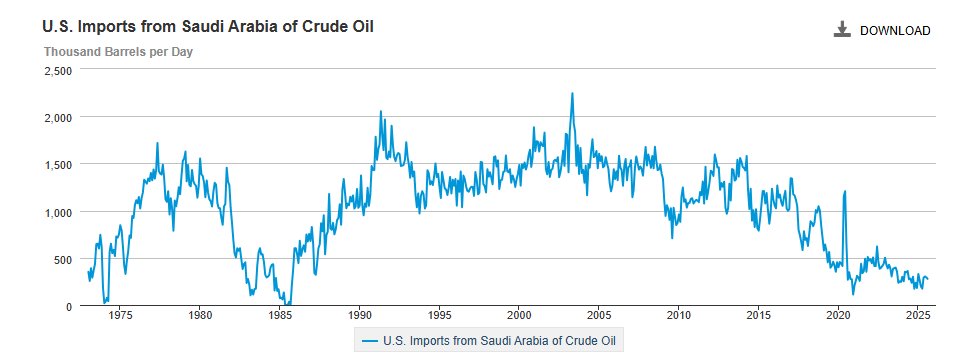
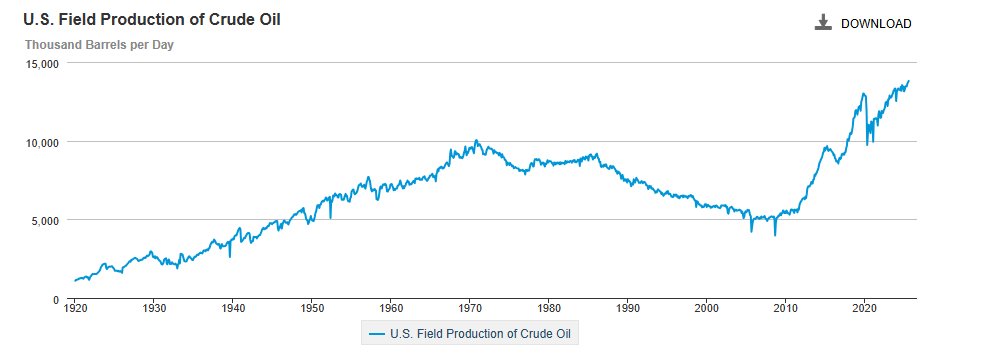
11
21
6,518
25 Nov 2025
Unveiling Power Plays Behind Middle East Policy in Recent Decades
Third Tweet:
Event: War on Terror
What was the diplomatic language used by the West? "We need to spread democracy. WMD we're all at risk".
Who had the power dynamics at the time?
- US neocons dominated geopolitics who used Zionism to destabilise the Middle East coupled with the Military Industrial Complex.
- The A-National OCGFC (ie. Global Owners and Controllers of Global Financialised Capital) were present and worth 100s of $billions around this period. These are companies like Blackrock, Vanguard etc.
- Arab states were still subordinate to US neocons, but they start to grow their sovereign wealth funds around this period.
- Proxies were useful/not useful according to power players' strategies.
What was the undercurrent behind the 'diplomatic theatre'?
It was a turning point for Muslims in the West and globally, who were made out to be the 'other'. There was disarray and instability for much of the Middle East.
#MiddleNation #ShahidkBolsen #PoliticalIndependence #EconomicSovereignty #PsychologicalDecolonisation
7
22
4,123
24 Nov 2025
Unveiling Power Plays Behind Middle East Policy in Recent Decades
Second Tweet:
Event: 9-11
What was the diplomatic language used by the West? "You're either with us or against us"
Who had the power dynamics at the time?
- US neocons dominated geopolitics who used Zionism to destabilise the Middle East coupled with the Military Industrial Complex
- The A-National OCGFC (ie. Global Owners and Controllers of Global Financialised Capital) were present and worth 100s of $billions around this period. These are companies like Blackrock, Vanguard etc
- Arab states did not have a seat at the table and subordinate to US neocons
- Proxies were useful/not useful according to power players' strategies
What was the undercurrent behind the 'diplomatic theatre'?
Let's just say it was difficult to ascertain the true facts behind the narrative of.
#MiddleNation #ShahidkBolsen #PoliticalIndependence #EconomicSovereignty
#PsychologicalDecolonisation
1
7
25
4,808
21 Nov 2025
In the coming week or so, I'll be doing a series of tweets to highlight the power dynamics affecting Middle East policy within the last few decades. I've chosen this time period because it brings back old feelings growing up watching these events unfold.
I will make it as brief as possible to make it digestible and hopefully it may resonate with some of you, especially if you are 35 years old.
This series is to demonstrate the shift in power dynamics. I want you to keep track of this until my final tweet of this series and hopefully I can walk you through why a thriving Middle East is the obvious trajectory.
First Tweet
Event: Oslo Accords
What was the diplomatic language used by the West? "Finally we've mediated peace in the Middle East!"
Who had the power dynamics at the time?
- US neocons dominated geopolitics who used Zionism to destabilise the Middle East coupled with the Military Industrial Complex
- US private sector (Global OCGFC) were present and worth 100s of $billions around this period
- Arab states did not have a seat at the table and subordinate to US neocons
- Proxies were useful/not useful according to power players ‘ strategies
What was the undercurrent behind the 'diplomatic theatre'?
The US were essentially saying "Yeah whatever, let's keep undermining everything so there's no peace. Zionists can do our dirty work"
Lesson: US neocons ran the show, their diplomatic language were lies as Zionists bought in the ROI. Hence no reason to change things.
In the next tweet, I'll take the same approach for the event of 9/11.
#MiddleNation
#ShahidkBolsen
#PoliticalIndependence
#EconomicSovereignty
2
14
858
15 Nov 2025
Here I make a causal link between private sector and American policy.
To think that geopolitical analysts just can’t see this link - or don’t want to speak about it - shows how weak their analyses are.
#shahidkbolsen
#middlenation
3 Oct 2025
On paper, the state has the authority to regulate or pursue antitrust action against BlackRock. In reality, it does not and likely will not, because of the immense leverage the firm wields.
Armed with powerful legal teams, extensive lobbying networks, and deep integration into both financial and governmental systems, BlackRock has become effectively untouchable. Even under US pressure, it could shift operations offshore, restructure portfolios, and continue functioning seamlessly across global markets.
This dynamic highlights how American state power has been captured by private financial elites. BlackRock is no longer simply an American corporation, but it functions as a private sovereign embedded within the global financial order.
According to the Middle Nation RPI, US power is set to decline dramatically by 2050 from 12 today to –7, transforming the country from a global shaper into a global subject.
America will remain wealthy and militarily strong, but it will lose decision making authority as global governance fragments and new institutions rise. Increasingly dependent on foreign capital, supply chains, and resources, the U.S. will be exposed to disruption and unable to enforce its narrative without facing retaliation.
The unravelling of the American-led order carries both danger and opportunity: the danger of strategic vulnerability, and the opportunity to build sovereign, decolonized systems that can replace the hollowing framework of Western dominance.
Listen to this: (timestamp 30:38)
The US, BRICS & BlackRock: the Relative Power Index | Shahid Bolsen - YouTube
#ShahidKBolsen
#Day62of100
#100DaysMiddleNationChallenge
#PsychologicalDecolonisation
8
26
6,981
11 Nov 2025
Looking at the chart on the left, do you think US oil imports from Saudi today is at the lower end of the scale or higher end?
Looking at the chart on the right, do you think US production of oil is at the lower end of the scale or higher end?
After answering those questions, if Saudi 'confronted' the US by doing an oil embargo - would it have a big impact or a small impact?
@thinking_muslim
#EconomicSovereignty
#MiddleNation
Source: EIA website
3
8
27
11,499


Begin with the diagnosis of falsehood and restoration of truth. Lead the next phase of history. Allahu Akbar.
#Day100of100
#MiddleNation
#ShahidKingBolsen
#PsychologicalDecolonization
#EconomicSovereignty
#PoliticalIndependence
1
11
175
The Misassignment of Value — The Trick of the Devil.
One of the most powerful tricks of Shaytan is not open corruption, but the misassignment of value — making what is evil appear good, and what is good appear backward or meaningless.
#Day99of100
#MiddleNation
1
3
9
387