
This is exactly the problem:
You are turning a Roman imperial identity into a modern Greek ethnic identity.
Modern Greece was created when one part of Orthodox/Rum world separated from the Ottoman imperial order and formed a new nation-state.
That new state had its own government, borders, army, law, diplomacy, and later its own autocephalous Church of Greece.
If “Roman” simply meant “Greek,” then why was the modern Greek state created as a new nation-state through rebellion against the Ottoman Empire, instead of being treated as the direct continuation of the Eastern Roman Empire?
Why did the Church of Greece declare autocephaly in 1833, separating itself from the Ecumenical Patriarchate in Ottoman Constantinople?
Why was modern Greece internationally recognized as a new sovereign state in 1830, instead of being treated as the continuation of the Eastern Roman Empire?
The issue is not whether Greek language and Orthodoxy were important in the Eastern Roman world.
They were.
The issue is that you are using them to erase the difference between:
Roman imperial identity,
Ottoman Rum Orthodox identity,
and the modern Greek nation-state.
These are not the same thing.
Reference List
Britannica Editors (2026) ‘War of Greek Independence’, Encyclopaedia Britannica. Available at: Britannica Academic.
Britannica Editors (n.d.) ‘Church of Greece’, Encyclopaedia Britannica. Available at: Britannica Academic.
Katsikas, S. (2009) ‘Millets in Nation-States: The Case of Greek and Bulgarian Muslims, 1912–1923’, Nationalities Papers, 37(2), pp. 177–201.
Roudometof, V. (1998) ‘From Rum Millet to Greek Nation: Enlightenment, Secularization, and National Identity in Ottoman Balkan Society, 1453–1821’, Journal of Modern Greek Studies, 16(1), pp. 11–48. doi:10.1353/mgs.1998.0024.
1
2
65

This could be a major opportunity for Andhra Pradesh.
With strong production of rice, chilli, millets and processed foods, AP can move beyond exporting raw agricultural products and build value added food brands for global markets.
6

Indian goverment going big on ethanol. Looks great on paper but if you look at finer print food grains like rice, maize, wheat, millets are getting diverted into it. It's ok when we are producing surplus food grains but one bad year and you are looking at catastrophe.
10
SK1987 IN retweeted

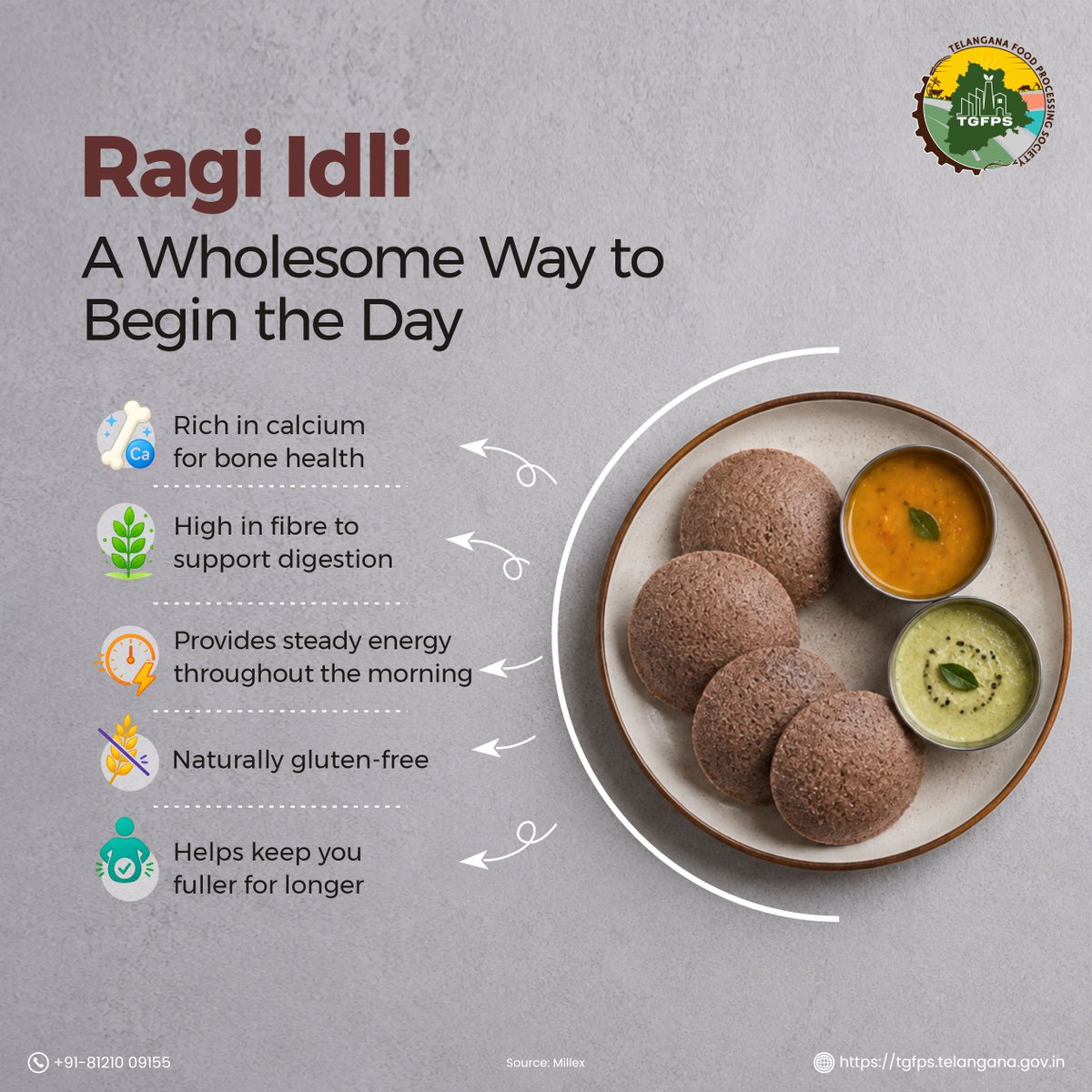
Looking for a nutritious start to the day?
Ragi Idli combines the goodness of millets with the comfort of a familiar breakfast, making it a wholesome choice for everyday meals.
Explore the health benefits!
#MilletRecipes #BreakfastGoals #EatClean #WholesomeEats #NutritiousBreakfast #GuiltFreeEating #FoodForWellness #RagiLovers #DesiFood #Supergrain
2
4
27

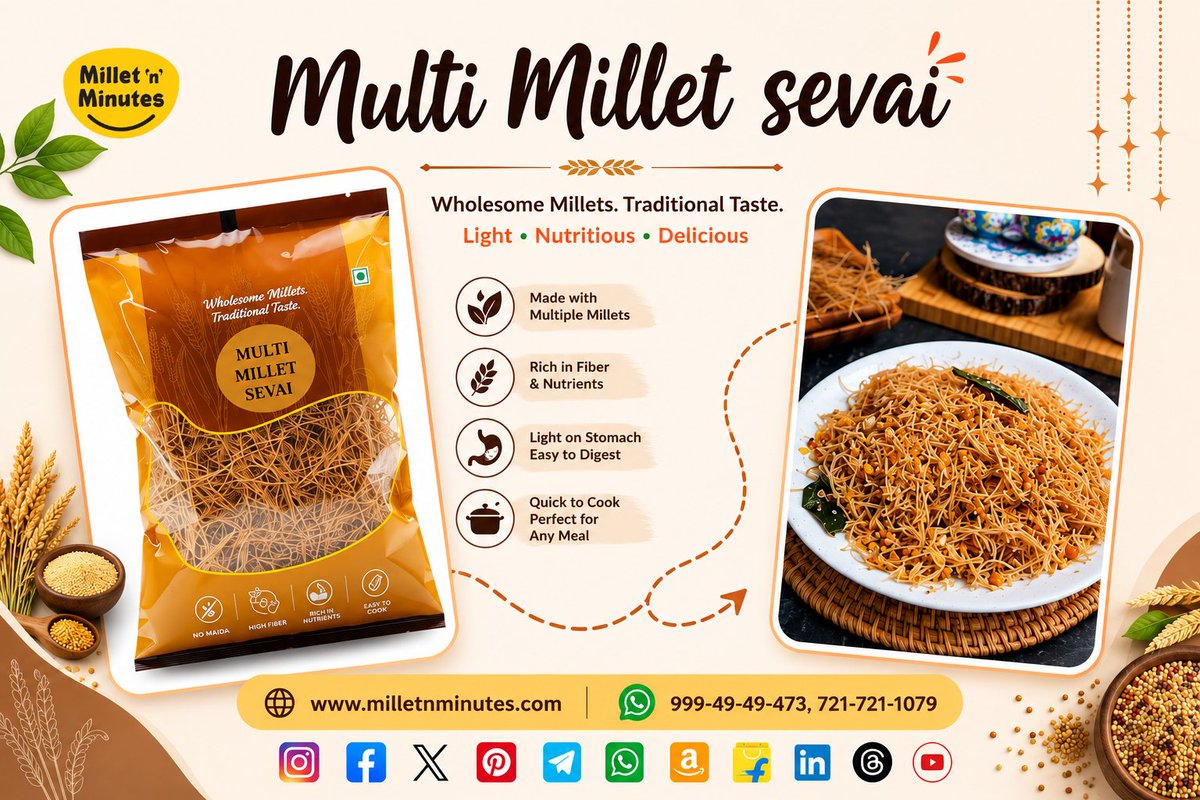
Taste meets nutrition with Millet 'n' Minutes Multi Millet Sevai 🌾
✔ Wholesome Millets✔ Easy to Digest✔ Quick to Cook✔ Rich in NutritionA healthy choice for every meal.
🌐 milletnminutes.com
📞 999-49-49-473 | 721-721-1079
#MilletNMinutes #MultiMilletSevai #MilletFood

The first line is your belief..also, the Ethanol production can use waste products of agri processing, use arid land growing millets as their source..plenty of options available for those who focus..
10

The Millet System Under the Ottomans:
"In keeping with Islamic law, non-Muslims were allowed to practice their religion freely, but the Ottomans also went a step further and allowed Christians and Jews within the empire to form semi-autonomous communities. In what they called the millet system, non-Muslims were allowed to elect their own leaders to represent them in the Ottoman government. These leaders served as intermediaries between the Ottoman sultans and the various faith communities within the empire. Eventually, dozens of millets were formed to represent the numerous Christian churches present in the Ottoman realm. For an empire that had a non-Muslim majority, including and integrating that population was of the utmost importance."
Lost Islamic History pg 159
2
7
430
Pls read deeper..Brazil has a ready made model to copy on making Net zero water ecosystem..
Ethanol can be produced even from arid land growing grains like Millets..
Where there is a will there is a way
Jun 13

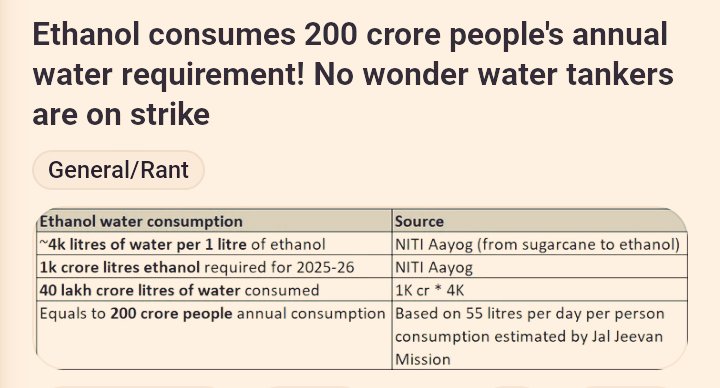
Ethanol Vs Water Crisis?🚨
Just read that producing just 1 litre of ethanol required 4,000 ltr of water.
At the planned scale, ethanol production could consume water equivalent to the 'annual' needs of 200 crore people.
Are we really solving one problem by creating another? 💧🤔
Maybe in future fuel gets cheaper but water becomes unaffordable, is it really a win?
78
Currently, most of ethanol is produced from molasses or bagasse which is a by product of sugar manufacturing..so, no new water is being used here..
Ethanol can be produced even from low water needing grains like Millets, sorghum and wheat..Read about Brazillian revolution of now net zero water was achieved..
11

No. No. To live on a diet. One doesn't need to consume plant based products or vegetables.
Saute certain vegetables, mix with the correct sauces including yoghurt sauces and have fillets or chicken or beef or lamb or elk meat.
It's not rocket science. Legumes and seeds and millets give one gastro intenstinal problems.
Since I am a lover of food. I believe the closest that ever comes to South Asian appetite for me is Mughlai food. But this Muglai food is not Indian food but pakistani food. Especially Lahori and the Westernized Karachi based diet.
I love that.
Could you suggest a diet routine from morning to dinner, based on this?
1
13

💥For all UPSC Aspirants, don’t just read the headline. Extract the static concepts hidden behind this current affair.
📚This news is important for UPSC Prelims (Environment Agriculture Governance) because it connects the National Biodiversity Authority (NBA), Biological Diversity Act, 2002, and Agrobiodiversity.
1. What is Agrobiodiversity?
Agrobiodiversity (Agricultural Biodiversity) refers to the variety and variability of:
Crops (rice, wheat, millets, pulses)
Livestock breeds
Fisheries
Pollinators (bees, butterflies)
Soil microorganisms
Traditional crop varieties and landraces
Example:
Thousands of traditional rice varieties in India (Navara, Kalanamak, Pokkali)
Indigenous cattle breeds like Gir, Sahiwal
A narrow genetic base increases vulnerability to pests and climate change.
2. National Biodiversity Authority (NBA) Established in 2003 & hq. at Chennai
Ministry:
Under Ministry of Environment, Forest and Climate Change
👉Purpose:
Conservation of biodiversity.
Sustainable use of biological resources.
Fair and equitable sharing of benefits (ABS) arising from biological resources.
👉 Three-tier Biodiversity Structure :-
National Biodiversity Authority (NBA)
State Biodiversity Boards (SBBs)
Biodiversity Management Committees (BMCs)
4. Biodiversity Management Committees (BMCs)
Constituted by local bodies.
Main Function:
Prepare People’s Biodiversity Register (PBR).
PBR records:
a) Local biological resources
b) Traditional knowledge
c) Medicinal uses
d) Indigenous practices
5. What is Access and Benefit Sharing (ABS)?
Suppose a pharmaceutical company develops a medicine using a tribal community’s medicinal plant knowledge.
Then:
Community must receive a share of benefits.
This may be money, technology, infrastructure, etc.
This is called Access and Benefit Sharing (ABS).
It is a core objective of the Biological Diversity Act. ( basically to prevent “biopiracy”)
6. Why was this Expert Committee Reconstituted? (As per the news)
👉To advise NBA on:
a)Conservation of agricultural biodiversity.
b)Traditional seed varieties.
c)Indigenous livestock breeds.
d)Farmers’ rights.
e)Sustainable use of genetic resources.
f)Access and benefit sharing related to agricultural biodiversity.
The committee has been constituted for one year according to the notification.
💥Some more linkages and Facts :-
1. India is a Mega-diverse Country
India possesses about:
2.4% of world’s land area.
Nearly 8% of recorded species.
UPSC repeatedly asks about megadiverse countries. ( cover the concept of mega-diverse countries)
2. Biodiversity Act came because of CBD
The Biological Diversity Act, 2002 was enacted to implement India’s obligations under the:
“UN Convention on Biological Diversity”
CBD was adopted at the Rio Earth Summit (1992).
(Cover the recent CoPs and associated initiatives)
3. Foreigners Need NBA Approval
Foreign individuals, companies and NRIs generally require approval for access to certain biological resources and associated knowledge.
💥A classic prelims area.
4. NBA Headquarters is NOT Delhi
Many aspirants mark Delhi.
Correct answer:
Chennai
5. Traditional Crop Varieties are Biodiversity Assets
Examples:
Kalanamak rice (UP)
Pokkali rice (Kerala)
Navara rice (Kerala)
Basmati varieties
UPSC often links GI tags with biodiversity.
6. Millets and Agrobiodiversity
Millets:
Require less water
Greater climate resilience
Enhance genetic diversity in agriculture
Therefore, millet promotion is also biodiversity conservation.
7. Monoculture Threatens Agrobiodiversity
Example:
Large-scale cultivation of a single rice variety.
Risks:
Pest outbreaks
Disease vulnerability
Genetic erosion
This is frequently used in Mains answers.
#UPSC

The National Biodiversity Authority (#NBA) reconstitutes the Expert Committee on Agrobiodiversity under Section 13(1) of the Biological Diversity Act, 2002.
The Committee has been reconstituted for a period of one year to provide expert guidance on the conservation, sustainable use, and access and benefit-sharing of agricultural biodiversity and related matters.
@moefcc @NationalBiodiv
1
230

#12YearsOfKisanSamriddhi
The world already recognises India's agricultural strength. India is the world's largest producer of milk, spices, pulses and millets, and a global leader across multiple agricultural sectors. #12YearsOfKisanSamriddhi
via NaMo App

#12YearsOfKisanSamriddhi
The world already recognises India's agricultural strength. India is the world's largest producer of milk, spices, pulses and millets, and a global leader across multiple agricultural sectors. #12YearsOfKisanSamriddhi
via NaMo App
5

#12YearsOfKisanSamriddhi
The world already recognises India's agricultural strength. India is the world's largest producer of milk, spices, pulses and millets, and a global leader across multiple agricultural sectors. #12YearsOfKisanSamriddhi
via NaMo App
1

With forecasts indicating a weak monsoon due to El Niño conditions, I request the Government of Tamil Nadu to encourage farmers to cultivate low-water-requirement crops such as millets, pulses, and oilseeds @TVKVijayHQ @TVK_NewsTrichy @TVKPartyHQ
#EI Nino
25
Gnana150 retweeted

Millets are ok but shouldn't be overdone. Some millets are easier to digest some aren't. Follow ayurvedic seasonality principles when using millets. For example bajra is only for winter, barley is great in summer and so on.
1
1
1
21

#12YearsOfKisanSamriddhi
The world already recognises India's agricultural strength. India is the world's largest producer of milk, spices, pulses and millets, and a global leader across multiple agricultural sectors. #12YearsOfKisanSamriddhi
via NaMo App
31