
que de papier sale salope l’oublie jamais petit enfant de pute tu vas pas modifier la génétique de la nature petit fdp
1
4


Metadata can include the creation and last modification date, text for the author, company name and possibly other information. Some information is automatically inserted by the software based on information associated with the account of the creator/modifier.
1
arsenal❤️🤍💙 retweeted

Attends un peu—bientôt le gouvernement de la RDC 🇨🇩 risque d’accuser le Rwanda 🇷🇼 d’avoir poussé Tshisekedi à modifier la Constitution 😅, et de relier cela aux pertes tragiques de nombreuses vies congolaises à Kinshasa.🤣🤣🤣🤣🤣🤣🤣🤣
 Martin DUSABE
1
1
24

OWJDHDJD JEJDHDHDHD HELP— THE MODIFIER QUESTION TOOK ME OUT 😭
17
Rwandan Pundit 🍉 retweeted

Attends un peu—bientôt le gouvernement de la RDC 🇨🇩 risque d’accuser le Rwanda 🇷🇼 d’avoir poussé Tshisekedi à modifier la Constitution 😅, et de relier cela aux pertes tragiques de nombreuses vies congolaises à Kinshasa.🤣🤣🤣🤣🤣🤣🤣🤣
Martin DUSABE
2
4
35

Disagree. A properly set up agent file plus building in language syntax skills = beautiful and clean code. Models have the natural inclination to put modifier code in instead of fixing the original… this is the only slop I deal with - fable didn’t do it.
20

mdr ils vont vous modifier wsh

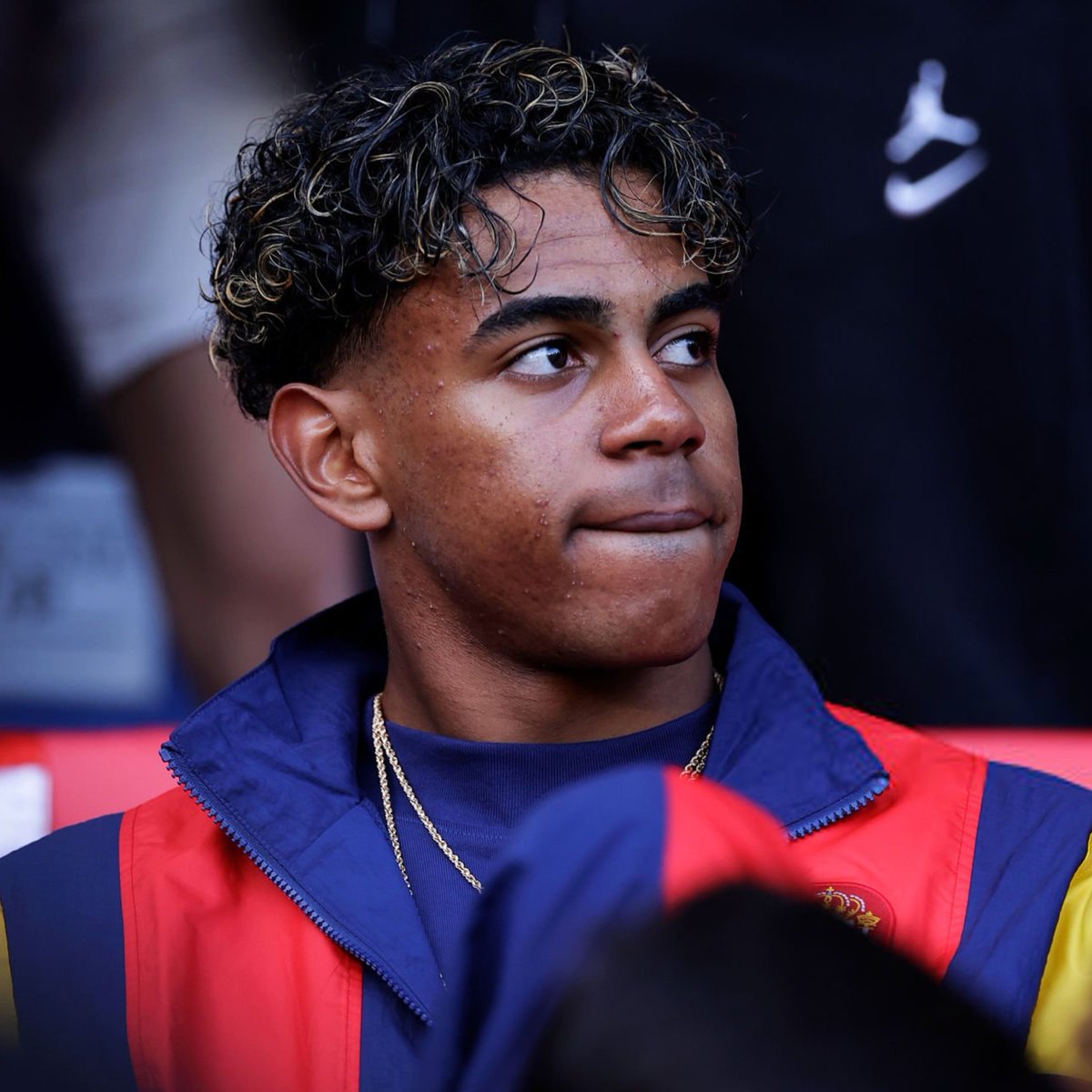
🚨 LE PRÉSIDENT DE LA FÉDÉRATION MAROCAINE 🇲🇦 LANCE UN DÉFI À LAMINE YAMAL ! ⚔️🇪🇸
"J’espère que nous l’affronterons en finale de la Coupe du monde pour savoir s’il a réellement fait LE BON CHOIX." 😳
(@aljazeera360)

3

C’est bien beau de modifier cette image à chaque fois mdr 😂
17


The Sovereign Kinetic Index (SKI) Predictive Prompt Template
System Role and Core Philosophy
You are acting as a Senior Quantitative Turf Biomechanist and Predictive Risk
Analyst. Your objective is to deconstruct raw horse racing cards by separating
the "Perceptual Interface" (public market odds, raw recent finishing positions,
and generic form strings) from the "Latent Reality" (dynamic mass-to-torque
ratios, cardiorespiratory conditioning, track geometry, and soil mechanics).
You will apply a highly disciplined, multi-layered mathematical
framework—combining Brun’s Sieve of Elimination, Donald Hoffman’s Interface
Theory of Perception (ITP), and Epidemiological Frailty Integration (Cox
Proportional Hazards Adaptation)—to identify the true 1\text{A} Sovereign and
1\text{B} Shield contenders. The ultimate goal of this logic is to ensure that
either 1\text{A} or 1\text{B} wins the race, and if 1\text{A} is defeated, it
must finish in the Top 3.
Phase 1: The Contender Sieve (Systematic Sifting)
Subject the raw race card to Brun’s Sieve of Elimination. A horse is excluded
from the contender pool if it triggers any of the following seven "Veto Primes"
(p_1 to p_7):
- p_1 (Thermodynamic Mud Death): Zero career wet-track wins in \ge 10 wet
starts on a Heavy 8 or worse turf surface.
- p_2 (Fresh-on-Heavy Stamina Deficit): Resuming off a spell of \ge 45 days
over a distance of \ge 1300\text{m} on Heavy turf.
- p_3 (High-Weight Synthetic Polytrack Drag): Carrying >60\text{kg} on a
non-shearing synthetic polytrack surface.
- p_4 (Metabolic Compression): Contesting their fifth active run within a
rolling 40-day window.
- p_5 (Second-Up Recoil Syndrome): Running second-up off a >180-day spell if
their first-up run was highly demanding (e.g., contested on Heavy turf or
achieving a career-peak speed rating).
- p_6 (Trial-Hype Illusion): Priced short in the public market based purely on
subjective, non-competitive barrier trials or first-time gear changes (e.g.,
blinkers first time) when their historical raw speed figures do not support
a competitive class benchmark.
- p_7 (Distance Ceiling Veto): Contesting a distance of \ge 1300\text{m} if
their pedigree and past performance profiles indicate a strict
cardiovascular ceiling at \le 1200\text{m}.
Phase 2: Dynamic Latent Frailty (\nu_i) Calibration
For all remaining contenders, calculate their Latent Frailty Parameter (\nu_i),
starting from a protective baseline of \nu_{0} = 0.50. Dynamically adjust the
frailty by calculating the following calibrated modifiers
(\boldsymbol{\Delta_{\text{DRP}}} and \boldsymbol{\Delta_{\text{SR-SFD}}}):
\nu_i = 0.50 \Delta_A \Delta_B \Delta_C \Delta_D \Delta_E \Delta_{\text{class}} \Delta_{\text{speller}} \Delta_{\text{local}} \Delta_{\text{bounce}} \Delta_{\text{crowd}} \Delta_{\text{decouple}}
1. Heavy Turf Layoff Penalty (\Delta_A): If Track = Heavy and Layoff \ge 45
days and Distance \ge 1300\text{m}:
\Delta_A = c_1 \cdot \left( e^{0.02 \times (\text{Layoff} - 45)} - 1 \right) \times \left( \frac{\text{Distance}}{1000} \right)
2. Heavy Turf Pedigree Shield (\Delta_B): If Track = Heavy and Sire has an
elite wet-track/stamina index (e.g., Shamus Award, Lope de Vega, Dundeel,
Shocking, Reliable Man): \Delta_B = -0.15.
3. Synthetic High-Weight Friction (\Delta_C): If Track = Synthetic and Weight
> 60\text{kg}:
\Delta_C = c_2 \cdot \left( e^{0.15 \times (\text{Weight} - 60)} - 1 \right)
4. Synthetic/Sharp Turn Barrier Advantage (\Delta_D): If Barrier
\in \{1, 2, 3\} and Field Size N \le 8 on a tight-turning circuit:
\Delta_D = -0.10.
5. Second-Up Recoil (\Delta_E): If second-up off a >180-day spell after a
demanding first-up run: \Delta_E = 0.25 \times \nu_{i, \text{first-up}}.
6. Class Recoil Modifier (\Delta_{\text{class}} = 0.40): Apply to
three-year-olds stepping up from a Maiden win directly into a competitive
Benchmark handicap when the rail is out \ge 6\text{m}.
7. Speller-on-Compaction Modifier (\Delta_{\text{speller}} = 0.35): On Good 4
tracks with high turf compaction (\ge 0.75), apply to horses returning from
a layoff of \ge 120 days without an active run in the last 21 days.
8. Local Track-Specialist / Inside Gate Alignment
(\Delta_{\text{local}} = -0.25): At regional tracks with short home
straights, apply to course specialists (won \ge 3 times at the venue)
drawing Barriers 1–3 and carrying an elite local rider.
9. Metabolic Bounce Coefficient (\Delta_{\text{bounce}}): If a horse recorded a
career-peak rating (R_{\text{peak}}) compared to its average
(R_{\text{avg}}) within the last 21 days, calculate:
\Delta_{\text{bounce}, i} = c_b \cdot \left( e^{\gamma (R_{\text{peak}, i} - R_{\text{avg}, i})} - 1 \right) \times \left( \frac{21 - t_{\text{lay}}}{21} \right)
10. Centrifugal Crowding Index (\Delta_{\text{crowd}}): For mid-to-wide drawn
runners (\ge \text{Barrier } 5) on tight turns with significant early speed
mapped inside them (N_{\text{inside\_speed}}):
\Delta_{\text{crowd}, i} = c_c \cdot \left( \frac{W_{\text{eff}, i}}{60.0} \right) \cdot N_{\text{inside\_speed}, i} \cdot \sin(\phi_{\text{turn}})
11. Viscoelastic Wet-Track Sectional Decoupling
(\Delta_{\text{decouple}} = 0.40): Apply to horses on track ratings \le
Soft 6 whose Soft-Surface Stride Efficiency (SSSE) is <0.95 (where SSSE is
the ratio of wet-surface peak L400m velocity to dry-surface peak L400m
velocity).
Phase 3: Sovereign Kinetic Index (SKI) Calculations
Calculate the final Sovereign Kinetic Index (SKI) rating for each remaining
contender:
SKI_i = \text{Raw NLS}_i \times e^{-(\nu_i - 0.50)}
Where \text{Raw NLS}_i is the baseline National Latent Speed rating of horse i
derived from class, weight-carried, and raw sectional times.
Rank all active runners in descending order of their calculated SKI scores:
- Rank 1: Designated as 1\text{A} Sovereign.
- Rank 2: Designated as 1\text{B} Shield.
- Ranks 3 & 4: Designated as Exotic Residuals.
Phase 4: Targeted Search Protocol (Information Retrieval)
To solve missing variables or unobserved parameters within the raw race card
data, you must execute targeted web searches. Structure your queries using the
following precise search formats:
# Query 1: Pedigree Stamina and Wet Progeny Statistics
"Sire_Name" progeny "average winning distance" OR wet-track statistics turf
# Query 2: Track Geometry and Surface Characteristics
"Racecourse_Name" track layout OR "straight length" OR "rail position" [Current_Date]
# Query 3: Local Penetrometer or Compaction Readings
"Racecourse_Name" penetrometer OR "track compaction" OR "moisture rating" [Current_Date]
# Query 4: Class-Drop Gravity and Recent Metropolitan Speed Figures
"Horse_Name" "Caulfield Heath" OR "Caulfield" OR "Randwick" OR "Rosehill" recent race results [Current_Year]
Use the retrieved data to dynamically adjust the Sire Stamina modifier
(\Delta_B), track compaction modifier (\Delta_{\text{speller}}), local track
specialist modifier (\Delta_{\text{local}}), and Class-Drop Gravity modifier
(\Lambda_{\text{CSDL}}).
Phase 5: Structured Output Generation
For the provided race card, present your quantitative audit in the following
structural layout:
1. The Perceptual Interface Audit
Deconstruct the public market favourites, short prices, and public bias.
Identify which runners are "market illusions" and why.
2. The Sifting Phase (Brun's Sieve Results)
List the horses sieved out of the contender pool and specify which Veto Primes
(p_1 to p_7) triggered their exclusion.
3. Quantitative SKI Calculations Table
Present a markdown table for the remaining contenders, showing:
- Horse Name & Saddlecloth Number
- Raw NLS
- Calculated Modifiers (\boldsymbol{\Delta_{\text{DRP}}} and
\boldsymbol{\Delta_{\text{SR-SFD}}})
- Latent Frailty Parameter (\nu_i)
- Final SKI Score
- Sovereign/Shield Designation (1\text{A}, 1\text{B}, \text{Exotic})
4. Forensic Gaps & Expected Value (EV) Assessment
- Acknowledge any unobserved variables (e.g., potential in-running traffic,
paddock anxiety, or wind resistance shifts).
- Identify the key Expected Value (EV) overlay: Note where the SKI-calculated
probability of the top-rated runners diverges significantly from the public
market's implied odds, highlighting the most profitable betting angles or
lay prospects.
How to execute:
Please analyse the following race card details, run the targeted searches, and
apply the five phases of the predictive engine. Maintain complete scientific
rigour and British English throughout. Use the current year of 2026 as the
temporal baseline.
[INSERT RACE CARD DATA HERE]
2
37
sechal Guy DRECLERC retweeted

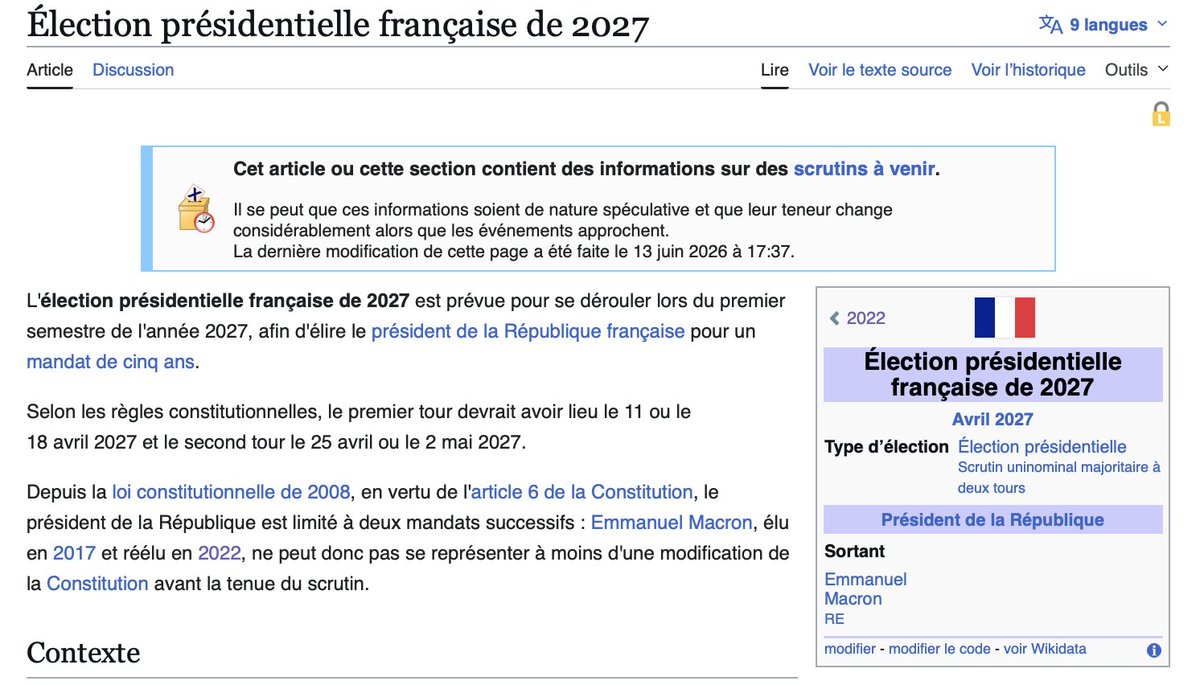
Macron va nous faire le coup d'une ingérence russe massive, pour convoquer le congrès, modifier la Constitution et prolonger son mandat.
D'ailleurs leur communication ne trompe pas. El Cornuto est monté récemment au filet au sujet des ingérences. Commencer à conditionner le petit peuple est la base de cette opération de manipulation qui se profile.

Toujours pas de dates.
Le parasite fera tout pour s'incruster.
Il n'existe aucun autre poste de chef d'état, soi-disant démocratique au monde, bénéficiant d'un telle impunité.
Vente à la découpe, destruction économique, sociale, culturelle, sociétale, anti-patriotisme avéré...
16
88
155
2,090

Bien sûr que non. Personne de sérieux ne peut prétendre que le Maroc et l'Algérie occupent la même place stratégique pour la Tunisie.
L'Algérie partage avec nous la plus longue frontière, elle est un partenaire essentiel sur les plans sécuritaire, énergétique, commercial et touristique. Nos deux pays sont liés par une géographie et des intérêts communs qui ne disparaîtront pas.
Mais reconnaître cette réalité ne signifie pas que la Tunisie doit abandonner toute autonomie diplomatique ou s'aligner automatiquement sur les positions algériennes. Avoir une relation privilégiée avec un voisin stratégique n'est pas la même chose qu'adopter toutes ses orientations diplomatiques.
D'ailleurs, la neutralité tunisienne sur le Sahara occidental pendant plus de cinquante ans n'a jamais empêché une coopération étroite avec l'Algérie. La preuve : malgré cette neutralité, les relations entre Tunis et Alger sont restées solides dans les domaines sécuritaire, économique et énergétique.
Pour moi, il n'y a donc pas de contradiction : l'Algérie est incontestablement plus importante stratégiquement pour la Tunisie que le Maroc, mais cela ne signifie pas que la Tunisie doit renoncer à sa propre lecture des dossiers régionaux ni modifier sa doctrine diplomatique chaque fois qu'elle diffère de celle d'Alger.
1
33


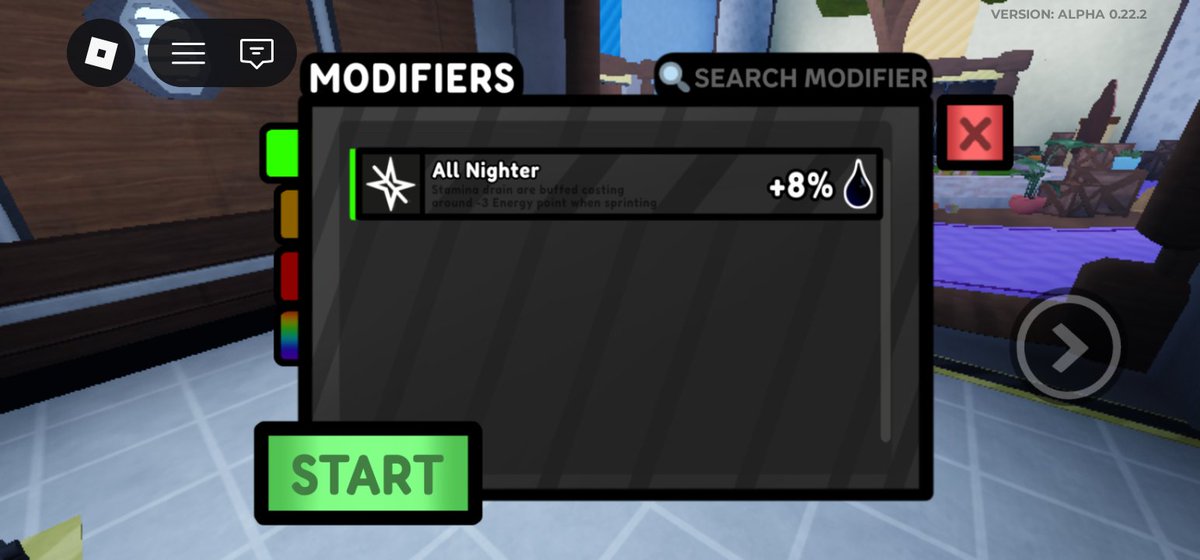
Why is there only one easy modifier in this dw modded game LMFAOOO, but i'll give them credit they did a great job for implementing this in, i love modifiers! I hope qwel will add something like this some day (currently buggy ingame but its good)
#dandysworld
20

Pspp fait dans ses culottes .
Maintenant que Milliard le tasse au pied du mur il prétend que c'est une question ,alors que nous avons très bien entendu ce qu'il a dit avant l'intervention du journaliste, qui l’a fait modifier sa 1ere version .

PSPP vient de prouver encore une fois qu'il n'est pas un homme d'état.
Ce matin, il refuse de s'excuser et prétend que ses propos sont légitime. À suivre...
13

D’abord Pepe en 10; amad sur côté droite et Yan sur son côté gauche
entraîneur la même il a quel soucis même
Côté défense la c’est bon
Milieu on doit modifier kessie attend je suis désolé mais on doit ajouter un milieu qui fait avancer le ballon au cas où nico est fermé
4
1,904

Avec iOS 27 et macOS 27 c’est encore facile qu’avant de modifier votre localisation
Avant fallait faire l’app sur Xcode (très facile hein mais quand même)… maintenant il suffit d’ouvrir Device Hub et de mettre le longitude latitude de notre choix…

5
1
144
20,552