Not at all. If a single team owns all 15 services and data ownership is a mystery, you haven’t built #microservices—you’ve just built a distributed monolith with a massive network tax. The #modularmonolith scales further and faster than 95% of teams want to admit
52
#Monolith, without doubt. A #modularmonolith can easily handle 1,000 users (aneven up to 100,000 ) on a single $10/month server instance. #Microservices means spending more time configuring API gateways, managing distributed transactions, and paying for idle cloud infra.
Jun 12

Your startup has 1,000 users. Would you choose a monolith or microservices?
And why?
1
1
201
Because companies traded code complexity for #distributedsystems complexity. Unless you have thousands of devs requiring team deployment autonomy, #microservices just introduce network latency, eventual consistency bugs, and high cloud bills. The future is the #ModularMonolith.
1
1
1
104
Don’t rush into #microservices. Start with a #modularmonolith to build clean, isolated domain boundaries inside a single deployment. It cuts out the massive network and operational tax early on, letting you surgically extract true microservices only when you actually scale.
1
58
#Microservices solve big Tech organizational bottlenecks, not product problems. For most startups, a clean #ModularMonolith gives you 95% of the performance at 5% of the cloud cost and operational complexity.
1
4
190
Why @Shopify Rejected #Microservices (And What They Did Instead)
Everyone talks about microservices when the system gets big. Shopify went in a different direction. So how Shopify evolved its architecture into a #modularmonolith, why that decision made sense at their scale, and what lessons apply directly to building large systems.
youtu.be/exPjdlMof1k?si=ntCL…
6
288
A modular monolith does not need #Kubernetes. In fact, one of the primary reasons teams choose a #modularmonolith over #microservices is to avoid the operational complexity of an orchestrator like Kubernetes.
1
2
163

17 Nov 2025
🔥 Modular Monolith Architecture en .NET 10
La arquitectura que TODO desarrollador debería dominar en 2025 con Visual Studio 2026.
Si quieres llevar tus aplicaciones .NET a un nivel profesional —más organizadas, escalables y listas para crecer sin caer en la complejidad de los microservicios— te invito a unirte al preview de mi nuevo curso:
🎓 Modular Monoliths in .NET – Fundamentos
👉 netuniversity.org/courses/mo…
Ideal para quienes quieren aprender desde cero o para quienes ya trabajan con .NET y desean estructurar mejor sus aplicaciones usando .NET 10, Docker, Postgres y Visual Studio 2026.
🧩 ¿Qué es realmente un Modular Monolith?
Un Modular Monolith NO es un simple monolito organizado.
Es una arquitectura donde tu aplicación se divide en módulos independientes, cada uno con su propio dominio, reglas y lógica, pero ejecutándose dentro de un solo proceso.
En pocas palabras:
➡️ Tan simple como un monolito
➡️ Tan organizado como microservicios
➡️ Sin la complejidad de infraestructura distribuida
⚙️ ¿Por qué es tan importante dominarlo?
✨ Reduce complejidad
No necesitas colas, mensajería ni despliegues distribuidos —al menos no desde el inicio.
🚀 Evolución natural a microservicios
Si un módulo crece demasiado, puedes extraerlo sin reescribir todo el sistema.
🧱 Ideal para equipos pequeños o medianos
Evitas microservicios prematuros sin perder escalabilidad.
📘 ¿Qué aprenderás en el curso?
✔ Cómo crear módulos separados con responsabilidades claras
✔ Cómo orquestar comunicación interna sin acoplamiento
✔ Cómo mantener independencia entre dominios
✔ Cómo evitar el “big ball of mud” en monolitos grandes
✔ Cómo preparar tu solución para una futura arquitectura distribuida
🚀 Conclusión
Si quieres construir aplicaciones más limpias, mantenibles y con visión a largo plazo, este es el momento perfecto para dominar Modular Monoliths en .NET.
👉 Regístrate aquí, y con la membresia ten acceso a mas de 50 cursos avanzados de .NET incluyendo este:
netuniversity.org/courses/mo…
#DotNet #Net10 #SoftwareArchitecture #ModularMonolith #MonolithicArchitecture
#Microservices #CleanArchitecture #DomainDrivenDesign #DDD
#DotNetDeveloper #BackendDevelopment #CSharp #PostgreSQL #Docker
#VS2026 #Developers #Programming #TechEducation #NetUniversity
#SoftwareEngineering #BestPractices #ArquitecturaDeSoftware
3
167

18 Oct 2025
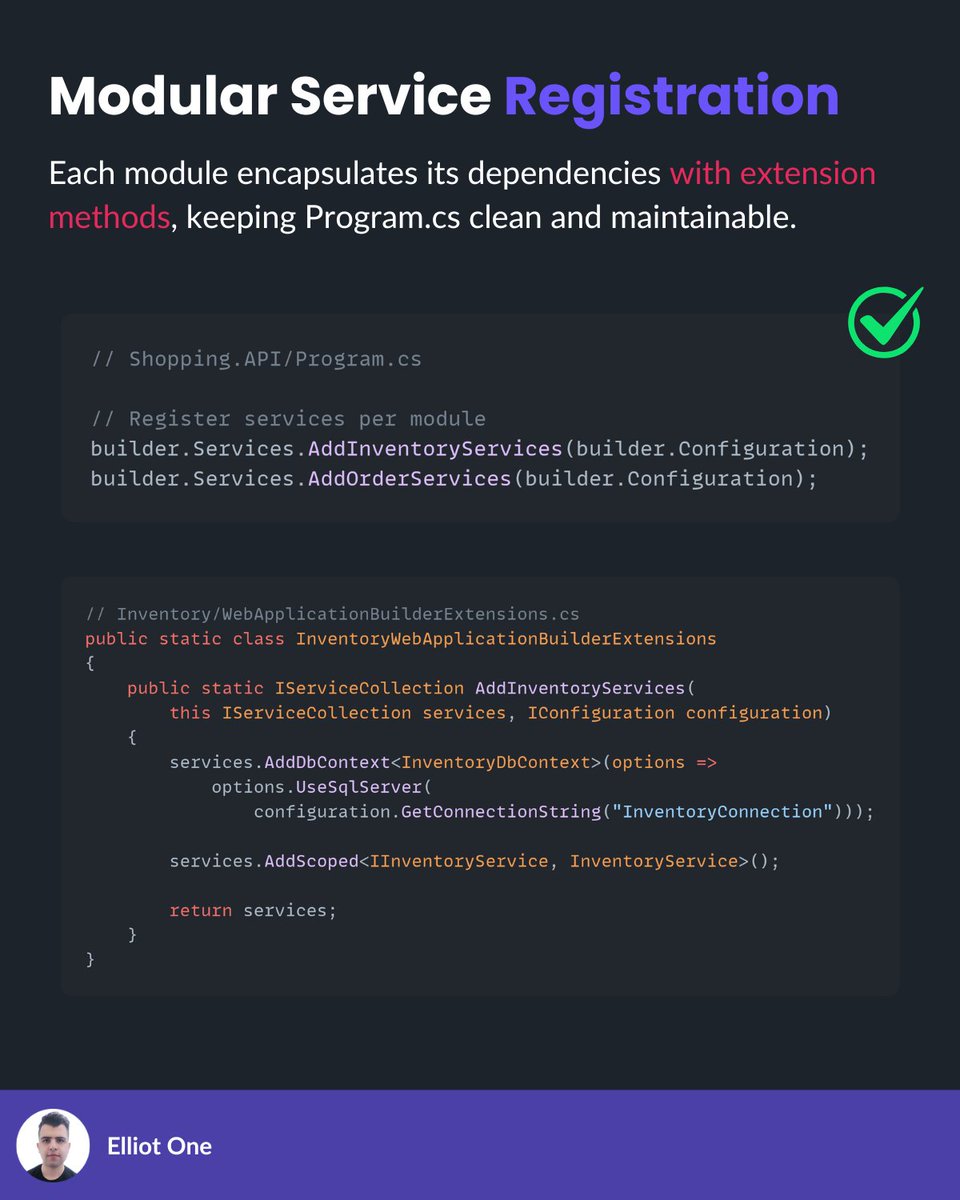
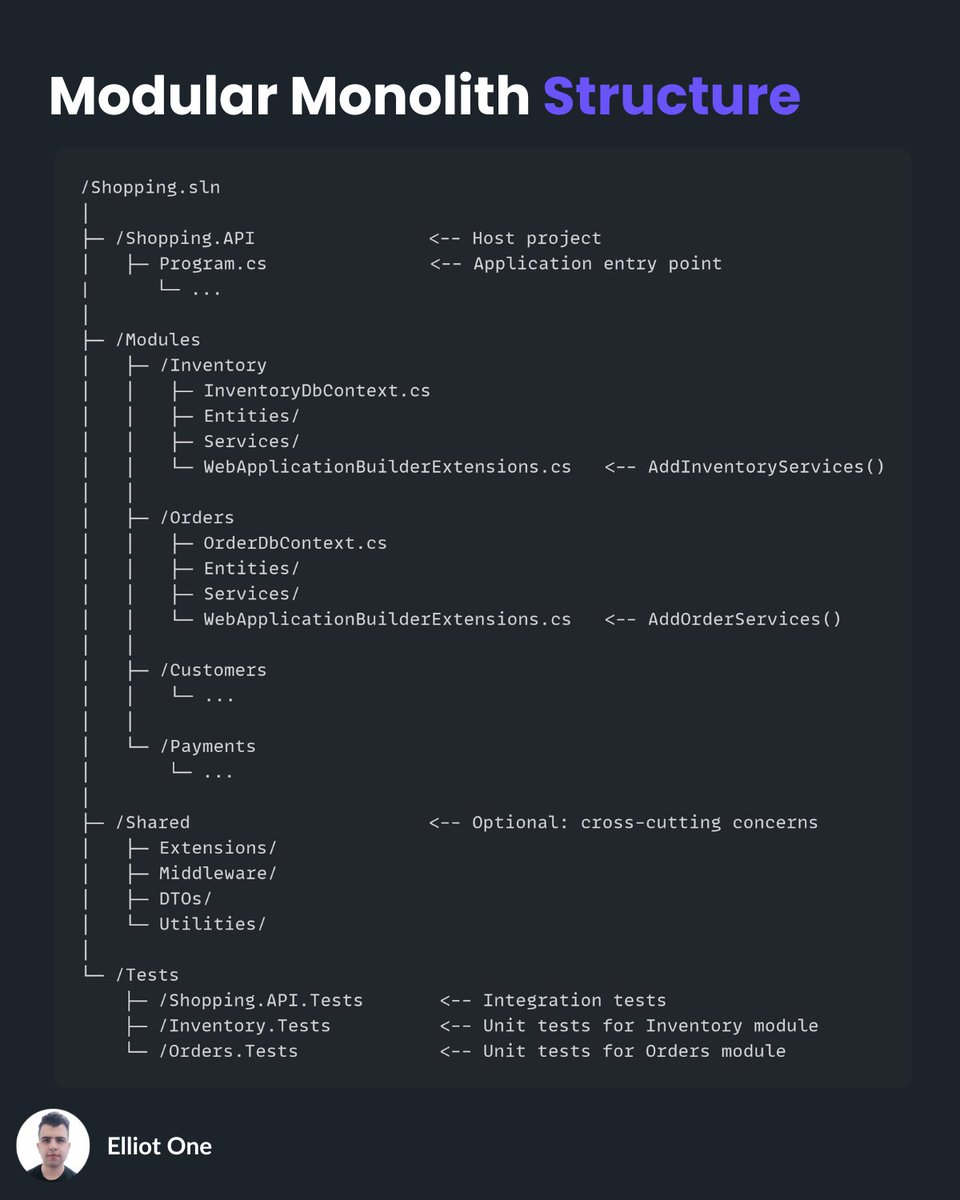
Keep Program.cs clean with feature-based DI.
✅Each module registers its own services.
You'll get:
1. Cleaner startup
2. Encapsulated modules
3. Scalable & maintainable
4. Easier testing & updates
♻️ Share to spread the knowledge!
#cleancode #modularmonolith #architecture
3
54

13 Oct 2025
Architecture starts with understanding, not abstraction. #ModularMonolith #Microservices
13 Oct 2025

Your first step to build a #modularmonolith is to define clear boundaries, not writing code. Design your domains, ownership, and communication patterns early. So here ode structure follows clarity, not the other way around. #Microservices
1
9
1,120

10 Oct 2025
The industry moved from #monoliths to #microservices. Now we're in full swing back to a #modularmonolith. Has the industry learned anything along the way? Or is it just a bunch of over correction because we're not focusing on the actual problems.
youtu.be/APAmLzZVlxU?si=JYsB…

2
319
6 Sep 2025
Build a #modularmonolith: design clear bounded contexts, clean APIs/interfaces, hexagonal layers, and strong test coverage. Keep modules decoupled, use feature flags, CI/CD, and well-defined data ownership. Document contracts — makes slicing into #microservices later painless.
5
400
25 Aug 2025
#Monolith → #ModularMonolith → #Microservices: Start with one codebase, break it into well-defined modules, then split critical modules into independent services only when scale, agility, or team ownership demands it.
1
2
182
3 Aug 2025
Public APIs in a #ModularMonolith let you control coupling
In a modular monolith, public #APIs between modules help control coupling by enforcing clear contracts. You expose only what’s needed — keeping boundaries clean and dependencies minimal.
youtube.com/shorts/jLeXNbILj…
1
4
404

این چند وقت دارم روی سیستم بک اند جدیدمون که دو تا فاز داره کار میکنم، فاز اول Modular کردن قسمت های جدید پروژه بود و انتقال دادن کدهای Legacy پروژه به این پروژه جدید.
فاز دوم ریفکتور قسمت های موجود به Modular هست که اونم تو فرصت بعدی شروعش میکنیم.
#ModularMonolith
9
188
2 Aug 2025
When you work with modular monoliths then make sure that you should - think “microservice mindset, monolith simplicity”.
#Microservices #ModularMonolith
2
171
2 Aug 2025
First step to adopting a modular monolith?
Define clear module boundaries based on business capabilities — not technical layers.
Keep a single deploy, but organize like it’s multiple services.
Clean inside, simple outside.
#SoftwareArchitecture #ModularMonolith #Microservices
1
2
146
13 Jul 2025
Modular Monolith: I’m all in one piece but well-organized.
Microservices: I’m 47 tiny apps in a trench coat.
Both: We hate each other but still deploy on Fridays.
#DevOps #Microservices #ModularMonolith
4
192

30 May 2025
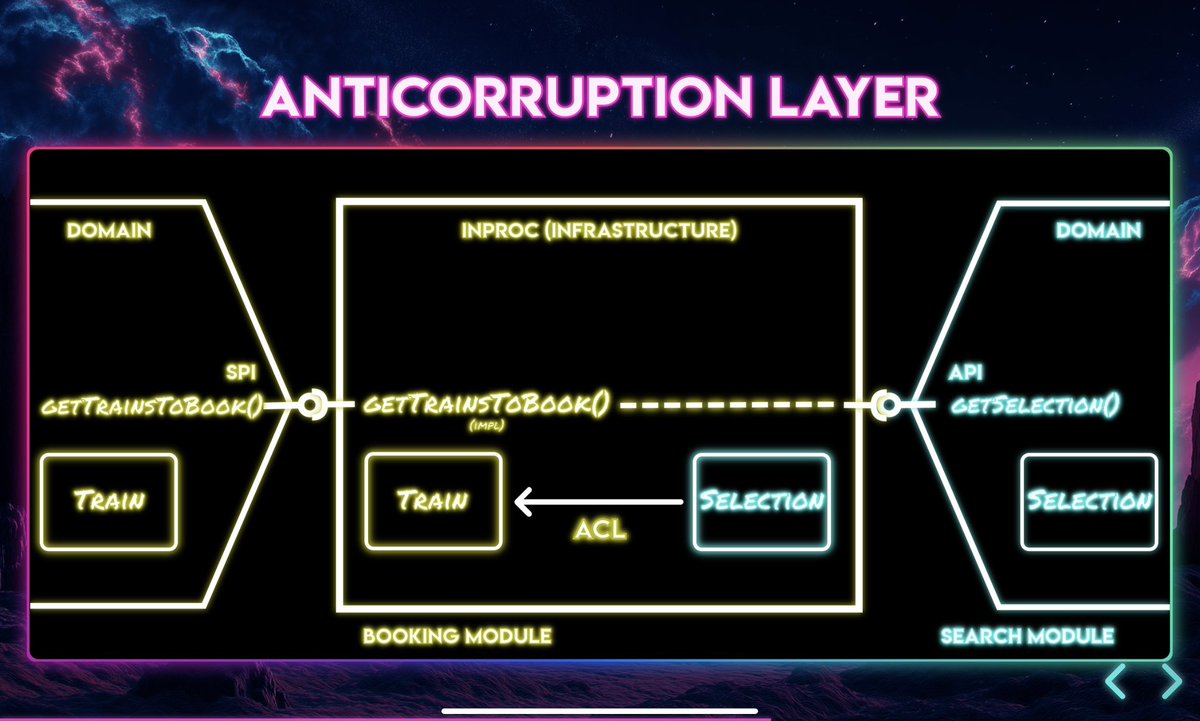
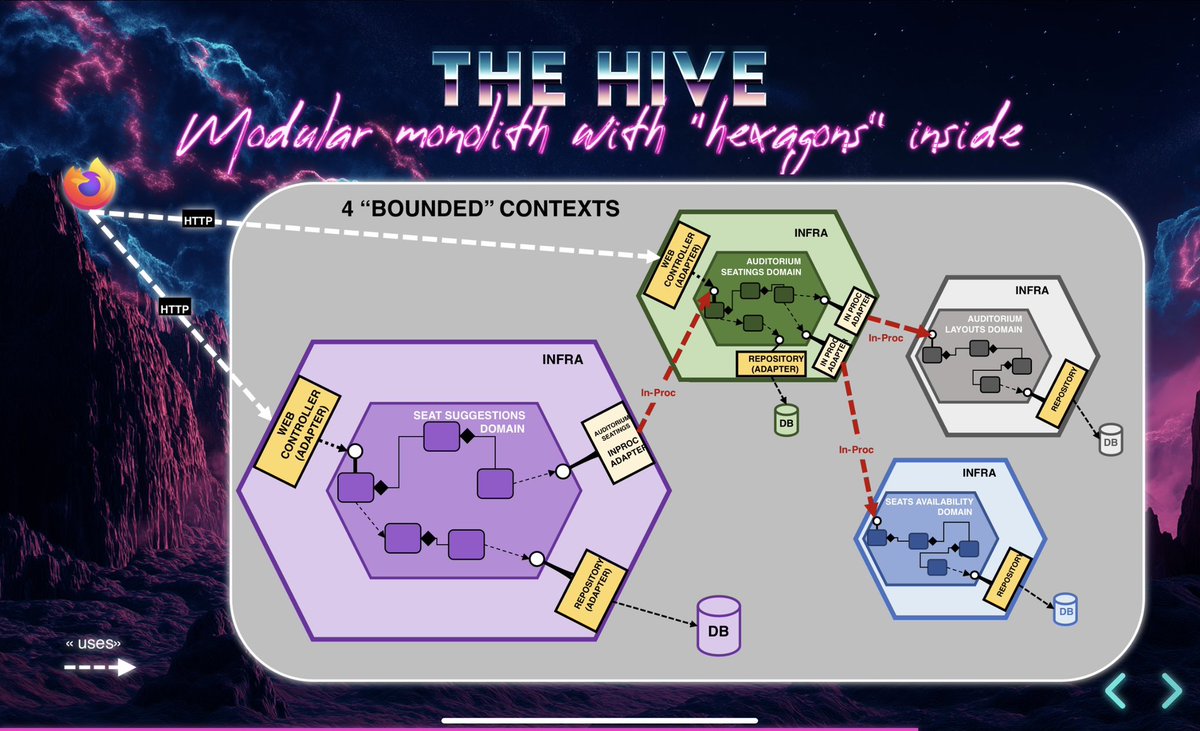
Today at @CraftConf 14:45pm (pink stage), @JulienTopcu and I will present you « the hive pattern », the missing link between Strategic Design & Deployment Strategies. #modularMonolith #microservices #craftConf


1
2
218

29 May 2025
なるほど👀
メルカリ ハロの技術スタックとその選定理由 | メルカリエンジニアリング engineering.mercari.com/blog…
#ModularMonolith #Monorepo
@mercaridevjpより
3
205