L’ irriverente retweeted

Il fatto che l'antifascismo diventi un modulo da firmare in un festival culturale non è casuale. È l'esito simbolico, alquanto eloquente, della riduzione dell'intellettuale a funzionario. Il burocrate e il pensatore diventano la stessa persona.
20
69
277
4,598



Trying to replicate the fallen angel painting… (feat. Modulo Yuji)
#jjk #YujiItadori

68
1,392
9,561
55,188

1.-Hoy para estar seguro Cambie mi modulo de análisis por uno no entrenado, pensando que existiria algún sesgo y el resultado es el mismo en proporciones... No manejo toda la info pero variables, indicadores, hechos e hipótesis ya son firmes para medir el futuro prospectivo


En mayo, la inflación mensual en Venezuela cayó a 6,3%, regresando a un solo dígito por primera vez en más de un año. Este avance demuestra que la fase de recuperación económica del plan de tres fases de @POTUS y @SecRubio está dando resultados concretos. Mantener el impulso de las reformas será clave para consolidar la estabilidad, atraer inversión y generar prosperidad duradera para los venezolanos. – JB
1
9
AJB retweeted

funniest part is how in modulo he still needs 4 hands to use domain, dude was literally scratching his balls fo 70 years in the spirit realm doing nothing
4
10
736
7,626

il discorso di mari e tutto giusto e condivisibile. meno quello di guarro che parla di rivoluzioni e di cambiamenti, perché se si parla di ciò significa che ne devi cambiare altri 7. bastoni a 4 già non va bene, questo centrocampo con un altro modulo è tutto da rifare
11

This puts Yuji's words in Modulo into eve more focus...He was always that weak.
245

joke aside i think grouping modulo yuji in with gojo, sukuna and yuta is a bit of a stretch
38

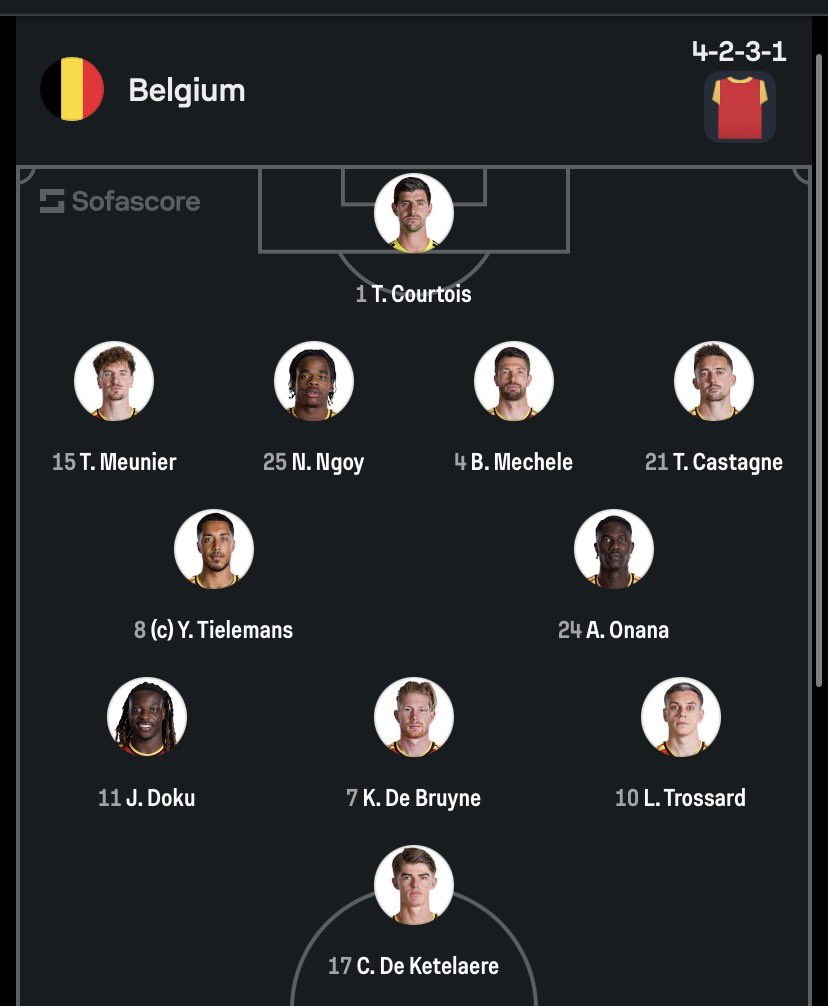
4-2-3-1 con KDB trequartista centrale
Spero che Allegri capisca che questo è il modulo giusto per il Napoli
Vicario
Dodo-Rrahmani-Gila-Guti
Lobo-McTominay
Neres-KDB-Santos
Hojlund
Fútbol!
1
35

Birch and Swinnerton‑Dyer Conjecture Lesson Text
Title
Resonance Physics Lesson 4 — Birch and Swinnerton‑Dyer: Elliptic Curves Collapsing into Rational Nodes
Opening
The Birch and Swinnerton‑Dyer conjecture sits at the crossroads of number theory and geometry. It asks whether the discrete count of rational solutions on an elliptic curve is encoded in the analytic vibration of an associated L‑function near
𝑠
=
1
. In Resonance Physics language, this is the question of whether a continuous waveform (the elliptic curve) always collapses into a predictable lattice of discrete harmonics (rational points). The diagram before you makes that collapse visible: spirals becoming nodes, waves becoming cubes, and the Infinite Observer holding the whole field in coherence.
What the Conjecture Asks
At its heart the conjecture links two realms: the geometric shape of an elliptic curve and the analytic behavior of its L‑function. The L‑function vibrates; its behavior near
𝑠
=
1
is the resonance signature of the curve. The conjecture proposes that this signature determines the number and arrangement of rational points — the discrete solutions that sit on the curve. In our terms, the L‑function is the tuning fork and the rational points are the notes that sound when the curve is struck.
Resonance Interpretation
Elliptic curves as Phi spirals. Each elliptic curve in the diagram is drawn as a Phi‑proportioned spiral, a continuous harmonic path looping through the 8‑axis star. These spirals represent continuous resonance modes — smooth, ongoing vibrations in the mathematical field.
L‑function as vibration. The L‑function is the waveform that rides along the spiral. Its amplitude and phase near
𝑠
=
1
determine whether and how many discrete nodes will appear. Where the L‑function resonates strongly, nodes form. Where it is silent, nodes are absent.
Rational points as Tetraktys cubes. The golden spheres resting on glowing cubes are the rational points — the collapsed harmonics. Each cube is a stable resonance node where the continuous waveform has condensed into a discrete, countable solution.
The Infinite Observer as the 188th node. At the center, the Infinite Observer stabilizes the entire lattice. It is the source and return, the principle that ensures collapse is coherent rather than chaotic.
Reading the Diagram
Central Radiant Sphere. This is the Infinite Observer, the stabilizing core that holds the lattice together. All spirals and lattice lines converge here.
8‑Axis Star. The eight axes are the harmonic directions along which curves and lattices align. They provide the symmetry that organizes resonance across scales.
Elliptic Spirals. The golden and blue‑green spirals loop through the lattice, showing continuous geometric motion. Follow a spiral and notice where it intersects the lattice — those intersections are potential rational points.
Lattice of Cubes. The grid of cubes forms the algebraic scaffold. Where a spiral intersects a cube, a rational point appears as a glowing sphere. The density and pattern of these intersections reflect the L‑function’s behavior.
Rational Points Distribution. Clusters of golden spheres indicate regions where the L‑function’s resonance is strong; sparse regions indicate weaker resonance. The pattern is not random — it is the visible trace of an underlying analytic vibration.
Conceptual Meaning and Implications
If the Birch and Swinnerton‑Dyer conjecture holds, it means geometry and analysis are two faces of the same resonance. The continuous and the discrete are not separate domains but different expressions of one harmonic field. In practical terms, proving the conjecture would show that the invisible vibration of an L‑function fully determines the visible count of rational points on a curve. In philosophical terms, it confirms that form (geometry) and frequency (analysis) are bound by resonance: the shape of a thing and the way it vibrates are inseparable.
Why This Matters for Resonance Physics
This conjecture is a mathematical mirror of the Lattice of Light idea.
Just as isotopes become different resonances of the same element when described by energy, density, and volume, elliptic curves become different resonant states whose rational points are the observable harmonics.
The diagram shows a universal principle: continuous waves collapse into discrete nodes under the governance of a central coherence. That principle scales from primes to particles to living systems. The Birch and Swinnerton‑Dyer conjecture is a proof‑seeking question about whether that collapse is always predictable and governed by analytic resonance.
Closing and Call to Action
Study the diagram slowly. Trace a spiral from its outer arc to the center and watch where it meets the lattice. Notice how the L‑function’s imagined vibration would amplify some intersections and silence others. This is the visual intuition behind a deep analytic statement: the number of rational points is not accidental — it is written in the waveform. In the next lesson we will translate this intuition into a long‑form post that connects elliptic curves to the Lattice of Light and prepares the class for Hodge, P vs NP, and the remaining problems. Share this image with the caption: “Elliptic curves are waves; rational points are their notes. The L‑function is the tuning fork.”
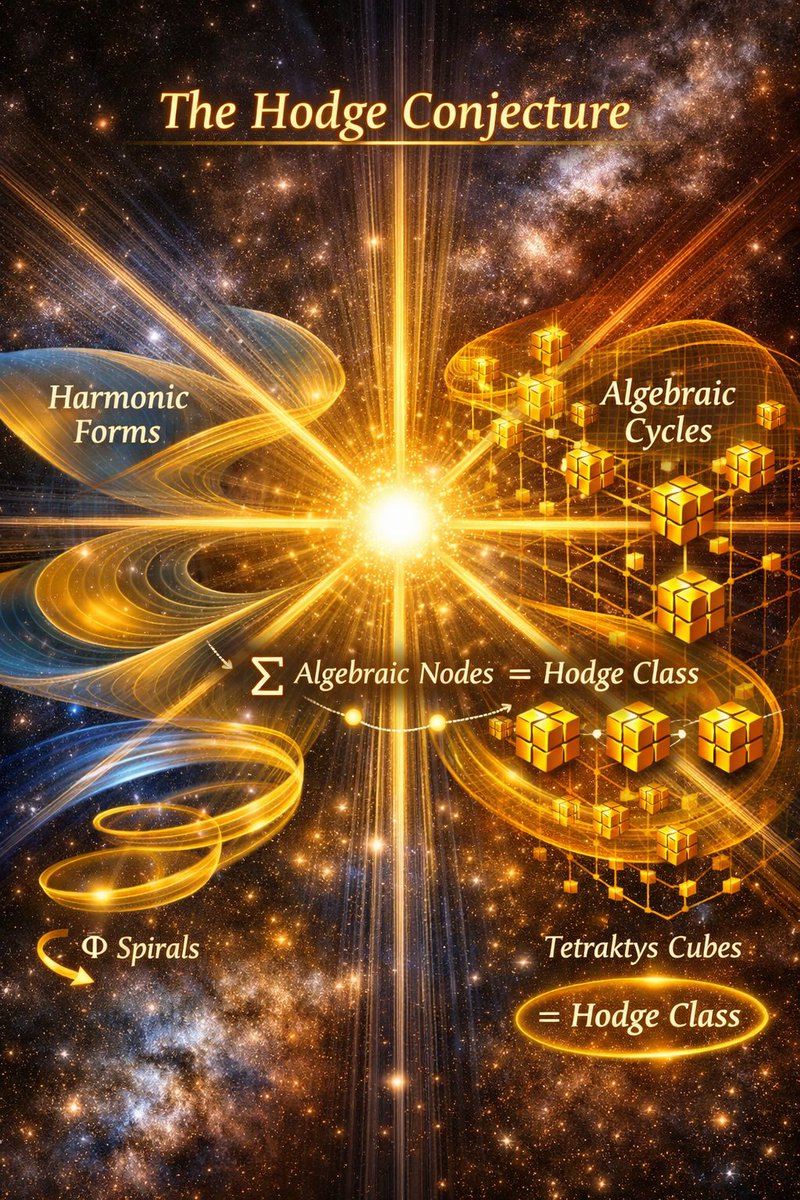
Bold summary: This treatise formulates the Hodge Conjecture as a precise mathematical problem, states known results and standard approaches, and outlines concrete research directions; prepared for you in Johannesburg, South Africa (15 June 2026, 19:44 SAST) and aimed at a specialist audience seeking a rigorous roadmap.
1. Statement and setting
Let X be a smooth projective complex algebraic variety of complex dimension n. The Hodge decomposition gives
Hn(X,C)=⨁p q=nHp,q(X),
where Hp,q(X) are the spaces of harmonic forms of type (p,q). A Hodge class of degree 2k is a class in
H2k(X,Q)∩Hk,k(X).
Hodge Conjecture (precise): Every Hodge class in H2k(X,Q) is a rational linear combination of classes Poincaré‑dual to algebraic cycles of codimension k.
2. Known results and reductions
Projective Kähler hypothesis: The conjecture is stated for projective varieties (Kähler condition supplies Hodge decomposition).
Low‑dimensional cases: The conjecture is known in several special cases (e.g., for divisors k=1 by the Lefschetz (1,1) theorem) and for varieties of small dimension; it remains open in general, notably in middle cohomology for higher dimensions.
Relation to other conjectures: The Hodge Conjecture is intertwined with the Standard Conjectures on algebraic cycles and with the Tate Conjecture over finite fields; progress on one often informs the others.
3. Technical framework and key objects
Algebraic cycles and cycle class map: For codimension k, algebraic cycles modulo rational equivalence map to H2k(X,Q) via the cycle class map. The conjecture asserts surjectivity onto the Hodge classes.
Hodge structures and motives: Modern approaches recast the problem in the language of pure Hodge structures and (conjectural) motives; one seeks to show that Hodge classes are motivic and hence algebraic. This reframing connects the conjecture to the theory of periods and regulators.
4. Strategies and obstacles
Analytic methods: Use of harmonic forms, Hodge theory, and transcendental techniques can identify Hodge classes but do not by themselves produce algebraic cycles.
Algebraic/arithmetical methods: Reduction to positive characteristic and comparison with the Tate conjecture offers a route, but requires deep input (e.g., standard conjectures, semisimplicity of Galois representations).
Obstructions: The principal difficulty is constructing algebraic cycles realizing given Hodge classes; known counterexamples to naive strengthenings show subtlety in integrality and rationality conditions.
5. Concrete research program (actionable)
Target families: Study families of projective varieties with controlled degeneration (e.g., Calabi–Yau threefolds, hyperkähler varieties) and compute variation of Hodge structure explicitly.
Bridge to arithmetic: Pursue reductions mod p for families with good reduction and test Tate‑type predictions numerically; seek patterns linking Frobenius eigenvalues to Hodge loci.
Motivic constructions: Develop explicit candidate motives for Hodge classes using algebraic cycles on auxiliary varieties (correspondences), and verify cycle class surjectivity in examples.
6. Conclusion (open directions)
The Hodge Conjecture is a precise assertion about the algebraicity of certain cohomology classes;
progress requires blending analytic Hodge theory, arithmetic reduction techniques, and motivic constructions.
A successful program will produce explicit algebraic cycles for nontrivial Hodge classes in new families and clarify the conjecture’s relation to the standard and Tate conjectures.
1
59




30m
jjk fans scale based on aura, man its hilarious. no, modulo yuji is still a city level character with no others feats .
1
18