
10 Oct 2025
Thin Bridges for Drug Text Alignment: Lightweight Contrastive Learning for Target Specific Drug Retrieval
1. The study explores a novel approach in drug discovery and biomedical applications, using lightweight contrastive learning to align chemical and textual representations without the need for heavy pretraining or large-scale multimodal corpora. This method, termed “thin contrastive bridges,” offers a computationally efficient alternative to existing models.
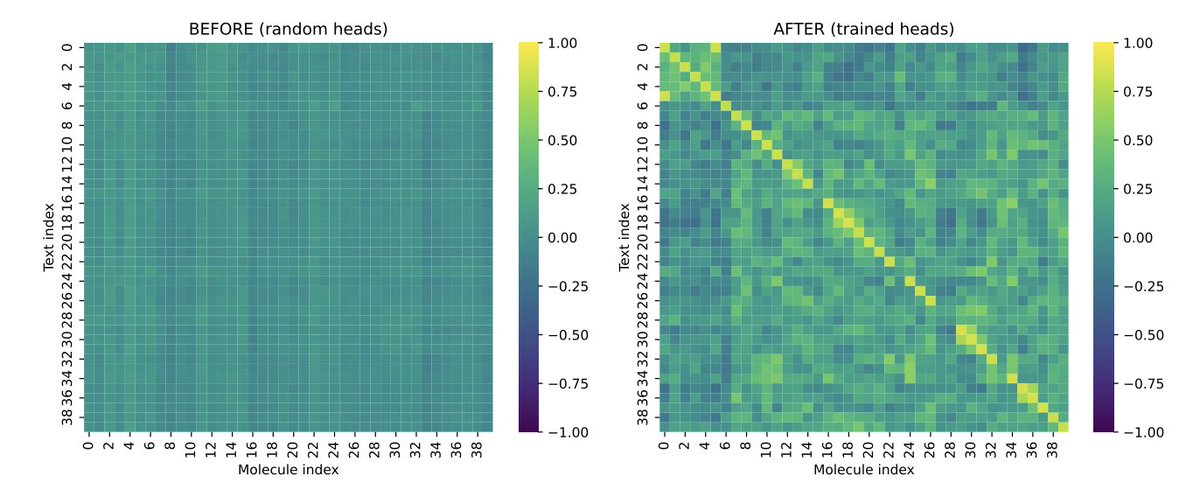
2. The researchers utilized paired mechanisms from ChEMBL to align ECFP4 molecular fingerprints with biomedical sentence embeddings through dual linear projections trained with a contrastive objective. A key innovation is the incorporation of hard negative weighting and a margin loss to better handle drugs sharing the same therapeutic target.
3. Evaluation under scaffold-based splits demonstrated that the thin bridges approach achieves non-trivial cross-modal alignment and significantly improves within-target discrimination compared to frozen baselines. This suggests that the method can generalize across disjoint chemical cores and enhance target-specific retrieval in precision medicine.
4. The study highlights the use of lightweight projection heads over frozen unimodal encoders, which are trained to map representations into a shared embedding space. This approach not only reduces computational costs but also maintains high performance, making it scalable for downstream generative drug discovery tasks.
5. The dataset constructed from ChEMBL v28 includes 3,030 high-quality drug–target pairs with both chemical and textual representations. This paired multimodal resource is well suited for contrastive drug text alignment tasks and provides a foundation for further exploration of efficient multimodal alignment methods.
6. The results show that the thin bridges approach achieves Recall@1 of 0.762 and MRR of 0.863 when combining ECFP4 molecular fingerprints with enriched text descriptions. Even under scaffold splits, the method maintains meaningful performance, with Recall@1 of 0.150 and MRR of 0.228.
7. The study concludes that thin contrastive bridges can serve as a scalable foundation for downstream generative drug discovery. By enabling efficient retrieval of molecule–mechanism pairs, this framework supports rapid in silico screening and provides interpretable links between chemical structure and biological function.
📜Paper: arxiv.org/abs/2510.03309
#DrugDiscovery #BiomedicalResearch #ContrastiveLearning #MultimodalAlignment
1
5
726

23 Jun 2025
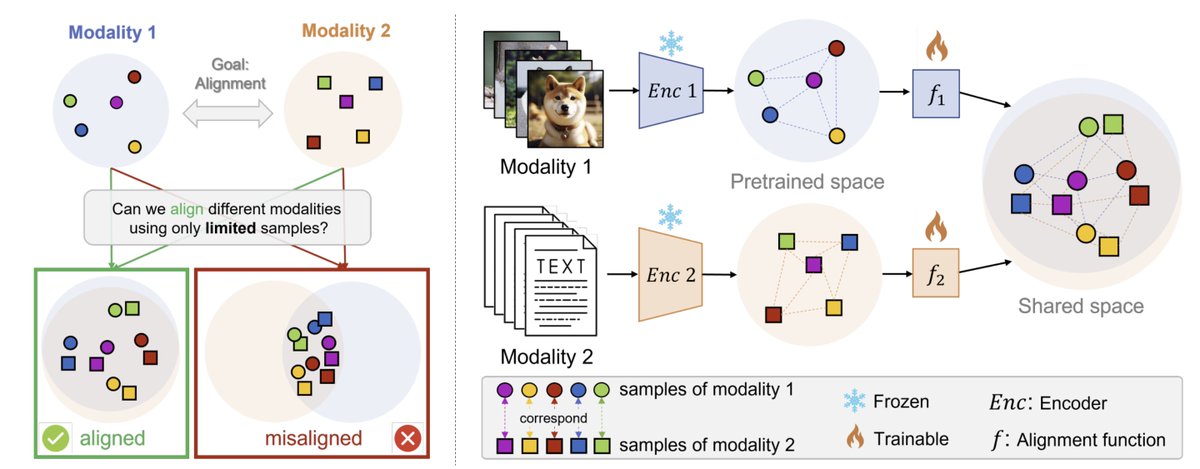
Can we build multimodal models by simply aligning pretrained unimodal models with limited paired data?
We introduce STRUCTURE 🏗️: a lightweight, plug-and-play regularizer that preserves latent geometry to align frozen unimodal models using <1% of paired data typically used in the field #AI #MachineLearning #MultimodalAlignment
🚀 51.6% avg boost in zero-shot classification
🔍 91.8% in retrieval tasks
Very proud of the fantastic team @FabianGroger @ShuoWen18 Huyen Le
Paper: arxiv.org/abs/2506.16895
Project webpage: brbiclab.epfl.ch/projects/st…
4
35
218
23,121