graceland retweeted

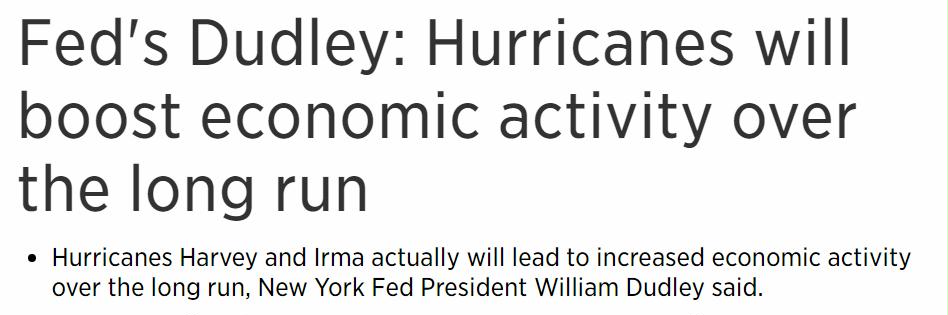
By this clown's logic we should build giant wind & rain machines to destroy US cities. Think about the NGDP growth. cnbc.com/2017/09/08/feds-dud…
91
108
354

maybe in Scott Sumner's dream world of NGDP futures markets even the short-run nominal interest rate would be effectively set by the market, rather than there being a rather nebulous degree of discretion and confusing monetary policy transmission channels 🙂
1
2
11

1. The Iran deal announced over the 14 June weekend in the US, to be signed on 19 June, if adhered to (which remains a risk) gradually opens the Strait of Hormuz for commercial oil and other shipping. Brent/WTI has fallen to 80s. This is an unambiguous positive for India’s balance of payments given that every $10 increase per barrel leads to $18b more of imports.
2. The measures announced by India on 5 June, in terms of RBI hedging support for FCNR/ECB as well as tax exemption for FPI investments in GOI bonds, could lead to around $70b in terms of extra flows over the coming year. Given that CAD was 0.6% of GDP ($25b) for both FY25 and FY26, this could stabilise the rupee via the capital account especially in terms of FPI debt flows (aggregate index inclusions) and the unwinding of over-hedging by importers, exporters, others which cumulatively was almost $150b over the last two years.
3. Nifty50 and Nifty500 trade at less than 21x and 23x trailing earnings as of 15 June, which are very reasonable valuations given that top-line growth (along with nominal GDP and bank credit growth) is comfortably back in double digits, and barring a June slowdown, earnings growth are also likely to be in strong double digits if the ceasefire holds and energy prices remain moderate. Large caps have better valuations, but SMIDs have better dynamics. Banks have probably best risk-reward (post-FCNR); metals, autos, discretionary consumer good too.
4. The broader positives of Indian equities in terms of its growth, liquidity, diversification, capital efficiency remain and are amplified as we are at the beginning of another decadal dollar down cycle (US REER), the way we were from 2002 to 2011. From early 2002 to early 2025, the full cycle, Indian equities constituted by far the best major returns (in dollars) in any market, EM or DM. Unlike some economies where NGDP did not convert into EPS, in India they did.
5. While the short term is uncertain, the rupee is an undervalued and oversold currency in terms of its core PPP fundamentals with India’s GDP (PPP)/GDP (USD) ratio around 4.7 times, which is high even adjusting for global cyclical and Indian developmental dynamics. While RBI will buy reserves and run its forward short book down during periods of rupee strength, the bias should now be on the gradual appreciation of the rupee, again assuming the Iran deal holds. An India-US trade deal could further boost sentiments.
6. There is a systematic churn in FPI books in terms of their India exposure. Going forward, via different players of course, they may gradually and in part swap their equity exposure for Indian bond exposure. Given that DII flows (both SIP and the more volatile bulk flows) are likely to get stronger, unless IPO/QIP/promoter supply dramatically increase we must not expect sustained FPI buying, derivative shorts unwinding notwithstanding.
7. The risks remain around lower/more uncertain rainfall (El Nino) impacting food inflation and potentially constraining RBI’s room going forward. But given that headline CPI YoY even in May was below 4%, and the base effect of gold-silver is still there in Indian inflation, the central bank may partially look through energy/food prices if the current situation holds. That they did not resort to a hike during the June meeting, even as India FY26 growth number surprised on the upside, should imply that the MPC is inclined to support growth for now.
3
20
88
9,090


Jun 15
Yeah that was Scott Sumner's thesis...NGDP targeting. Of course Sumner argued persuasively that the narrative of 2007-09 crisis is wrong. The fed was being way too tight in 2007 and that led to a recession which led to financial crisis...not vice versa as is often supposed
10

Employer risk preferences changed in the direction of tolerating more risk by 2020. Which was in the government's control to influence in 2009, but the easier fix would have been supporting NGDP growth to begin with and entirely skip the recession.
1
36


Agreed, aggregate demand policies in response to COVID caused the inflation surge; however, it is important to note that in the absence of deficit monetization by the Fed (aka QE), the COVID fiscal deficits would not have caused inflation, nor NGDP recovery.
To illustrate, in the 1990s and 2000s, Japan tried massive fiscal support without QE - a period we now refer to as the lost decades. It is really thanks to the fiscal-monetary coordination that we got the V-shaped recovery.
Furthermore, as soon as the Fed stopped QE in 2022 and started hiking rates, inflation peaked and began to subside, and we ended up with Goldilocks outcome (I'd say, one of Jay Powell's greatest accomplishments).
67

Jun 14
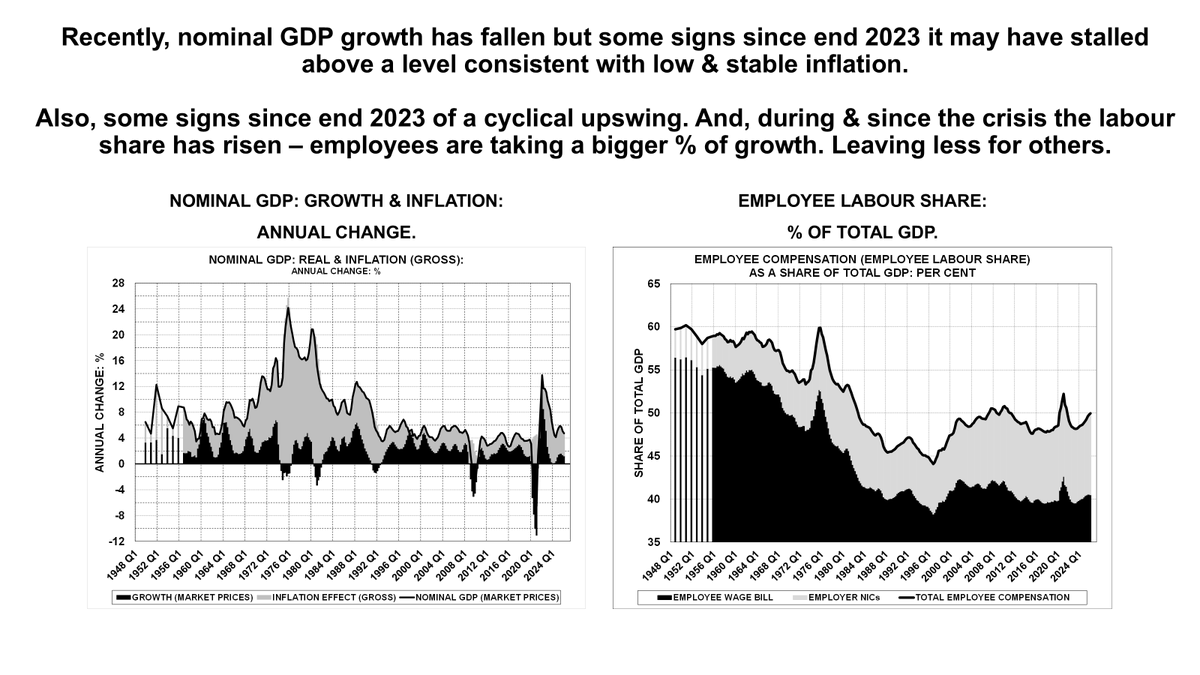
Afraid I largely disagree with you. And would pray in @OBR_UK evaluation of the forecast. They keep stressing big rise in NGDP is a major factor
Where govt policy may have had some effect is in balance between growth & inflation. But not all policies have been bad & some legacy
1
9


Jun 13
I’m not hating either. But I’d prefer the game were changed to prioritize the labor market. Tight labor markets give workers bargaining power, and that helps reduce inequality. We can do that by stabilizing the path of NGDP, so that recessions are mild and the labor market returns to full employment quickly.
1
1
184

Jun 13
The first half of this last quoted passage puzzles me. Nominal GDP is just a name for total $ spent on output, that is, its a popular measure of Py. (Hence the “expenditure approach” to determining nominal GDP.) So NGDP As can’t go up unless “expenditure” goes up.
1
1
291
Jun 13
That’s a popular narrative, both the truth is more complex. Monetary policy must be set to produce NGDP expansion, so that the banking system doesn’t collapse.
Rate policy, or “printing,” isn’t the culprit, but a symptom of lack of investment (partly created by a lack of ag demand). And with decades of slow growth and excessive labor market slack, labor had low bargaining power. Meanwhile, successful businesses could reach a global audience. Capital>labor.
So the problem wasn’t loose money, it was actually tight money, which allows businesses to increase margins while stifling wages.
Run the economy hot, labor can negotiate, and inequality is reduced. Loose money isn’t what got us here, it’s the internet age and a crappy labor market for decades.
1
23