
1 Aug 2025
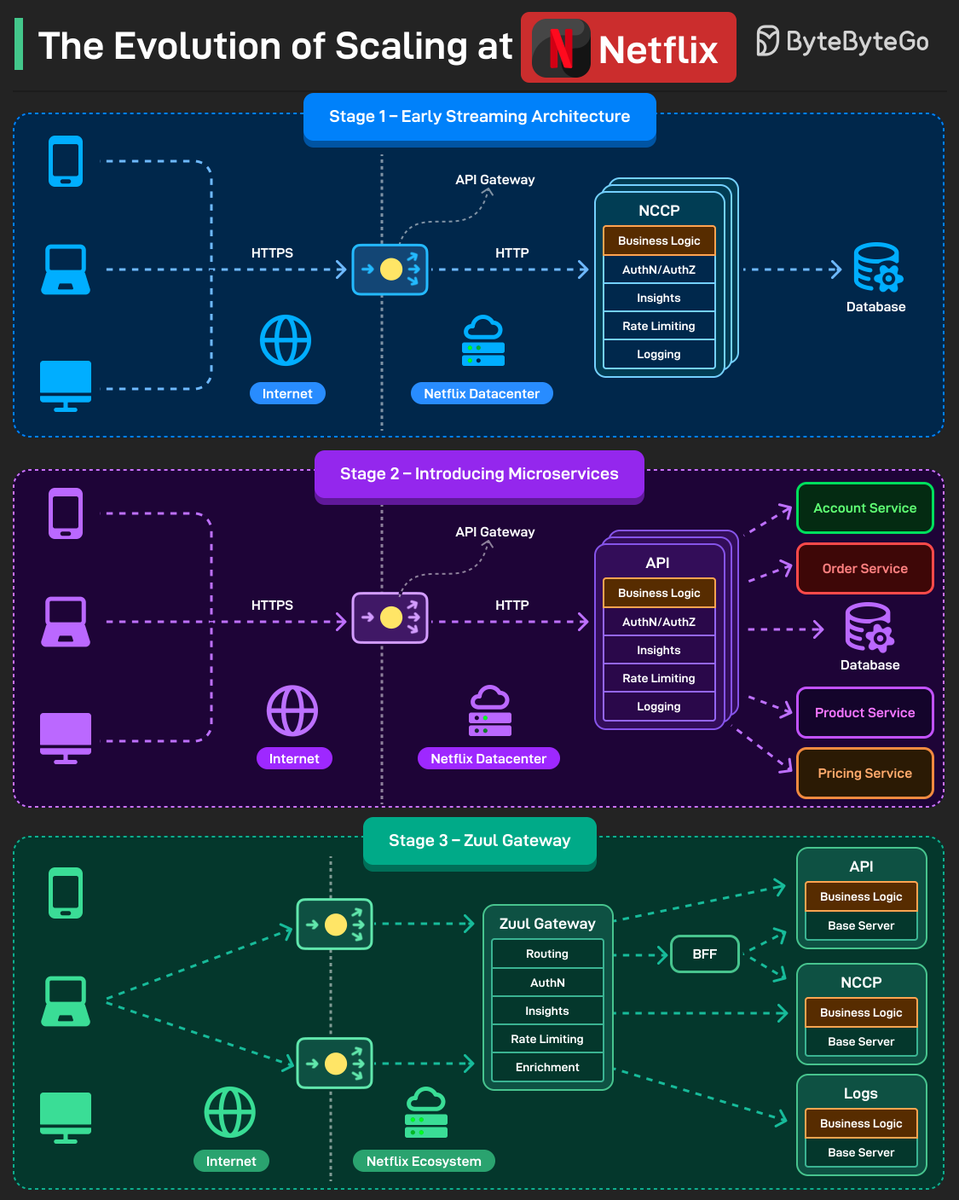
The Evolution of Scaling at Netflix
Reference: netflixtechblog. com
2
63
356
33,122
6 Jun 2025
A Distributed Counter is a system where the responsibility of counting events is spread across multiple servers or nodes in a network. Netflix needs to track and measure multiple user interactions to make real-time decisions and optimize its infrastructure.
For this reason, they built a Distributed Counter Abstraction.
Netflix’s Distributed Counter Abstraction operates in four main layers, ensuring high performance, scalability, and eventual consistency.
1 - Client API Layer
Users interact with the system by sending AddCount, GetCount, or ClearCount requests. The Netflix Data Gateway efficiently processes and routes these requests.
2 - Event Logging and TimeSeries Storage
Events are stored in Netflix TimeSeries Abstraction for scalability. Each event is tagged with an Event ID to ensure idempotency. To avoid database contention, events are grouped into time partitions known as buckets. Data is stored in Cassandra.
3 - Rollup Pipeline or Aggregation
Rollup Queues collect event changes and process them in batches. Aggregation occurs in immutable time windows, ensuring accurate rollup calculations. Data is stored in the Cassandra Rollup Store for eventual consistency.
4 - Read Optimization (Cache & Query Handling)
Aggregated counter values are cached in EVCache for ultra-fast reads. If a cache value is stale, a background rollup refresh updates it. This model allows Netflix to process 75K requests per second with single-digit millisecond latency.
Reference: netflixtechblog. com/netflixs-distributed-counter-abstraction-8d0c45eb66b2
--
Subscribe to our weekly newsletter to get a Free System Design PDF (158 pages): bit.ly/bbg-social
1
3
21
6,580

16 Apr 2024
Explore top engineering blogs:
🔗 Airbnb: medium .com/airbnb-engineering
🔗 AWS: aws .amazon .com/blogs/aws
🔗 GitHub: github .blog
🔗 Netflix: netflixtechblog .com
🔗 Microsoft: devblogs .microsoft .com
🔗 Spotify: engineering .atspotify .com
Stay on top of the latest in tech!
5
610

2 Dec 2023
Unlocking the full power of Psyberg! Explore how we automate and streamline end-to-end data pipeline catch-ups at Netflix, turning late-arriving data challenges into proactive, efficient solutions. Feel the impact! #DataEngineering #NetflixTechBlog
netflixtechblog.com/3-psyber…
3
534

21 Nov 2019
google alert,google scholarのアラート機能,google newsで情報収集
オススメのブログはNetflixTechBlog,Multithreaded(stitchfix),TJO氏,Gunosyデータ分析モデル,ABEJA Tech Blogなど
#dgtalk
2
3

Netflix lessons from building observability tools are generally applicable:
- use structured queryable logs
- enrich distributed tracing with an additional context
- make alerts actionable
- it's critical to understand your users
medium.com/netflix-techblog/…
#netflixtechblog
2
5

3 Aug 2017
Introducing Vectorflow: a lightweight #neuralnetwork library for sparse data @NetflixTechBlog buff.ly/2hpQhoL #ML #DataScience

9 Dec 2016
NetflixTechBlog Announcing Hollow techblog.netflix.com/2016/12… If you can cache everything in a very efficient way, you can often change the game
1

7 Dec 2016
Find out more about what's happening behind the streams of our new downloads feature! #netflixtechblog #WeAreNetflix tinyurl.com/gsmdkbp
3
3
12 Feb 2016
Why build a time machine? Read the latest #NetflixTechBlog post here: goo.gl/aakB8D #FeatureGeneration
1
4