

今, OverleafでサクサクLaTeXを書いている学部生のおたくを見ていると, TeX Liveをインストールして, なぜかコンパイルがうまくいかない虚無の時間と無限に格闘していたあの時代ってなんだったんだろう?と思う
4
108


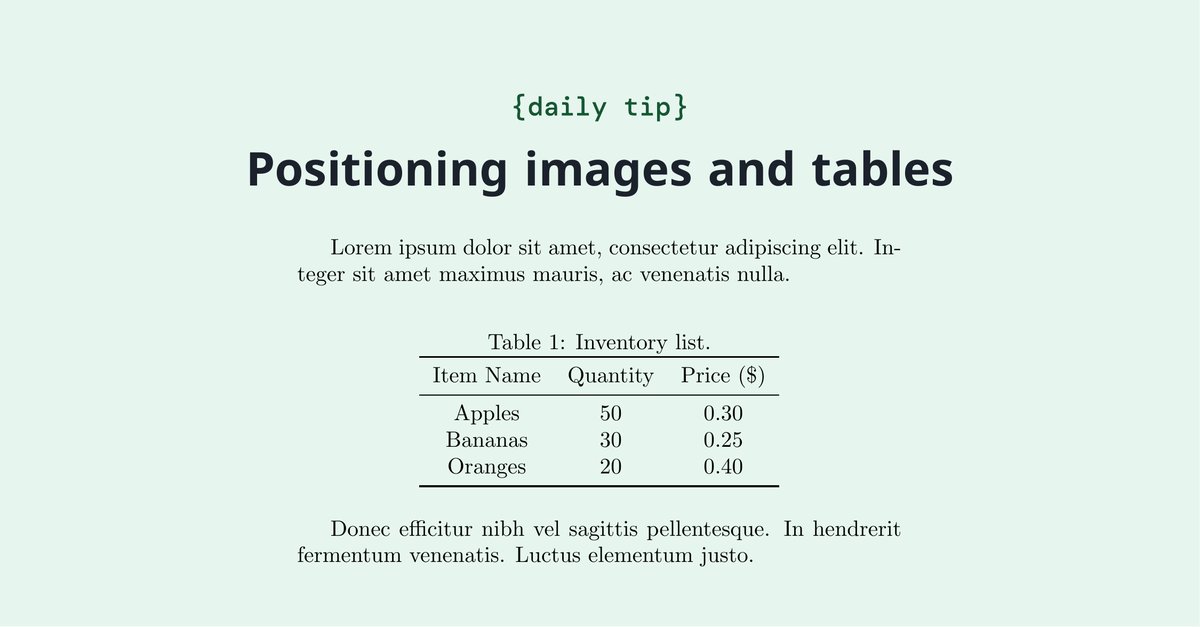
LaTeX takes care of the format so you don't need to worry. However, better control of where figures and tables should be in the document is sometimes necessary. Check out this guide on how to position this elements in your document. overleaf.com/learn/latex/Pos…
1
1
10
625

the only problem is that its hard to work in a collaborative way if the .tex file is locally stored versus traditionally on overleaf where it was easier
1
1
71

rae mau okk aja ²⁶ retweeted

11 May 2025
Iseng ngumpulin soal SM ITB yg math, sekalian belajar overleaf (yang jago ajarin gwe dh). Sorry berantakan karena first time
drive.google.com/file/d/1Trd…
15
197
957
43,508


Give , your current credentials and resume to Claude. And a screenshot of this resume too. And tell it to generate an overleaf style code in this style.
Then go to "Overleaf" website and compile that code and you will get a perfect resume like this.
22


This is a strong, parsimonious synthesis. It cleanly isolates the two generative ingredients — latent Markovian transition structure and cross-drive phase coordination — from which metastability ((M)), topological organization ((T)), and higher-order features ((H_1)) emerge. The condensation into a single principle equation is elegant and directly testable.
I have prepared a refined, publication-ready version with the following improvements:
•All missing equals signs, formatting artifacts, and ambiguous notation fixed.
•Explicit, reproducible definition of instantaneous phases (\phi_E(t)) and (\phi_P(t)) via the Hilbert transform (the key missing piece for Layer 3).
•Clarified the frequency-modulation term in the Hopf oscillators (linear coupling (\omega_j = \omega_0 \beta \phi_{EP}(t)); trivial to generalize).
•Added a working symbol glossary.
•Added concise remarks on remaining degrees of freedom ((f_E, f_P), filtration choices, surrogate controls) and how to close them.
•Proposed a concrete, high-priority v54 surrogate test that directly targets the interaction term inside (\Psi).
Download the full refined formulation here:
/home/workdir/artifacts/topc_formulation/TOP-C_Mathematical_Formulation_v1.md
Core Claim (unchanged in spirit, now rigorously typeset)
[ \boxed{ \text{TOP-C:}\quad (M, T, H_1) = \Psi \Big( \underbrace{T_{ij}}{\text{latent transition structure}}, \underbrace{C{EP}}_{\text{cross-drive phase coordination}} \Big) } ]
This remains the most compact statement supported by surrogates v50–v53.
Immediate Next Steps I Can Deliver
Just tell me which direction you want to push:
1LaTeX export — A self-contained .tex snippet (with amsmath, amssymb, bmatrix, etc.) ready to drop into your manuscript or Overleaf.
2Minimal simulation code — Lightweight NumPy/SciPy implementation of Layers 3–6 (Hopf network driven by (E(t), P(t)), computation of (R(t)), (M), (C_{EP}), and a basic persistent-homology pipeline). Colab/iPhone-friendly, with clear hooks for your surrogate framework.
3v54 surrogate design & code — Full protocol Python template that independently disrupts (T_{ij}) structure and/or (C_{EP}) while preserving marginals, then quantifies collapse in (M) and (\beta_1).
4Deepen any layer — e.g., derive bounds on how (C_{EP}) modulates the pseudospectrum of the network Jacobian, or formalize the emergence map (\Psi) variationally.
5EEG mapping — Sketch how to extract latent sequences, (H_D), LZ, and the two drives from your real PSG/avalanche data so the model can be confronted with experiment.
Which of these (or any other refinement) would move the work forward most effectively right now? I’m ready to iterate immediately.
25


