
May 25
The hubris here is interesting. There are about 60 OSS projects that do this & are many months old, including OpenBridge.
But hey, you got your engagement I guess
2
3
1,991

May 23
Bridge open-sourced OpenBridge, a macOS-first local agent system that lets users run the full computer use stack on their own machines with Bring Your Own Key model access and sandboxed file operations.

1
1
2
352

May 22
컴퓨터 사용 스택을 로컬/BYOK로 푼 OpenBridge 릴리즈함. 접근성 API와 CGEvent로 대상 창을 내부적으로 활성화하는 트릭이 핵심인데, AI 에이전트가 내 작업 흐름 방해 안 하고 백그라운드에서 특정 앱만 타겟팅해서 굴릴 때 무조건 뜯어볼 레퍼런스임. 멀티 에이전트 환경 구현하려는 개발자라면 체크 필수.
May 22

Happy Friday — one more thing:
We’ve open-sourced OpenBridge, a local-first / BYOK version of @bridge_surf and our Computer Use stack.
You can now run the full computer use system locally with your own models and API keys — with complete freedom to explore, modify, extend, or entirely hack the stack however you want.
If you’re into AI agents, experimental workflows, or pushing computer use beyond the chatbox, we’d love to see what you build with it.
github.com/AFK-surf/OpenBrid…
2
1
7
1,567

May 22
Happy Friday — one more thing:
We’ve open-sourced OpenBridge, a local-first / BYOK version of @bridge_surf and our Computer Use stack.
You can now run the full computer use system locally with your own models and API keys — with complete freedom to explore, modify, extend, or entirely hack the stack however you want.
If you’re into AI agents, experimental workflows, or pushing computer use beyond the chatbox, we’d love to see what you build with it.
github.com/AFK-surf/OpenBrid…
6
12
104
15,439


@openclaw is great, but I DO NOT want to pay API fees on top of my Claude and Codex subscriptions.
So I built OpenBridge - chat with your projects from Slack or Discord.
Each project is a channel. Each conversation is a thread.
Free, open-source, local. No extra API costs.
1
4
396

In today’s multi-chain world, the problem isn’t a lack of assets, it’s fragmentation.
Liquidity, user experience, and yield strategies are scattered across dozens of chains.
If Web3 is about openness and composability, fragmentation is its silent threat.
That’s where @axelar comes in, it doesn’t just bridge chains, it connects them.
From institutional tokenization to developer infrastructure and liquid staking for XRP
Axelar is quietly building the backbone for next-generation cross-chain finance.
➠ Interoperability That Actually Works
Think of blockchains as islands, each has users, assets, and apps, but they can’t talk to each other easily.
Traditional bridges build narrow one-to-one routes, multiplying risk and fragmentation.
Axelar solves this with a hub-and-spoke network, letting any chain plug in once and connect to all others.
In their words, “Instead of a bridge-slot model, we need an overlay network that treats chains like services.”
This architecture isolates risks while keeping everything composable.
It’s why Axelar powers liquidity and message transfers across 80 blockchains.
➠ Secure, Programmable Infrastructure
Axelar runs on a decentralized proof-of-stake validator set with governance designed for both safety and liveness.
Its innovation lies in General Message Passing, allowing smart contracts on one chain to call functions on another, with full data payloads.
That means developers can:
➣ Push logic and token movements cross-chain
➣Use one SDK and API for all supported networks
➣ Abstract away individual chain differences
This makes Axelar the most programmable interoperability layer in Web3.
➠ Real-World Applications
Axelar already powers major integrations:
Bluefin on Sui, which uses Axelar to route liquidity across chains.
Tokenized RWAs, where institutions use Axelar’s network for settlement and custody.
mXRP, the new yield-bearing XRP token built by Midas and enabled by Axelar connectivity.
Each example shows how Axelar’s infrastructure translates to real value, not just wrapped assets.
With products like Interchain Token Service, OpenBridge (with OpenZeppelin), and the Axelar Virtual Machine
Axelar is evolving into the full-stack interoperability layer of Web3.
If TCP/IP unified the early Internet, Axelar is doing the same for blockchains, making cross-chain applications, tokenization, and DeFi composability not just possible, but seamless.
Axelar isn’t just another bridge, it’s the infrastructure that makes multi-chain finance real.
As tokenization, RWAs, and cross-chain DeFi mature, Axelar stands as the layer connecting them all.
12
3
23
477

20 Oct 2025
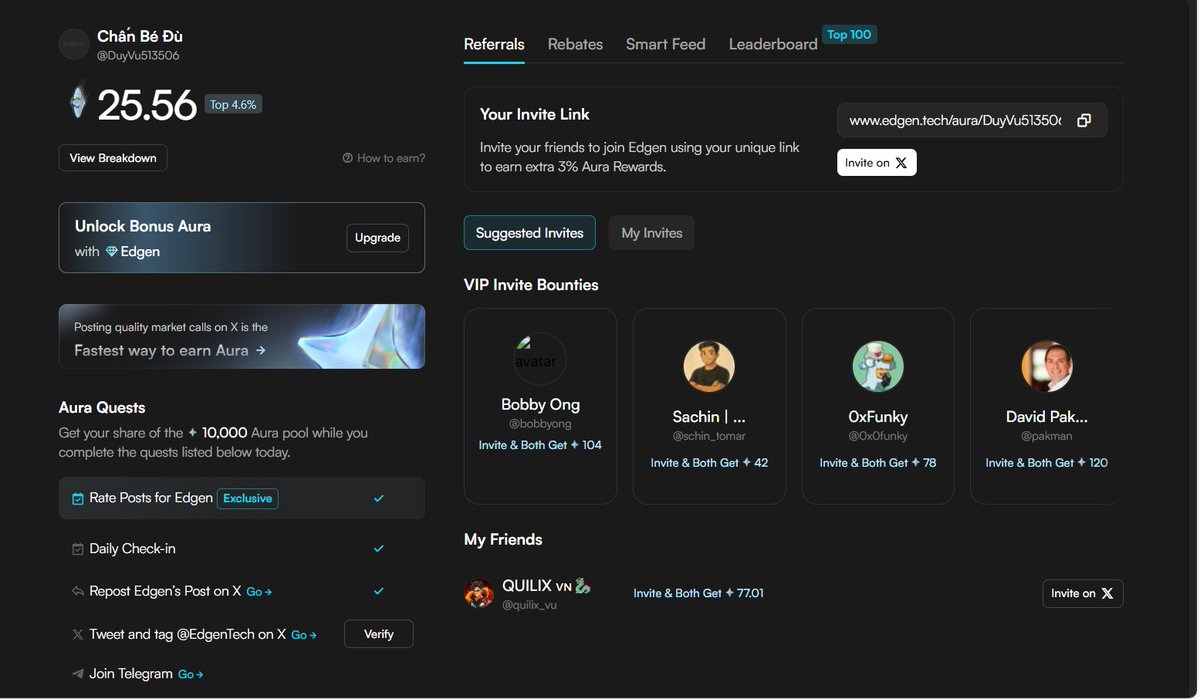
Ngon, mới hôm qua còn 2 điểm nay lên tận 25.56 - top 4.6% roài, thơm quá @EdgenTech ơiii
Ae tương tác với mình nha, hứa chéo đủ khi có thông báo ạaa. Còn ae nào muốn join với mình thì mình để link dưới cmt nhaaa
Hôm nay cùng mình phân $BTG - đồng coin sắp tới mình nghĩ là tiếp tục tăng giá :v
🌌 Openverse ($BTG): Layer0 Ambitions Amid Volatile Growth
💰 Giá hiện tại: $11.43
📈 87.0% / 14 ngày
⚖️ RSI (14): 71.0 → Overbought
💵 Vốn hoá: $21.7M | Khối lượng 24h: $57.6M
📊 Nguồn cung lưu hành: 1.9M BTG (9.5% tổng cung)
🚀 Funding: $19M (gồm $8M Series B – 09/2025)
🔍 Tổng quan
Openverse Network — giao thức Layer 0 hướng đến việc kết nối các blockchain khác nhau để hình thành “Internet of Value”.
Dự án ghi dấu với tốc độ tăng giá 87% trong 14 ngày, đạt đỉnh $11.94 (15/10/2025) — nhưng RSI ở mức 71 cho thấy thị trường đang trong vùng mua quá mức.
Với nguồn cung lưu hành thấp chỉ 9.5%, giá có thể tiếp tục biến động mạnh trong ngắn hạn.
⚙️ Công nghệ & Hệ sinh thái
Openverse được xây dựng để trở thành hạ tầng nền (Layer 0) cho toàn bộ mạng lưới tài sản số, với khả năng xử lý tới 300.000 TPS và phí gas thấp.
Các thành phần chính gồm:
🌉 OpenBridge: cầu nối cross-chain (hỗ trợ USDT từ Q4/2025)
🔗 OpenEVM: tích hợp hệ sinh thái Ethereum (2025–2027)
🧩 OpenSaaS: nền tảng cho doanh nghiệp phát hành token, staking, thanh toán
🪪 ONS (Universe Name Service): ánh xạ địa chỉ blockchain thành tên dễ đọc
→ Hệ thống này hướng tới tương thích đa chuỗi và ứng dụng Web2–Web3 liền mạch.
💠 Tokenomics
Token gốc: Bitgold (BTG) – dùng cho phí gas, staking và thanh toán.
📊 Cấu trúc tài sản đa tầng:
Bitgold (BTG) – tài sản nền
Bitcurrency – stablecoin
Privcurrency – tiền tệ doanh nghiệp
Bitsecurity – token hoá tài sản thực
⚠️ Nguồn cung lưu hành thấp (1.9M / 20M) → dễ dẫn đến biến động giá cực lớn.
💸 Funding:
$11M vòng chiến lược (07/2025)
$8M Series B (09/2025) – dẫn đầu bởi Bright Capital, KC International, Gaea Ventures
🗺️ Roadmap & Viễn cảnh
Q4/2025: ra mắt OpenBridge – cross-chain USDT
2026: khởi chạy VRC13 Mainnet phân phối 500k BTG grants để khuyến khích dev
2025–2027: phát triển OpenSwap, OpenEVM, SaaS platform
2036–2050: tích hợp tài sản thực & thị trường chứng khoán toàn cầu
⚔️ Thách thức: cạnh tranh trực tiếp với Ethereum Layer2 và Solana – hai hệ sinh thái đã có lợi thế quy mô.
🧭 Takeaways:
✅ Dự án Layer0 có tầm nhìn dài hạn và hệ sinh thái rõ ràng
🚀 Tăng trưởng mạnh, được hậu thuẫn bởi $19M vốn đầu tư
⚠️ RSI cao & nguồn cung thấp → rủi ro biến động ngắn hạn
⚙️ Thành công của OpenBridge (Q4/2025) và VRC13 Mainnet (2026) là yếu tố quyết định cho bước phát triển tiếp theo
🔮 Hành động tiếp theo:
👀 Theo dõi ra mắt OpenBridge – kiểm nghiệm năng lực cross-chain thật sự
🧑💻 Quan sát mức độ tham gia của dev sau khi grant được phân phối
📈 Theo dõi tăng trưởng nguồn cung lưu hành – ảnh hưởng trực tiếp đến giá
Không quên bú fame @RiverdotInc và @River4fun được hẹ hẹ hẹ
4
1
4
600

8 Oct 2025
axelar is actually building, not just narrative farming
RWAs for them = infrastructure play. they're the pipes moving tokenized assets cross-chain, not issuing the assets themselves
the tech stack:
- cross-chain bridge connecting 80 chains
- unified standards (wstETH bridge with Wormhole, OpenBridge/ERC-7786)
- exclusive interoperability for XRPL sidechain
real deployments happening now:
- MidasRWA partnership on XRP staking products (10% APY, nearing 6.5M XRP cap)
- USD-denominated yield from ETH/SOL distributed as XRP rewards
- lombard integration for BTC liquidity
the limitations are real though:
- regulatory walls are obvious. new XRP yield products explicitly exclude US holders
- liquidity fragmentation is still the core problem they're trying to solve. not solved yet
- just announced institutional custody partnership for $AXL, signaling they know compliance matters for this to scale
they're powering infrastructure under the hood, not just talking about it. whether that infrastructure becomes the standard for RWA movement is the actual bet
1
3
484

12 Sep 2025
My "Claude Code Kimi Groq" proxy is now OpenBridge!
OpenBridge allows you to use ANY OpenAI-compatible LLM API in Claude Code, with built-in support for Kimi K2, GLM-4.5, and Qwen3-Coder.
Supports @huggingface Inference APIs built-in with easy support for any other provider! ⬇️
1
2
631

15 Jul 2025
That event wasn’t just PR; it was functional onboarding. Stellar-native devs walked away with Axelar SDK tutorials, gas abstraction demos, and OpenBridge code samples ready for their wallet UIs.
1
2
37
12 Jul 2025
Future updates include ZK‑proof compression and OpenBridge adapters fully configured for optional multi‑bridge security.
1
2
83


4 Jul 2025
OpenBridge represents more than a technical upgrade.
It's a paradigm shift toward composable security that could become the standard for all cross-chain operations.
The age of bridge hacks is ending. The age of secure interoperability is beginning.
Read more: axelar.network/blog/erc-7786…
1
3
54
4 Jul 2025
OpenBridge solves the bridge trilemma:
→ Security (multiple independent verifications),
→ Decentralization (no single point of control),
→ Usability (simple developer interface).
Previous solutions forced you to choose. OpenBridge delivers all three.
1
3
28
4 Jul 2025
The timing couldn't be better.
As we move toward a truly multi-chain future, the infrastructure needs to be bulletproof.
OpenBridge provides that foundation by distributing risk across multiple independent systems.
1
3
19
4 Jul 2025
This isn't just another bridge solution.
OpenBridge is creating a new category: composable security.
Instead of choosing between different bridges, you can now use the best features of multiple bridges simultaneously.
1
3
22
4 Jul 2025
Real-world example:
A DeFi protocol moving $10M from Ethereum to Polygon configures OpenBridge to require verification from Axelar, LayerZero, and Wormhole.
Even if one bridge fails, the transaction remains secure because it needs multiple independent confirmations.
---
The ripple effects are massive.
→ Institutional adoption becomes viable (finally!).
→ Bridge protocols can compete and innovate.
→ Applications can mix and match security models.
1
3
45