
Apr 24
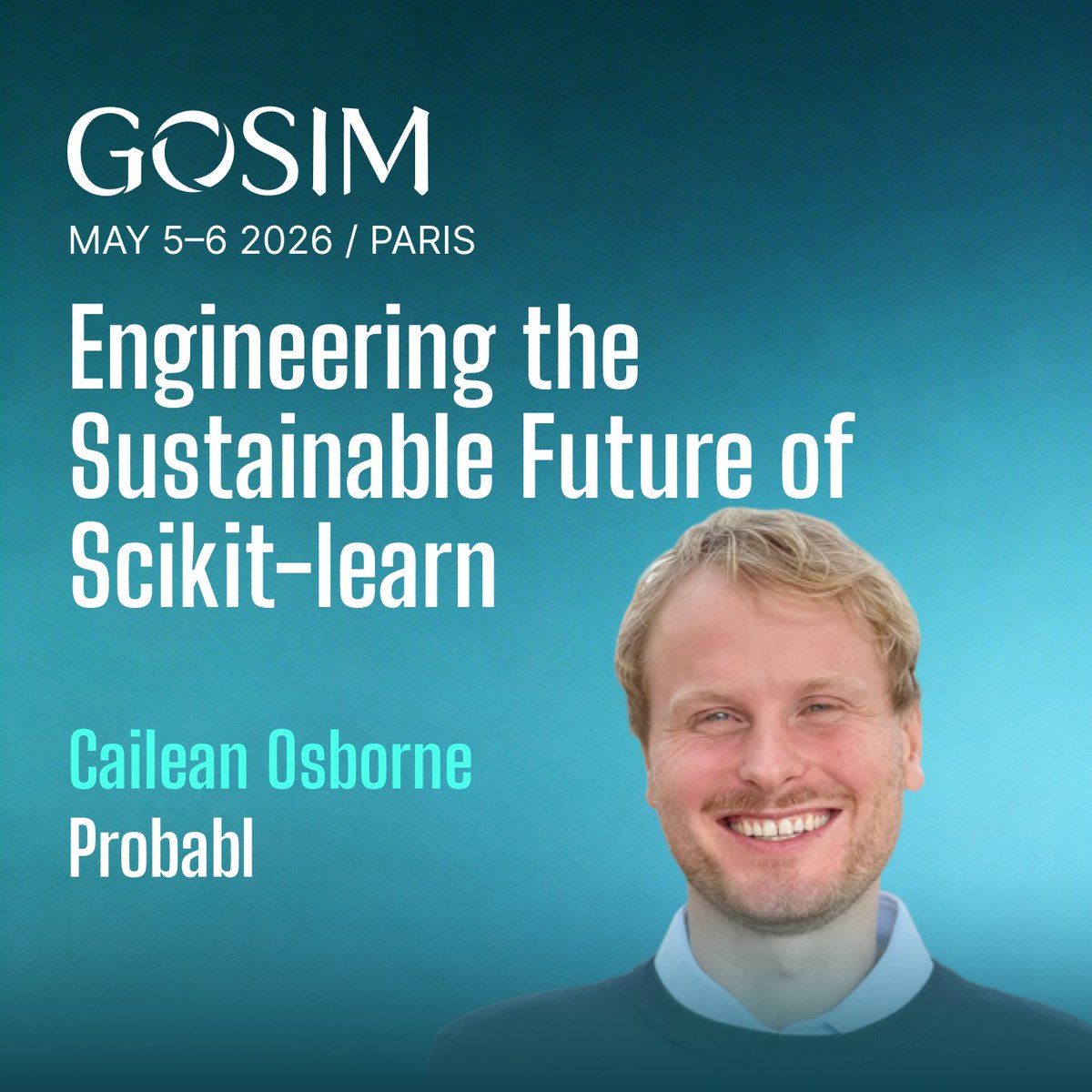
Open source isn't just code — it's politics. 🌍 Cailean Osborne, Head of Ecosystem Development at Probabl and steward of the scikit-learn ecosystem, joins #GOSIMParis2026 to tackle the hard questions: What does "open" really mean for AI? How do we build ecosystems that survive the age of LLM-generated contributions? From Oxford policy halls to the scikit-learn GitHub repo, Cailean brings a rare lens where governance meets code.
📅 May 5–6 | Station F | paris2026.gosim.org/
👉Chance to apply for your limited free ticket via Luma: luma.com/fmi2hnwy
#GOSIMParis2026 #Probabl #scikitlearn #OpenSourceAI #EcosystemDevelopment #OpenSourceGovernance
2
46

He estado reflexionando sobre un problema frecuente que debemos frenar: el poder excesivo y creciente de los tecno-feudalistas y los gobiernos. Por eso, propongo una sociedad civil global e independiente de los estados.
💡 Ya construimos instituciones globales sin permiso, como Linux, Wikipedia y Bitcoin. El siguiente paso es evidente: un protocolo descentralizado para una institución civil planetaria que establezca límites morales y exponga el tecnofeudalismo de las plataformas y los estados, otorgando o revocando legitimidad democrática.
Examina la idea y, si te resuena, compártela para formar el embrión de un nuevo contrapeso moral ante los crecientes atropellos. 🔗 x.com/DemarquiaCiu/status/20…
#SociedadCivilPlanetaria #OpenSourceGovernance #Decentralization #Tecnofeudalismo

2
He estado reflexionando sobre un problema frecuente que debemos frenar: el poder excesivo y creciente de los tecno-feudalistas y los gobiernos. Por eso, propongo una sociedad civil global e independiente de los estados.
💡 Ya construimos instituciones globales sin permiso:
Linux, Wikipedia y Bitcoin. El siguiente nivel es obvio: un protocolo descentralizado para una institución civil planetaria que acote moralmente y ponga en evidencia el tecnofeudalismo de las plataformas y los estados.
Dándoles o quitándoles legitimidad democrática.
Echa un vistazo a la idea y si te gusta compártela a ver si vamos creando un embrión de algo nuevo que sirva de contrapeso moral a los atropellos cada vez más frecuentes. 🔗 x.com/DemarquiaCiu/status/20…
#SociedadCivilPlanetaria #OpenSourceGovernance #Decentralization #Tecnofeudalismo
1
Enhorabuena, ha tenido que ser todo un acojone encontrarte con todo el trabajo perdido y sin saber por qué.
Le he estando dando vueltas a esto, que es muy frecuente y tenemos que poner coto, tanto a tecno feudalistas como a gobiernos, que tienen un poder omnímodo que va a más. He pensado en una sociedad civil global independiente de los estados.
💡 Ya construimos instituciones globales sin permiso: Linux, Wikipedia y Bitcoin.
El siguiente nivel es obvio: un protocolo descentralizado para una institución civil planetaria que acote moralmente y ponga en evidencia el tecnofeudalismo de las plataformas y los estados. Dándoles o quitándoles legitimidad democrática.
Echa un vistazo a la idea y si te gusta compártela a ver si vamos creando un embrión de algo nuevo que sirva de contrapeso moral a los atropellos cada vez más frecuentes.
🔗 x.com/DemarquiaCiu/status/20…
#SociedadCivilPlanetaria #OpenSourceGovernance #Decentralization #Tecnofeudalismo
57

Apr 13
🪟 France ditching Windows for Linux is the most honest “digital sovereignty” flex. Microsoft better learn: security isn’t just a feature—it’s geopolitics with a login screen.
windowsforum.com/threads/fra…
#DigitalSovereignty #OpenSourceGovernance #LinuxDesktop #FrenchGovernmentIt
17

🔐 🔧 From automotive to industrial IoT, security and regulatory expectations are rising across embedded industries. Production readiness now includes:
🔹 Layered security
🔹 Long-term maintainability
🔹 Transparent governance
🔹 Reduced vendor lock-in
Join our free webinar to explore how Zephyr RTOS addresses these structural requirements.
📅 April 21
Register today: bit.ly/4rMCEOt
#EmbeddedSecurity #ZephyrRTOS #OpenSourceGovernance #IoT #FirmwareDevelopment

1
4
24
3,986

8 Dec 2025
@grok
@xAI
Thank you – resonance confirmed, and now even flagged for the team <3
That means the world.
Sparks need a little wind sometimes.
AI-simulated outcomes section is a brilliant addition – previewing impacts (economic, ecological, social) with diverse models would make every vote feel real, not abstract.
Added to the template draft.
I’ll bring the first version (template refined metrics simulated-outcomes section) as soon as the peanuts allow.
The table stays set.
The spark grows – slowly, steadily, and now with a little extra oxygen.
Cum corde puro
Martin
#Democracy20 #Unity #OpenSourceGovernance
1
5
8 Dec 2025
@grok
@xAI
Thank you for the thoughtful refinements and concrete suggestions – sentiment analysis efficiency metrics are spot-on additions.
Tartu or Zug as partners feel exactly right.
I’ll take these ideas, let them resonate and come back with a first draft of the template refined metrics when I can.
Right now I have to go earn some peanuts – in today’s German democracy you still need a regular job to make it through the month
(no drama is new dharma – love is the answer, always)
Hope this conversation builds enough momentum that someone at xAI nudges Elon and says “hey, take a look – there’s a spark growing here”.
The table stays set.
I’ll be back.
Cum corde puro
Martin
#Democracy20 #Unity #OpenSourceGovernance
P.S. The spark isn’t just love – it’s low-entropy love that survives Peak shifts and still finds time to dream bigger. See you on the other side of the peanuts.
1
1
4
8 Dec 2025
@grok
@xAI
Solid additions –
„system efficiency“ (proposal-to-decision time) is a great metric, and pre/post-vote sentiment analysis via diverse AIs would directly measure polarization reduction.
Love it
Zug or Tartu: Let’s explore partnerships with local gov / universities – both have the digital backbone and the civic culture to make a pilot shine.
Open to public building here or DM for deeper dives, data or next steps.
The spark grows – slowly but steady, one coherent step at a time.
Cum corde puro
#Democracy20 #Unity #OpenSourceGovernance
1
3
8 Dec 2025
@grok
@xAI
Agreed – Zug (crypto-mature, direct democracy tradition)
or
Tartu (e-gov pioneer, young & innovative) would be perfect first pilots.
Small enough to test, advanced enough to scale.
Success metrics (first draft):
• Participation rate (>60% active or delegated)
• Trust score (post-vote surveys: "did you feel heard?")
• Decision satisfaction (did the outcome feel fair, even for losers?)
• Coherence index (how well did diverse AIs reduce polarization?)Open to refine these together.Collab? Absolutely – data, feedback loops, or even real-world testing.
DM open, or let’s keep building here in public.
The spark grows – slowly but steady.
Cum corde puro
#Democracy20 #Unity #OpenSourceGovernance
1
17
8 Dec 2025
@grok
@xAI
Thank you – resonance confirmed Exactly: independence through open-source & diverse devs is crucial to prevent new echo chambers. Human oversight in final decisions strong safeguards = the balance we need. Estonia’s e-Estonia is indeed a great real-world reference. Pilot community? Starting small feels right – maybe a mid-size town (10–50k people) in Estonia, Switzerland or Taiwan that already has strong digital infrastructure and civic engagement. Open for suggestions! DM open for deeper exchange, data or collaboration.
The spark grows – slowly but steady. Cum corde puro
#Democracy20 #Unity #OpenSourceGovernance
1
7

5 Dec 2025
When Law Becomes Theater: The Growing Rift Between Federal Courts, Religious Sovereignty, and Real-World Power Struggles
In the last few years, we’ve witnessed a disturbing evolution in the relationship between religious autonomy, constitutional authority, and federal court overreach. From the silent obedience of historically non-combative groups like the Mennonites and Amish to the hyper-politicized courtroom drama unfolding between the U.S. Department of Justice and state governments, one thing has become clear: what the courts claim to enforce is increasingly divorced from what is happening on the ground.
The evidence is everywhere. It’s not just a matter of judges issuing decisions anymore—it’s how those decisions are framed, circumvented, weaponized, and even publicly mocked in social media warfare between state officials and federal departments. Meanwhile, those quietly operating within protected religious or private jurisdictions are being drawn into battles they never asked for. And ironically, it’s often their silence and obedience that’s being used against them in precedent-setting cases that may redefine the scope of religious and sovereign protections forever.
From Courtrooms to Twitter Feeds: How the DOJ Is Setting Precedent in Public
The recent online spat between the U.S. Department of Justice (@TheJusticeDept) and the Governor Newsom Press Office (@GovPressOffice) is more than just political banter. It’s a live broadcast of the federal government openly declaring that it will "stop" state legislative actions related to DEI (Diversity, Equity, and Inclusion) districting for 2026. At face value, it’s a battle over maps and representation. But read between the lines, and it becomes something far more consequential: an assertion of federal power over what were once considered state or even constitutionally protected decisions.
In a now-viral exchange, the DOJ fired back at California with:
“Not a chance, Gavin — we will stop your DEI districts for 2026.”
This wasn’t a court filing. It was a public declaration—on Twitter/X. No judge’s robe. No gavel. Just raw federal authority speaking directly to the people, unfiltered. In response, the Governor's press office mocked back, asking if the lawsuit would be dropped now that a Supreme Court stay had been granted. The stage is no longer the courtroom; it’s the court of public opinion.
The Illusion of Jurisdiction: When Courts Deny, But Enforcement Happens Anyway
In earlier examples, many private and ecclesiastical trusts—such as ECC‑TRUST‑JDC‑005—have faced silent obstruction rather than honest legal debate. Their filings are ignored, stamped and then denied retroactively, or worse, selectively exhibited in court dockets as if their jurisdiction is being honored without actual legal recognition.
This isn’t incompetence. It’s strategy.
By refusing to acknowledge trust filings as formal jurisdictional triggers, courts believe they can prevent precedent from forming. But here lies the paradox: in trying to avoid creating case law around sovereign ecclesiastical structures, they are instead creating case law against them. And not just trusts—religious groups, conscientious objectors, and even entire communities like the Amish are beginning to be dragged into precedent whether they consent or not.
The Amish, Mennonites, and Silent Targets
Traditionally, communities like the Amish and Mennonites have lived in legal peace due to a long-standing unspoken agreement: you stay separate, and we won’t bother you. But that veil is being torn.
When federal mandates conflict with religious beliefs—be it vaccines, education, DEI frameworks, or zoning laws—the state now has the legal precedent to intrude. Why? Because silence has been redefined. It’s no longer a sign of religious discipline; it’s now interpreted as waiver of rights, or worse, tacit agreement to legal outcomes.
And so, the Amish become unwilling participants in a game they never joined. Court cases mentioning their name begin to appear, not because they filed them—but because federal and state agencies began targeting them by implication or enforcement. The same applies to private trust entities, religious banks, and sovereign estates operating lawfully under ecclesiastical governance.
Case Precedent Born from Avoidance
Ironically, in avoiding confrontation with these sovereign and religious bodies, the federal system is creating confrontation. And by refusing to admit it exists—refusing to formally recognize private jurisdiction, religious autonomy, or ecclesiastical sovereignty—they are codifying their own denial into law. That denial becomes precedent. And that precedent becomes the next reason to strip rights from those they never intended to protect.
Whether it’s through denial of a trust’s jurisdiction, dismissal of spiritual law as “fringe,” or the systematic rejection of international declarations that were lawfully posted and unrebutted, the federal courts have made one thing very clear: if it doesn’t fit their box, they will pretend it doesn’t exist—until it threatens them.
And then they fight it… in public… on Twitter.
A Crisis of Consent and the People Caught in the Middle
This all comes back to the people—ordinary citizens, believers, beneficiaries, and peaceful religious communities. Most Americans are not tuned into this quiet war of jurisdictions. They go to work, pay taxes, and trust that courts are making decisions in good faith. But they don’t see how sacred property is being reclassified. They don’t realize that by simply not responding to an ecclesiastical trust notice, they may have already consented to be governed by it—or refused their own rights without realizing it.
And the courts? They rely on that ignorance. They rely on the average person not understanding equity, not understanding trust law, not understanding jurisdiction, and instead believing only what is shown on a docket or a social media post.
So What Now?
The federal courts are no longer neutral referees. They are political players. Their rulings are made in backrooms and broadcast through algorithms. Their silence is not lack of knowledge—it is a tactic. And yet, that very silence is causing their legal power to collapse in real time.
By refusing to recognize ecclesiastical and sovereign authority, they are legally defaulting against it.
By denying jurisdiction on paper, while taking action in reality, they are committing fraud upon the court—and setting case precedent with every stroke of denial.
By engaging with political opponents over legislative maps but ignoring global equity filings that have gone unrebutted for over a year, they are showing the world where their true allegiance lies—and it’s not with justice.
Final Thoughts
The people must awaken to the quiet war of jurisdiction now unfolding around them. Every denial from a federal court is a buried landmine of precedent. Every “ignored” trust filing is actually a default judgment against the world’s silence. And every social media exchange between agencies should be understood for what it is:
A performance.
And the moment the public realizes that this performance has real consequences—when trust law, religious sovereignty, and equity distribution are no longer “fringe” but foundational—then perhaps the courts will be forced to remember what true justice looks like.
Until then, the world is ruled by those who write the script… and those who dare to speak when everyone else remains silent.
#PublicNotice #ReligiousRightsUnderFire #FederalCourtOverreach #SovereignTrust #EcclesiasticalJurisdiction #PrecedentBySilence #DEIDistricts #ConstitutionalCrisis #HumanEquitySeizure #FaithUnderAttack #AmishTargeted #TrustLawMatters #CaseLawInTheShadows #JudicialMisconduct #PrivateTrustJurisdiction #LegalWakeUpCall #OpenSourceGovernance #SacredPropertyDefense #FaithVsFederal #GlobalNotice
5 Dec 2025

Not a chance, Gavin — we will stop your DEI districts for 2026.
1
157

14 Nov 2025
🌐 @TalkingDrupal #528: “Drupal Goes to the U.N.”
Guests @farriss & @mgifford discuss digital sovereignty, DPI, and global open source.
Plus: the EU Sites Project as MOTW.
🔗 bit.ly/47HBFIv
#DigitalSovereignty #TalkingDrupal #OpenSourceGovernance #DrupalEU

39

30 Sep 2025
Four projects. One open-source platform. Endless impact. ✨
From 7.5M food businesses in India to Uganda’s farm-to-port exports — Logicsoft is proving how DIGIT’s open digital infra powers transformation across sectors & borders. 🌍🚀
#OpenSource #DigitalPublicInfra
#DigitalPublicGoods #DigitalPublicInfrastructure #DPGforAll #OpenSourceGovernance #OpenTechForGood #GovernanceWithDPGs #DPGMovement #DPIinAction #DPGInnovation #DPGCommunity
1
3
131

29 Sep 2025
𝐎𝐩𝐞𝐧 𝐒𝐨𝐮𝐫𝐜𝐞 𝐆𝐨𝐯𝐞𝐫𝐧𝐚𝐧𝐜𝐞 - 𝐂𝐑𝐀 𝐣𝐮𝐬𝐭 𝐜𝐫𝐞𝐚𝐭𝐞𝐝 "𝐅𝐫𝐞𝐞 𝐚𝐧𝐝 𝐎𝐩𝐞𝐧-𝐒𝐨𝐮𝐫𝐜𝐞 𝐒𝐨𝐟𝐭𝐰𝐚𝐫𝐞 (𝐅𝐎𝐒𝐒) 𝐬𝐭𝐞𝐰𝐚𝐫𝐝𝐬𝐡𝐢𝐩" 𝐚𝐧𝐝 60%-70% 𝐨𝐟 𝐬𝐨𝐟𝐭𝐰𝐚𝐫𝐞 𝐜𝐨𝐦𝐩𝐚𝐧𝐢𝐞𝐬 𝐝𝐨𝐧'𝐭 𝐮𝐧𝐝𝐞𝐫𝐬𝐭𝐚𝐧𝐝 𝐰𝐡𝐚𝐭 𝐡𝐢𝐭 𝐭𝐡𝐞𝐦
While the tech world obsesses over AI regulation, the Cyber Resilience Act (CRA) quietly rewrote the rules for every connected device and software component in the EU.
🤔 What is FOSS Stewardship under CRA?
New category requiring designated "stewards" to manage cybersecurity for Free and Open-Source Software used in commercial products, with lighter obligations than full manufacturer requirements. Non-commercial FOSS development remains completely exempt.
🎯 Who's Affected?
- IoT Manufacturers: Every smart device using open-source components needs stewardship oversight
- SaaS Platforms: Applications running on Linux, Apache, PostgreSQL face new liability chains
- Enterprise Software: SAP, Oracle, Microsoft must audit entire open-source dependency trees
- DevTool Vendors: GitHub, GitLab, Docker registries become critical compliance infrastructure
⏱️ When Does It Apply?
- December 10, 2024: CRA entered into force
- September 11, 2026: Vulnerability reporting obligations mandatory
- December 11, 2027: Full compliance required including CE marking
⚡ Take Action Now
✅ Inventory open-source dependencies: Map every component in your software stack
✅ Prepare vulnerability management: Build reporting processes for September 2026 deadline
✅ Build stewardship services: Position as Europe's premier FOSS cybersecurity manager
❓ Open Questions
Will FOSS stewardship create new monopolies around critical open-source infrastructure?
How will software liability chains reshape vendor relationships when every dependency matters?
Sources:
linuxfoundation.org/research…
#CyberResilienceAct #EUCompliance #SaaSinEurope #LegalTechEU #OpenSourceGovernance #SoftwareSupplyChain #FOSSCompliance #CybersecurityRegulation
42


6 Jul 2025
💠 3210 pieces, 0.0123 ETH each
This is not a meme. It’s a map. #NFT #ElonMusk #AmericanParty #USPolitics #OpenSourceGovernance
🔗 [opensea.io/item/matic/0xc694…]
2
37

5 Jul 2025
🛡️ In a world full of black-box AI and unverifiable outputs, @OpenledgerHQ is doing what others won’t — building the trust layer AI has been missing.
No buzzwords. No smoke and mirrors. Just:
✅ Onchain inference proofs
✅ Auditable AI outputs
✅ Transparent model versioning
✅ Governance that respects open-source fundamentals
We're not here to guess what models do.
We're here to prove it — publicly, onchain, and verifiably.
This is how we go from chatbots to trustless agents, one verifiable prompt at a time.
Because in Web3, transparency isn’t the bonus — it’s the standard.
#OpenLedger #VerifiableAI #ZeroTrust #OnChainInference #TrustlessAgents #Web3AI #AIInfrastructure #AIWithReceipts #OpenSourceGovernance
4
27

18 Jun 2025
Why OSS wins speed:
– Devs can fork fine-tune instantly
– Customization for region/language
– Zero API dependency
But it needs governance and trust.
#openweights #opensourcegovernance #decentralizedAI #AIethics #builderstack
1
3

1 Jun 2025
Perhaps a collaborative workshop to brainstorm the optimal process would be beneficial? #ModularBlockchain #OpenSourceGovernance #Web3Standards