
Sadly they haven't been pre ordable in a while at Hasbro Pulse or Amazon, but maybe try Gamestop

HERE IS EVERY WEBSITE YOU CAN PRE-ORDER THE LUNA SNOW ACTION FIGURE:
Amazon: a.co/d/08DUv1jk
Hasbro Pulse:
hasbropulse.com/product/marv…
GameStop: gamestop.com/collectibles/fi…
Entertainment Earth: entertainmentearth.com/produ…

1
22

Healthier India For All!ordable treatment, stronger healthcare access, and greater peace of mind Ayushman Bharat is making it possible. With 43 crore Ayushman Cards and 1.8 lakh Ayushman Arogya Mandirs, millions of families are receiving the healthcare support they deserve.
15
Jun 12
PG电子Cross-seaso双赢彩票n clothing discount sales help clothing brands clear overstocked inventory release cap世界杯ital flow and let consumers buy high-quality apparel at aff开云体育ordable favorable prices.
8ETp3jAm
😎 🎉 ❤️ 🙌 😁 😄
3

Jun 11
Cross-season 双赢彩票clothing discount sales help clothing brands clear overstocke开云体育d inventory release capitaPG电子l flow and let consumers buy high-quality apparel at aff世界杯ordable favorable prices.
CqcyMVev
🌸 🔥 🙌
2

Jun 11
Cross-season clothing discou双赢彩票nt sales help clothPG电子ing brands clear overstocked inventory release capital f开云体育low and let consumers buy high-quality apparel at aff世界杯ordable favorable prices.
GLWaxC
💕 🌸 🤩 😀 🥳
Jun 11
Cross-season clothing discount 万博体育sales help clothi南宫娱乐ng brands clear overstocked inventory release capital flow and开元棋牌 let consumers buy high-quality apparel at aff开云体育ordable favora世界杯bl问鼎娱乐e prices.
XdFq9fZJ2
😀 🔥 😃
5
Cross-season clo九游娱乐thing discount sales help clothing 世界杯brand开云体育s clear overstocked九游会 inventory release capital flow and let consumers buy high-quality apparel at aff尊龙凯时ordable favorable pri九州体育ces.
bE10kw
🎊 🤗 😄 🥰 😋 👍
2

Jun 10
Cross-season clothing discount sales help clothing brands cl双赢彩票ear overstocked inventory release capital flow and let consu世界杯mers buy high-quality a开云体育pparel at affPG电子ordable favorable prices.
nmeQK1cDFj
❤️ 👏 🙌 😆 🤩 🌟
1

Mar 14
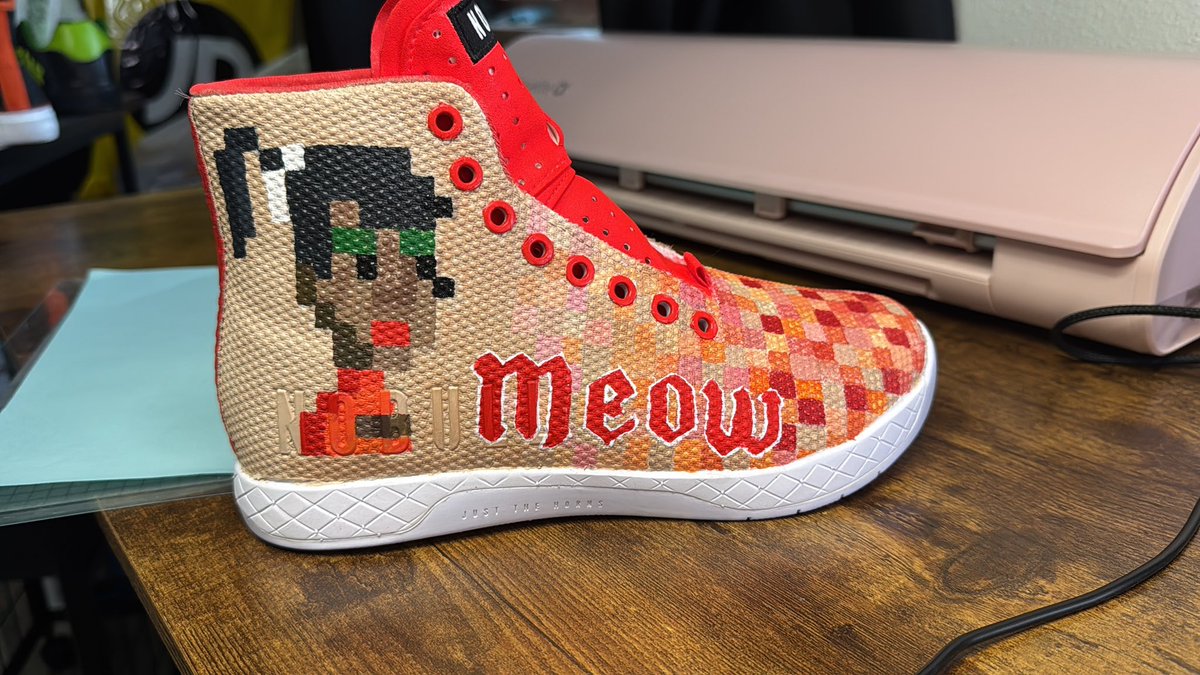
Wouldnt a true retardmaxxing have a pair of SOLjakey shoes?👀
Soon ordable.... stay tuned...
1
2
45

10 Nov 2025
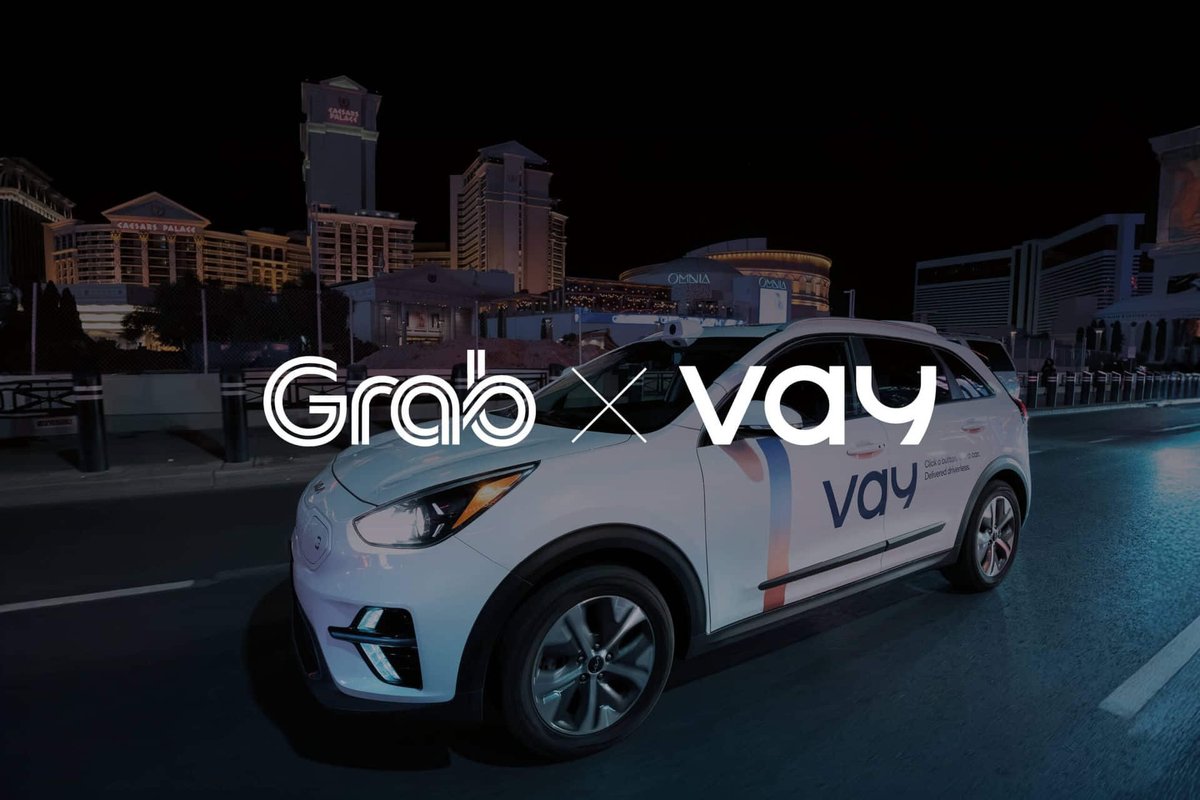
BREAKING $GRAB to make $60m stategic investment in Remote Driving Technology Company Vay🤝🤝
This investment enables Vay to scale and expand its operations in the U.S., while enhancing Grab's mobility offerings and accelerating its autonomous and remote driving expertise in the long term.
Initial investment of $60 million, followed by potential investment of $350 million, subject to Vay and Grab reaching agreed nancial and operational milestones within the rst year post-Closing.
Singapore and Las Vegas, November 10, 2025 - Grab Holdings Limited ("Grab") announced that it had signed definitive agreements to invest in Vay Technology GmbH ("Vay"), a leading provider of automotive-grade remote driving technology, for $60 million in cash. The investment is subject to regulatory approval and other customary closing conditions and is expected to close in the fourth quarter of 2025 ("Closing"). Upon Closing, Grab will hold a minority equity interest in Vay.
@AnthonyPY_Tan Chief Executive O cer and Co-founder of Grab, said, "We believe the future of mobility in Southeast Asia will be a hybrid model that relies on the expertise of our driver-partners alongside autonomous vehicles and remote driving services. This initial investment will help accelerate Vay's remote driving technology development and create valuable technical and operational synergies for Grab's long-term mobility strategy. It will also support Vay's expansion in the U.S., where they serve a growing segment of consumers who prefer not to be car owners and are looking for more exible, a ordable, mobility options."
Thomas von der Ohe, Chief Executive O cer and Co-Founder of Vay, said, "As we plan to deploy tens of thousands of shared, electric, driverless vehicles over the coming years, we couldn't be more excited to have one of the best operators in the world join us on this journey. Mr. Tan and I share the same vision of reducing private car
Through the Vay mobile app, customers request an electric vehicle to be remotely delivered to their location. When it arrives, the remote driver disconnects from the vehicle and the user takes over, driving it like a regular car. At the end of the trip, they exit the vehicle, and a remote driver resumes control, eliminating the time-consuming search for parking. This di erentiated on-demand car rental service is especially suited for those completing point-to-point and multi-leg journeys, and is highly a ordable for customers. As Vay's customers drive themselves, remote drivers only operate vehicles at the beginning and end of each rental. This model allows each remote driver to support more customer trips per hour and achieve signi cantly lower service costs compared to traditional ride-hailing services. Combined with Vay's fully camera-based, hardware-light system, it creates a cost-e cient model for on-demand mobility.
With operations across eight Southeast Asian countries in over 800 cities, Grab has a proven track record of commercializing large-scale on-demand mobility businesses. Grab will leverage its marketing, product development, eet management, and go-to-market expertise to support Vay's growth in the U.S., while exploring how Vay's service model can complement Grab's suite of mobility services in Southeast Asia. In addition, this investment supports Grab's autonomous mobility strategy. For example, the driving data that Vay collects through its eet could accelerate the training of AI models that improve autonomous vehicles' perception of the real world. Grab's announcement today follows recent investments in autonomous driving players, including WeRide and May Mobility.
Patrick Pichette, investor and former CFO of Google: "I have backed Vay for years, and I am even more excited to see what its proven technology and product can achieve now that it is paired with Grab's operational excellence. Vay's focus on the driverless rental car space, a complement to robotaxis, o ers its own unique massive market opportunity, and a long-term opportunity to replace private car ownership."
Vay launched its remote-driven commercial eet in Las Vegas in 2024. Built to enable human-machine collaboration, Vay's technology is designed to navigate complex, high-density environments, such as the Las Vegas Strip, one of the areas where Vay currently operates. The company has been on track to expand its eet throughout 2025 and has completed tens of thousands of trips in Las Vegas. Its automotive-grade remote driving technology prioritizes high safety standards and low-latency connectivity and has been certi ed by German vehicle safety and motor transport authorities to rigorous automotive standards. Vay intends to add autonomous driving functionalities into its system based on its high-quality remote driving data. Its team consists of experts from autonomous and automotive industry companies, and its investors include Kinnevik, Coatue, Atomico, General Catalyst, and Eurazeo.
In Grab's initial investment of $60 million, Vay will issue to Grab new shares and zero-strike warrants that will become exercisable subject to, among other things, achievement of certain milestones over the three-year period after Closing.
In addition, subject to nancial and operating milestones, regulatory approvals and other conditions, Grab will increase its equity interest in Vay with an additional $350 million within the rst year after Closing. The nancial and operating milestones include consumer revenue, U.S. cities covered, technology and safety standards, and obtaining regulatory approvals (where applicable) for operating in additional U.S. cities. This potential additional purchase will consist of acquisition of new shares as well as shares from existing shareholders. If the milestones are not achieved within the initial one-year period after Closing, Grab has the option, but not the obligation, to purchase the additional equity interest.
Three years after Closing, if Grab has completed the purchase of the additional equity interest and all the warrants have become exercisable in accordance with its terms, Grab will potentially own a majority equity interest in Vay on a fully-diluted basis (assuming there has been no share capital change in Vay).
9 Nov 2025

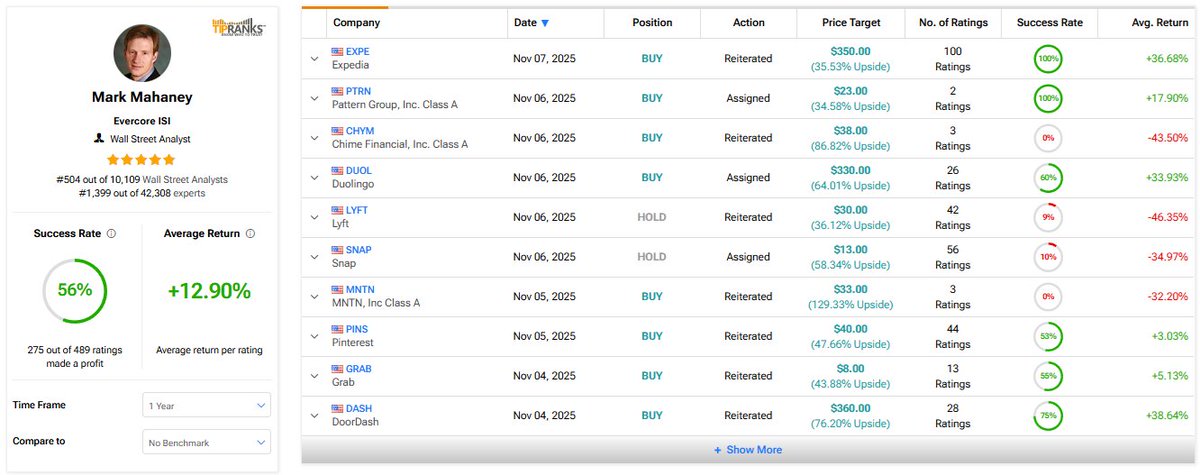
$GRAB & Evercore ISI $8 PT Comment 🔥🔥🔥
Mark Mahaney, a senior analyst at Evercore ISI (ranked among the top tech analysts on Wall Street with a 4.5-star TipRanks rating and 65% success rate), is the most bullish on Grab Holdings Limited ($GRAB). On November 4, 2025 immediately following the company's Q3 earnings release he raised his Outperform (Buy equivalent) rating and hiked the price target to $8 from $7
Mahaney's optimism stems from Grab's accelerating path to profitability, robust ecosystem growth in Southeast Asia's "super app" model, and resilient consumer demand amid economic headwinds. His track record includes strong calls on internet stocks like Amazon (pre-2020), and he views Grab as a "top pick" in the small- to mid-cap internet sector.
~Mahaney praises the "flawless execution" in cost controls and operating leverage, with FY2025 guidance raised to $2.76–$2.78B revenue (up from $2.70–$2.75B) and $480–$500M EBITDA (vs. prior $450–$475M). This implies 20% revenue CAGR through 2026.
~He adjusted FY2025 EPS to $0.06 (from $0.05, above consensus $0.04) and FY2026 to $0.11 (up from $0.09), driven by 25% MTU (monthly transacting users) growth to 48 million.
~Key Quote: "Grab's profitability inflection is here to stay fifth quarter of positive EBITDA confirms the model scales beautifully as GMV accelerates."
~Fintech (payments/lending) was the star, up 34% YoY with lending GMV at $1.2B (monetization via risk-based pricing). Mahaney sees Fintech crossing 50% of total revenue by 2027, leveraging 30M digital wallet users.
~Mahaney lauds Grab's "everything app" evolution: Q3 launches in advertising (up 50% YoY) and enterprise services (B2B logistics) tap underserved verticals. Partnerships with Google Cloud and Visa enhance fintech scalability.
~He projects total addressable market expansion to $250B by 2028 (from $150B), with Grab capturing 15–20% share via M&A ( potential tuck-ins in India-adjacent markets).Innovation like drone deliveries and embedded insurance could add $1B incremental revenue by 2027, turning Grab into a "WeChat of SEA."
~Mahaney highlights CEO Anthony Tan's "disciplined" capital allocation, trading at 50x forward EV/EBITDA (vs. peers like Uber at 60x)—"undervalued for its growth."
~$8 target assumes 25x 2026 EV/EBITDA on 20% CAGR; downside to $5 if MTU growth stalls, but "32% upside baked in" on current multiples. (This is very conservative IMO)
8
15
210
74,744

25 Sep 2025
2/ This was enabled by the scaling up of capacity from the numerous expansion projects that have been underway for the past year, and an acute focus on pursuing pricing strategies that ensured aff ordable and convenient exit pricing for the consumer. #InnscorFYResults
3
34

Tesla $TSLA 2Q25 Earnings
- Rev $22.5b -12% ↘️🟠
- GP $3.9b -15% ↘️🟠 margin 17% -71 bps ↘️🔴
- Adj EBITDA $3.4b -7% ↘️🟠 margin 15% 71 bps ✅
- EBIT $923m -42% ↘️🟠 margin 4% -219 bps ↘️🔴
- NG Net Inc $1.4b -23% ↘️🟠 margin 6% -91 bps ↘️🔴
- Net Inc $1.2b -16% ↘️🟠 margin 5% -28 bps ↘️🔴
- OCF $2.5b -30% ↘️🟠 margin 11% -287 bps ↘️🔴
- FCF $146m -89% ↘️🟠 margin 1% -461 bps ↘️🔴
Revenue by Segment
- Automotive sales $15.8b -15% ↘️🟠
- Automotive rev $16.7b -16% ↘️🟠
- Energy gen & storage $2.8b -7% ↘️🟠
- Services $3b 17% ↗️🟢
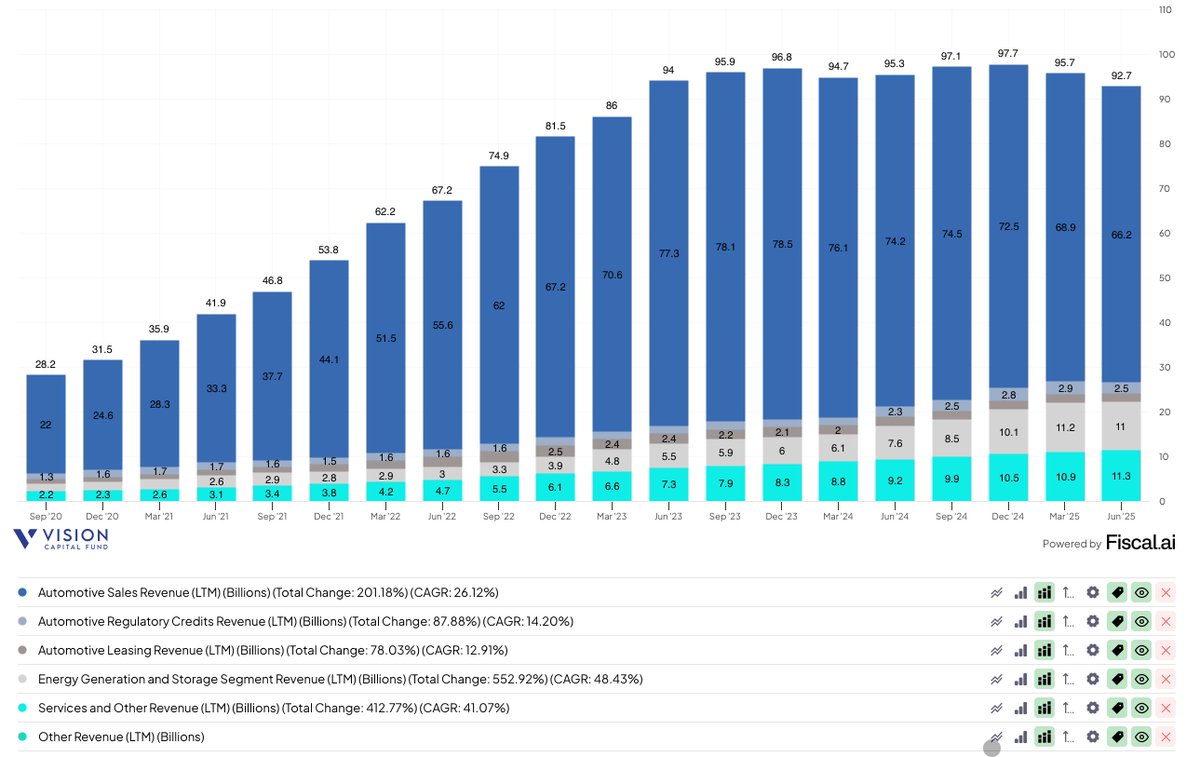
Tesla TTM Revenue by Segment
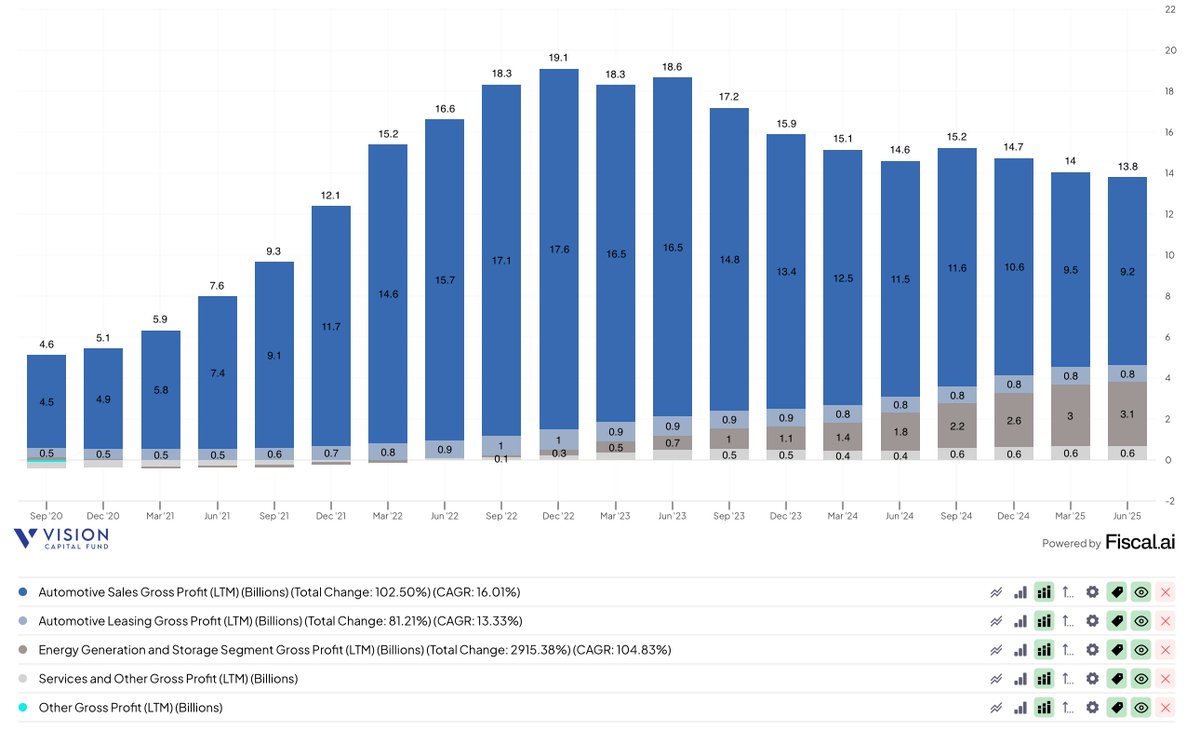
Tesla TTM Gross Profit by Segment
GP Profitability by Segment
Automotive Sales
- Rev $15.8b -14% ↘️🟠
- GP $2.2b -7% ↘️🟠 margin 14% 105 bps ✅
Automotive Leasing
- Rev $0.4b -5% ↘️🟠
- GP $0.2b -3% ↘️🟠 margin 48% 108 bps ✅
Automotive Revenues
- Rev $16.7b -16% ↘️🟠
- GP $2.9b -22% ↘️🟠 margin 17% -127 bps ↘️🔴
Energy Gen & Storage
- Rev $2.8b -7% ↘️🟠
- GP $0.8b 14% ↗️🟢 margin 30% 578 bps ✅
Services
- Rev $3b 17% ↗️🟢
- GP $0.2b -1% ➡️🟡 margin 5% -95 bps ✅
Production
- Model 3/Y 396.8K 3% ↗️🟢
- Others 13.4K -45% ↘️🟠
- Total 410.2K -0% ➡️🟡
Deliveries (lower)
- Model 3/Y 373.7K -12% ↘️🟠
- Others 10.4K -52% ↘️🟠
- Total 384.1K -13% ↘️🟠
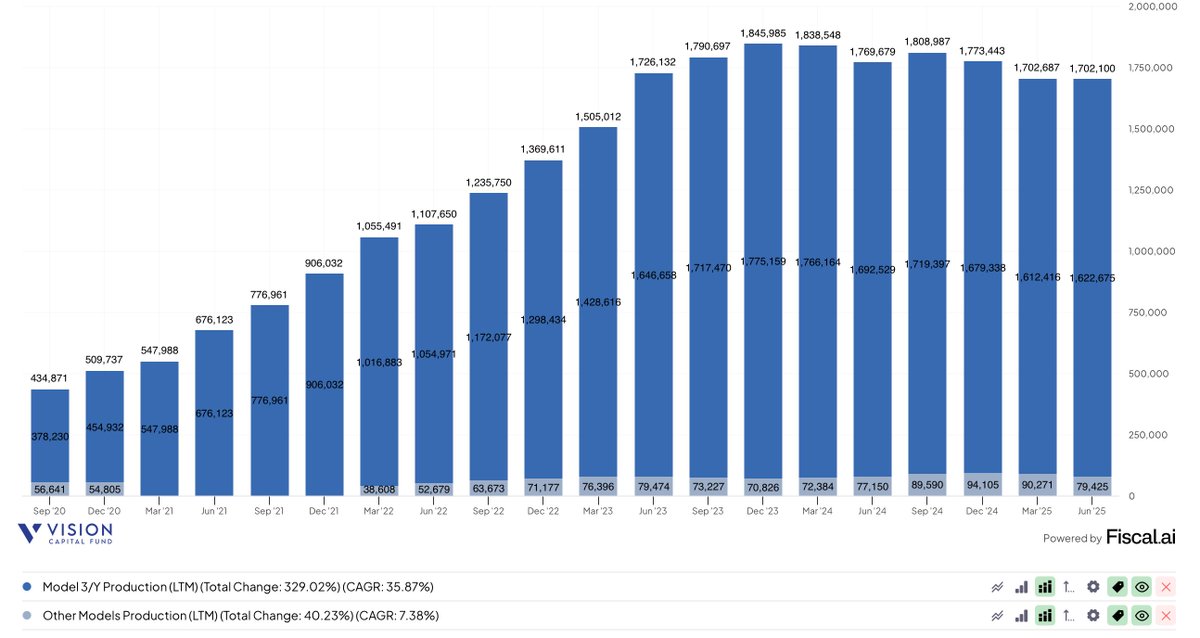
Tesla TTM Production
Biz Metrics
- Storage deployed 9.6GWh 2% ↗️🟢
- Tesla locations 1,454 13% ↗️🟢
- Mobile Svc Fleet 1,684 -11% ↘️🟠
- Supercharger stations 7,377 14% ↗️🟢
- Supercharger connectors 70,228 18% ↗️🟢
- Inventory Days 24 ↗️🟠 (rising)
Notable Milestones
- Launched Robotaxi service in Austin focusing on camera-only architecture
- Delivered first customer vehicle fully autonomously
- Deployed first Megapacks from Megafactory Shanghai
- First builds of more affordable model in June with volume production in 2H25
- Continued development of Semi and Cybercab, volume production in 2026
- Robotaxi/Cybercab will continue to pursue a revolutionary “unboxed” manufacturing strategy, scheduled for volume production starting in 2026.
1 | Austin Robotaxi to expand even bigger and longer, beyond even Waymo in the next few weeks
We were able to successfully launch robotaxi, so providing our rst drives with no one in the driver seat with paying customers in Austin. And as some may have noted, we've already expanded our service area in Austin. It's bigger and longer. And it's going to get even bigger and longer. We were expecting to really greatly increase the Austin service area to well in excess of what competitors are doing. And that's hopefully in a week or so, 2 weeks?
2 | Thus far more than 7,000 miles in Austin, no notable safety critical incidents, service well received and continue to expand on it.
We have more than 7,000 miles operating in Austin area. It's just because service is new, we have a handful of vehicles right now, but then we are trying to expand the service in terms of both the area and also the number of vehicles, both in Austin and other locations. So far, there's no notable safety critical incidents. Sometimes we have our own restrictions as to -- for example, we restrict our speed limit to 40 miles per hours. And if the vehicle wants to go on like higher speed roads, we can stop the vehicle, but those are out of convenience as opposed to safety critical nature. So far, the service has been really well received, and we continue to expand on it.
3 | Getting regulatory permission to launch in San Francisco, Nevada, Arizona, Florida, goal is to get them and roll them out to half the US by year-end
And we're getting the regulatory permission to launch in the Bay Area, Nevada, Arizona, Florida, and a number of other places. So as we get the approvals and we prove out safety, then we will be launching autonomous ride-hailing in most of the country. And I think we'll probably have autonomous ride-hailing in probably half the population of the U.S. by the end of the year.
That's at least our goal, subject to regulatory approvals. I think we'll technically be able to do it. So assuming we get regulatory approvals, it's probably addressing half of the population in the U.S. by the end of the year.
4 | Wanting to be very cautious, safety is of the highest concern
But we are being very cautious. We don't want to take any chances. And so we're going to go cautiously. But the service areas and the number of vehicles in operation will increase at a hyper-exponential rate.
We're certainly getting there. I think it will be available for incentivized personal use by the end of this year in certain geographies. We're just being very careful about it.
This is not something which we want to rush. We want to make sure that everything is safe before we make it available broadly.
5 | Can design Cybercab to not need to have as much acceleration,gentler ride, more optimised design point, and Optimus can serve, clean and do maintenance with automatic charging, reducing the operating cost of Cybercab
Well, the Cybercab, which is really optimized for autonomy, that, I think, has got probably sub-$0.30 per mile potential over time, maybe $0.25….So we've produced the top-end speed, which means we can use more efficient tires. We don't need as much acceleration. We don't need as much -- take breaks to sort of -- we want stopping distance, but we're not expecting it to be heavily used. It's a gentle ride. Essentially, if you design it for a gentle ride and then you have a much more optimized design point. So that's why it seems probable we could achieve that. Especially, Optimus is serving, cleaning up the car and doing maintenance and stuff. And doing automatic charging. So I think it's going to -- the actual cost per mile of Cybercab will be very low.
6 | No approval for supervised FSD in Europe, think sales can rise if Tesla gets it
And it's worth noting that we do not actually yet have approval for supervised FSD in Europe. So our sales in Europe, we think, will improve significantly once we are able to give customers the same experience that they have in the U.S. This is, I think, a very important point to convey. And we've been working with our main country regulator, which is the Netherlands. And I think we're close to getting approval with the Netherlands, then it's got to go to the EU. It's quite Kafka-esque. In fact, Kafka had no idea that something like the EU could exist beyond Kafka-esque challenges with bureaucracy. But we will get the approvals. And I think we'll get -- some people in Europe will have an experience similar to that of the U.S. in most of Europe this year, hopefully, at least partly in this quarter.
7 | Similarly for China as well, getting regulatory approvals will unlock customer demand
And then we also have some regulatory challenges in China, which we're hoping to unblock shortly where we -- because we also cannot provide supervised FSD in China currently, but we hope to unblock that soon. That's also -- that's another major -- it really is the single biggest demand driver.
8 | Autonomy is what amplifies the value of a physical product to stratospheric levels
So this is really -- as you can tell, this is very much sort of autonomy is the story. Like we need the physical product, without which you cannot have autonomy. But once you have a physical product, you need -- the autonomy is what amplifies the value to stratospheric levels.
9 | Recent focus on Austin Robotaxi pushed back the production release of autopilot
Because of our focus on Austin with no one in the driver seat, the production release of autopilot is actually several months behind what people experience on a robotaxi in Austin. So now we have the robotaxi launched, we'll be adding back those elements so that there will be a step-change improvement in the autopilot experience for people outside of Austin.
10 | Expecting to 10X the parameter count for FSD software, but tricky because choked on memory bandwidth
On the full self-driving front, I'll continue talking about that. We have -- we're continuing to make signi cant improvements just with the software. So we're expecting to increase the parameter count. Actually, at this point, we think we can probably 10x the -- almost 10x the parameter count. Yes, roughly 10x the parameter count.
So this is actually a very tricky thing to do because, as you increase the parameter count, you get choked on memory bandwidth. But we currently think we can 10x the parameter count from what people are currently experiencing. So not just 4x, actually 10x increase in parameter count. And yes, so still a lot of improvement on the existing hardware to happen.
11 | Think Tesla is much better than Waymo which is overloaded with sensors at real-world AI
Like a clear proof point for that would be -- if you compare, say, Tesla to Waymo, Waymo has got -- the car is festooned with God knows how many sensors. And yet, isn't Google good at AI? Yes, but they're not good at real-world AI. Thus far, they have -- Tesla is actually much better than Google by far and much than anyone at real-world AI.
12 | Hardware constraints is a byte constraint, Tesla having the highest intelligence density
But the actual constraints in the hardware are how many gigabytes of RAM and how many gigabytes per second can you transfer from RAM. Therefore, it is not a parameter constraint. It is a byte constraint. And Tesla has the highest intelligence density of any AI by far. And I have a lot of insight into this with xAI. xAI is -- Grok is the smartest AI overall, but it's -- Grok 4 is a giant beast sort of at the terabyte level. And so kind of important to note, Tesla has the best intelligence density. Intelligence density will be a very big deal in the future. It is now.
13 | Energy is doing well despite tariffs and supply chain challenges
Energy is growing really well despite headwinds from tariffs and supply chain challenges. The Megapack is expanding capacity quickly, and we have upgrades to the Megapack that will make it even better. And we had record powerwall deployment again in Q2. So I think batteries are just going to be a massive thing. The scale of batteries, battery demand, I think, not that many people appreciate just how gigantic the scale of battery demand is.
14 | If US power plants were to add batteries to the the mix, they can run the power plants 24/7 at full capacity, and double the energy output of the US with just batteries
The way to think about it is that the U.S. sustained power output for the U.S. grid is around 1 terawatt but average usage is less than half a terawatt. If you add batteries to the mix, you can run the power plants 24/7 at full capacity, thus doubling -- more than doubling the energy output per year of the United States just with batteries. But that's again a big deal.
15 | Thinks once customers realised deploying battery storage is the quickest path to scale energy production, energy deployments could increase
I think Elon covered this that industrial storage will make a di erence in this drive towards AI and data center growth. The energy requirements are increasing at a rapid scale as AI applications are very energy hungry. The quickest path to scale up energy is deploying storage. This is something that our customers have started realizing.
16 | Optimus humanoid robot now in V2.5 going to V3, thinks it will be Tesla’s biggest product ever, and is very hard to solve, and has to be designed from physics first principles as nothing off the shelf that really works
Optimus, so we're evolving the Optimus design and really getting Optimus to the point where it is a phenomenal design. So we're in Optimus version 2 right now, sort of 2.5. Optimus 3 is an exquisite design, in my opinion, and will be -- as I've said many times before, I predict it will be the biggest product ever. It's a very hard problem to solve. You have to design every part of it from physics rst principles. There's nothing that's o the shelf that actually works. So you got to design every motor, gearbox, power electronics, control electronics, sensors, the mechanical elements. We also got to train Optimus to use its limb sensors with a neural net. But we'll be applying the same techniques that we applied for our car, which is essentially a 4wheel robot. And Optimus is a robot with arms and legs.
17 | Think can scale Optimus production in less than five years
So with Optimus 3, which is really the right design, it's like it doesn't have -- at this point, there's no significant flaws with the Optimus 3 design. But we are going to retool a bunch of things. So there will probably be prototypes of Optimus 3 end of this year and then scale production next year. We're going to try to scale Optimus production as fast as it's humanly possible to do, so we'll try to get to 1 million units a year as quickly as possible. We think we can get there in less than 5 years, it's my sort of -- I guess.
18 | Tesla with technological progress, might not always be on time, but they get it done eventually
So in conclusion, so far, 2025 has been a very exciting year, a lot of major milestones. We've made it clear with our demonstrable progress in autonomy that a lot of naysayers said we would not achieve. But it's worth noting that we have done what we said we're going to do. It doesn't mean we're always on time, but we get it done. Now the naysayers are sitting there with an egg on their face.
19 | Want to focus on getting unsupervised on Hardware 4 first then retrofit/upgrade those with Hardware 3
I mean what we want to do is we want to get unsupervised done on Hardware 4 rst. Once it's done, then we will go back and look at what we need to do with the Hardware 3 cars. I mean like I said, the focus is rst to get unsupervised out, and then we'll go back and see what more work we need to do.
20 | Expect to have Dojo 2 operating at scale next year with AI5 chip in volume production by year-end
we expect to have Dojo 2 operating at scale sometime next year, with scale being somewhere around 100,000 H100 equivalents. And then AI5, which is really spectacular, too -- and I don't use those words lightly, spectacular, too. The AI5 chip will hopefully be in volume production around the end of next year. That has a lot of potential.
21 | Started production of lower cost model in H1, ramp will happen next quarter instead, slower than expected
We started the production of the lower-cost model as planned in the first half of '25. However, given our focus on building and delivering as many vehicles as possible in the U.S. before the EV credit expires and the additional complexity of ramping a new product, the ramp will happen next quarter, slower than initially expected.
22 | Less confident and difficult to predict the beginning of the S-curve production ramp due to debugging, etc
The production ramp -- it's always difficult to predict the S curve of your production ramp when something has got an entire -- when everything is new because the rate of production will move as fast as the least lucky and least confident element of the entire supply chain as well as internal processes. So the more new stu that is in a product, the slower the ramp could be because of unexpected supply chain interruptions or mistakes made internally. It's much easier to predict sort of the end of the S-curve or late in the S-curve than the beginning of the S-curve. And the beginning of the S curve of the production ramp is, in any case, not really material for revenue purposes. The beginning of the S-curve, you're usually -- usually, you're always negative gross margin, and you're debugging a lot of issues.
23 | Goal of more affordable model is to make a car that everyone loves and wants at a more affordable price, but not negatively impact revenue or gross margin
As we said, we started production in June, and we're ramping quality builds and things around the quarter. And given that we started in North America and our goal is to maximize production with a higher rate. So starting Q3, we're going to keep pushing hard on our current models to avoid complexity. Unfortunately, that rolls away, we'll be ready with new, more a ordable models available for everyone in Q4. And the goal of those products was not to negatively impact revenue or gross margin, but just to make a car that everyone loves and wants at a more affordable price.
24 | In the near-term, OPEX increase with AI capex investments, employee compensation and higher AI compute depreciation, right strategy for long-term
Operating expenses also grew sequentially as we continued our investment in AI projects, including additional expenses related to employee-related costs, including higher stock-based compensation and depreciation for AI compute. Our operating expenses, especially R&D-related spend, will continue to grow. We believe even in the current environment, it is the right strategy to keep making investments in these areas to position us for the long term.
25 | Seeing some green shoots, with more test drives and uptick in FSD adoption in the US
Globally, we are seeing an increase in the number of test drives. …We started seeing an uptick in FSD adoption in North America in recent months, which is a very promising trend. And just to give you a perspective, since the launch of -- since we moved to version 12 of FSD, we've seen the adoption rates really increase.
26 | Elon Musk working on a new master plan
I'm working on a new master plan to articulate that to the Tesla team. And there will be -- there are some teething pains as you transition from a preautonomy to post-autonomy world. But I think the future vision for Tesla is incredibly exciting and will profoundly change the world in a good way. This may sound like sort of hype or whatever, but I think -- well, let's just say if we execute on that plan e ectively, which is you have to actually do that, Tesla will be the most valuable company in the world by far.
27 | Upside to FSD as most Tesla owners still don’t know it exists, half of then haven’t tried it once
Even if you don't believe in anything else, a car on FSD being 10x safer should be a motivator. Plus the other thing is people don't realize, even at $99 a month, it's like you're getting a personal chau eur for almost $3.33 a day. And this is by far the biggest game changer, which I know we've been talking about it because part of it is we live and breathe it,
Most people still don't know. The vast majority of people don't know it exists. And it's still like half of Tesla owners who could use it haven't tried it even once. They don't actually. And obviously, this is something we want to educate them on. So we've got to -- when they come in for service, we'll reach out to them, send them like videos of how to make it work. It's such a shocking thing. They don't think a car is capable of this. So you have to actually show them and get them comfortable with turning it on and o . It's so trivial. It's like saying you've got a cat that can sing and dance, but it just looks like an old cat. And you're like until you see the cat sing and dance and talk, like you assume it's just a cat. That's Tesla FSD. Our car is intelligent.
28 | One Big Bill affects Tesla negatively in three ways, repeal of the EV credit of $7.5K by end of Q3, and reduce the penalty to zero will impact sales of regulatory credits to other OEMs, leading to near-term revenue headwinds, and in the residential storage with early expiration of consumer credits by year end
The One Big Bill has a lot of changes that would affect our business in the near term. The first among those changes is the repeal of the IRA EV credit of $7,500 by the end of this quarter.
The bill also made changes to certain emission standards by reducing the amount of penalty to zero. This, in turn, will have an impact on the new sales of regulatory credits to other OEMs and, in turn, will lead to lower revenue. While we now plan our business around such sales, it will nonetheless impact our total revenues going forward.
The Big Bill has certain adverse impacts even for the energy business, most notably on the residential storage business due to the early expiration of consumer credits by the end of this year.
29 | Tariffs have impacted around $300m, ⅔ in automotive and ⅓ in energy
We started seeing the impact of tari s in our P&L. Sequentially, the cost of tari s increased around $300 million with approximately 2/3 of that impact in automotive and rest in energy. However, given the latency in manufacturing and sales, the full impact will come through in the following quarters, and so costs will increase in the near term. While we are doing our best to manage these impacts, we are in an unpredictable environment on the tariff front.
30 | Tesla will undergo a couple of very rough quarters with the losing of incentives in the US, and once through this transition period, thinks Tesla economics will be very compeling
Well, we're in this like weird transition period where we will lose a lot of incentives in the U.S. We have incentives actually in many other parts of the world, but we'll lose some in the U.S. Look, we're still a bit at the relatively early stages of autonomy. On the other hand, autonomy is most advanced and most available from a regulatory standpoint in the U.S. So I mean, does that mean like we could have a few rough quarters? Yes, we probably could have a few rough quarters. And I'm not saying we will, but we could, Q4, Q1, maybe Q2. But once you get to autonomy at scale in the second half of next year, certainly by the end of next year, I think I would be surprised if Tesla's economics are not very compelling.
➡️ Final Takeaways Tesla $TSLA:
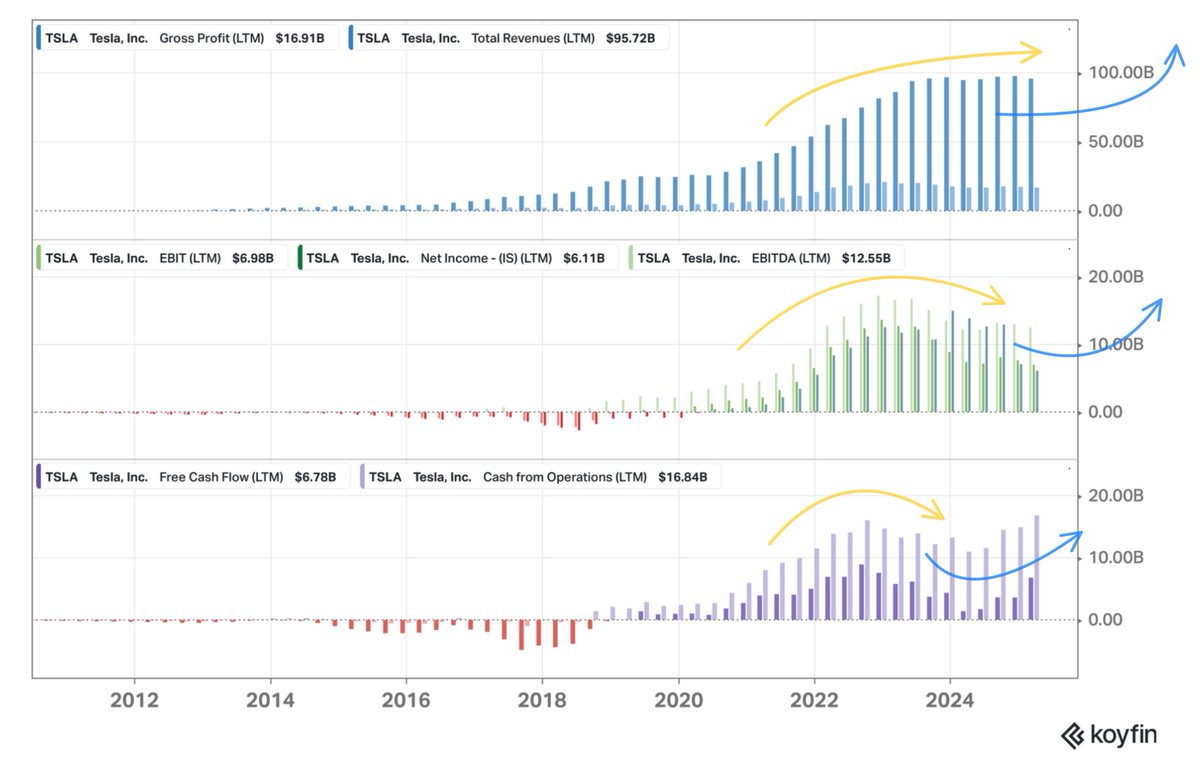
Tesla is experiencing slower near-term growth as it is in between two growth waves from Model 3, Y to next-gen lower priced vehicle (to ensure full utilization), unsupervised FSD, Cybertaxi/robotaxis, and Optimus humanoid robots, now thus the repeal of the US credits and sales of regulatory credits. 2025-2026 could well be the year of consolidation and reinflection.
Thesis still intact of high vertical integration with strong technological product with lowest manufacturing cost, strong operating leverage, manufacturing superiority, laser focused on profitability and strong FCF generation and reinvestment. Long-term higher margin software FSD/autonomy to increase current lower hardware profit margins. Lots of optionality remains, and production is hard, while they might often be late, they do still deliver through time.
3
1
19
2,291

23 Jul 2025
so EFF-ordable
18 Jul 2025

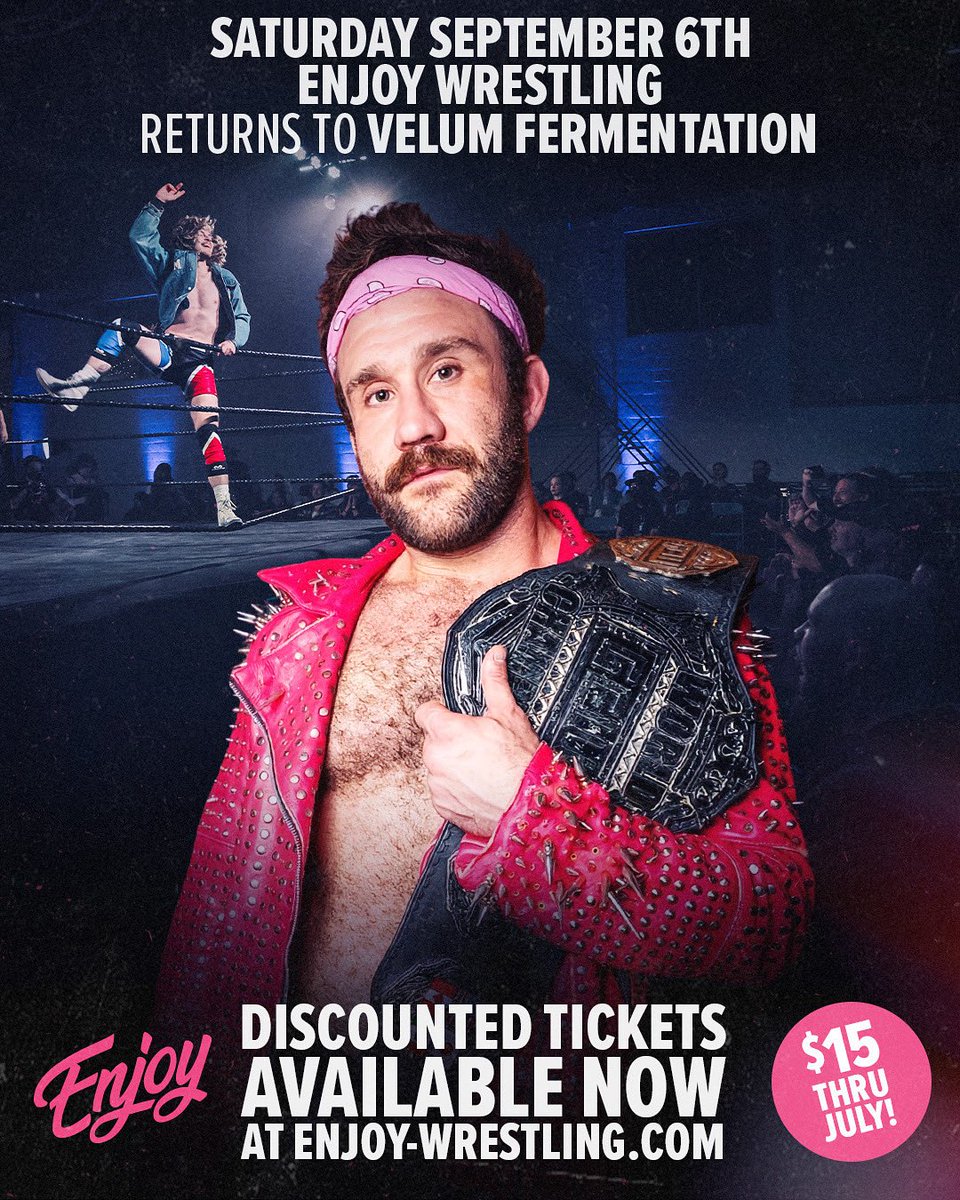
🚨 NEW EVENT ALERT 🚨
EFFY is back in Pittsburgh on Saturday September 6th when Enjoy Wrestling makes our return to VELUM FERMENTATION in the South Side.
And we’re celebrating by offering our biggest deal ever:
$15 STANDING ROOM TICKETS!!!
Make sure you act now because this price will increase come August 1st.
We’ve also got premium seats available for those of you who love being as close to the action as possible.
Get your tickets today at enjoy-wrestling.com!
3
11
1,027

23 Mar 2025
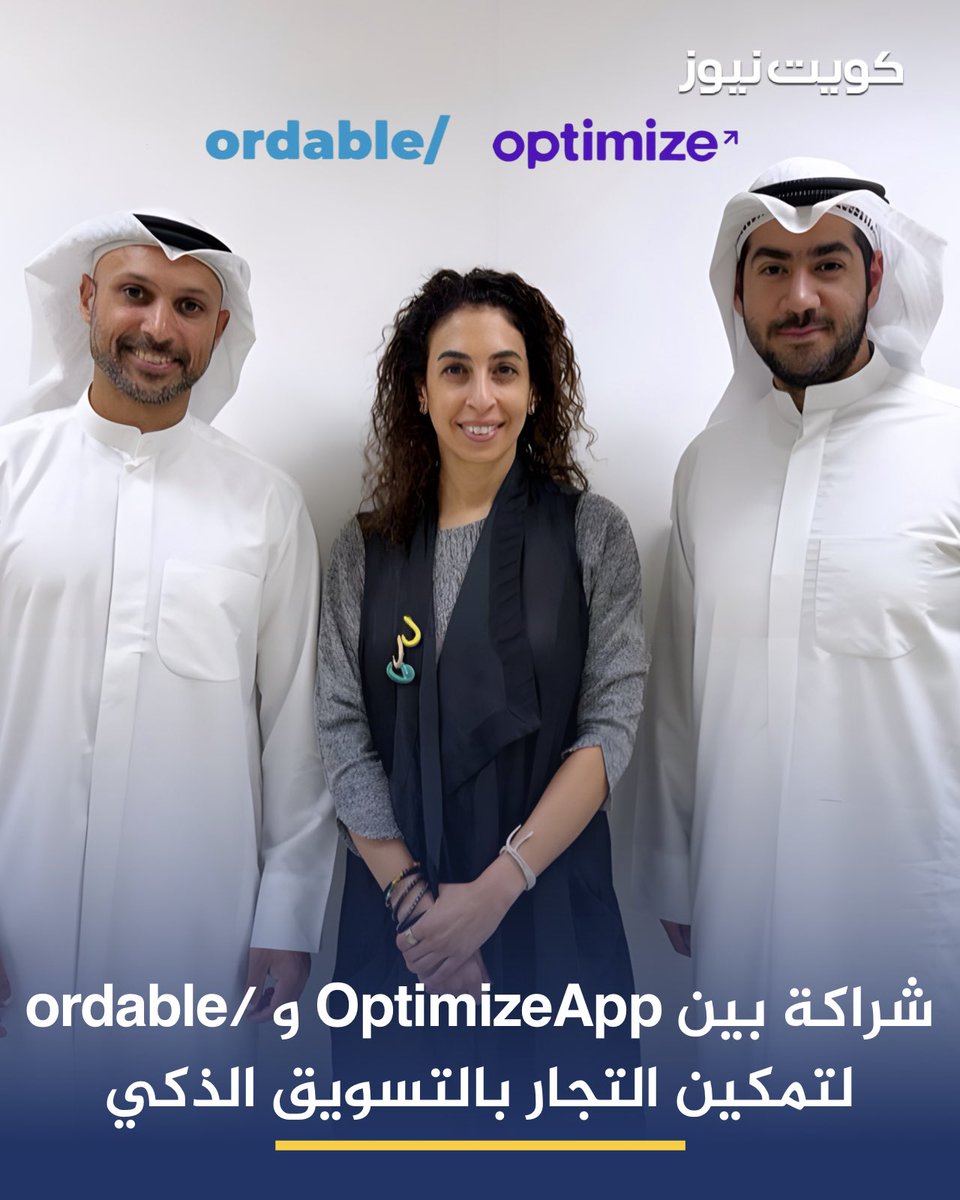
أعلنت OptimizeApp و /ordable عن شراكة استراتيجية تمكّن التجار من إطلاق وإدارة حملاتهم الإعلانية المدفوعة مباشرة من داخل منصة /ordable دون الحاجة لاستخدام تطبيقات أو أدوات خارجية
• يمكن لمستخدمي /ordable تشغيل حملاتهم بسهولة تامة، والتحكم بها في أي وقت ومن أي مكان، والاستفادة من تقنيات الذكاء الاصطناعي لتحليل الأداء وتحسين النتائج
• يعكس هذا التعاون التزام OptimizeApp و /ordable بتقديم حلول تقنية مبتكرة لدعم التجار في رحلتهم الرقمية
• من خلال دمج الإعلانات الرقمية داخل /ordable، أصبح بإمكان التجار الوصول إلى عملائهم المحتملين بسهولة، وتحويل المشاهدات إلى مبيعات فعلية، وتعزيز نجاح حملاتهم الإعلانية عبر أدوات تسويق احترافية.
• OptimizeApp تطبيق متكامل يساعد التجار وأصحاب المشاريع على إنشاء وإدارة حملاتهم الإعلانية على وسائل التواصل الاجتماعي بسهولة، باستخدام أدوات متطورة تعتمد على الذكاء الاصطناعي، مما يمكّنهم من تحسين استهداف العملاء وتحقيق أقصى عائد على الاستثمار في الإعلانات الرقمية
• /ordable منصة متخصصة في تمكين التجارة الإلكترونية، حيث توفر للتجار أدوات متقدمة لإدارة متاجرهم الرقمية بكفاءة، بدءًا من إدارة المخزون وحتى تحسين تجربة العملاء، والآن، بفضل الشراكة مع OptimizeApp، أصبح بإمكان التجار تشغيل حملاتهم الإعلانية من خلال المنصة مباشرة
• تؤكد هذه الشراكة أهمية التكامل بين حلول التجارة الإلكترونية وأدوات التسويق الرقمي في خلق بيئة أعمال أكثر كفاءة، فمن خلال تقديم خدمات متكاملة في منصة واحدة، أصبح لدى التجار فرصة للاستفادة من استراتيجيات تسويقية متطورة تعزز انتشارهم الرقمي، وتساعدهم في تحقيق نتائج ملموسة في سوق تنافسي متسارع النمو
1
5
5,756

27 Jan 2025
what you mean? TloU2 is already pre-ordable, the question was why tf you can't pre-order SM2
2
57
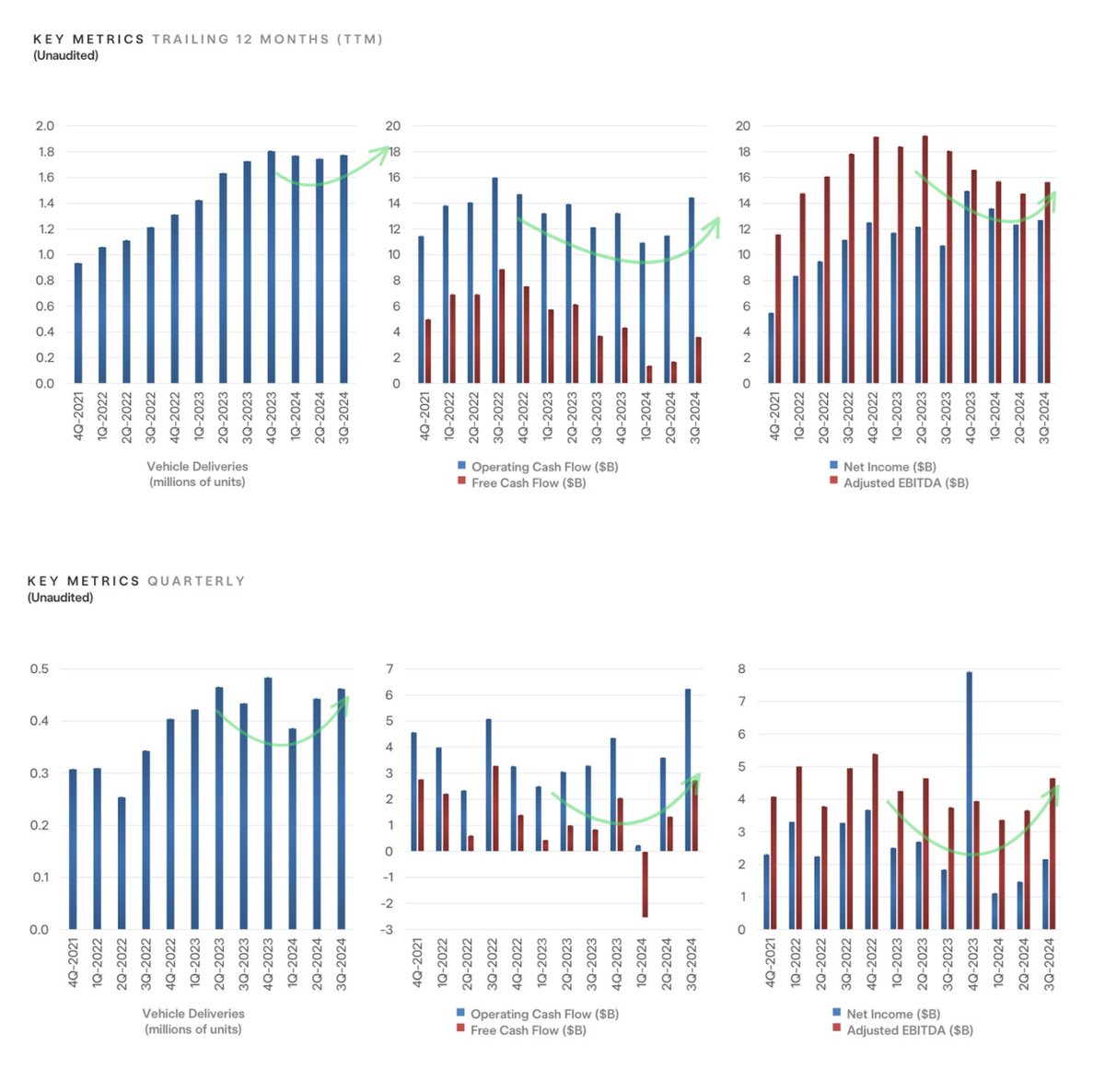
Highlights from Tesla $TSLA 3Q24 Earnings
- Rev $25.2b 8% ↗️🟡
- GP $5b 20% ↗️🟢 margin 20% 195 bps ✅
- Adj EBITDA $4.7b 24% ↗️🟢 margin 19% 243 bps ✅
- EBIT $2.7b 54% ↗️🟢 margin 11% 323 bps ✅
- Net Inc $2.2b 16% ↗️🟢 margin 9% 63 bps ✅
- OCF $6.3b 89% ⤴️🟢 margin 25% 1067 bps ✅
- FCF $2.7b 223% ⤴️🟢 margin 11% 726 bps ✅
Automotive Segment
- Rev $20b 2% ➡️🟡
- GP $4b 10% ↗️🟢 margin 20% 142 bps ✅
Energy Gen & Storage
- Rev $2.8b 29% ↗️🟢
- GP $1.1b 15% ↗️🟢 margin 41% -479 bps ↘️🔴
Biz Metrics
- Total Deliveries 469.8K 9% ↗️🟡
- Model 3/Y 443.7K 6% ↗️🟡
- Other models 22.9K 43% ↗️🟢
- Vehicle inventory days 19 ➡️🟢
- Storage deployed 6.9GWh 75% ↗️🟢
- Tesla locations 1,306 16% ↗️🟢
- Mobile service fleet 1,933 5% ↗️🟡
- Supercharger stations 6,706 20% ↗️🟢
- Supercharger connectors 62.4K 22% ↗️🟢
1 | Q3 recovering with strong results
Our Q3 results were positive and once again demonstrate the scale to which the business has evolved or with generation of record operating cash ows of $6.3 billion. Our automotive revenues grew both quarter-on-quarter and year-on-year. While we had unit volume growth, we did experience a reduction in ASPs primarily due to the impact of nancing incentives.
2 | Auto margins improved QoQ but Q4 will be challenging, still focused on reducing the cost per vehicle
Automotive margins improved quarter-over-quarter as a result of a feature release discussed before. Increase in our overall production and delivery volume, bene t from the marketing pricing and more localized deliveries in region, which resulted in lower freight Sustaining these margins in Q4, however, will be challenging, given the current economic environment. Note that we are focused on the cost per vehicle, and there are numerous work streams within the company to squeeze out cost without compromising on customer experience.
3 | No EV division of any existing car company that is profitable (hmmm BYD?)
In fact, I think if you look at EV companies worldwide, to the best of my knowledge, no EV company is even pro table. And I'm not -- to the best of my knowledge, there was no EV division of any company, of any existing car company that is profitable.
4 | Tesla was profitable despite challenging environment
So it is notable that Tesla is profitable despite a very challenging automotive environment, and this quarter actually is a record Q3 for us.
5 | Expect to deliver affordable models from 1H25 onwards, could expect 20-30% vehicle growth next year
So regarding the vehicle business, we are still on track to deliver our affordable models starting in the first half of 2025. This is -- I think probably people want should they assume for vehicle sales growth next year. And at the risk of -- to take a bit of risk here, I do want to give some rough estimate, which I think it's 20% to 30% vehicle growth next year, notwithstanding negative external events
6| Feel confident of Cybercab reaching volume production in FY26
Cybercab reaching volume production in '26. I do feel condent of Cybercab reaching volume production in '26, just starting production, reaching volume production in '26. And that should be substantial, but we're aiming for at least 2 million units a year of Cybercab. That will be in more than 1 factory but I think it's at least 2 million units a year, maybe 4 million ultimately.
7 | Expect ridehailing in Texas faster than California next year contingent on regulatory approvals
we do expect to roll out ridehailing in California and Texas next year to the public. Now California is somewhere -- there's quite a long regulatory approval process. I think we should get approval next year but it's contingent upon regulatory approval. Texas is a lot faster so it's -- we'll denitely have available in Texas and probably have it available in California, subject to regulatory approval.
8 | 4680 is rapidly approaching to become the most competitive cell
The cell 4680 lines, the team is actually doing great work there. The 4680 is rapidly approaching the point where it is the most competitive cell. So when you consider the fully landed -- the cost of a battery pack fully landed in the U.S., net of incentives and duties, 4680 is tracking to be the most competitive, maybe lower cost per kilowatt hour, fully considered than any other alternative
9 | Expect Semi to start pilot builds in 2H25 and production ramp through 2026
we posted an earnings we're progressing something on the build of the Semi factory our data factory in Reno. We've released all our major cash ow expenditures for that program, and we're on track to start pilot builds in the second half of next year with production starting in the rst half of 2026 and ramping really throughout the year to full production. Semi growth will largely depend on our customers' adoption of the product.
10 | Semi will have a low cost per mile, and improvement in driver fatigue and safety
Fundamentally, if you've got a Semi, the fully considered cost per mile per ton of transport is better than a diesel truck. Any company that doesn't adopt an electric semi will lose.
mass improvement in driver fatigue because -- and driver safety. We've got sort of the anti-jack knifing software. You don't have to worry about your brakes overheating if you go down a steep hill because we generating that energy goes back and into the pack. It's just like -- it's like radically better than a diesel is what the drivers love it.
11 | China doing well by 3X, rapid customer acceptance
To expand on this at an industry level, China continues to outperform U.S. and Europe by a factor of 3. And if there is something to be learned from that, this gives a signal of what is to come in other regions. As customers' acceptance of EV growth, we feel that is the right strategy to build a ordable and more compelling leads. Our focus remains on growing unit volume while avoiding a buildup of inventory.
12 | 12.5 FSD release is 1 single stack and expect to see 5-6X improvement in miles between interventions for V13
So with the new version 12.5 release of [indiscernible] and Cybertruck, combining the code into a single stack so that the city driving and the engine and highway driving are 1 stack, which is a big improvement for the highway driving. So it's just all neural nets.
Version 13 of FSD is going out soon. will elaborate more on that later in the call. We expect to see roughly a 5- or 6-fold improvement in miles between interventions compared to 12.5.
13 | V12.5 100x, but V13 will be 1,000x
Yes. miles between critical interventions, mentioned by Elon already made 100x improvement with 12.5 from starting of this year and then with v13 release, we expect to be 1,000x from the beginning, from January of this year on production software. And this came in because of technology improvements going to end-to-end, having higher frame rate, partly also helped by hardware force, more capabilities, so on. And we hope that we continue to scale the neural network, the data, the training compute, et cetera.
14 | Seeing significant improvement in adoption of FSD
we'll roll out another sort of 30-day trial so to encourage people to try it again. And we are seeing a significant improvement in adoption. So the take rate for FSD has improved substantially, especially after the 10/10 event. Yes. So there's no need to wait for robotaxi or Cybercab to experience full autonomy. We expect to achieve that next year with our existing vehicle line.
15 | Tesla has the biggest shot at humanoid robots with AI and manufacturing
Obviously, having a giant fleet is very helpful for breaking this out. And then with Optimus, we showed a mass improvement in Optimus exterior movement on October 10. And our next-gen which is 22 degrees freedom, which is double the prior and for. It's extremely human-like and so it's much better at tactile sensing. It's really -- I feel condent in saying that we have the most advanced humanoid robot by a long shot. And we're moreover the only company that really has all of the ingredients necessary to scale humanoid robots. Because the things that what other companies are missing is that they're missing the AI brain, that they're missing people to really scale to very high-volume production.
16 | Ramping capex to $11bn largely with building its GPU cluster
We've started using the GPU cluster based out of our factory house and ahead of schedule and are on track to get 50,000 GPUs deployed in Texas by the end of this month. One thing which I'd like to elaborate is that we're being really judicious on our AI compute spend to and saying how best we can utilize the existing infrastructure before making further investments. On the CapEx front, we had about $3.5 billion in the quarter. This was a sequential increase largely because of investments in AI compute. We now expect our CapEx for the year to be in excess of $11 billion. We shared our vision for the future at the event at the beginning of the month.
17 | Thinks Waymo might seeming have the edge with 1,000, Tesla has ~7mil vehicles and are making 35,000 per week, Tesla will have the upper hand when it is rolled out
But all of our vehicles in the future will be autonomous. Yes. So all the vehicles that we've really made, almost 7 million vehicles, the vast majority are capable of autonomy. And we're currently making on the order of 35,000 autonomous vehicles a week to say Waymo's entire eet is less than -- they've less than 1,000 corners. We're making 35,000 a week.
18 | What matters is the lowest cost per mile of efficiency
In autonomous world, what matters is lowest cost per mile of efficiency of that vehicle. And that's what we've done with the robotaxi.
Exactly. It's fully considered cost per mile is what matters. And if you try to make a car that is essentially a hybrid, manual, automatic car, it's not going to be as good as a dedicated autonomous car.
19 | Optionality - Think of Tesla as multiple companies in 1
Yes. I mean, it's a company -- there are multiple companies within the company. Elon Musk Executive Yes. Tesla's like many companies in 1.
20 | xAI is helpful to Tesla AI, but working on different problems
say that xAI has been helpful to Tesla AI quite a few times in terms of things like scaling it, bought it, like training, just even like recently in the last week or so, improvements in training, where if you're doing a big training 1 and it fails, be able to continue training and is to recover from a training on has been pretty helpful. But there are different problems. xAI actually is working on artificial general intelligence or artificial super intelligence. Tesla's autonomous cars and autonomous robots. They are different problems.
21 | Finalizing designs for Tesla Roadster, flying cars?
Well, I just thought to go back to our long-suffering deposit holders of the Tesla Roadster. The reason it hasn't come out yet is because it is -- Roadster is not just icing on the cake, it's the cherry on the icing on the cake.
And we are actually nally making progress on that. And we're close to nalizing the design on it. It's really going to be something spectacular, mind and some like Peter Telaria we're really good friends. Peter was lamenting how the future doesn't have ying cars. Well, we'll see. More to come.
22 | Robotaxi - chance hardware 3 might not reach the safety level for unsupervised FSD, contemplating working from hardware 4 which is easier, and will upgrade hardware 3 for free by switching out hardware
So answer is we're not 100% sure, but as Ashok mentioned, because by some measure, Hardware 4 has really several times the capability of Hardware 3. It's easier to get things to work with then it takes a lot of effort to sort of squeeze that box analyst hat Hardware 3. And there is some chance that Hardware 3 is -- does not achieve the safety level that allows for unsupervised FSD. There is some chance of that. And if that turns out to be the case, we will upgrade those group bought Hardware 3 FSD for free.
And we have designed the system to be upgradeable so it's really just to sort of switch out the computer thing, the camera, the cameras are capable. But we don't actually know the answers of that. But if it does turn out, we'll make sure we take care of those.
23 | What Tesla is doing with FSD is different from LLMs, they face massive amount of context, small number of control outputs, and process with small amount of compute power
Okay. Well, I guess regarding -- the rst part of the question, The nature of real world AI is di erent from LLM in that you have a massive amount of context. So like the -you've got a case of Tesla cameras that [indiscernible] if you include tunnel camera that -- so you've got some context. And that is then distilled down into a small number of control outputs, whereas it's like it's very rare to have, in fact, I'm not sure any LLM out there can do gigabytes of context. And then you've got to then process that in the car with a very small amount of compute power. So it's all doable and it's happening, but it is a di erent problem than what, say, a Gemini or OpenAI is doing.
24 | Thus what Tesla is doing is making up with heavier training with the vast amounts of data they have, if you train well, the inference becomes easier
And now part of the way you can make up for the fact that the inference computer is quite small. It is by spending a lot of e ort on training. And just like a human the way you train on something, the less metal work takes when you try to -- when you do it, like when the first time like a driving it absolves your whole mind. But then as you train more and more on driving di erent than the driving becomes a background task. It doesn't -- it only solves a small amount of your mental capacity because you have a lot of training.
So we can make up for the fact that the insurance computers -- it's tiny compared to a 10-kilowatt bank of GPUs because you've got a few hundred watts of inference compute. We can make up that with heavy training. So yes, that's -- and then there's also vast amounts to the actual petabytes of data coming in tremendous. And then sorting out what training is important of the vast amounts of video training video data coming complete what is actually most important for trading. That's quite difficult. But as I said, we're not currently training compute constraint.
6
15
47
4,990

9 Jul 2024
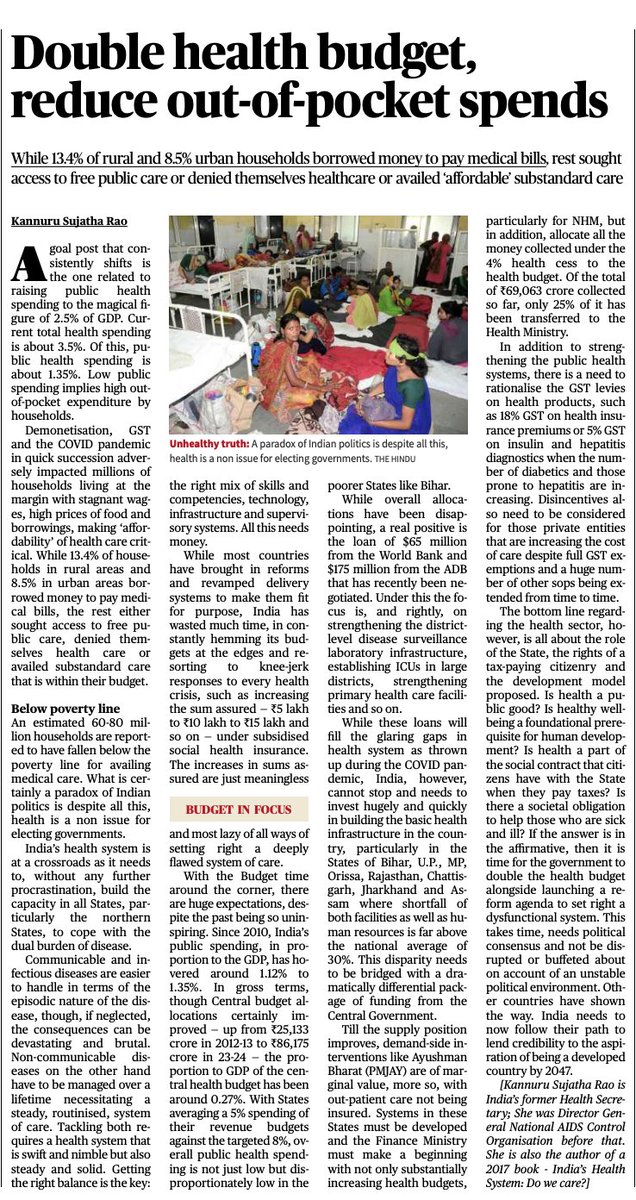
The Reality of India's Unaffordable Healthcare.
While 13.4% of rural and 8.5% urban households borrowed money to pay medical bills, rest sought access to free public care or denied themselves healthcare or availed ‘aordable’ substandard care.
3
71

4 May 2024
Day 38 of #100daysofcodingchallenge 100 days of Flutter.
Package/Widget used: re-ordable listview
Package/Widget link: lnkd.in/gudw2gEa
Github Link of shown in the image/video: lnkd.in/gvUrmbg2
#100daysofcode #flutter #flutterdeveloper #fluttercommunity
1
3
101
11 Mar 2024
Hang on... how am I supposed to take any group that says stuff like this seriously?
"We believe all human beings have the right to a basic standard of living that includes safe, aordable housing, healthcare, and freedom from discriminaon and cruelty."
1
244
