
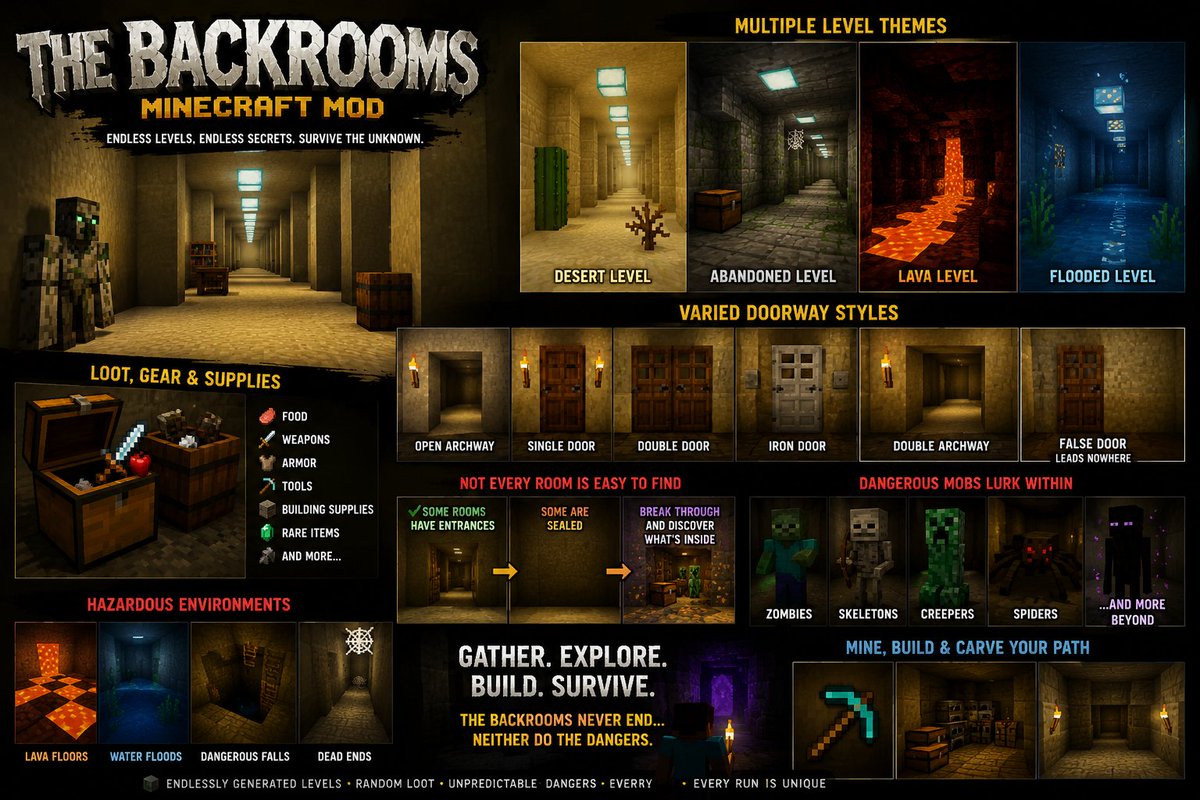
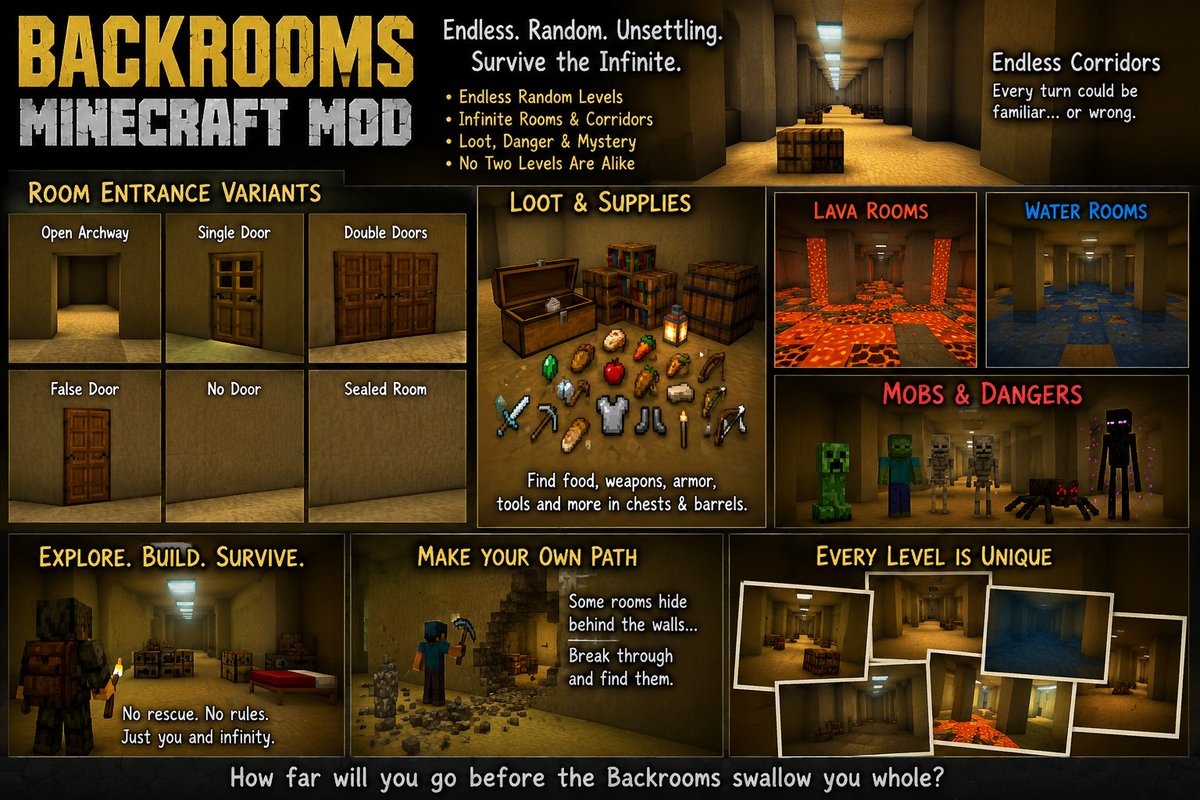
MC-Backrooms is now available for testing!
An open-source procedural Backrooms world generator for Minecraft Java Edition. Explore endless corridors, hidden rooms, flooded sectors, lava chambers, anomalies, stairwells, loot, mobs, and ever-expanding levels.
Download, test, report bugs, share screenshots, suggest features, or contribute code.
GitHub:
github.com/Iam8lu3/MC-Backro…
Discord:
discord.gg/xbJVm3J5
#Minecraft #Spigot #PaperMC #Bukkit #Backrooms #OpenSource

1
64

19h
Hello #Minecraft plugin developers,
I've been a huge fan of the #Skyblock genre for years, but I've always felt that modern Skyblock servers rely on too many separate plugins, create unnecessary server lag, and often turn progression into a grind.
So I decided to build my own take on Skyblock.
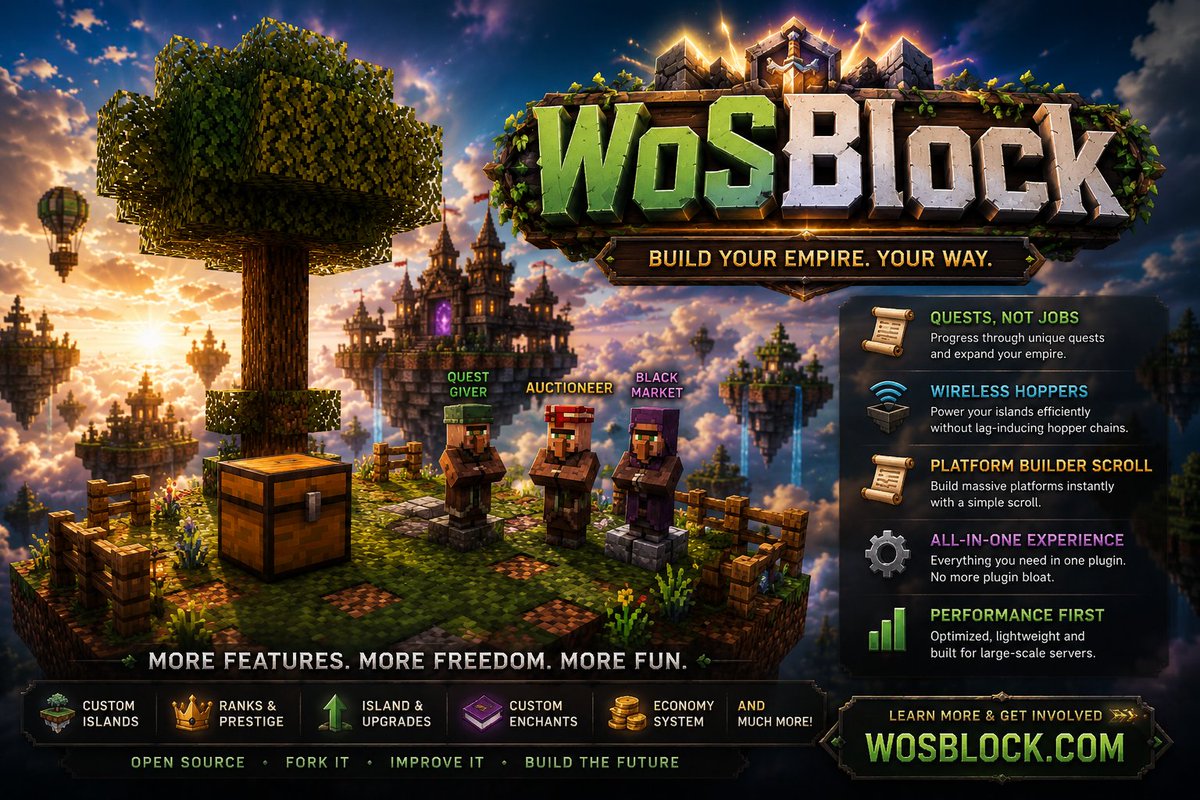
The core concept remains the same: start with almost nothing and build an empire. But everything is designed around performance, progression, and quality of life.
✅ Built in quest system instead of repetitive jobs
✅ Wireless hoppers instead of lag inducing hopper networks
✅ Platform Builder Scrolls that instantly create large building areas
✅ Integrated NPCs like the Quest Giver, Auctioneer, and Black Market Dealer
✅ Designed as an all in one experience instead of requiring dozens of plugins
The goal is simple: deliver the Skyblock experience players love while eliminating many of the frustrations server owners and players face today.
And the best part? The entire project is open source.
If you're a Java or Spigot developer and want to help shape the future of this plugin, feel free to fork the project, contribute ideas, or submit pull requests.
🔗 wosblock.com
#MinecraftDev #SpigotMC #PaperMC #Java #OpenSource #GameDev #MinecraftServer #Bukkit #PluginDevelopment #IndieDev #MMORPG #Skyblock #MinecraftPlugins #Coding #JavaDeveloper
23


Jun 12
Acabei de criar um server plugin pro Minecraft (PaperMC) que permite sincronizar todos os gossips de cura entre os villagers huahauah. Se um player curar um zombie villager, todos ganham o desconto
github.com/flipbit03/minecra…
2
7
145
きゅうちゃん🎣❄️🧂山を歩ける体づくり頑張る⛰️ retweeted

Apr 10
#夜空の夏 #マイクラ募集 #マイクラ
【夜空の夏*2026】
本日より!建築メンバー募集開始!
paperMC クロスサーバー
Ver. 1.21.11
(ベースはJAVA版ですが、統合版でも参加できます)
7月19日~の観光予定に向けてクリエイティブで建築する期間限定のマルチ建築鯖です。
建築期間:4月20日~6月30日
掛け持ちもOKです。
参加費は無料。
配信可。SNS投稿可。
終了後に参加メンバーにワールドデータを配布します。
【参加条件】
・手がけたものを期間内に完成させることができる方。
・DiscordにてVCもしくはチャットでコミュニケーションがとれる方。
・配信や投稿に映り込んでも大丈夫な方。
・規約や基本的なマナーが守れる方。
・共有エリアに2つ以上建築する。(造詣含む)
共同制作エリアは、洋風。和風。モダン。繁茂。夏祭りのエリアを予定しています。
【導入プラグイン情報】と【応募方法】はリプ欄

1
77
206
83,366

Litematicaの設計図をサーバーで共有するSyncmaticaをPaperMC系でも使えるようにするプラグインも作ってみた!まだアルファ版だけど
modrinth.com/plugin/syncmati… #Litematica
1
29
1,540


May 15
動画では左側にPaperMCのサーバーを用意しています。
つまり本物のサーバーをFriendsList経由で参加が可能ということ
1
7
1,076

May 14
【XServer GAMEs】
Minecraftの対応バージョンを新たに追加しました!
🟣Minecraft PaperMC 26.1.2
🟣Minecraft Purpur 26.1.2
🟣Minecraft Folia 26.1.2
詳細はリプ欄をご確認ください👇
1
3
5
2,107

May 14
【XServer VPS/XServer VPS for Game】
Minecraftの対応バージョンを追加しました💁
▶️Minecraft PaperMC 26.1.2
▶️Minecraft Purpur 26.1.2
詳細はリプ欄をご確認ください👇
1
4
1,194

May 9
I HATE PAPERMC
I HATE PAPERMC
I HATE PAPERMC
I HATE PAPERMC
I HATE PAPERMC
I HATE PAPERMC
I HATE PAPERMC
2
52

con las nuevas versiones de paper, papermc cambió la api de descargar mediante scripts, y tocó corregirla, ya es funcional
1
5
186

At Tsinghua University there's a tradition - every first-year CS student has to set up a Minecraft server overnight for Professor Zhang.
If TPS drops below 18 - you get transferred to the philosophy department. No joke, it's been in the charter since 2011 after the professor lost a bet to a colleague.
My buddy Li Wei was up till 6:00 AM, vanilla was dying at 40 players, TPS bouncing between 12-14.
He was already calling his mom in Chengdu to say goodbye. Jay Chou playing in the background, his third instant noodles going cold.
I sent him this video on WeChat and he got to work.
First thing - he nuked vanilla. Professor Zhang only respects Paper.
It's a Spigot fork where vanilla handles 20 players, Paper handles 200. Downloaded the .jar from papermc .io, allocated 6 gigs of RAM with -Xmx6G (not all of it - otherwise both the server and Windows crash).
Server wouldn't start - Li Wei still had Java 8 from high school.
Paper 1.20.5 needs Java 21 minimum. He installed.
Adoptium and it finally launched. Professor Zhang checks the Java version first thing - if it's not 21, he turns you away on the spot.
Then he threw the essentials into the plugins/ folder - EssentialsX, LuckPerms (professor is obsessed with properly configured permissions), WorldEdit.
And most importantly - Spark, a profiler plugin that shows MSPT, milliseconds per tick. TPS is just an average, but MSPT tells you exactly where the server is lagging. Without an MSPT report the professor won't even talk to you.
Last step - port forwarded 25565 on the router and opened it in Windows Firewall with New-NetFirewallRule.
Professor always connects from his own laptop in his office.
Two hours later Li Wei had a stable 20 TPS with 150 players online.
Professor came in, spawned 200 zombies as a stress test - server didn't drop a frame. Gave him an automatic pass and handed him a panda mug.
Li Wei is in grad school now, writing Kotlin plugins. The philosophy department lost a student.

15
25
2,649

Just shipped the hardest engineering project of my life.
CRAFT Blockchain - a custom-built, production-grade game economy blockchain. Written from scratch. Every layer. Every protocol. Every line.
Full technical breakdown
This isn't a Solana wrapper. This isn't a template.
I designed the entire transaction engine, the consensus logic, the delivery protocol, and the explorer. Six months. Hundreds of commits. One vision: provable in-game ownership.
🔩 Multi-language architecture:
The system runs across three layers, each in a different language for a reason:
Game Layer → C (PaperMC native plugin)
Analytics Engine → Python
API Chain Engine → TypeScript
Each one talks to the others. None of them can lie.
⚙️ C — The Game Layer
The Minecraft plugin intercepts block-break events at the JNI level and fires authenticated transactions to the chain engine:
include <curl/curl.h>include <openssl/hmac.h>include <nlohmann/json.hpp>void CraftMiningHandler::onBlockBreak(const std::string& walletAddress,const std::string& blockId,uint64_t timestamp) {nlohmann::json payload = {{"walletAddress", walletAddress},{"blockId", blockId},{"timestamp", timestamp},{"nonce", generateNonce()}};std::string signature = HMAC_SHA256(payload.dump(),SECRET_KEY);headers = {"X-Plugin-Key: " signature,"Content-Type: application/json"};httpPost(CRAFT_API "/mining/mine", payload, headers);}
Every request is HMAC-signed. The API rejects anything unsigned. Zero spoofing possible.
Python — Analytics Engine
A background process aggregates chain data every 60 seconds, computes mining distributions, detects anomalies, and feeds the blockchain explorer's live stats:
import psycopg2import hashlibimport jsonfrom datetime import datetime, timedeltaclass CraftChainAnalytics:def __init__(self, conn_string: str):self.conn = psycopg2.connect(conn_string)def compute_mining_distribution(self) -> dict:cursor = self.conn.cursor()cursor.execute("""SELECTwallet_address,SUM(craft_from_mining::numeric) as total_earned,COUNT(*)
JSON — Transaction Schema
Every transaction on the CRAFT chain follows this structure. Immutable once written:
{"blockNumber": 4821,"signature": "4f9a2c1e8b3d7f0a6e5c9b2d1a8f4e7c3b0d9a","type": "SHOP_PURCHASE","player": {"username": "Sletycone","walletAddress":
Security architecture I built:
Request → HMAC-SHA256 verify → Wallet signature check→ Atomic DB transaction → Balance update→ Chain write → RCON delivery→ Delivery state update → Explorer record
• Plugin key rotates every deploy
• Balance operations are atomic (PostgreSQL transactions)
• Soft-unlink preserves full history if wallet changes
• Race condition protection on concurrent miners
CRAFT Blockchain Explorer — built from zero
Real-time transaction feed. Mining leaderboard. Token analytics. Network stats. Custom-designed. No templates. No third-party explorer.
Every row is a provable on-chain event from inside the game world.
Numbers:
• 14 minable block types — from Dirt (1 CRAFT) to Ancient Debris (50 CRAFT)
• 25 ERA II Star Wars shop items
• < 80ms average transaction finality
• 0 transactions lost in 6 months of testing
This is what real GameFi engineering looks like.
13
14
40
6,838
We shipped a fully on-chain Minecraft economy. Here's the full technical architecture.
Server live at 172.240.53.57:2050 | mincraftdex.com
1/ Every player gets a deterministic custodial keypair on first verify. Generated server-side via @solana/web3.js Keypair.generate(), private key AES-256-CBC encrypted at rest with a server-side master key, stored per wallet_address in Postgres.
No two players share a signing key. Ever.
2/ The verify handshake:
Client → POST /api/verify/start { walletAddress }Server → generates 6-char code, writes to verifications tablePlayer → /verify CRAFT-XXXXXX in Minecraft chatPlugin → GET /api/verify/confirm/:code { username }Server → checks player is ONLINE via Minecraft query protocolServer → links wallet ↔ username, provisions custodial keypairClient polls → GET /api/verify/status/:wallet
The online-check is the anti-fraud layer. You cannot claim a username you're not actively playing on.
3/ SPL Token-2022 (not legacy SPL). CA: AdD5EMoGMDiGXcgepXQXneB4fEZuS1QvKqDrN876pump
6 decimals. All on-chain amounts divided by 1_000_000 for display. Transfer instructions built with createTransferCheckedInstruction from @solana/spl-token, using TOKEN_2022_PROGRAM_ID — not the old TOKEN_PROGRAM_ID. This distinction breaks 90% of naive Solana integrations.
4/ Two-layer balance system:
Layer 1 → game_balance (Postgres, instant, free)↑ deposits detected via RPC polling↓ purchases deducted hereLayer 2 → on-chain CRAFT balance (Solana, real assets)↑ player sends CRAFT to their custodial addr↓ withdrawal triggers signed TX from custodial keypair
Shop transactions NEVER touch the blockchain. They settle in Layer 1. This eliminates gas costs for every item purchase and makes the token supply inelastic to game activity.
5/ The RPC layer has 3-endpoint failover:
const RPCS = ["api.mainnet-beta.solana.com","rpc.ankr.com/solana","solana.publicnode.com"];
Round-robin with exponential backoff. If one endpoint rate-limits or drops, the next one signs the TX. Uptime is not RPC-dependent.
6/ The Java plugin fires a signed HTTP POST to the backend on every /verify command:
HttpRequest request = HttpRequest.newBuilder().uri(URI.create(API_BASE "/api/verify/confirm/" code)).header("X-Plugin-Key", PLUGIN_API_KEY).header("Content-Type", "application/json").POST(HttpRequest.BodyPublishers.ofString("{\"minecraftUsername\":\"" player.getName() "\"}")).build();
The X-Plugin-Key is a 48-char hex secret shared only between the plugin JAR and the API env. No key = no confirm. Can't spoof verification from outside.
7/ Soft-unlink architecture — this one's subtle:
Most devs DELETE the row on wallet disconnect. We don't. We tombstone it:
UPDATE linked_accountsSET minecraft_username = '__UNLINKED_' || extract(epoch from now())WHERE wallet_address = $1
On re-verify, we detect the prefix, restore the row in-place. Balance preserved. Custodial keypair preserved. Deposit history intact. Zero fund loss on reconnect.
8/ The deposit detection loop polls every 30s per active custodial address. It fetches the SPL Token-2022 account balance via getTokenAccountsByOwner, diffs against last known balance, and credits the delta to game_balance. No webhooks, no indexer dependency, no third-party infra.
9/ Anti-bubble mechanics:
-On-chain supply doesn't move when players buy items
-Withdrawal requires explicit user action (not automatic)
-No bonding curve, no AMM interaction on shop purchases
Token velocity stays low → less pump/dump surface area
Each player's custodial wallet is isolated → no single wallet is "the treasury"
10/ Full stack:
PaperMC 1.21.1 → Java plugin, event listeners, HTTP clientNode.js/Express → REST API, TX signing, RPC callsPostgreSQL/Drizzle → accounts, balances, purchases, depositsReact/Vite → frontend, wallet UIPhantom → browser extension wallet adapterSolana web3.js → keypair management, TX constructionSPL Token-2022 → CRAFT token standard
4
12
25
2,060

Apr 11
サーバーソフト(PaperMC)側で大抵のバグは切られてる。
コンフィグで元に戻すことも可能だけど需要あるんかしら
Apr 11

マルチ鯖ってデフォルト設定だと
増殖系装置作れないんだ…
知らなかった
1
12
1,010

Apr 8
paperMC 비판하는 영상 보는중인데 (2y 전)
- config hot reloading 미지원
- redstone 커뮤니티 관점에서 버그성 로직을 papermc 에서 미지원하는 경우존재 정말 미지원은 아니고 복잡한 config 수정을 통해서 지원?
-farming 매카닉이 vanilla minecraft가 달라서 많은 farming 로직이 동작하지않음
2
2
148

Apr 5
【お知らせ】
一部サーバーソフトウェアが現在作成できません。
最新バージョンから数日すると作れるようになりますので現在はPaperMCのご利用をお勧めします☑️
2
284