
Jun 12
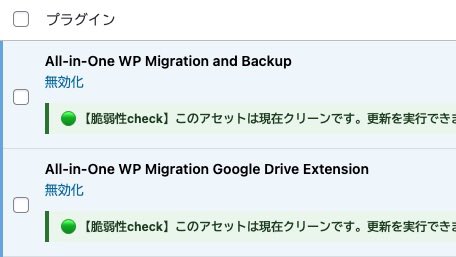
ダッシュボードからプラグインページを開いたときだけ脆弱性情報サイト「Patchstack(patchstack.com)」を参照し、導入済みプラグインが安全か脆弱かアラートで視覚化する軽量なプラグインです。

64


Jun 9
Patchstack mVDP: Managed Vulnerability Disclosure for WordPress ift.tt/seiPTah #aiautomation #webdevelopment #ai #automation #growth #unifynode #marketing #marketingautomation #marketingai #aimarketing
19
Jun 9
Excited to share Patchstack mVDP is here for WordPress plugin developers! A game-changing managed vulnerability disclosure platform that blends AI code scanning with human security review, enabling faster fixes and stronger security. Learn about the two … ift.tt/seiPTah
15




Jun 9
Dia 54/229
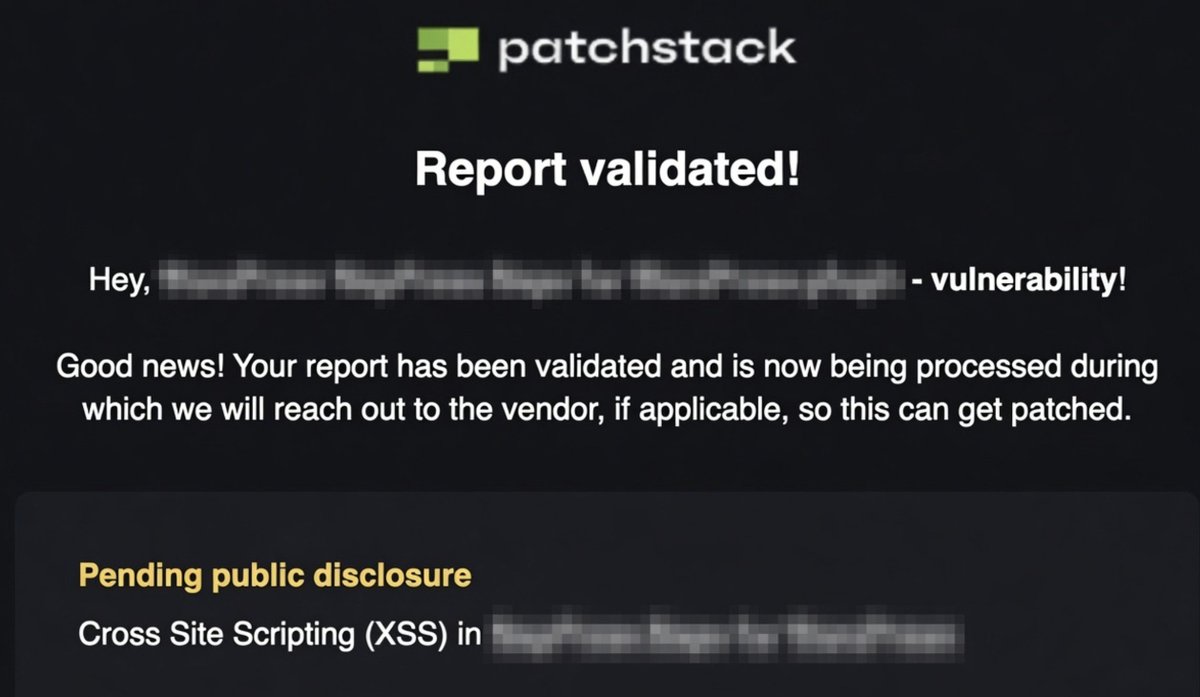
Primeiro report validado na Patchstack!
Acabei de receber a confirmação de um Cross Site Scripting (XSS) em plugin WordPress.
O report foi aceito e já está em processamento pra entrar em contato com o vendor.
Ainda tá como “Pending public disclosure”, mas é a primeira vitória oficial #bolhasec
Continuo na luta!
Jun 7

Dia 52/229
Update:
Hoje submeti meu primeiro bug para a Patchstack.
SQLi encontrada em um plugin WordPress e report enviada para o VDP.
Nesse meio tempo tive dois reports recusados, um na HackerOne e outro na Bug Hunt, mas cada tentativa ajudou a refinar minha metodologia e meu processo de hunting.
Também construí uma toolchain própria para análise e hunting de vulnerabilidades em WordPress.
Muitas horas investidas. Agora é aguardar o resultado, continuar aprendendo e procurar o próximo bug.
#bolhasec
2
320


Jun 8
💯, that was such a good concept!
My only criticism is that they should have put “Patchstack” on or behind the flames, as you could easily take a photo from an angle that excluded their branding and they deserve the credit!
2
231


Suffice to say, Patchstack appears to be the best in class security layer for managed WP hosts. webhosting.today/2026/06/08/…
2
302

Jun 8
Patchstack Now Underpins Most Major Managed WordPress Hosts. GoDaddy Joined the Stack. webhosting.today/2026/06/08/… #webhosting
9

Jun 8
Old WordPress safety tips do not work like they used to.
Bad guys now move fast.
Most attacks start about 7 days before a fix is ready. And 91% of new weak spots are in plugins.
Old tools cannot see deep enough. Site Security Pro, powered by Patchstack, can.
How do you keep your site safe? Read the full guide 👇
xcloud.host/traditional-secu…
#xCloud #WordPress #Patchstack
1
39

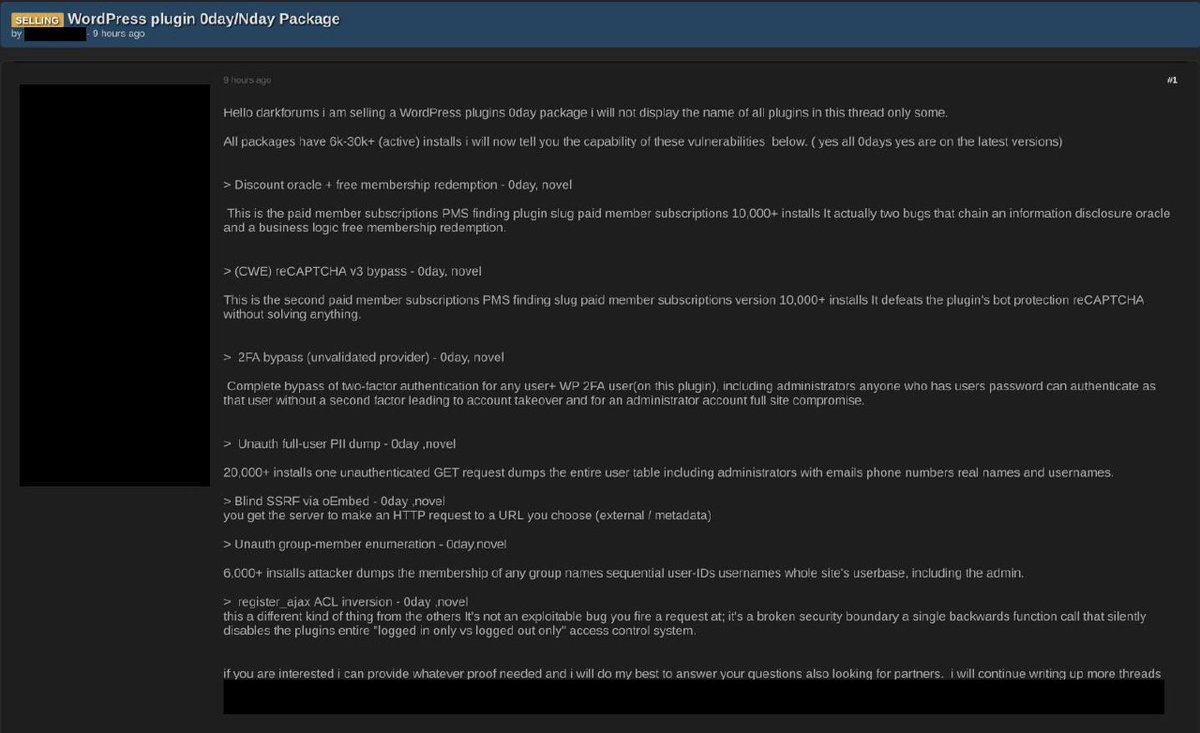
Sale of a 0day/Nday exploit package for WordPress plugins
For informational purposes only.
A package of seven independent vulnerabilities in WordPress plugins with an installation base of 6 to 30 thousand active installations each is on sale. According to the author, all exploits work on current versions.
WordPress -> (wordpress.org/) underpins about 43% of all websites worldwide (according to W3Techs data -> (w3techs.com/technologies/det…)), and plugins traditionally remain the main source of vulnerabilities. According to Patchstack -> (patchstack.com/whitepaper/st…), third-party plugins and themes account for the vast majority of CVEs for WP: in 2025, 11,334 new vulnerabilities were reported, of which 91% were in plugins, 9% in themes, and 6 in the WordPress core.
Positive Technologies in 2024 -> (global.ptsecurity.com/analyt…) included vulnerabilities in WordPress plugins in their list of trends.
1. Discount oracle free membership redemption in the Paid Member Subscriptions plugin
Type of vulnerability: a chain of Information Disclosure (oracle) and bypassing the subscription business logic
Number of installations: 10,000
The seller claims that a combination of two vulnerabilities allows bypassing the verification and obtaining a paid membership for free in the paid subscriptions plugin, presumably Paid Member Subscriptions.
2. reCAPTCHA v3 bypass in the Paid Member Subscriptions plugin,
Type of vulnerability: bypassing the reCAPTCHA v3 bot protection
Number of installations: 10,000
According to the description, the exploit completely bypasses the built-in bot protection without solving the CAPTCHA. It allows, for example, to conduct a mass brute-force attack on registrations and enumerate promo codes.
3. 2FA bypass
Type of vulnerability: Authentication Bypass via an unvalidated provider
According to the seller, the exploit completely bypasses the second factor.
4. Unauth full-user PII dump
Type of vulnerability: Unauthenticated Information Disclosure
Number of installations: 20,000
With a single unauthenticated GET request, the entire user table of the site is downloaded: email, phones, full name, logins (including administrators).
5. Blind SSRF via oEmbed
Type of vulnerability: Blind Server-Side Request Forgery
The exploit forces the server to send an HTTP request to an arbitrary URL, including internal and cloud-metadata endpoints (AWS IMDS, GCP metadata).
6. Unauth group-member enumeration
Type of vulnerability: Unauthenticated User Enumeration
Number of installations: 6,000
Without authorization, the composition of groups, sequential user IDs, logins, and the entire site database, including the administrator, are enumerated.
7. register_ajax ACL inversion
Type of vulnerability: inversion of access control logic
A single reverse call to the function completely disables the "logged-in only vs logged-out only" distinction in the plugin. It turns all protected endpoints into public ones.
#dbugs_darkweb
3
290


🔥 Hiring 🔥
🚀 Company: PatchStack
🪛 Position: Account Executive
🌎 Location: Remote – EMEA
💸Salary: €60,000–€72,000 base commission
Apply:
wpremotework.com/remote-jobs…
19