𝐭𝐚࡙֟͡ᰱ፝𝐚𝐣 retweeted

Jun 5
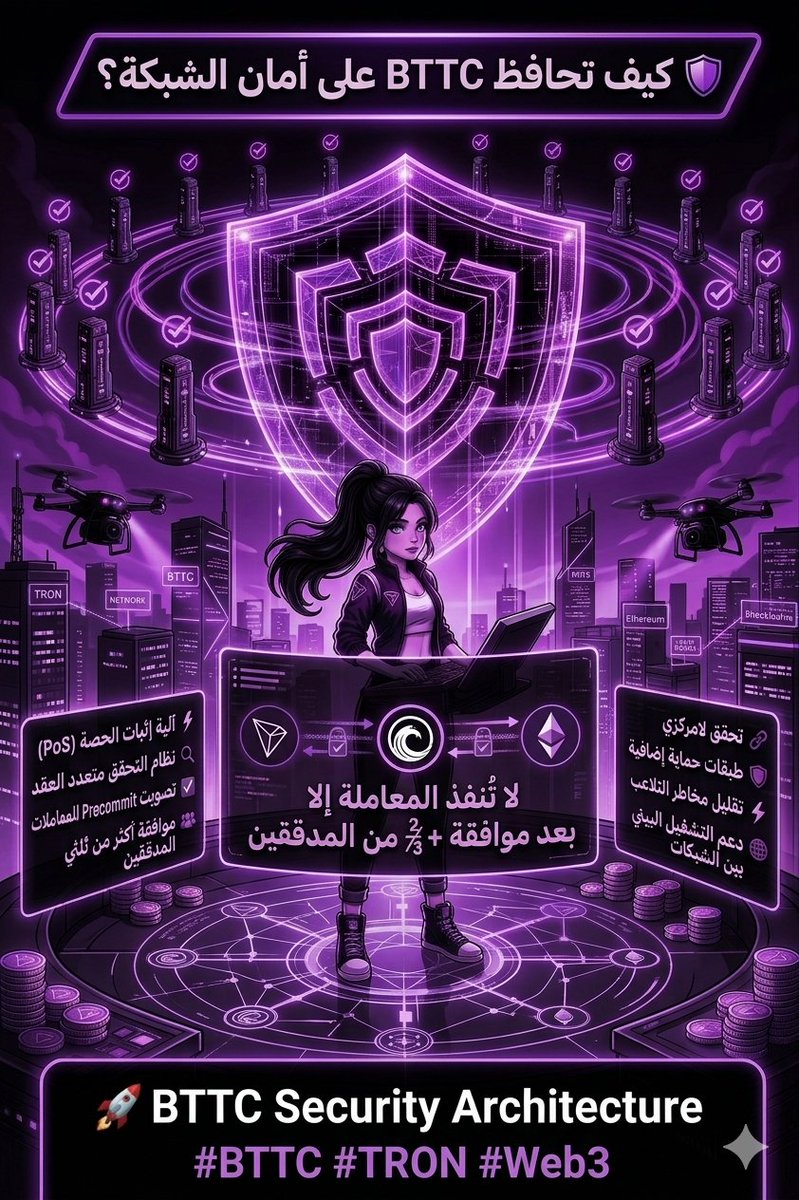
🚨 ماذا يحمي شبكة BTTC؟
✅ موافقة أكثر من ثلثي المدققين
⚡ تصويت Precommit
🔗 تحقق لامركزي للمعاملات
منظومة أمان مصممة لتقليل التلاعب وتعزيز موثوقية الشبكة، خطوة مهمة نحو مستقبل أكثر ترابطًا بين البلوكتشينات. 🛡️🚀
#BTTC #TRON #Web3
#TRON #TGF #TRONGlobalFriends
Jun 3

🔍 Security Mechanisms: PoS and Multi-Node Validation on BTTC
Security on the BTTC network is fortified through a Proof of Stake (PoS) mechanism and multi-node validation. Every sidechain transaction requires Precommit votes, needing over two-thirds approval to be executed. This significantly mitigates the risk of potential malicious activities.

2
2
10,023

whenever someone says something like that you gotta precommit to giving this answer

2
4
97

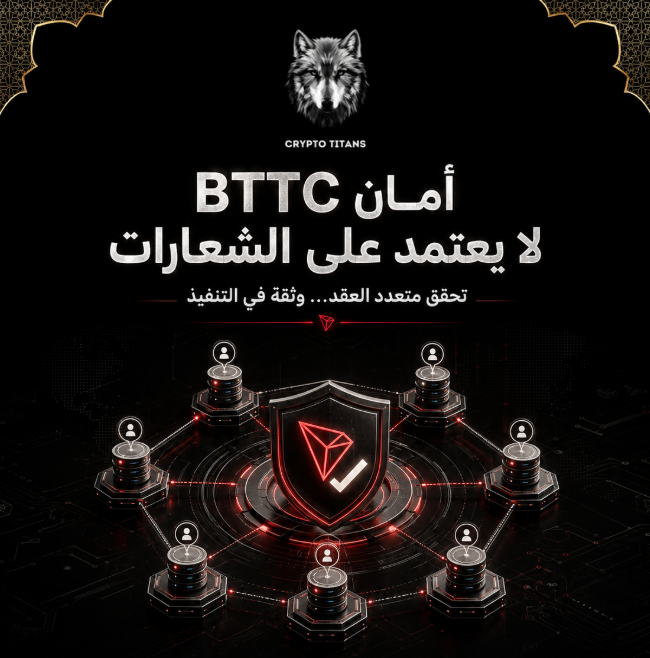
أمان الشبكات لا يُبنى بالشعارات.
في BTTC، تعتمد البنية على Proof of Stake ونظام تحقق متعدد العقد، حيث تحتاج معاملات السلاسل الجانبية إلى تصويت Precommit، ولا يتم تنفيذها إلا بعد موافقة أكثر من ثلثي المدققين.
هذه الآلية تضيف طبقة مهمة من الحماية ضد الأنشطة الضارة ومحاولات التلاعب.
في عالم التشغيل البيني بين الشبكات، السرعة وحدها لا تكفي.
الثقة في التنفيذ والتحقق هي ما يجعل البنية قابلة للاعتماد.
#TRON #TRONGlobalFriends #TGF
24
9,515

Jun 13
It depends on how it works. Hard to say this about a hypothetical. But, my question, why are you so defensive about this? Asking me to precommit to a judgment like this is strange
1
17

Jun 13
The Fable decision is fundamentally a domestic US policy mess, and it seems likely to resolve itself, albeit chaotically. For middle powers, it's a tempting starting point for ill-conceived 'sovereign' AI takes, but I think the right move is to let it blow over and buy more time.
The decision itself seems counterintuitively domestic in scope. USG got worried about the prospect of a jailbreak, didn't feel like it had a particularly precise and effective way to tackle that risk, and defaulted to limiting access in an obvious and available way. The easy way to do this was also a way to make Anthropic uncomfortable and annoy allies, but these seem like secondary considerations at best.
That's still relevant information for middle powers--it goes to show that there is no immediately effective and legible reason for USG or American developers to consider their interests in making access decisions. As for middle powers' posture in reacting to this: I think nothing good comes from wading into a politically charged AI policy environment, solidarising with Anthropic and drawing the continued ire of the Trump administration. Right now, middle powers are collateral damage, and acting hastily risks making them parties to the conflict.
What would have helped in this case? It's not clear that even a European model would really have. Imagine you had the absolute best case European sovereignty in place, up and running since 2024. would it have a Fable-class model by now? or would it 'only' be at the level of Opus 4.8 - a near-frontier model in its own right that remains available today? you'd have to be quite confident that the European champion would not just be 2 months behind the curve, but at the absolute bleeding edge of frontier development, to make a difference to this particular scenario. Not even the most bullish views of the domestic project makes that kind of outcome particularly likely, so this really is not a particularly incisive wake-up call on European frontier models specifically.
But even if you disagree, what would it actually *mean* for this to be a wake-up call for European sovereignty? Are you going to build your own model now? What are you going to do in the--generously--three years between announcing this project and reaping the frontier models it would build: are you willing to give up frontier access in the meantime? Because the resources required for building this frontier model directly trade off against the resources you could invest into guaranteeing access instead (most notably through compute); and the political fallout from announcing an attempt to build the very kind of model capability the US is attempting to restrict would also make future access negotiations harder.
Let's say you're willing to bear that delay: do you think a Trump administration that just refused to give you access to Fable is going to let you buy enough frontier chips to train an unrestricted Fable clone yourself? Are you willing to go the mat on semiconductor chokepoints, even if it comes with sky-high costs in Ukraine and trade policy? I don't actually think so. Look into the details of what would be required for a big European push right now, and you'll see the leverage for 'waking up' and divorcing from the US ecosystem simply is not feasible in the current technological or geopolitical environment. I regret that this is the case, but that doesn't make it the case any less!
What, then, is the alternative?
First, I think it's worth noting that this is fundamentally a very good version of a very bad thing. In a fortuitous turn of events, the Trump administration has picked the most ill-conceived version of access restrictions you could possibly come up with. It's legally fraught, so domestically impactful that it will lead to massive internal pushback, and likely extremely economically harmful. As a result, it will likely go down in flames eventually. The U.S. is not yet in the spot to actually go through with long-term cut off: international markets are still too important, the security situation is not yet sufficiently dire, and so on. So the first live fire exercise of cutting off the rest of the world is going to fail, which means labs and the admin are going to be much more wary of subsequent attempts to do the same, even if they end up more sophisticated.
Second, I think the access recipe is fundamentally the same as it was yesterday: build leverage on the margins that makes cut-offs like these even less attractive, for instance through access-for-compute deals and by creating deep economic integrations that are economically central to US labs and strategically central to the US supply chain--create a lobby to push back harder against attempts like this in the future. In the future, we can use the resources and capacities that gives us to sprint toward our own frontier project if we must, but right now we neither have the political will nor the relative power to get even close to trying that.
Third, and somewhat trivially, we should start thinking about what we want to do the next time this happens. I suspect any analyses that assess whether you can use ASML or any semiconductor chokepoint to avert this will come up short, but there's still value in analysing and then credibly precommitting to threats. Right now, USG did this operating under the assumption there would be absolutely no reaction from middle powers at all. Any plan in the drawer that suggests there is a non-negliblie cost for the US to act like this in the future would be helpful. There's little use in deploying it reactively now; there's lots of value in precommitting to it for the next iteration. That's different than actually going to the mat; the goal here is to play chicken a bit, increase uncertainty and latent risk for the administration in making these decisions to tilt the calculus toward integration, not to go all out on a highly costly tradewar.
Fourth, I think this clarifies the specific concerns that could motivate access restrictions. Security concerns, both on misuse as well as distillation and model theft, fundamentally make the US more likely to restrict model access; this time around, it was concerns around reducing surface area for unmonitored jailbreak attempts. That is, in principle, fixable--middle power governments can and should engage with labs to create security conditions that create permission structure for exports and model sharing. Make your infrastructure as secure as they want it to be, and you reduce the risk they consider exporting to you a security vulnerability. Again, I understand if this sounds submissive and uncomfortable to you---but again, all this is necessary even if you go for the maximal sovereignty playbook at the same time, because you will need frontier access in the meantime.
Instead of these reasonable responses, I worry that the low-resolution view on this whole affair is to think this should shake middle powers into the wrong kind of action. Realising how important and contingent frontier AI access is quickly leads down the path of wanting to build your own; realising how capricious the American ecosystem is makes you want to divorce from it faster.
But for better or for worse, the central implication of this episode is the opposite: as evidenced by this episode being possible at all, middle powers currently do not have the leverage to do much about any of this, and building up this leverage is almost impossible to do in an openly adversarial relationship to the US. In that sense, waking up is not a matter of loud yelling, decisive action or pivotal decisions. For all the internal urgency with which I think we should precommit to some leverage and shore up our security concerns, I still think the optimal strategy is one of public restraint and progress on the margins of the current playbook. I'm just not sure there's that much to wake up from - this is just what life is like for now.
Jun 13

The US government, citing national security authorities, has issued an export control directive to suspend all access to Fable 5 and Mythos 5 by any foreign national, whether inside or outside the United States, including foreign national Anthropic employees.
The net effect of this order is that we must abruptly disable Fable 5 and Mythos 5 for all our customers to ensure compliance.
Access to all other Claude models is not affected.
We apologize for this disruption to our customers. We believe this is a misunderstanding and are working to restore access as soon as possible.
Read our full statement: anthropic.com/news/fable-myt…
41
53
410
125,193

Jun 12
ECB policymaker Rehn saying he won’t precommit to a rate path is central-bank code for one thing: oil still controls the clock. If crude turns again, the ECB already knows the chain — oil to inflation expectations, expectations to policy, policy to sovereign funding costs. Energy is the tax collector for borrowers.
14

David Benjamin retweeted

Jun 12
ECB's Rehn: We will not precommit to any particular rate path
1
1
26
18,554

Jun 12
ECB'S REHN: WE WILL NOT PRECOMMIT TO ANY PARTICULAR RATE PATH ...
155
Jun 12
ECB REHN: WILL NOT PRECOMMIT TO ANY PARTICULAR RATE PATH ...
138

Jun 12
ECB REHN: WILL NOT PRECOMMIT TO ANY PARTICULAR RATE PATH
1
19
17,249

Precommit all the money.
Hypothetically. Smh
30

Jun 11
Đúng là TPS không đủ. Với DeFi/bridge, deterministic finality và dữ liệu đáng tin cậy quan trọng hơn số benchmark. Phần khó trong production là giữ precommit/view-sync ổn định khi leader lỗi hoặc mạng bị nghẽn.
3

Jun 11
withdraw any remaining RLS from the precommit platform to your wallet precommit.rayls.com/
the next step is to bridge your RLS from Ethereum to the Rayls network using Stargate stargate.finance/
after bridging, make sure you have USDr on the Rayls network to cover gas fees
then you can stake your RLS here staking.rayls.com/
you can find the full staking guide here rayls.com/blog/secure-the-ra…
1
3
153


Jun 10
Every morning I tell myself no more infra today and then I crack open the @quipnetwork repos and end up sketching pricing curves on a napkin
The bit that hooked me is how compute bursts clear through bids instead of vibes. Precommit a window and you get a cut, miss your target and the bond drips to the other side, hit your SLA and the receipt carries a bonus against baselind. Feels like an actual market not screenahots
Also watching the firewall counters on BTC ETH SOL, real vlows showing up as receipts makes me trust the guard more than any pitch
I’m going to try being a price taker for morning spikes and a verifier at night. If you had to pick one lever this week, would you tune bids or write a tiny verifier rule
2
4
58

Jun 10
🔐 BTTC 安全模型:重新理解侧链中的“信任机制”
如果拆解来看,每一个区块链系统其实都在回答同一个问题:
👉 “如何在不牺牲速度的前提下防止恶意行为?”
BTTC 的答案,是一套基于多层设计的机制:质押 共识 多节点验证。
💡 核心理念
BTTC 不依赖单一权威,而是要求多个独立验证者在达成一致后,交易才会最终确认。
🧱 一笔交易是如何被确认的?
在侧链交易被接受之前:
✔ 验证者必须质押资产,才能参与网络
✔ 他们对交易进行审查与投票
✔ 必须达到 2/3 超级多数(Precommit) 才能最终确认
没有捷径,没有特权,也没有单点控制。
🧮 为什么是 2/3 ?
这个阈值并非随意设定,而是为了确保:
• 共谋攻击的成本极高
• 少数节点无法篡改结果
• 恶意或错误节点会被自然压制
安全性由“多数共识”来保证,而不是信任个体。
🌐 系统带来的影响
由于验证过程是分布式的:
⚡ 网络依然保持高效运行
🛡 安全性由机制而非人为保障
🔗 跨链转账更加稳定可靠
📉 双花与篡改风险大幅降低
🚀 总结
BTTC 并不是依赖“信任人”,而是依赖:
经济激励 分布式共识 密码学验证
这正是 Web3 可扩展基础设施的核心逻辑。
@BitTorrent @bttcdao @justinsuntron
#BTTC #TRONEcoStar
Jun 3
🔍 Security Mechanisms: PoS and Multi-Node Validation on BTTC
Security on the BTTC network is fortified through a Proof of Stake (PoS) mechanism and multi-node validation. Every sidechain transaction requires Precommit votes, needing over two-thirds approval to be executed. This significantly mitigates the risk of potential malicious activities.
8
1,143

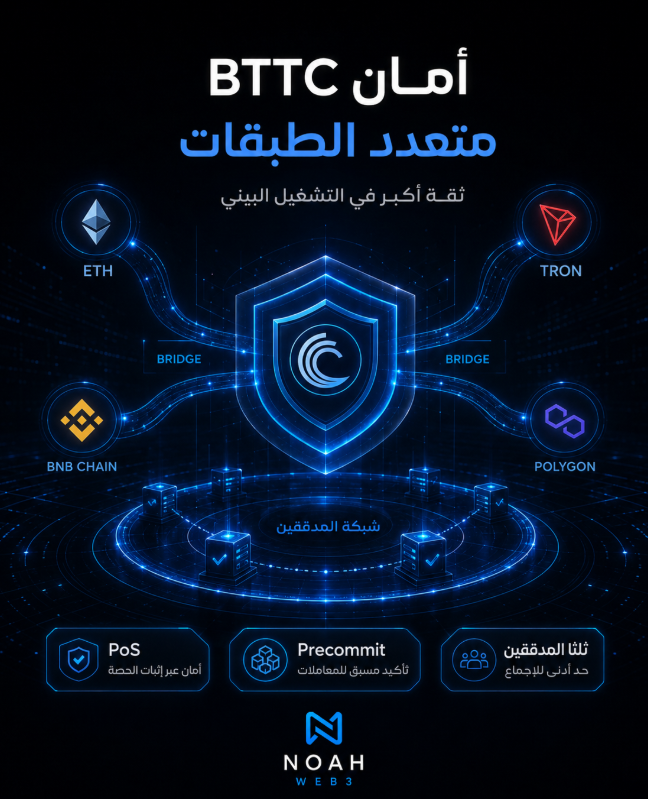
أمان BTTC يعتمد على أكثر من طبقة واحدة.
الشبكة تستخدم آلية إثبات الحصة PoS، إلى جانب التحقق متعدد العقد، حيث تحتاج معاملات السلاسل الجانبية إلى تصويت Precommit وموافقة أكثر من ثلثي المدققين قبل التنفيذ.
#BTTC #BitTorrent #BTT #TRONGlobalFriends #TGF
1
27
6,413

Jun 10
𝗕𝗲𝗵𝗶𝗻𝗱 𝗘𝘃𝗲𝗿𝘆 𝗦𝗲𝗰𝘂𝗿𝗲 𝗖𝗿𝗼𝘀𝘀-𝗖𝗵𝗮𝗶𝗻 𝗡𝗲𝘁𝘄𝗼𝗿𝗸 𝗜𝘀 𝗔 𝗦𝘁𝗿𝗼𝗻𝗴 𝗖𝗼𝗻𝘀𝗲𝗻𝘀𝘂𝘀 𝗠𝗲𝗰𝗵𝗮𝗻𝗶𝘀𝗺
Most users notice when assets move between blockchains.
Far fewer notice the security infrastructure that helps make those transfers possible.
As blockchain ecosystems become increasingly interconnected, secure validation mechanisms play a critical role in protecting transactions, maintaining network integrity, and supporting user confidence.
This is where BTTC's security architecture becomes especially important.
By combining Proof of Stake (PoS) consensus with multi-node validation, BTTC has built a framework designed to enhance reliability while reducing the risk of malicious activity across its cross-chain infrastructure.
Why does this matter?
Because scalability alone is not enough.
For cross-chain ecosystems to grow sustainably, users need confidence that transactions are being validated securely and that network participants are operating within a reliable consensus framework.
Security remains one of the most important foundations of blockchain adoption.
Looking deeper reveals several key components that help strengthen BTTC's network.
1⃣ Proof of Stake aligns network incentives
Proof of Stake relies on validators who participate in transaction verification and consensus processes.
By requiring validators to have a direct stake in the network, the model helps align incentives with the long-term health and stability of the ecosystem.
This encourages responsible participation and strengthens overall network security.
2⃣ Multi-node validation improves resilience
BTTC does not rely on a single participant to validate transactions.
Instead, validation occurs across multiple nodes, creating a distributed process that helps:
▫️ Improve fault tolerance
▫️ Reduce centralization risks
▫️ Enhance reliability
▫️ Strengthen transaction verification
The result is a more resilient infrastructure capable of supporting cross-chain activity at scale.
3⃣ Supermajority approval adds an additional layer of protection
Every sidechain transaction on BTTC requires Precommit votes, with more than two-thirds approval needed before execution.
This supermajority requirement helps:
➝ Prevent unauthorized transactions
➝ Reduce the influence of malicious actors
➝ Improve consensus reliability
➝ Strengthen overall network integrity
Requiring broad validator agreement creates additional safeguards within the validation process.
4⃣ Secure infrastructure supports cross-chain growth
As assets, liquidity, and applications increasingly move across multiple blockchain ecosystems, robust security mechanisms become even more important.
Reliable validation helps support:
▫️ Safer asset transfers
▫️ Greater user confidence
▫️ Stronger network interoperability
▫️ Sustainable ecosystem expansion
Secure infrastructure provides the foundation that allows cross-chain systems to operate effectively.
This is how blockchain networks build trust.
Not only through speed and scalability, but through the security mechanisms working behind the scenes to protect users, transactions, and ecosystem activity.
More validation.
More resilience.
More security.
More confidence in cross-chain participation.
That’s how BTTC continues strengthening the infrastructure that powers a more connected blockchain future.
@BitTorrent @justinsuntron
#TRONEcoStar

5
13
100,047