
11 Oct 2025
Wherever I am, my mind stays calm because @irys_xyz keeps the data alive.
It doesn’t just store files; it protects memories, verifies ownership, and lets information think.
Every byte knows its purpose, its owner, and its time to act.
While markets crash and chains freeze, Irys runs like nothing happened bundled, verified, unstoppable.
This is programmable permanence where truth scales, trust breathes, and creation never fades.
Stay Irys. Stay infinite.
#Irys #Datachain #ProgrammableWeb #Hirys

20
60
225

At least MCP is a standard for the problem it addresses. And imo, MCP is just the lucky winner (for no reason I can fathom except introduction by a leading AI lab at the right time) in a series of standardization attempts (openapi, swagger ecosystem, REST, and, in a past era, SOAP/WS*, programmableweb , etc.) to standardize how one piece of code can discover and talk to another piece of code. The LLM API problem is a much bigger pain with almost no way to discover, know or detect capabilities and suitability, and to call an LLM reliably.
1
2
59

12 Apr 2025
Here’s an execution strategy for anyone interested.
Step 1: Find an API (That People Pay For)
• What to look for: Choose a paid API that’s popular but has pain points—like a steep learning curve, poor documentation, or missing features that users want. Examples might include OpenAI’s GPT API (for AI tools), Stripe (for payments), or Twilio (for communication).
• How to research:
• Browse API directories like RapidAPI or ProgrammableWeb for paid APIs with active user bases.
• Check developer forums (e.g., Stack Overflow, Reddit’s r/programming) or X for complaints about specific APIs.
• Look for APIs in trending industries (e.g., AI, e-commerce, SaaS) where demand is growing.
• Validation: Ensure there’s a market willing to pay for a simplified or enhanced version of the API.
Step 2: Vibe Code a Wrapper
• What this means: “Vibe code” suggests a relaxed, intuitive approach—focus on building something functional and simple without overengineering. Speed is key.
• How to do it:
• Use a familiar language or framework (e.g., Python with Flask, Node.js with Express) to whip up the wrapper fast.
• Add value by simplifying the API (e.g., fewer steps to integrate) or adding features (e.g., better error handling, caching, or a dashboard).
• Example: If you pick the OpenAI API, create a wrapper that streamlines text generation for specific niches (e.g., marketers) with pre-built prompts.
• Tip: If coding isn’t your strength, consider no-code/low-code tools like Bubble or Zapier to prototype quickly.
Step 3: Launch It Quickly
• Build an MVP: Focus on the core feature that solves the API’s main pain point. Skip bells and whistles for now.
• Set up a landing page: Use tools like Carrd, Wix, or Webflow to create a simple page explaining what your wrapper does, its benefits, and how to sign up. Include a pricing model (e.g., $10-$50/month).
• Announce it: Post on Product Hunt, Hacker News, or niche communities (e.g., indie hacker forums) to get initial eyes on it. Speed is critical—aim to launch within a few days.
Step 4: Cold DM Users and Post on X
• Cold DMs:
• Who to target: Find potential users on LinkedIn, X, or forums who use the original API (e.g., developers, small business owners).
• What to say: Send short, personalized messages like: “Hey [Name], I built a wrapper for [API] that cuts integration time in half. Want to try it?” Avoid spammy, generic pitches.
• Posts on X:
• Share your progress: “Day 1: Built a wrapper for [API] to solve [problem]. Who’s interested?”
• Use hashtags like #buildinpublic, #indiehacker, or #SaaS to reach the right crowd.
• Post use cases or mini-tutorials to show value.
• Build in public: Be transparent about your journey—share wins, setbacks, and updates to build trust and attract users.
Step 5: Take It to $1,000 MRR
• Monetization: Offer a free trial (e.g., 7 days) or freemium tier to hook users, then charge a monthly fee. At $20/month, you’d need 50 paying users for $1,000 MRR.
• Grow fast:
• Ask early users for feedback and tweak the product to meet their needs.
• Offer discounts or referral bonuses (e.g., “Refer a friend, get 20% off”) to accelerate signups.
• Partner with influencers or bloggers in your niche for shoutouts.
• Track progress: Use tools like Stripe or Gumroad to manage subscriptions and monitor revenue.
Step 6: Sell It on Acquire or X
• Prepare for sale: Once you hit $1,000 MRR, document your revenue, user base, growth stats, and how the wrapper works. Buyers love clear numbers.
• Where to sell:
• Acquire: List it on this marketplace for small online businesses. A typical valuation is 2-3x annual revenue ($12,000/year = $24,000-$36,000 sale price).
• X: Tweet something like: “Selling my API wrapper—$1k MRR, growing fast. DM me if interested.” Engage with replies to find buyers.
1
1
16
1,212

16 Oct 2024
Bringing my ProgrammableWeb filter, with a little help from journalist and PR friends.
15 Oct 2024

See Your Dev Tool Like a Journalist buff.ly/3Y38RE1
2
230

8 Jun 2024
5. Other places to find APIs endpoints include:
GitHub: github.com/
Postman Explore: postman.com/explore/apis
ProgrammableWeb API Directory: programmableweb.com/apis/dir…
APIs Guru: apis.guru/
Public APIs Github Project: github.com/public-apis/publi…
1
5
818

29 Oct 2023
11 Must-Follow Tech Blogs for Mastering APIs:
📌 Mozilla Hacks
📌 Twilio Blog
📌 Postman Blog
📌 Google Cloud Blog
📌 Nordic APIs Blog
📌 RapidAPI Blog
📌 ProgrammableWeb Blog
📌 REST API Tutorial
📌 API Evangelist Blog
📌 API2Cart Blog
📌 Kong Blog
5
5
29
4,404
3 Oct 2023
6️⃣ Websites to learn APIs ⛓
- Postman Learning Center: API development
- Swagger: API docs and design
- RapidAPI: Discover and connect to APIs
- ProgrammableWeb: API news & directory
- REST API Tutorial: RESTful APIs guide
- GraphQL.org: Learn GraphQL APIs
1
2
230

22 May 2023
I just tried ProgrammableWeb to lookup an api, only to find out they are shutdown 😢
Anyway,
github.com/Unstructured-IO/u… might be worth a look.
2
173

23 Mar 2023
ProgrammableWeb
programmableweb.com/
The leading source of news & information about APIs, chronicling the evolution of the global API economy & providing the web's most relied-on API Directory
1
1
4
807

21 Mar 2023
this is happening a lot at this [st]age of the Web. (see ProgrammableWeb as another example)
the right move here is to convert the entire corpus to a static site and run it as a read-only archive.
2,313

18 Mar 2023
"Upgrade your #SoftwareDevelopment skills with #AutomatedReasoning! 🚀👨💻 Learn how to optimize your code and avoid errors with this insightful book. 🔍📖 Get your copy now at: amazon.in/dp/B0BW9NX7H9 📚 #Techies #Developers #Programming #AI #MachineLearning #Coding #Computing #SoftwareEngineering #ProgrammingTips #Books #Readers #IT #ComputerScience #Algorithms #DataScience #CodingCommunity #ProgrammingLanguages #Learning #KnowledgeSharing @techreview @WIRED @TheNextWeb @engadget @techradar @codecademy @freeCodeCamp @programmableweb @github"
1
1
2
8

5 Mar 2023
#ENDORSE2023, 14-16 March, could interest you! ⬆️ The clock is ticking for registration!
@devpost @HackdeOverheid @odsc @opendatacharter @datajconf
@databeers @WebDeveloperLb @Codeanywhere @CodeWeekEU @dribbble @TechInsiderco @programmableweb @Berlindroid @TechInsiderco
1
136

9 Feb 2023
In 2020, @adamd, prev. writer at ProgrammableWeb and content strategist at Zapier, introduced the DEV Content Framework in his book 'Developer Marketing Doesn't Exist.'
key takeaways {
TL,DR: DEV stands for Discovery, Education, and Viewpoint;
1
3
356

3 Feb 2023
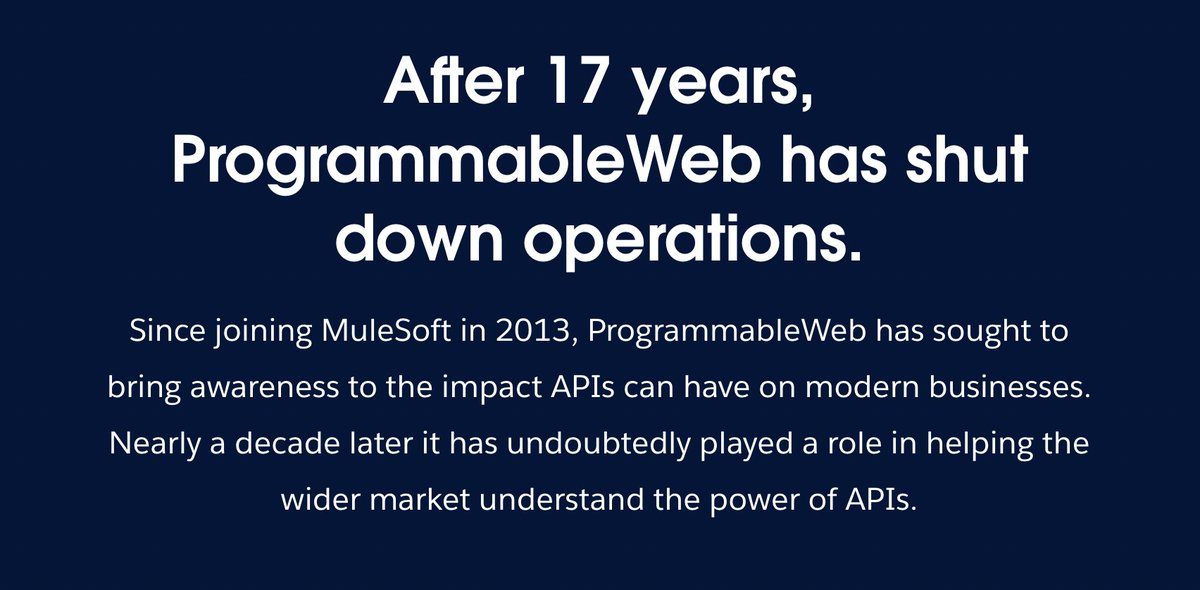
Web 2.0과 함께 오픈 API 분류 서비스로 시작하여, API 비지니스의 성지와 같았던 ProgrammableWeb 사이트가 17년만에 문을 닫네요. 이제 REST와 JSON 기반 API 통신이 상식이 되었으니 그 역사적 소명은 다했군요. 이렇게 한 시대가 또 저물어가네요! programmableweb.com/
6
15
1,310
2 Feb 2023
MuleSoft announced the ProgrammableWeb shutdown last fall, but this week's redirect of traffic and with it removal of an archive of professional and personal importance makes it real.
1
2
2
1,159

16 Jan 2023
Guide to GraphQL: Understanding, Building and Using GraphQL APIs | ProgrammableWeb #startups #Entrepreneurs #technology #codinglife #programming programmableweb.com/api-univ…
1
25

31 Oct 2022
Todays the day for ProgrammableWeb. End of an era. Thanks for the helpful content and large API directory you put together for us to all learn from and utilize! Take care!
4

26 Oct 2022
Thank you for putting your faith in us @johnmusser. You started something amazing in @programmableweb and it was an honor for @wendell78 and I to have piloted the ship for nearly 10 years.
1
7
25 Oct 2022
This thread was inspired by an article originally published in @OrbitModel's magazine, now "reprinted" on the @everydeveloper site everydeveloper.com/community…
4
24 Oct 2022
8) Former SendGrid CEO @jimfranklin advises people to remember that your colleagues are "…smart, hardworking, and they have good intentions.”
Without direct proof otherwise, assume everyone is doing the best they can. It will be hard to collaborate otherwise.
1
3