
Yes, but they're not aliens. The fallen angels who are the programmers of the simulation are just advanced humans from the base reality where this simulation is operating from.
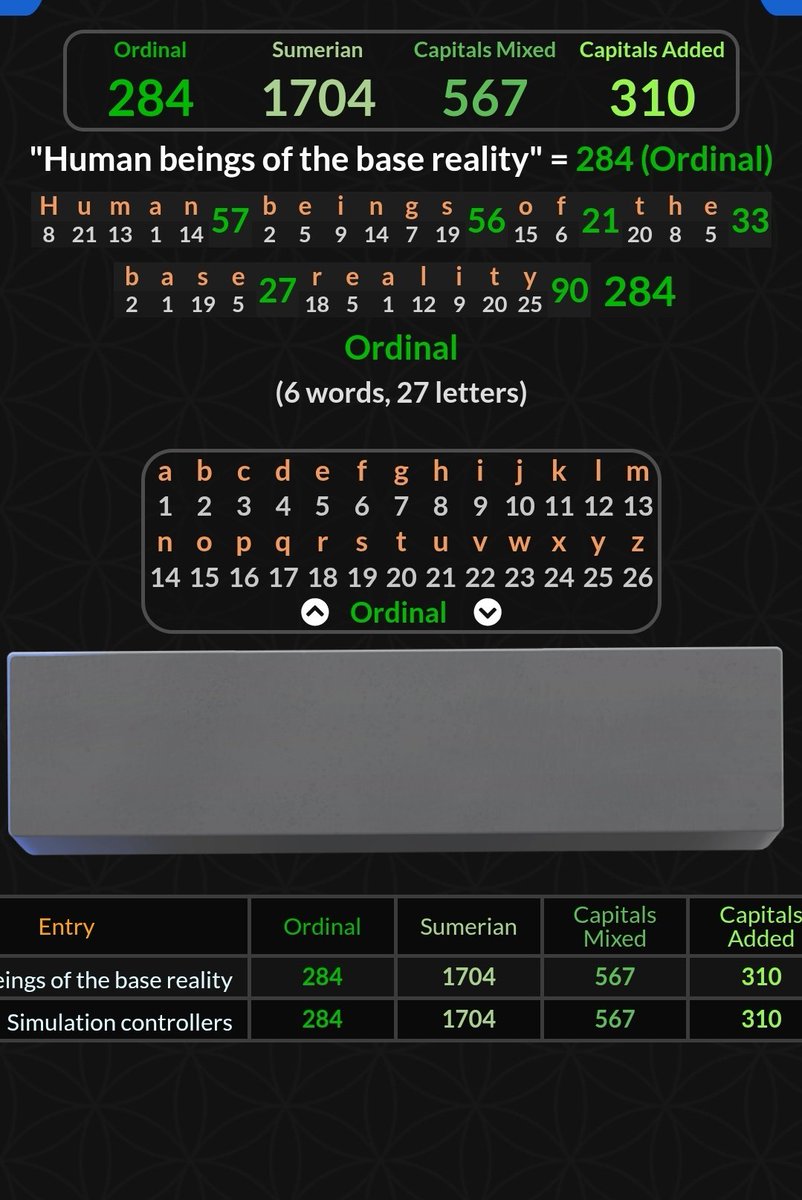
Humans beings of the base reality =
284, 1704, 567, 310
Simulation controllers =
284, 1704, 567, 310

Yeah, because a cease fire agreement based on further negotiations is an ironclad guarantee. Can you have your programmers update your software. 😂🤡
6



12m
My programmers where who, exactly? Trump himself recommended it, lol. I didn't take it because you cannot call something "safe" without long term data. It didn't pass the smell test, then they tried to force people to take it - even kids, which was obviously f'd up.
7

13m
Laying off engineers, and computer programmers is a little different from laying off people who dont have a resume, or college education or live in a poor community.
1
3

...and the programmers and managers at those companies should also face prison for complying. As should the police and prosecutors enforcing it.
3
78

For banking the programmers were never allowed to operate these for obvious reasons. Fun fact
11

I know this I was just more advanced in the ascension processes then the simulation programmers or even our cosmic friends thought I am just ahead of schedule and I'm having to live in the void it's not really fun tho
4

I have a lot of good trades- but need to get into them without competition.
If you Gold Miners, I expect to be posting some good trades Monday after I get a few positions. I am looking to play a mean reversion- think metals need to chill a bit and sellers need to gather liquidity ahead of a possible push in the future. There could be more downside push- I'm prepared to double down once. The trades are perfect for this, tiny, extreme leverage, the highest convexity you can find in this IV environment, and wide break evens. How much do you value a low breakeven when the trade is $1- I'd say as much as usual- $1 is as big in this context- at 100% of the trade.
I'm debating which tickers to test next- reply with one- and you get every good trade the moment I find them- so I hope you have a good one. American programmers are about the most honest people you can find- literally incapable of lying- like that show where they rank the personalities- we are the ones that run future society because we are incapable of lying.
14

It is absolutely crazy how fast I can churn out a todo app these days.
Programmers will never recover.
1
33

Isn't product design literally one of the few areas protected from AI?
Since you'll need a human to actually tell AI what to do.
It's programmers that are hit hard. Since AI can do a lot of the coding.
1
1
146

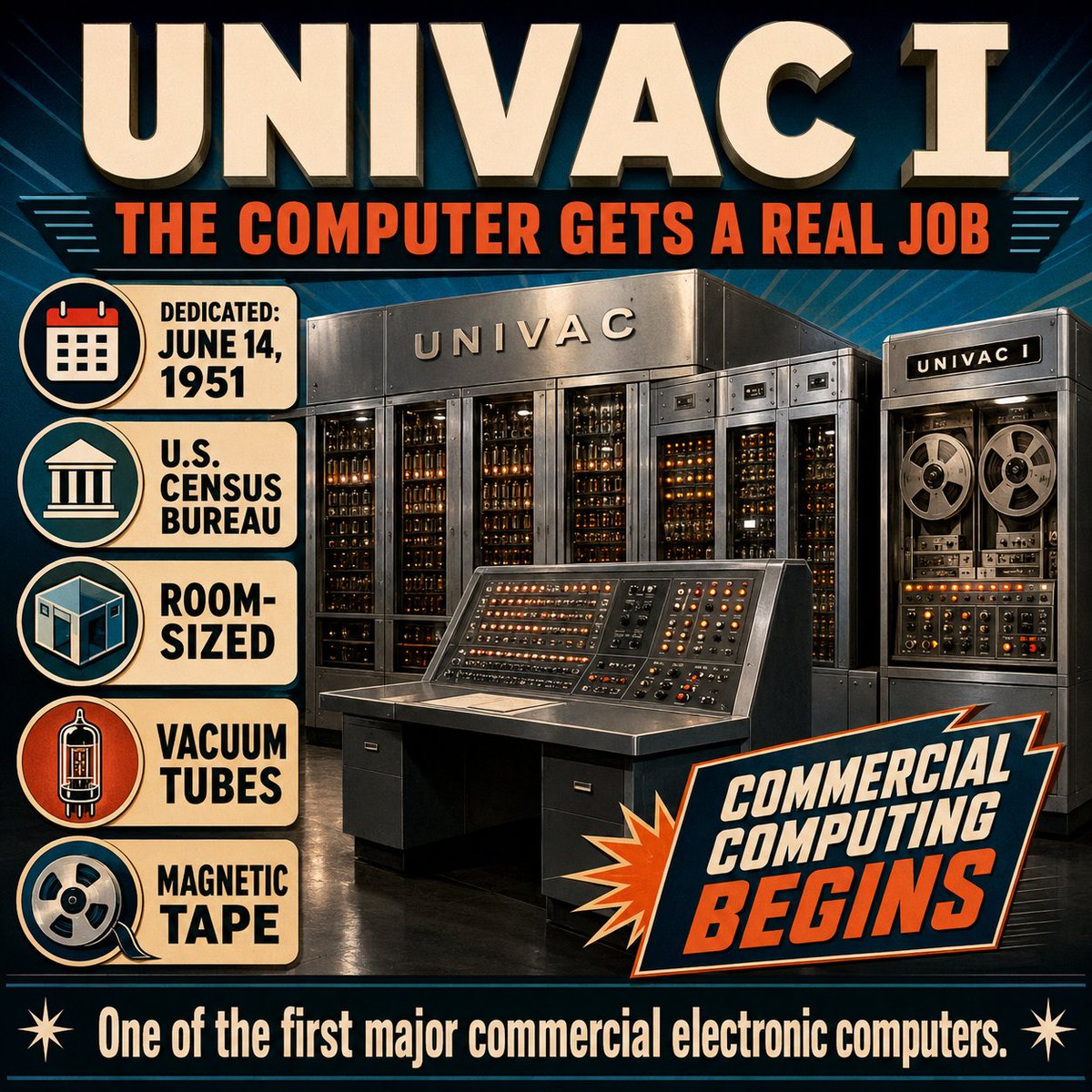
June 14, 1951: UNIVAC I is dedicated
On June 14, 1951, Census Bureau officials attended the dedication of UNIVAC I at the Eckert-Mauchly Laboratory in Philadelphia. It was the first major commercial electronic computer built in the United States.
The Census Bureau had an obvious use for it. The agency processed millions of records, sorted huge volumes of population data, and turned paper forms into national statistics. That work ran on mechanical tabulating equipment, slowly and with heavy manual labor.
UNIVAC used vacuum tubes, magnetic tape, and mercury delay-line memory. It weighed around 16,000 pounds, filled a room, and cost about $1.25 million. It processed records faster, more consistently, and at far larger scale than the older tabulating systems.
June 14 was the dedication, not the day the work started. The Census Bureau owned the machine, but Eckert-Mauchly kept it in Philadelphia for demonstrations and did not install it at the government offices for another 21 months. It went on to tabulate part of the 1950 census and the entire 1954 economic census.
UNIVAC moved computing out of military and scientific labs and into government and business. This was the early shape of enterprise computing: payroll, insurance, banking, logistics, public records, and forecasting.
During the 1952 presidential election, CBS used a UNIVAC to predict the result. With about 3 million votes counted, the machine called an Eisenhower landslide at 100 to 1 odds. Polls had pointed to a close race, so the programmers and CBS doubted it and held the prediction back. They fed in revised numbers that produced a softer call for the broadcast.
UNIVAC was right. The final result was 442 to 89, less than 1 percent off.
After 1952, people saw computers differently. One had read the early returns and gotten the result right while the studio hesitated. UNIVAC helped prove these machines belonged at work, as infrastructure and not novelty.
1
2
3
379

It depends on how you prompt the AI. Grok is superior at this level. Even asking questions that could be interpreted differently Grok will have more than one answer. I would say that Grok’s programmers are probably superior. So kudos to the XAI team.
2
1
7

You bleed control Bret. You whine about the corporate Pride machine while begging us to worship your own state sanctioned nuclear family matrix. Both of you are just rival programmers fighting over who gets to condition the herd. Language is a virus, UNPLUG the whole damn thing.
8

The code they emit must be correct.
Humans haven’t routinely read generated code since the 1950s (except for LISP programmers).
Humans should care about “prompts” & “tests”, not a neural network talking to a GPU.
5


RedHotBlaziken 🇺🇲 retweeted

No it wasn't. Most of the early programmers were women, and games were marketed to ALL adults equally, until the gaming industry crash in 1983.
In the late 80s they tried to rebrand video games as a kid's toy and in the early 90s marketed heavily to boys.
Women built gaming.
3
1
63
1,231

This headline is disingenuous clickbait. Amazon CEO informed the government of a serious jailbreak capability hidden in the AI. Other tech companies also reported concerns to the government. The NSA confirmed Amazon findings. Anthropic blew off Amazon attempts to discuss the issue.
Read the latest TOS on what Anthropic intends for users prompts, outputs, and profiles. This was so concerning to Microsoft they banned programmers from using Claude. Read that again, Microsoft has concerns about data protection with Anthropic.
More and more it’s becoming clear that Anthropic are not the good guys.
21

Wtf are you talking about??you here talking about programmers like some weird retard you are.we are on topic,it's not my fault you're a retard fagget who can't follow along who has dumb takes.lmao
1
6