24 Jun 2025
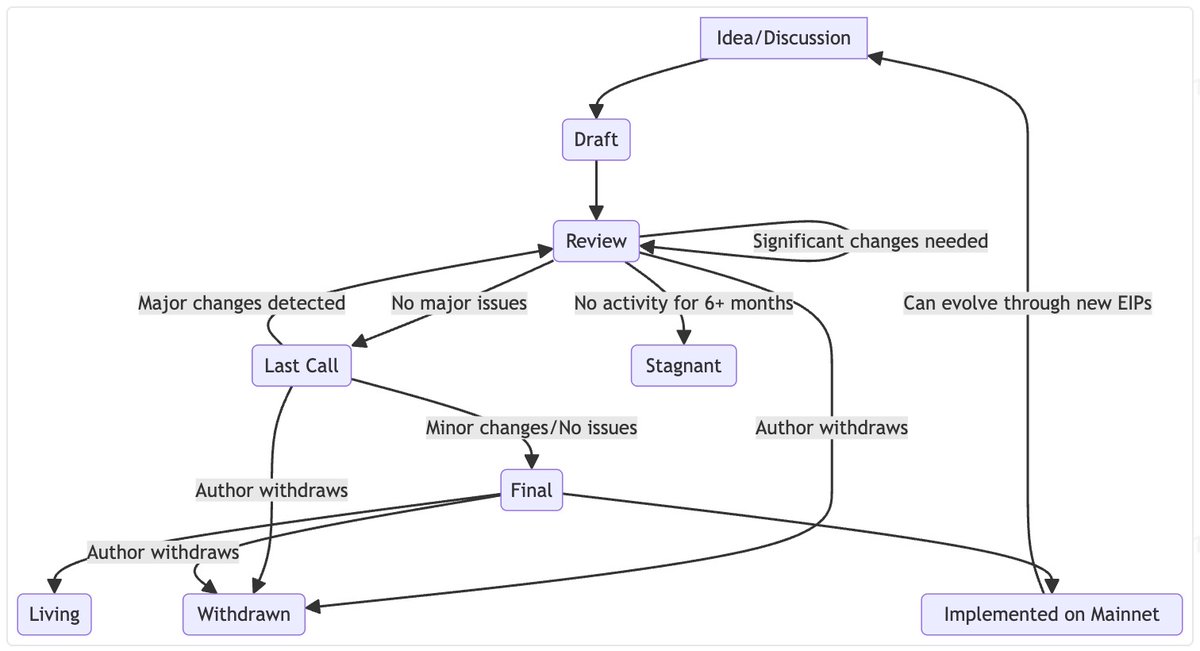
[EIP Sharing Series - 5] 📢 Over the past few days, we've shared several interesting EIP proposals. Today, we're looking back at the complete lifecycle of an #EIP: a long journey from idea to mainnet! 🚀 Understanding this process is crucial for every developer who wants to participate in building the Ethereum ecosystem.
EIP Lifecycle Overview 🔄
An #EIP goes through 7 key states from conception to final mainnet integration:
📝 Draft: This is the first step for an EIP to enter the formal process. The author submits the proposal, which meets formatting requirements, to the GitHub repository, where it undergoes technical review and formatting by the EIP editor team.
🔍 Review: The author considers the proposal initially complete and it begins to receive peer review from the community. This stage involves extensive technical discussions and feedback.
⏰ Last Call: The final review stage, usually lasting 14 days. If significant changes are found to be necessary, it will revert to the Review state.
✅ Final: The proposal meets the final standards and no further significant changes are required. However, this does not mean it will be automatically included in the next upgrade.
🔄 Living: Applicable to standards that require continuous updates, such as interface specifications like ERC-20.
❌ Withdrawn: Proposals actively withdrawn by the author.
😴 Stagnant: Proposals with no activity for more than 6 months will be marked as stagnant.
Core Aspects of Community Collaboration 🤝
🔹 Open Discussion Phase: Before formal submission, authors need to conduct preliminary discussions on Ethereum community forums or GitHub to ensure the feasibility and originality of their ideas.
🔹 Editor Team Review: An editor team, composed of the Ethereum Cat Herders organization, is responsible for reviewing technical accuracy and formatting specifications.
🔹 Core Developer Involvement: Core development teams have significant influence in technical discussions, especially for core proposals requiring a hard fork.
🔹 Community Consensus Building: Final adoption depends on the consensus of Ethereum users and the community, not on a single entity's decision.
Classic Cases:
EIP-1559: The Road to Success 💰 Let's track EIP-1559, which changed Ethereum's fee mechanism: This proposal introduced a dual structure of base fee tip, solving the problem of fee uncertainty caused by the traditional "first-price auction" mechanism. From proposal to implementation, EIP-1559 underwent years of community discussion, multiple rounds of testnet validation, and extensive security audits. It was successfully launched in the 2021 London upgrade, providing users with a more predictable transaction fee experience.
EIP-4844: A Major Milestone on the Scaling Path 🌟 Let's look at EIP-4844 (Proto-Danksharding), which was just implemented in the Cancun upgrade: This proposal introduced the blob data structure, providing a cheaper data storage solution for Layer2s. From its initial conception in 2020 to its official launch in 2024, it went through 4 years of design iteration, testnet validation, and community discussion. EIP-4844 demonstrates how complex proposals can ultimately be realized through community collaboration: technical contributions from multiple development teams, active testing by Layer2 projects, and broad community consensus on scaling needs.
Testing and Auditing: Safety First 🔒 Every important EIP needs to go through:
🔹 Testnet Deployment: Full validation on test networks like Goerli and Sepolia.
🔹 Developer Testing: Independent implementation and testing by multiple client teams.
🔹 Community Auditing: Open-source code undergoes security review by global developers.
🔹 Progressive Deployment: Secure network upgrades through the hard fork mechanism.
Why is this process so important? 🎯 This rigorous process ensures:
🔹 Technical Quality: Every proposal undergoes in-depth technical review.
🔹 Community Consensus: Avoids fragmentation and ensures network unity.
🔹 Backward Compatibility: Protects existing users and applications.
🔹 Security and Reliability: Reduces risks through multiple rounds of testing.
We deeply understand the importance of participating in the Ethereum ecosystem. Understanding the EIP process not only helps us better adapt to mainnet upgrades but also provides a clear path for us to contribute our technical innovations!
#EIP #Ethereum #ProposalProcess #CommunityGovernance #TechnicalSpecification #Layer2
1
2
3
1,183

24 Apr 2023
Check out our latest Blog post for tips on how to streamline your proposals and how a marketing firm can help!
3090marketing.com/post/strea…
#proposals #proposalprocess #marketinghelp #marketingadvice #marketingservices #smallbusinesscoach
2
8

Increase efficiency with #RFP Review to maximize your time for the #proposalprocess. Here's how: zbizlink.com/?utm_source=twi…
1
2

#TouchBase offers a #proposalmanagement solution which automates complete #proposalprocess & digitizes full proposal content generating professional looking #proposals on a click of a button. Visit: productdossier.com/proposal-… #rfp #projectmanagement #projectplanning #projectsuccess
1
3

22 Jan 2019
How to solve vexing proposal problems by applying the review process to the proposal process itself: lnkd.in/eDD4eeG
#proposals #proposalmanagement #proposalprocess #capture #capturemanagement #proposalreviews #proposalqualiy lnkd.in/e5yph-r
3
2

4 Jun 2018
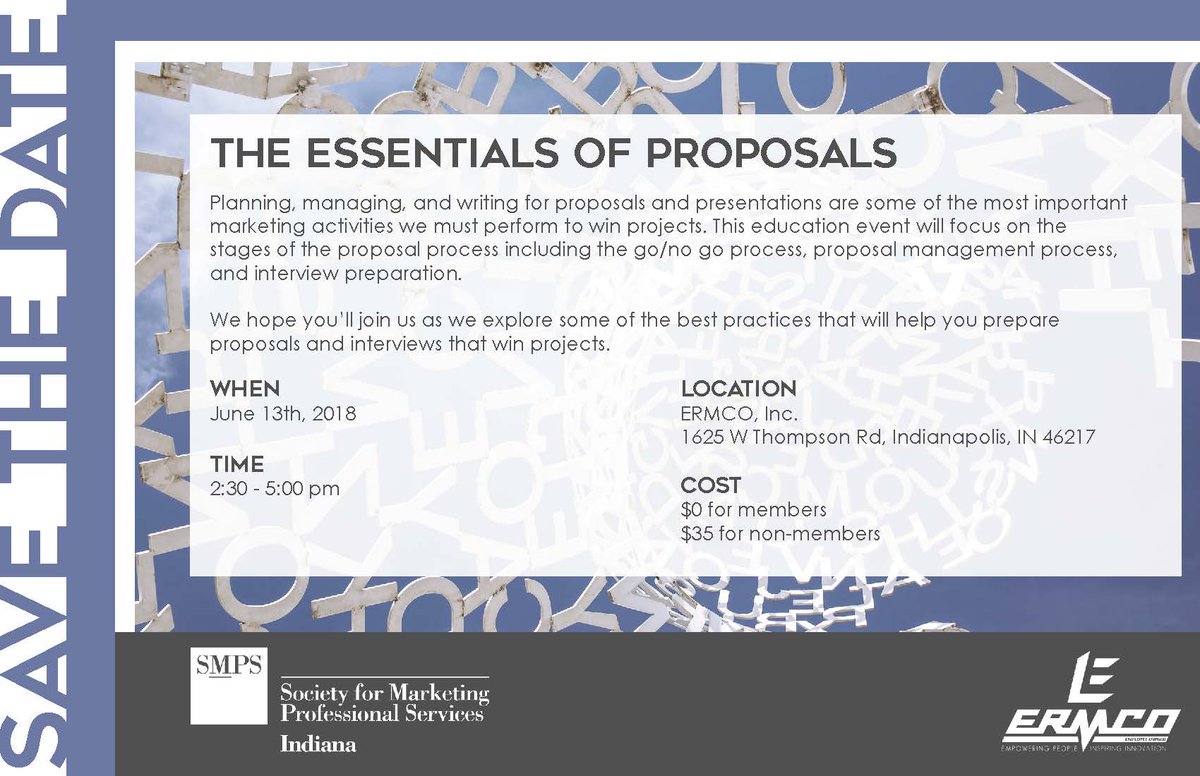
There’s still time to sign up for The Essentials of Proposals Workshop on June 13, which will focus on the stages of the proposal process. View the flier below for more information & visit bit.ly/2jWQUEM to register. #SMPSIN #educationseries #proposalprocess #marketing
2
4
28 May 2018
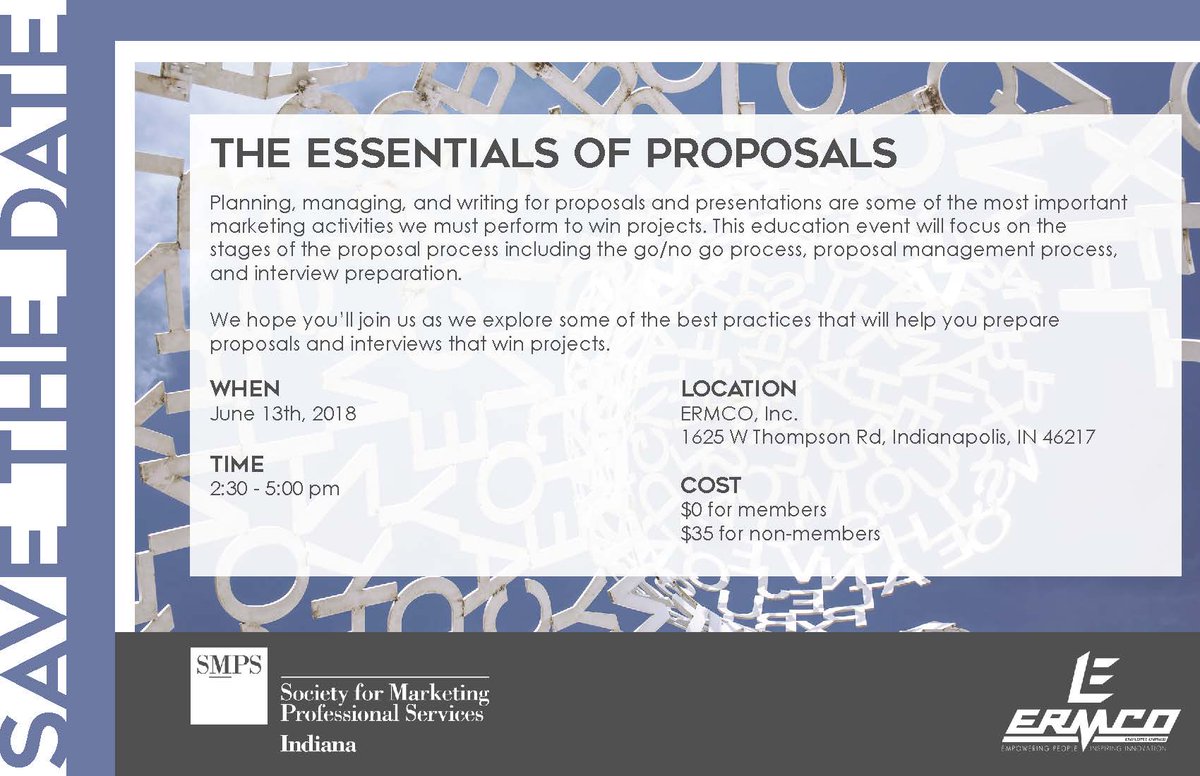
Don’t forget to sign up for The Essentials of Proposals Workshop on June 13! This event will focus on the stages of the proposal process. View the flier below for more information and visit bit.ly/2jWQUEM to register. #SMPSIN #educationseries #proposalprocess #marketing
3
4

15 May 2018
Join BGRS’s Erin Andersen for two informative panel discussions on May 16 @APMPConnect #Bid and #Proposal Conference. Read more #BGRSNews #mobility #proposalprocess ow.ly/2Ddv30k0pDZ

1

3 Jul 2017
Digital Marketing Freelancers Need to Ditch Their Proposal Process Now business2community.com/digit… #proposalprocess #talking @johnahodge

1